Bulimia: Symptoms, Causes, and Treatment

Updated: 3 days ago
Medically reviewed by Dr. Baraa Alnahhal, MD · Last reviewed: October 2026

Quick answer
Bulimia is an eating disorder marked by binge eating, a feeling of lost control and purging behaviors such as vomiting or misusing laxatives. See a doctor right away if symptoms appear, and immediately for fainting, chest pain, a very irregular heartbeat or suicidal thoughts. Treatment combines talk therapy, the antidepressant fluoxetine and nutrition education. [1] [2]
What the research says
According to PubMed:
CBT beat waiting lists for remission. A systematic review and meta-analysis of 42 randomized trials (2,807 participants) in bulimia nervosa and binge-eating disorder found cognitive behavioral therapy (CBT) was superior to waitlists for remission (RR 3.21, 95% CI 2.15 to 4.81) and for reducing binge-eating frequency (SMD -0.88, 95% CI -1.08 to -0.69). Against self-help, the remission advantage shrank (RR 1.53, 95% CI 1.19 to 1.95). (Sioziou et al., DOI).
CBT outperformed antidepressants head to head. In a meta-analysis of 11 randomized trials (531 participants) comparing CBT with drugs in bulimia nervosa or binge-eating disorder, CBT was superior to antidepressants for remission, binge frequency, and eating disorder psychopathology. The authors note that data are scarce and comparisons underpowered. (Samara et al., DOI).
Antidepressants cut binge episodes versus placebo. In 52 randomized trials with 3,313 participants, drugs overall did not differ significantly from placebo for remission, but antidepressants significantly reduced the frequency of binge episodes. (Argyrou et al., DOI).
Study details are from PubMed abstracts.
What is bulimia nervosa?
Bulimia nervosa is a serious, potentially life-threatening eating disorder. It has two main behaviors that work together: binge eating and purging. During a binge, a person eats unusually large amounts of food in one sitting and feels unable to stop or control what they eat. Binging often occurs in secret, and it is usually followed by strong guilt and shame. [1]
Purging means trying to get rid of the food and extra calories in an unhealthy way. The most common forms are vomiting on purpose and misusing laxatives. But purging can also include extreme exercise, fasting, limiting calories, or using water pills (diuretics), enemas, or herbal weight-loss supplements. [1]
Key fact | What to know |
Medical name | Bulimia nervosa (boo-LEE-me-uh) [1] |
Core behaviors | Binge eating followed by purging (vomiting, laxatives, extreme exercise, fasting) [1] |
How severe it is | Based on how many times a week a person purges and the problems it causes [1] |
Who gets it | More common in females; usually starts in the late teens or young adulthood [1] |
Body weight | Can affect people at any weight; you cannot tell by looking at someone's size [1] |
Is it a choice? | No. It is a complex illness that affects how the brain works and how decisions are made [1] |
The severity of bulimia depends on how often purging happens each week and what problems it causes. A diagnosis usually includes binge and purge episodes at least once a week for three months. But even less frequent bingeing and purging is dangerous and needs treatment. [2]
One of the most important things to understand is that bulimia is related to how you see yourself, not just about food. A person may focus on weight and body shape almost constantly and judge themselves harshly for perceived flaws in their appearance and personality. It is also not something a person chooses. An eating disorder is a complex illness that affects how the brain works and how decisions are made. Effective treatment can help people eat healthier, feel better about themselves, and reverse serious complications. [1]
What are the symptoms of bulimia?
People with bulimia live in fear of gaining weight and try to lose weight in unhealthy ways. They repeatedly eat unusually large amounts of food in one sitting and feel a loss of control during the episode, as if they cannot stop or cannot control what they eat. Afterward they may vomit on purpose or exercise to extremes so they will not gain weight. [1]
Purging methods vary. Some people use water pills (diuretics), laxatives, or enemas to pass stool when it is not needed. Others fast, limit calories, or avoid certain foods between binges. Some use dietary supplements or herbal products to lose weight, and these products can be dangerous. [1]
The emotional signs are just as important as the physical ones. People with bulimia are often very unhappy with their body shape and weight. Their body shape and weight guide how they feel about themselves and their self-worth. Extreme mood swings are also common. [1]

The table below shows symptoms and behaviors a person may experience, along with signs that family and friends might notice.
Sign | What to look for |
Fear of weight gain | Living in fear of gaining weight and losing weight in unhealthy ways [1] |
Loss of control | Feeling unable to stop eating during a binge, as if control is gone [1] |
Secret eating | Binging on large amounts of food, often in secret, followed by guilt and shame [1] |
Purging | Vomiting on purpose or exercising to extremes after binging [1] |
Unnecessary medicines | Using water pills, laxatives, or enemas when they are not needed [1] |
Strict dieting | Fasting, limiting calories, or avoiding certain foods between binges [1] |
Self-worth tied to body | Body shape and weight guiding feelings about self and worth [1] |
Mood swings | Extreme shifts in mood [1] |
Family and friends may notice other signs. People with bulimia may constantly worry about eating or being overweight, and they may have a distorted or negative body image. Stomach problems such as acid reflux or trouble passing stool are common. Some people will not eat in public or in front of others, or they may go to the bathroom right after eating or stay there for long periods. [1]
Physical clues can include exercising a lot, sores or calluses on the knuckles or hands, damaged teeth and gums, weight that goes up and down, and swelling in the hands and feet or in the cheeks and jaw area. Remember that people with bulimia can be any weight, including average weight or overweight, so size alone is never a reliable sign. [1]
When to see a doctor
If you have any bulimia symptoms, seek medical help right away. Left untreated, bulimia can severely affect both your physical and mental health. Talk to a primary healthcare professional or a mental health professional about your symptoms and feelings. [1]
If you are not sure you want treatment, talking to someone you trust can still help. A friend, a loved one, a teacher, or a faith leader can listen and help you take the first steps toward getting help. [1]
If you think a loved one may have bulimia, talk with the person openly and honestly about your concerns. You cannot force someone to get help, but you can offer encouragement and support. You can also help find a healthcare professional, make an appointment, and offer to go along. [1]
What causes bulimia?
The exact cause of bulimia is not known. Genes may play a role in how it develops, along with other eating disorders. Emotional health and family history may also play a role. Pressure from society to be thin may play a part as well. [1]
Risk factors
Females are more likely to have bulimia than males, and it often begins in the late teens or young adulthood. [1]
Risk factor | How it raises risk |
Family history and genes | First-degree relatives (siblings, parents, or children) with an eating disorder raise the risk, suggesting a possible genetic link [1] |
Mental health issues | Depression, anxiety, and substance misuse are closely linked with eating disorders. Bullying about weight or shape and being mistreated as a child may also play a part [1] |
Dieting | People who diet are more likely to develop eating disorders. Severely limiting calories between binges can trigger the binge-purge cycle [1] |
Stress and emotions | Strong emotions, a distorted or negative body image, and boredom can also cause binge eating [1] |
What complications of bulimia should you watch for?
Bulimia may cause many serious and even life-threatening complications. Emotional complications include not seeing yourself as worthy, feeling hopeless, or even suicidal. People may also struggle to get along with others or become socially isolated. [1]
Physical complications can affect nearly every part of the body. Poor nutrition is common, and not drinking enough fluids can lead to major medical problems such as kidney failure. Heart problems include an irregular heartbeat or heart failure. Dental problems include severe tooth decay and gum disease. Menstrual problems include having no period or having an irregular schedule. [1]
Gastrointestinal problems are especially dangerous. They include tears in the tube that carries food to the stomach, a hole in the stomach or small intestine, and rectal prolapse, where part of the large intestine slips outside the anus. [1]
Complication | What happens |
Emotional harm | Feeling worthless, hopeless, or suicidal; social isolation [1] |
Kidney failure | Caused by not drinking enough fluids [1] |
Heart problems | Irregular heartbeat or heart failure [1] |
Dental damage | Severe tooth decay and gum disease [1] |
Digestive damage | Tears in the food tube, a hole in the stomach or intestine, rectal prolapse [1] |
Menstrual problems | No period or an irregular period [1] |
Conditions that often occur along with bulimia include anxiety, depression, personality disorders, bipolar disorder, and misuse of alcohol or drugs. Self-harm, thoughts about suicide, and suicide can also occur. [1]
How is bulimia diagnosed?
No blood test can diagnose bulimia directly, even though blood and urine tests are part of the evaluation. Instead, a healthcare professional builds the diagnosis from your history, an exam, and a set of standard tests. [2]
To diagnose bulimia, your healthcare professional will talk to you about your eating habits, ways you try to lose weight, and any physical symptoms. You will have a physical exam. Blood and urine tests are requested, and an ECG or other tests look for problems with your heart. A mental health evaluation includes talking about how you feel about your body and weight. [2]
Diagnostic step | What happens |
Conversation | Talking about eating habits, weight-loss methods, and physical symptoms [2] |
Physical exam | A full examination to look for signs of purging and related harm [2] |
Blood and urine tests | Checking for dehydration, nutrient problems, and organ strain [2] |
Heart tests | An ECG or other tests to look for heart problems caused by bulimia [2] |
Mental health evaluation | Discussing how you feel about your body and weight [2] |
More tests may be requested to pinpoint the diagnosis, rule out medical causes for weight changes, and check for related complications. A diagnosis of bulimia usually includes episodes of binging and purging at least once a week for three months. But any binge and purge behaviors, even when done less often, can be dangerous and need treatment. The more often the episodes occur, the more severe the bulimia is. [2]
What are the treatment options for bulimia?
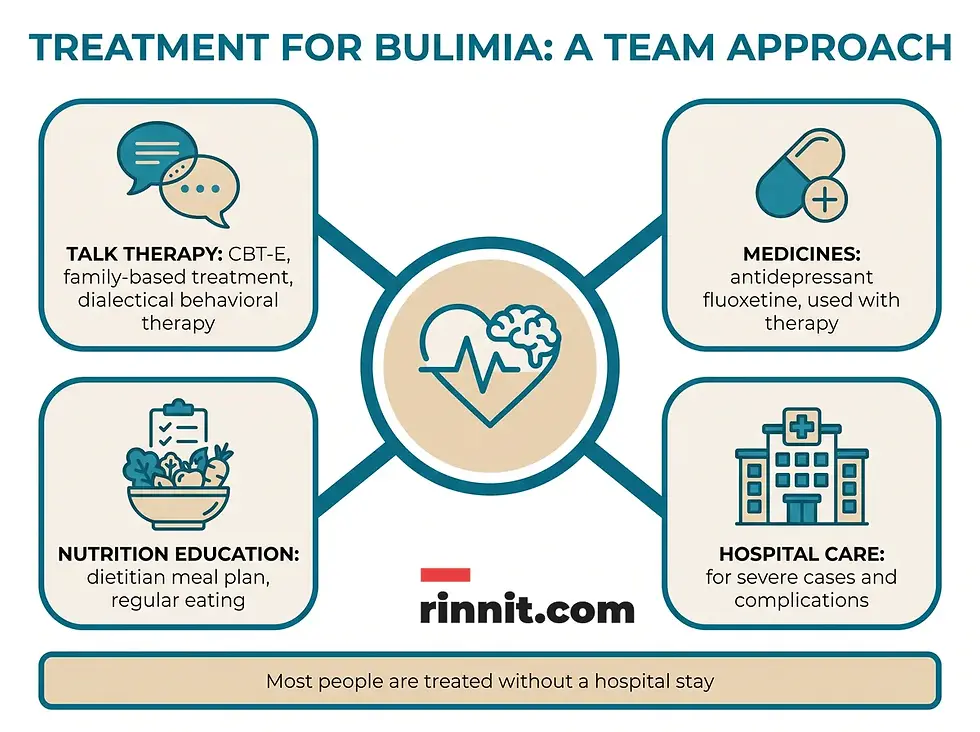
Bulimia treatment generally involves a team approach. The team includes you, your family, your primary healthcare professional, a mental health professional, and sometimes a dietitian who knows how to treat eating problems. You may need one or more types of treatment, combining proven therapies and medicines. [2]
Talk therapy
Talk therapy, also known as psychotherapy, involves talking to a mental health professional about your bulimia and related issues. Studies show that specific types of talk therapy can reduce bulimia symptoms. [2]
Therapy | How it helps |
Enhanced cognitive behavioral therapy (CBT-E) | Helps teenagers and adults create healthy-eating patterns and replace unhealthy, negative beliefs and behaviors with healthy, positive ones [2] |
Family-based treatment (FBT) | Helps parents of children and teenagers learn what to do about unhealthy-eating behaviors and help their child regain control over what is eaten [2] |
Dialectical behavioral therapy | Helps people better tolerate distress, become more emotionally balanced, be more mindful, and get along better with others [2] |
Ask your mental health professional which type of therapy will be used and how it helps treat bulimia. [2]
Medicines
Specific antidepressants may reduce the symptoms of bulimia. The only antidepressant the U.S. Food and Drug Administration (FDA) has approved specifically to treat bulimia is fluoxetine (Prozac). It is a selective serotonin reuptake inhibitor (SSRI). It may help with bulimia symptoms even if you are not depressed, and it works better when used together with talk therapy. [2]
Nutrition education
Dietitians with special training in treating eating disorders can help. They design an eating plan to help you eat healthier, manage feelings of being overly hungry or having too many cravings, and provide good nutrition. Eating regularly and not limiting the amounts or types of food you eat is important in overcoming bulimia. [2]
Hospitalization
Bulimia can usually be treated outside of the hospital. But if symptoms are severe and you have serious health complications, you may need hospital treatment. Some eating disorder programs offer day treatment rather than a hospital stay. [2]
Coping with setbacks
Although most people with bulimia get better, some find that symptoms do not go away entirely. Periods of binge eating and purging may come and go through the years, for example when under a lot of stress. [2]
If you find yourself back in the binge-purge cycle, get help. Follow-up sessions with your healthcare professional, dietitian, or mental health professional can help before the eating problem gets out of control again. Learning positive ways to cope, finding healthy ways to get along with others, and managing stress help keep the problem from returning. If you have had an eating disorder in the past and notice symptoms returning, seek help from your medical team right away. [2]
What self-care at home helps with bulimia?
In addition to professional treatment, self-care steps support recovery. Follow your treatment plan and do not skip therapy sessions. Try to follow what you and your therapist plan for the time between sessions, even when those plans make you uncomfortable. [2]
Learning about bulimia helps you stay with your treatment plan. Getting the right nutrition matters too. If you are not eating well or purging a lot, your body may be missing key nutrients. Talk to your healthcare professional or dietitian about which vitamin and mineral supplements you need, but try to get most vitamins and minerals from food. [2]
Stay in touch with caring family and friends who want to see you get healthy. Be kind to yourself: try not to weigh yourself or check the mirror often, because these actions can fuel unhealthy habits. Be cautious with exercise and ask your healthcare professional what kind of physical activity is right for you, especially if you exercise a lot to burn off calories after binge eating. [2]
How can you prevent bulimia?
No sure method exists to prevent bulimia in yourself or in someone you care about. But you can steer someone toward healthier behavior or professional treatment before it gets worse. [1]
Prevention step | What it looks like |
Healthy body image | Support a healthy body image in children no matter their size or shape, and build confidence in many parts of their personality, not just looks [1] |
Family meals | Have regular, enjoyable family meals together [1] |
No weight talk | Avoid talking about weight or shape at home [1] |
Discourage dieting | Avoid unhealthy weight-control behaviors such as fasting, labeling foods as good or bad, using weight-loss supplements or laxatives, or vomiting [1] |
Early screening | Ask your healthcare professional to look for early signs of an eating problem [1] |
If you notice a loved one or friend who seems to have food issues that could suggest an eating disorder, think about talking with the person and ask how you can help. Stay supportive while you do. [1]
How should you prepare for a bulimia appointment?
Having a family member or friend go with you can help you remember key points and give your healthcare team a fuller picture of what is going on. [2]
Before your appointment, make a list of your symptoms, even those that do not seem related. Note key personal information, including any major stresses or recent life changes. List all medicines, including over-the-counter products, vitamins, herbal products, and supplements, along with their doses. Bring questions to ask so you make the most of your time together. [2]
Good questions to ask include what kinds of tests you need and whether you should prepare for them, which treatments are recommended, whether a generic alternative exists for any prescribed medicine, and how treatment will affect your weight. You can also ask for brochures or recommended websites. [2]
Your healthcare professional will likely ask how long you have worried about your weight, whether you think about food often, and whether you ever eat in secret. Expect questions about vomiting when too full, taking medicines for weight loss, how often you exercise, and any other ways you have tried to lose weight. You will also be asked about physical symptoms and whether any family members have had symptoms of an eating problem or an eating disorder diagnosis. [2]
What should you know about supplements and bulimia?
People with eating disorders are at risk of misusing dietary supplements and herbal products designed to make them less hungry or help them lose weight. Weight-loss supplements and herbs can have serious side effects, and they can be even more dangerous when taken with other medicines. [2]
The FDA does not need to approve weight-loss and other dietary supplements before they go on the market. Natural does not always mean safe. If you use dietary supplements or herbs, talk to your healthcare professional about the risks. [2]
How can people with bulimia cope and find support?
Coping with bulimia can feel hard when the media, coaches, family, or even friends send mixed messages about body size. A few habits make a real difference. Remind yourself what a healthy weight is for your body. Try not to diet or skip meals, which can cause binge eating. Do not skip therapy sessions, and do not visit websites that support or praise eating disorders. [2]
Work with your treatment team to figure out which situations trigger thoughts or behaviors tied to your bulimia, and create a plan to deal with those situations. Make a plan for coping with setbacks. Look for positive role models, find enjoyable activities and hobbies that distract you from thoughts of bingeing and purging, and work on feeling better about yourself by forgiving yourself and focusing on the positive. [2]
Support groups can be a source of encouragement, hope, and coping advice. Group members understand what you are going through because they have been there. Ask your healthcare professional if a group is in your area. [2] The National Eating Disorders Association and the National Alliance on Mental Illness also list screening tools, support resources, and information on co-occurring conditions.
Advice for parents
If your child has bulimia, you may blame yourself. But eating disorders have many causes, and parents do not cause them. Parents play a very important role in helping children recover. [2]
Make sure your child gets treatment, and take part in the treatment plan so you know how to best support them. Listen actively and give your child a safe space to share feelings without judgment. Schedule regular family mealtimes, because eating at routine times helps reduce binge eating. Let your teenager know your concerns without placing blame. An eating disorder is not a choice; it is a complex illness that affects your child's brain and how they make decisions. [2]
Eating disorders affect the whole family, so take care of yourself too. If you are not coping well with your child's bulimia, professional counseling could help, or ask your child's healthcare professional about support groups for parents. [2]
Conclusion
Bulimia nervosa is a serious eating disorder built on the cycle of binge eating and purging. It can affect people of any body weight, so it cannot be spotted by size alone. The condition can cause life-threatening complications, from heart problems and kidney failure to severe dental damage. But it is not a choice, and it is not something a person must face alone. [1] [2]
Most people with bulimia get better with treatment. The team approach, combining talk therapy, the antidepressant fluoxetine, and dietitian-guided nutrition education, has strong evidence behind it. Even setbacks can be managed with follow-up care and a solid coping plan. [2]
Next steps: If you or a loved one show any signs of bulimia, seek medical help right away. Talk to a primary healthcare professional or a mental health professional, or start with someone you trust, such as a friend, teacher, or faith leader. Getting help early gives treatment the best chance to reverse complications and support lasting recovery.
Frequently asked questions
Do I need to be underweight to have bulimia nervosa?
No. People with bulimia can be any weight, including average weight or overweight. Body size is not a reliable sign, which is why bulimia is often hidden from family and friends. [1]
How long after a binge does someone with bulimia purge?
Purging typically follows a binge closely, often within minutes to hours, to get rid of the food and calories. Behaviors include vomiting, laxatives, diuretics, extreme exercise, or fasting. [1]
Can bulimia go away without treatment?
Bulimia usually does not go away on its own, and untreated it can severely harm physical and mental health. Seek medical help right away if you have symptoms; effective treatment can reverse serious complications. [1]
What is the only medicine approved specifically for bulimia nervosa?
Fluoxetine (Prozac), a selective serotonin reuptake inhibitor (SSRI), is the only antidepressant specifically approved by the FDA to treat bulimia. It may help even without depression and works better alongside talk therapy. [2]
Is bulimia nervosa genetic or caused by dieting?
The exact cause is unknown, but genes, emotional health, and family history may play a role. Dieting also raises the risk, since limiting calories between binges can trigger the binge-purge cycle. [1]
This article is for general education and is not a substitute for professional medical advice, diagnosis, or treatment. Always consult a qualified healthcare professional about your individual situation.
References
Mayo Clinic Staff. Bulimia nervosa - Symptoms and causes. Mayo Clinic. February 29, 2024. https://www.mayoclinic.org/diseases-conditions/bulimia/symptoms-causes/syc-20353615
Mayo Clinic Staff. Bulimia nervosa - Diagnosis and treatment. Mayo Clinic. February 29, 2024. https://www.mayoclinic.org/diseases-conditions/bulimia/diagnosis-treatment/drc-20353621
Office on Women's Health. Bulimia nervosa. womenshealth.gov. September 18, 2025. https://www.womenshealth.gov/mental-health/mental-health-conditions/eating-disorders/bulimia-nervosa
National Eating Disorders Association. Bulimia nervosa. National Eating Disorders Association. Accessed October 14, 2026. https://www.nationaleatingdisorders.org/bulimia-nervosa
National Alliance on Mental Illness. Eating disorders. NAMI. Accessed October 14, 2026. https://www.nami.org/types-of-conditions/eating-disorders/
Sioziou AL, Stefanou A, Dimitrakopoulou F, et al. Cognitive behavioural therapy compared to control conditions in treating bulimia nervosa and binge-eating disorder: a systematic review and meta-analysis. Br J Clin Psychol. 2026;65(4):1248-1261. PMID 42170764. https://doi.org/10.1111/bjc.70070
Samara MT, Michou N, Lappas AS, et al. Is cognitive behavioral therapy more effective than pharmacotherapy for binge spectrum disorders? A systematic review and meta-analysis. Aust N Z J Psychiatry. 2024;58(4):308-319. PMID 38179705. https://doi.org/10.1177/00048674231219593
Argyrou A, Lappas AS, Bakaloudi DR, et al. Pharmacotherapy compared to placebo for people with bulimia nervosa: a systematic review and meta-analysis. Psychiatry Res. 2023;327:115357. PMID 37562154. https://doi.org/10.1016/j.psychres.2023.115357



Comments