Assertive Community Treatment (ACT): What It Is and Benefits

Updated: 2 days ago
Written and medically reviewed by Dr. Baraa Alnahhal, MD · Last reviewed: November 2026 · How we review
Quick Answer
Assertive community treatment (ACT) is a set of treatment and support services for people with severe mental health conditions, delivered by a specialist team at home and in the community instead of in a hospital. It's for people at the highest risk of a psychiatric crisis or hospitalization. Studies show ACT reduces hospital stays and improves quality of life.
What the research says
ACT reduced homelessness: in a review of 10 studies with 5,775 people with severe mental illness who were homeless, the randomized trials showed ACT led to a 37% greater reduction in homelessness and a 26% greater improvement in symptoms than standard case management (Coldwell CM et al., American Journal of Psychiatry, 2007) [2]
Housing plus ACT kept people housed: in a five-city trial of 950 homeless people with serious mental illness, those given housing with ACT spent 71% of their time stably housed versus 29% with usual care, and found housing much faster (73 vs. 220 days) (Aubry T et al., Psychiatric Services, 2016) [3]
Key takeaways
ACT brings a mental health team to you at home and in the community.
It's for people with severe mental illness at high risk of crisis.
Help is available 24/7.
Services cover treatment, housing, work and daily life.
It reduces hospital stays and improves quality of life.
What is assertive community treatment?
ACT is a holistic, recovery-focused approach. You and your team decide together which services will help most. A version called forensic assertive community treatment (FACT) serves people who have been arrested or incarcerated. Sources: [1]
Who it's for

Availability varies by location.
Schizophrenia spectrum disorders, such as schizoaffective disorder and schizotypal personality disorder.
Borderline personality disorder. Sources: [1]
It's meant for people at the highest risk of a crisis leading to hospitalization, homelessness or legal involvement. Sources: [1]
The ACT team
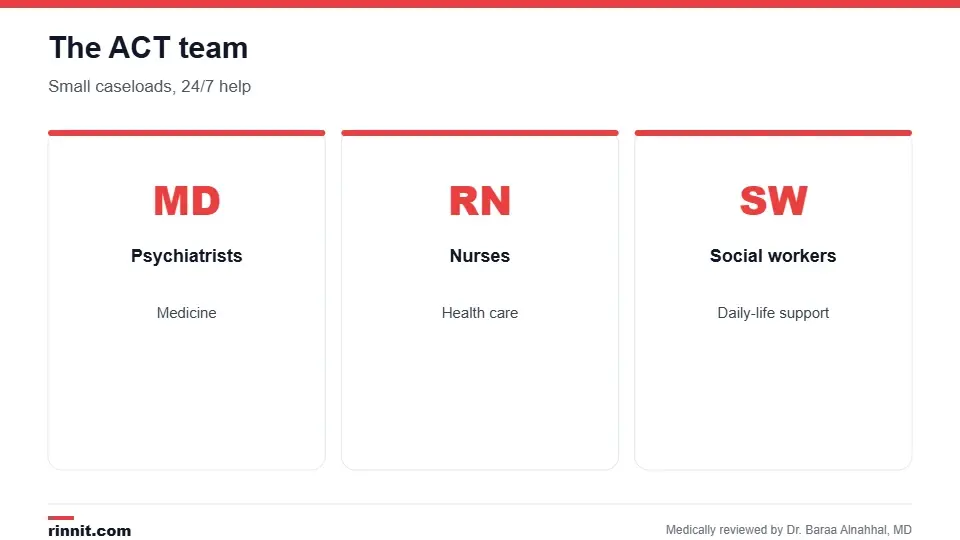
The team works with you where you live.
Psychiatrists and psychologists.
Registered nurses.
Social workers and case managers.
Dual diagnosis specialists for mental health and substance use. Sources: [1]
Services ACT may offer
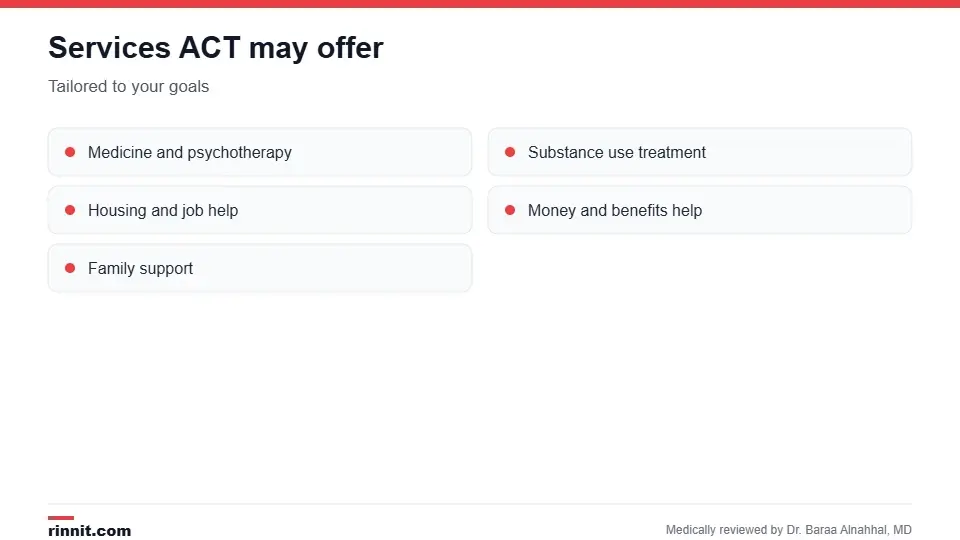
Services are tailored to your goals.
Area | Examples |
Health care | Medicine, psychotherapy, substance use treatment, other health conditions |
Family | Family education and support |
Daily life | Housing, jobs, money management, groceries, transportation |
Benefits | Insurance and food assistance |
Other | Education support, rehabilitation after incarceration |
Sources: [1]
How long it lasts
ACT usually lasts at least several months, depending on your needs. Some people use ACT more than once in their lifetime. Sources: [1]
Benefits
Fewer psychiatric hospital admissions.
Shorter hospital stays.
Better quality of life.
Better treatment follow-through.
Fewer arrests and incarcerations, especially with FACT.
Less homelessness. Sources: [1, 2, 3]
Risks
ACT has no specific risks. Availability varies by location, and programs may be government-funded or run by private mental health centers. Sources: [1]
How to get started
Talk with a healthcare provider or mental health professional if you're interested. They can guide you to an ACT program near you. Sources: [1]
Conclusion
Assertive community treatment brings intensive, round-the-clock mental health care to people where they live. It can help people with severe mental illness stay out of the hospital and build stable lives.
Keep learning: read about psychotherapy and dual diagnosis.
Frequently asked questions
What is assertive community treatment?
Team-based mental health care delivered at home and in the community.
Who is ACT for?
People with severe mental illness at high risk of crisis.
What conditions does it help?
Mostly schizophrenia spectrum disorders, plus bipolar and borderline personality disorder.
Who is on the team?
Psychiatrists, psychologists, nurses, social workers and case managers.
Is help available at night?
Yes, ACT offers 24/7 support.
What services are included?
Treatment, substance use care, housing, job and money help.
What is FACT?
A version of ACT for people involved with the legal system.
How long does ACT last?
Usually at least several months.
Does ACT work?
Studies show fewer hospital stays and better quality of life.
How do I find a program?
Ask your healthcare or mental health provider.
Related Reading
Dual Diagnosis: When a Mental Health Condition and Addiction Occur Together mental illness and substance use together.
Schizoaffective Disorder Guide: Symptoms, Causes, Diagnosis, and Treatment a condition ACT helps.
Bipolar Disorder: Symptoms, Causes, and Treatment another condition ACT helps.
Borderline Personality Disorder: Symptoms, Causes, and Treatment a personality disorder ACT may help.
References
Cleveland Clinic. Assertive Community Treatment: What It Is & Benefits. Cleveland Clinic. Last updated April 15, 2024. https://my.clevelandclinic.org/health/treatments/assertive-community-treatment-act
Coldwell CM, Bender WS. The effectiveness of assertive community treatment for homeless populations with severe mental illness: a meta-analysis. American Journal of Psychiatry. 2007;164(3):393-399. PMID 17329462. https://doi.org/10.1176/ajp.2007.164.3.393
Aubry T, Goering P, Veldhuizen S, et al. A multiple-city RCT of Housing First with assertive community treatment for homeless Canadians with serious mental illness. Psychiatric Services. 2016;67(3):275-281. PMID 26620289. https://doi.org/10.1176/appi.ps.201400587
Medical disclaimer
This article is for general education only and does not replace advice from a qualified healthcare professional. Talk to your doctor about your own diagnosis and treatment, and seek emergency care right away for severe or sudden symptoms.



Comments