Schizoaffective Disorder Guide: Symptoms, Causes, Diagnosis, and Treatment

Updated: 2 days ago
Medically reviewed by Dr. Baraa Alnahhal, MD · Last reviewed: September 2026
TL;DR
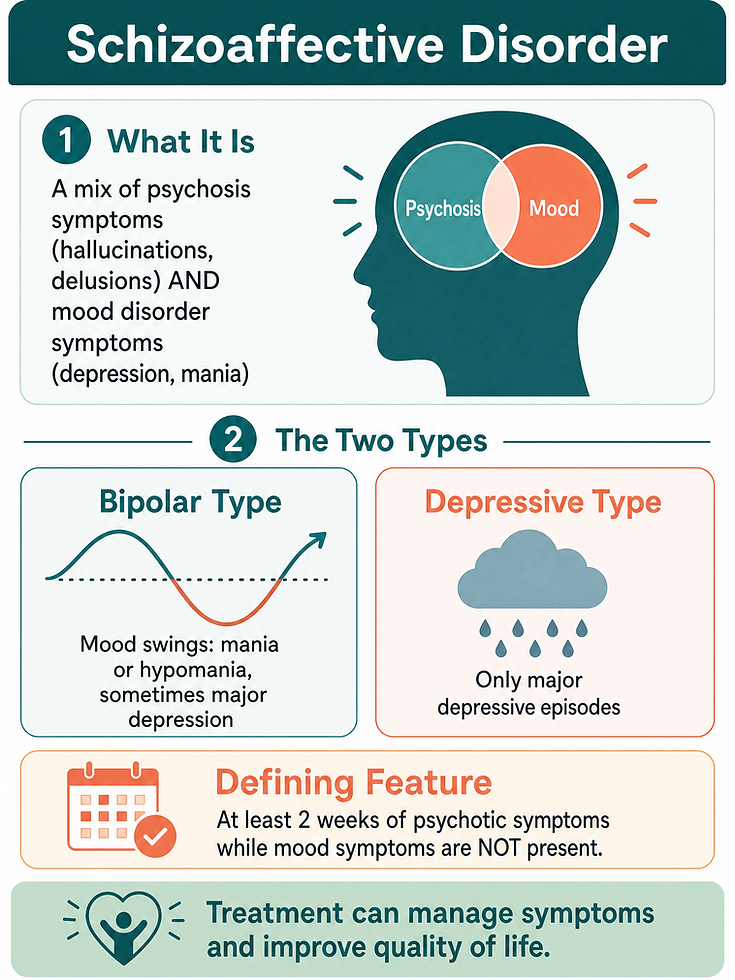
Schizoaffective disorder is a mental health condition marked by a mix of schizophrenia-type symptoms (hallucinations and delusions) and mood disorder symptoms (depression, mania, and the milder hypomania). It comes in two types — the bipolar type (mania or hypomania, sometimes major depression) and the depressive type (only major depressive episodes). A defining diagnostic feature: at least two weeks of psychotic symptoms occurring while mood symptoms are not present. Left untreated, it can disrupt work, school, and social life; but with the right combination of medicines, talk therapy, and life skills training, symptoms can be managed and quality of life improved.
Quick Answer
Schizoaffective disorder is a mental health condition that combines psychosis symptoms (hallucinations, delusions) with mood disorder symptoms (depression, mania, or hypomania). It has two types: the bipolar type (bouts of hypomania or mania and sometimes major depression) and the depressive type (only major depressive bouts). The cause is not known, though genes passed down through families likely play a part. Diagnosis works by ruling out other mental health conditions — a physical exam, tests and screenings (sometimes MRI or CT), and a full mental health evaluation, confirming symptoms are not due to substance use, medicine, or a medical condition. Treatment is usually medicines (antipsychotics, mood stabilizers, antidepressants) combined with talk therapy and life skills training; hospital stays cover crises, and ECT is an option when other treatments fall short.
What Is Schizoaffective Disorder?
Schizoaffective disorder is a mental health condition marked by a mix of two symptom groups. On one side, schizophrenia-type symptoms: hallucinations (seeing things or hearing voices that others don't observe) and delusions (believing things that are not real or not true). On the other, mood disorder symptoms: depression, mania, and a milder form of mania called hypomania.
The disorder changes how people think, feel, and act. It can vary widely from person to person — and when it isn't treated, it can make it hard to function at work or school or in social settings, and it can cause loneliness. People with schizoaffective disorder may need help and support in their daily lives. But treatment can help manage symptoms and make quality of life better.
What Are the Two Types?
Both types include some symptoms of schizophrenia. The difference lies in the mood component.
Type | What it includes |
Bipolar type | Bouts of hypomania or mania, and sometimes major depression |
Depressive type | Only major depressive bouts |
A key defining feature across both types: the pattern includes a major bout of depressed or manic mood plus at least a two-week period of psychotic symptoms when mood symptoms are not present. That two-week window of psychosis standing on its own is part of what distinguishes schizoaffective disorder from a mood disorder with psychotic features.
What Are the Symptoms?
Symptoms may vary from person to person, but people with the condition have psychotic symptoms — hallucinations and delusions — along with symptoms of a mood disorder. The full list to know:
Possible sign or symptom | What it means |
Delusions | Having false, fixed beliefs, despite facts showing that they're not true |
Hallucinations | Hearing voices or seeing things that others don't observe |
Disorganized thinking and speech | Thoughts and language that don't follow a logical pattern |
Bizarre or unusual behavior | Behavior that stands out as out of character or odd |
Symptoms of depression | Feeling empty, sad, or worthless |
Periods of manic mood | More energy and less need for sleep over several days, plus behaviors that are out of character |
Trouble functioning | Having a hard time functioning at work or school or in social situations |
Poor personal care | Problems managing self-care, such as not looking clean or not taking care in how one looks |
When Should You Seek Help?
If you think someone you know may have schizoaffective disorder symptoms, talk with that person about your concerns. Although you can't force someone to seek professional help, you can offer encouragement and support and help find a healthcare professional or mental health professional.
If you're concerned about a loved one's safety or ability to get food, clothing, or shelter, you may need to contact emergency responders, a mental health hotline, or a social service agency to get help from a mental health professional.
What About Suicidal Thoughts?
A person with schizoaffective disorder may talk about or attempt suicide. If you have a loved one who is in danger of suicide or has attempted suicide, make sure someone stays with that person, and contact a suicide hotline. In the U.S., call or text 988 to reach the 988 Suicide & Crisis Lifeline, available 24 hours a day, seven days a week. You can also use the Lifeline Chat. Services are free and confidential. The lifeline also offers a Spanish-language phone line at 1-888-628-9454 (toll-free).
What Causes Schizoaffective Disorder?
Straight answer: it isn't known what causes schizoaffective disorder. What is understood is that genes that are passed down through families likely play a part. The section below covers the factors that raise the odds.
What Are the Risk Factors?
Three factors raise the risk of developing schizoaffective disorder.
Risk factor | Details |
Family history | Having a close blood relative, such as a parent or sibling, who has schizoaffective disorder, schizophrenia, or bipolar disorder |
Stressful events | Stressful events that may cause symptoms |
Mind-altering drugs | Taking mind-altering drugs, which may make symptoms worse when an underlying problem is present |
What Are the Complications?
People with schizoaffective disorder are at a greater risk of several serious complications.
Complication | Why it matters |
Suicide, suicide attempts, and suicidal thoughts | The most serious risk — take any suicidal talk or behavior seriously |
Social isolation | Withdrawal from family, friends, and community |
Conflicts with others and within families | Strained relationships during and between episodes |
Unemployment | Difficulty holding jobs without consistent support |
Anxiety disorders | Additional mental health conditions can develop alongside |
Alcohol or other substance misuse | Coping through substances that can worsen symptoms |
Heart disease, stroke, and obesity | Physical health conditions that need attention |
Poverty and homelessness | Risk of being poor and not having a home |
Being assaulted | Notably, people with schizoaffective disorder are more likely to be assaulted than to assault others |
Aggressive episodes | Can occur, though victimization is the more common direction |
How Is Schizoaffective Disorder Diagnosed?
Diagnosis involves ruling out other mental health conditions. A healthcare professional also must conclude that symptoms are not due to substance use, medicine, or a medical condition. The process typically includes:
Diagnostic step | What happens |
Physical exam | May be done to rule out other problems that could cause symptoms and to check for related complications |
Tests and screenings | Tests that help rule out conditions with similar symptoms, plus screenings for alcohol and drug use. In some situations, imaging studies such as an MRI or a CT scan may be requested |
Mental health evaluation | A professional checks mental status by noting how a person looks and acts, and asks about thoughts, moods, delusions, hallucinations, substance use, and potential for suicide, along with family and personal history |
How Is Schizoaffective Disorder Treated?
People with schizoaffective disorder generally respond best to medicines along with talk therapy and life skills training. Talk therapy is also known as psychotherapy. Treatment varies depending on the type and severity of symptoms and whether the disorder is the depressive or bipolar type. Some people may need a stay in a hospital, and long-term treatment can help manage symptoms.
Medications
In general, healthcare professionals prescribe medicines to ease psychotic symptoms, stabilize mood, and treat depression. Three classes are used.
Medicine type | What it does |
Antipsychotics | Paliperidone (Invega) is the only medicine the U.S. Food and Drug Administration has approved specifically to treat schizoaffective disorder. But healthcare professionals often prescribe other antipsychotic drugs to manage psychotic symptoms such as delusions and hallucinations |
Mood-stabilizing medicine | When the disorder is the bipolar type, mood stabilizers can help level out the mania highs and depression lows |
Antidepressants | When depression is the underlying mood disorder, antidepressants can help manage feelings of sadness and hopelessness or trouble sleeping and focusing |
Talk Therapy
In addition to medicine, talk therapy may help. Individual therapy may help improve thought patterns and ease symptoms. Building a trusting relationship in therapy can help people with schizoaffective disorder better understand their condition and learn to manage symptoms. Sessions focus on real-life plans and problems, getting along with others, and ways to cope.
Family or group therapy can make treatment more effective when people with schizoaffective disorder discuss their real-life problems with others. Supportive group settings also can lessen social isolation, provide a reality check when people have psychotic symptoms, and make sure people use their medicine properly. These groups also help people learn how to get along better with others.
Life Skills Training
Life skills training can ease isolation and make quality of life better.
Training type | What it covers |
Social skills training | Helps people communicate better, get along with others better, and improve their ability to take part in daily activities — practicing new skills and behaviors for settings such as home or work |
Work rehabilitation and supported work | Helps people prepare for, find, and keep jobs |
Hospital Stays
During crisis periods or times of severe symptoms, people with schizoaffective disorder may need to stay in a hospital to make sure they are safe and taking basic care of themselves.
Electroconvulsive Therapy (ECT)
For adults with schizoaffective disorder who do not respond to talk therapy or medicines, healthcare professionals may suggest electroconvulsive therapy (ECT). ECT is done with a general anesthetic that puts you to sleep. While you are asleep, small electric currents are passed through the brain, intentionally causing a therapeutic seizure that lasts 1 to 2 minutes.
What Coping and Support Steps Help?
If you have schizoaffective disorder, you'll likely need ongoing treatment and support. The clinical guidance recommends these practices.
Support practice | What it involves |
Build strong relationships with your treatment team | An alliance with your healthcare and mental health professionals makes you better able to take part in, and benefit from, treatment |
Learn about the disorder | Understanding may help you follow your treatment plan; friends and family can also learn more to understand the disorder and be more compassionate |
Pay attention to warning signs | Look for things that may cause symptoms or get in the way of daily activities; make a plan for what to do if symptoms return, and contact your professional if needed to stop things from getting worse |
Get more sleep | If you're having trouble sleeping, lifestyle changes can help |
Stay focused on goals | Managing schizoaffective disorder is an ongoing process — keeping treatment goals in mind helps you stay motivated and work toward your goals |
Don't use alcohol or drugs | Alcohol, nicotine, or recreational drugs can make treatment harder, worsen symptoms, or change how medicines work. Quitting can be hard — get advice from your healthcare team on how best to quit |
Learn relaxation and stress management | Stress-reduction techniques such as meditation, yoga, or tai chi may help you and your loved ones |
Join a support group | Helps you connect with others facing similar challenges, and helps family and friends cope |
Ask about social services assistance | Services may help with affordable housing, transportation, and daily activities |
How Should You Prepare for Your Appointment?
If you think you may have schizoaffective disorder — or that a loved one may — take steps to prepare. If the appointment is for a relative or friend, offer to go along: getting information firsthand will help you know how you can help.
What You Can Do
Make a list of:
What to bring | Details |
Any symptoms you've noticed | Including any that don't seem related to the reason you made the appointment |
Key personal information | Any family history of mental health conditions, any major stresses or recent life changes |
All medicines | Vitamins, herbal preparations, and any other supplements you take — including doses |
Questions to ask | To help make the most of your time |
Basic questions worth asking: What is causing the symptoms? Are there other possible causes? How will you make the diagnosis? Is this condition likely short-term or long-term? What treatments do you recommend? What are the options to the main approach you're suggesting? What are the side effects of the medicine you're prescribing? Are there brochures or other printed material I can have? What websites do you recommend?
What to Expect From Your Doctor
Your healthcare professional likely will ask several questions. Being ready with answers gives you time to focus on your own points.
Likely question | Why it's asked |
What symptoms have you noticed? | Establishes the symptom picture |
When did you start noticing symptoms? | Establishes timeline |
Have symptoms been occurring some of the time or all the time? | Patterns matter for diagnosis |
Have you thought about or attempted suicide? | Safety assessment |
How are you functioning in daily life? | Eating regularly, bathing regularly, going to work or school, taking part in social activities |
Have other family members or friends shared concerns about how you're acting? | Outside observations matter |
Have you been diagnosed with any other medical conditions? | Rules out or flags overlapping conditions |
Has anyone else in your family been diagnosed with or treated for mental illness? | Family history is a key risk factor |
Conclusion
Schizoaffective disorder sits at the intersection of two worlds: psychosis symptoms like hallucinations and delusions, and mood episodes like depression and mania. The two-week rule — psychotic symptoms occurring for at least two weeks while mood symptoms are not present — is the diagnostic hinge that separates it from other conditions, and careful evaluation rules out substance use, medicines, and medical causes first. Only one medicine carries a specific FDA approval for this disorder, but the fuller picture is more encouraging: people respond best to a combination of antipsychotics, mood stabilizers, or antidepressants plus talk therapy and life skills training, with hospital care for crises and ECT as a later option. The risks are real — from suicide and isolation to job loss and housing instability — but the same guidance that names those risks also points to what helps: a strong treatment alliance, early warning-sign plans, avoiding alcohol and drugs, and ongoing support. If symptoms are showing up, the first move is a conversation — with the person affected, and with a mental health professional.
Frequently Asked Questions
What exactly is schizoaffective disorder?
It is a mental health condition marked by a mix of schizophrenia-type symptoms (hallucinations and delusions) and mood disorder symptoms (depression, mania, and hypomania). It changes how people think, feel, and act, and untreated it can make work, school, and social life difficult.
What are the two types of schizoaffective disorder?
The bipolar type, which includes bouts of hypomania or mania and sometimes major depression, and the depressive type, which includes only major depressive bouts. Both types include some symptoms of schizophrenia.
What is the defining diagnostic feature?
A major bout of depressed or manic mood combined with at least a two-week period of psychotic symptoms when mood symptoms are not present — plus a conclusion that symptoms are not due to substance use, medicine, or a medical condition.
What causes schizoaffective disorder?
It isn't known what causes it. Genes that are passed down through families likely play a part, and risk rises with a close relative who has schizoaffective disorder, schizophrenia, or bipolar disorder, with stressful events, and with mind-altering drug use.
What are the main symptoms?
Delusions (fixed false beliefs), hallucinations (hearing voices or seeing things others don't), disorganized thinking and speech, bizarre or unusual behavior, depression symptoms (feeling empty, sad, or worthless), manic periods (more energy, less sleep, out-of-character behavior), trouble functioning at work or school, and poor personal care.
What is the most serious complication to watch for?
Suicide, suicide attempts, and suicidal thoughts. If a loved one is in danger or has attempted suicide, make sure someone stays with them and contact the 988 Suicide & Crisis Lifeline (call or text 988 in the U.S., free and confidential, 24/7) or emergency responders.
How is schizoaffective disorder diagnosed?
Through a physical exam, tests and screenings (including alcohol and drug screenings, sometimes an MRI or CT), and a mental health evaluation that covers thoughts, moods, delusions, hallucinations, substance use, suicide potential, and family and personal history — while ruling out other conditions.
How is it treated?
People generally respond best to medicines combined with talk therapy and life skills training. Antipsychotics handle psychotic symptoms (paliperidone is the only drug specifically FDA-approved for this disorder), mood stabilizers level out the mania highs and depression lows in the bipolar type, and antidepressants treat the depressive type. Individual, family, and group therapy, social skills and work training, hospital care during crises, and ECT for those who don't respond to other treatments round out the toolkit — with long-term treatment helping to manage symptoms.
External Links
This article is for general informational purposes only and is not a substitute for professional medical advice, diagnosis, or treatment. Always consult a qualified healthcare professional about any medical condition or treatment decision. If you or someone you know is in crisis, call or text 988 to reach the 988 Suicide & Crisis Lifeline, available 24/7 in the U.S.
Comments