Dual Diagnosis: When a Mental Health Condition and Addiction Occur Together

Updated: 3 days ago
Medically reviewed by Dr. Baraa Alnahhal, MD · Last reviewed: November 9, 2026
Quick Answer
Dual diagnosis is the medical term for having a mental health disorder and a substance use disorder at the same time, with each condition worsening the other [1]. About 50% of people with a substance use disorder also have a mental health disorder [1]. Treatment works best when both are addressed together through therapy, medication, support groups or inpatient care [1].
What the research says
Dual diagnosis is common in clinical settings. A systematic review and meta-analysis of 32 studies covering 2,805,009 patients found a pooled proportion of 44.7% of patients with a dual diagnosis (median 47.9%, range 5.9%–91.55%). Rates varied by setting, assessment method, and country, and the authors call for greater recognition of integrated management (PubMed: Choudhary et al., J Dual Diagn, 2025 [2]).
For PTSD plus alcohol or drug use, combining treatments gave the biggest gains. In a meta-analysis of 36 studies (4,046 participants) of adults with co-occurring PTSD and alcohol or other drug use disorders, trauma-focused therapy combined with medication for substance use produced the largest effects versus treatment as usual at end of treatment: d = −0.92 for PTSD severity and d = −1.10 for alcohol use severity (PubMed: Hien et al., Am J Psychiatry, 2023 [4]).
The evidence for talk therapy in depression plus substance use is still thin. A Cochrane review found only 7 randomized trials (608 participants) of psychological treatments for co-occurring depression and substance use disorders, all at high risk of performance bias; the authors judged the evidence too limited to draw conclusions about efficacy, which is why individualized care with your provider matters (PubMed: Hides et al., Cochrane Database Syst Rev, 2019 [3]).
What Is Dual Diagnosis?
Dual diagnosis means you have a mental health disorder and a substance use disorder (SUD) at the same time. Mental health disorders can include depression, anxiety and ADHD. A substance use disorder may involve alcohol, drugs or other addictive substances [1].
The two conditions don't sit side by side quietly. When they occur together, the effects of each can worsen the other. Untreated mental health issues can cause substance use problems to get worse. And when substance use increases, your mental health problems may worsen. This can become a tough cycle to break [1].
Quick fact | Detail |
What it is | A mental health disorder and a substance use disorder occurring at the same time |
Also called | Co-occurring disorder; comorbidity |
Common pairings | Depression, anxiety or ADHD with alcohol, drugs or other addictive substances |
How common | About 50% of people with a substance use disorder also have a mental health disorder (and vice versa) |
U.S. prevalence (2023) | About 20.4 million U.S. adults [1] |
Best treatment approach | Both conditions treated at the same time |
Recovery outlook | About 50% respond well to a combined treatment program; chances are very good with the right treatment |

Which Disorder Comes First?
Like the chicken or the egg, it can be hard to figure out which came first. Dual diagnoses occur together, but that doesn't mean one caused the other.
Substance use disorders may not directly cause mental health disorders, and vice versa. But there's a clear connection between the two. Drugs and alcohol can worsen the symptoms of mental health conditions, and continued use of these substances can increase your risk of developing a mental health disorder [1].
Common pairing | Example combination |
Depression + alcohol | Major depressive disorder with alcohol use disorder |
Trauma + opioids | Post-traumatic stress disorder (PTSD) with opioid use disorder |
Bipolar disorder + stimulants | Bipolar disorder with stimulant addiction |
Schizophrenia + cannabis | Schizophrenia with cannabis use disorder |
A typical example: having major depressive disorder and alcohol use disorder at the same time. If you have depression, you may drink alcohol as a coping mechanism — which can make your depression worse. If you have alcoholism, it can worsen your depression. This may lead you to drink more [1].
Trauma is another common thread. To learn more about one of these conditions, read our guide to post-traumatic stress disorder (PTSD).
Signs and Symptoms of Dual Diagnosis
Your substance addiction and your mental health issue each have their own symptoms. So, the symptoms of dual diagnosis depend on which substances and mental health disorders are involved. Symptoms may vary widely — there are many different combinations of dual diagnoses. Sometimes, the symptoms overlap [1], which can make the picture harder to read.
Substance use disorder signs | Mental health disorder signs |
Withdrawal from your family and friends | Extreme mood changes |
Trouble focusing | Confusion |
Sudden behavior changes | Irritability |
Engaging in risky behaviors | Problems concentrating |
Developing a high tolerance for the substance | Unable to function at work or school |
Having withdrawal symptoms | Avoiding social activities |
Feeling like you need the substance to function | Thoughts of suicide |
If you or someone you know is in crisis: thoughts of suicide can be part of a mental health condition. If you are having thoughts of harming yourself, call or text the 988 Suicide and Crisis Lifeline (available 24/7, free and confidential) or seek emergency care.

What Causes Dual Diagnosis?
Mental health disorders and substance use disorders are interconnected — and the influence runs in both directions.
Mental health disorders may contribute to substance use disorders. If you have a mental health disorder, you may self-medicate — using alcohol or drugs to try to feel better or cope. These substances may briefly help your symptoms, but they can make them worse over time. Mental health conditions can also affect how your brain handles rewards, making addiction more likely [1].
Substance use disorders may contribute to mental health disorders. Alcohol, drugs and other substances can trigger changes in your brain's structure and function. This can make it more likely that you'll develop a mental health disorder [1].
Direction of influence | How it works |
Mental health disorder → substance use disorder | Self-medication to cope or feel better; substances briefly help but worsen symptoms over time; brain reward pathways make addiction more likely |
Substance use disorder → mental health disorder | Alcohol, drugs and other substances trigger changes in the brain's structure and function, raising the risk of a mental health disorder |
Risk Factors
Certain risk factors can contribute to both mental health conditions and substance use disorders.
Risk factor | What it means |
Genetics | Both types of disorders can run in biological families; many different genes may contribute to your risk of developing either condition |
Environmental factors | Stress and trauma can be passed down through generations and contribute to developing a substance use disorder or a mental health disorder |
How to Lower Your Risk
Mental health disorders and substance use disorders are both brain diseases — you can't prevent them. But you can reduce your risk by learning about your biological family history, limiting the amount of alcohol you drink, and talking to a healthcare provider about risk factors [1].
How Is Dual Diagnosis Diagnosed?
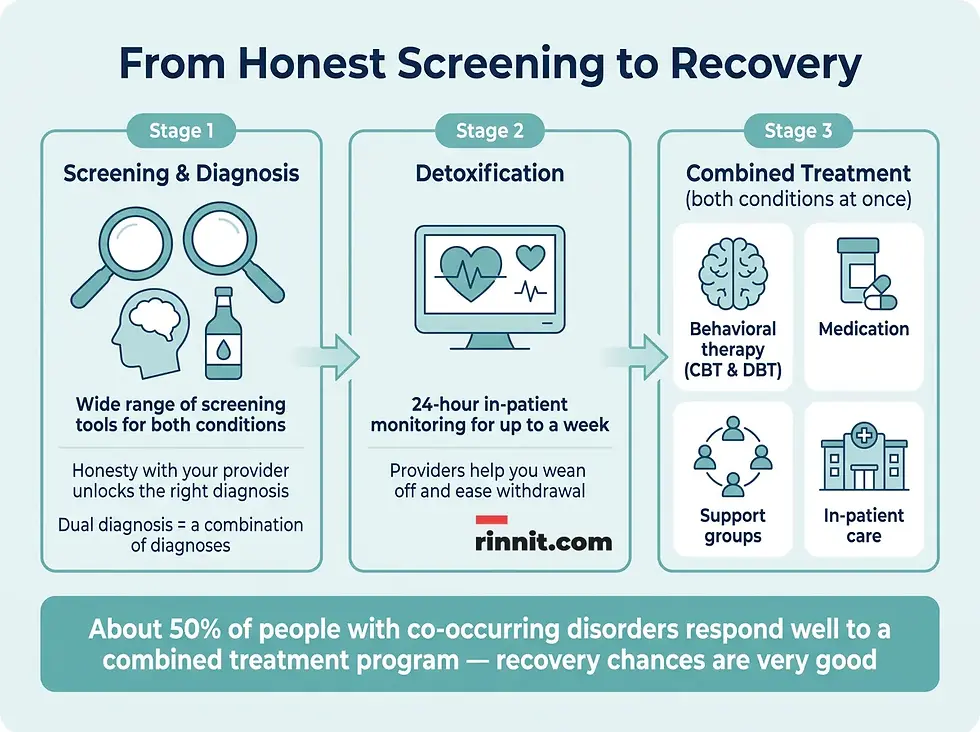
An important thing to understand: dual diagnosis isn't a single diagnosis — it's a combination of diagnoses. It can be hard for your healthcare provider to make the right diagnosis, because the symptoms of the disorders can overlap [1].
Your provider will use a wide range of screening tools to test you for both conditions. It's important to be honest when speaking with your provider. Based on your answers, they can figure out which disorders you have — and then get you started on the right treatment [1].
Step | What happens |
Screening | A wide range of screening tools tests you for both conditions |
Honest conversation | Your answers help your provider figure out which disorders you have |
Diagnosis | Two (or more) diagnoses are identified — not one single label |
Treatment plan | Both conditions are treated at the same time |
How Is Dual Diagnosis Treated?
It's important that you receive treatment for your mental health condition and your substance use disorder at the same time. You'll work with your healthcare provider to understand the ways each disorder affects the other — which helps you figure out which dual diagnosis treatment will be most effective [1].
For you to reach recovery, you'll need to stop using the addictive substance. For many people, this may start with detoxification. During in-patient detox, healthcare providers will monitor you 24 hours a day for up to a week. They'll help you wean off the substance and provide ways to lessen the effects of withdrawal [1].
Treatment type | What it involves |
Detoxification | In-patient detox with 24-hour monitoring for up to a week; providers help you wean off the substance and lessen withdrawal effects |
Behavioral therapy | Cognitive behavioral therapy (CBT) to cope with and change ineffective patterns of thinking; dialectical behavioral therapy (DBT) to reduce self-harm behaviors such as drug use, cutting and suicidal thoughts or actions |
Medication | Prescribed for one or both conditions; some drugs relieve symptoms of both (for example, the FDA has approved bupropion for both depression and nicotine dependence [1]) |
Support groups | Emotional and social support to stay sober; peers who have been in your shoes share experiences, answer questions and offer tips |
In-patient care | A co-occurring disorders treatment center providing medical and mental health care, including medication, therapy and support |
What Is the Best Treatment?
The best dual diagnosis treatment combines care for your mental health condition and your substance use disorder. That means working with the same healthcare provider(s) to treat both conditions at the same time. Combined care is your best chance for long-term recovery [1].
There's no one-size-fits-all solution. The best treatment is the one you and your provider decide will be most successful.
Situation | Recommended path |
Seeking recovery | Stop using the addictive substance; many start with supervised detoxification |
Ongoing treatment | Combined therapy, medication, support groups and provider follow-through |
Dependent use with a mental health condition | Consider a co-occurring disorders treatment center (in-patient care) |
Choosing a plan | Work with your provider to pick what will be most successful for you |
How Can You Help a Loved One?
Helping someone with a co-occurring disorder can be hard. Your loved one may deny they have a problem or resist treatment, and when they do begin treatment, the road to recovery can be long.
Accept what you can and can't do. You can't force your loved one to remain sober, take their medication or go to counseling. But you can make positive choices for yourself, encourage your loved one to get help, and offer your unconditional support [1].
Outlook: What Are the Success Rates?
With the right treatment, your chances for recovery are very good. About 50% of people with co-occurring disorders respond well to a combined treatment program [1].
Recovery is a continuing effort rather than a finish line. You'll need to keep working with your healthcare providers, and you may also need to work with a support group for your recovery to last. Don't be afraid to reach out for help.
Recovery factor | What it means for you |
Success rate | About 50% of people with co-occurring disorders respond well to a combined treatment program |
Continuing care | Keep working with your healthcare providers |
Support groups | May be needed for your recovery to last |
Mindset | Don't be afraid to reach out — mental health disorders and substance use disorders are real medical diseases |
Key Takeaways
Dual diagnosis can feel like a double whammy, and it's common to feel you brought it on yourself. But mental health disorders and substance use disorders are medical diseases — just because you can't see them doesn't mean they aren't real. The encouraging reality is that both conditions can be treated together, and the most effective approach is combined care delivered by the same providers at the same time. Whether that path involves therapy, medication, support groups, inpatient care or a combination of all four, the destination is the same: long-term recovery with your whole health in view.
Take the Next Step
If you recognize these overlapping signs in yourself, the single most important move is honesty. Be open with a healthcare provider about both your mental health and your substance use — that honesty is what allows them to identify the right combination of disorders and start the right combined treatment. Asking for help is the first step.
If you are in crisis: call or text the 988 Suicide and Crisis Lifeline anytime, 24/7, free and confidential. You don't have to face this alone.
Further reading: SAMHSA — Co-Occurring Disorders, NIMH — Substance Use and Co-Occurring Mental Disorders, NIDA — Co-Occurring Disorders and Health Conditions
Frequently Asked Questions
1. What is dual diagnosis?
Dual diagnosis is the medical term for having a mental health disorder and a substance use disorder at the same time. It is also called a co-occurring disorder or comorbidity. Mental health disorders can include depression, anxiety and ADHD, while a substance use disorder may involve alcohol, drugs or other addictive substances.
2. How common is dual diagnosis?
Studies suggest about 50% of people who experience a substance use disorder during their lives will also have a mental health disorder (and vice versa). In 2023, about 20.4 million U.S. adults had a dual diagnosis.
3. Which comes first, the mental health disorder or the substance use disorder?
It can be hard to tell which came first — like the chicken or the egg. Having one doesn't automatically mean it caused the other, but there is a clear connection: substances can worsen mental health symptoms, and continued use can increase the risk of developing a mental health disorder.
4. What does an example of dual diagnosis look like?
A classic example is major depressive disorder combined with alcohol use disorder. Drinking as a coping mechanism can make depression worse, and alcoholism can worsen depression — leading to more drinking. Other pairings include PTSD with opioid use disorder, bipolar disorder with stimulant addiction, and schizophrenia with cannabis use disorder.
5. What are the symptoms of dual diagnosis?
Symptoms depend on which conditions are involved and can overlap. Substance use disorder signs include withdrawing from family and friends, trouble focusing, sudden behavior changes, risky behaviors, high tolerance, withdrawal symptoms and feeling you need the substance to function. Mental health signs include extreme mood changes, confusion, irritability, concentration problems, trouble functioning at work or school, avoiding social activities and thoughts of suicide.
6. What causes dual diagnosis?
The conditions are interconnected. A mental health disorder may lead to self-medicating with alcohol or drugs, which briefly helps but worsens symptoms over time and can affect how the brain handles rewards. Conversely, substances can trigger changes in the brain's structure and function that raise the risk of a mental health disorder. Genetics and environmental factors like stress and trauma are shared risk factors.
7. How is dual diagnosis diagnosed?
Dual diagnosis isn't one diagnosis — it's a combination of diagnoses. Because symptoms can overlap, providers use a wide range of screening tools to test for both conditions. Being honest with your provider about your symptoms and substance use is the key to getting the right diagnoses and the right treatment.
8. How is dual diagnosis treated?
Both conditions should be treated at the same time. Treatment may include detoxification (24-hour in-patient monitoring for up to a week), behavioral therapies such as cognitive behavioral therapy (CBT) and dialectical behavioral therapy (DBT), medication for one or both conditions, support groups and in-patient care at a co-occurring disorders treatment center.
9. What is the best treatment for dual diagnosis?
The best treatment combines care for the mental health condition and the substance use disorder, delivered by the same provider(s) at the same time. Combined care offers the best chance for long-term recovery — but there is no one-size-fits-all solution, so the best plan is the one you and your provider decide will be most successful.
10. What are the success rates of dual diagnosis treatment?
With the right treatment, chances for recovery are very good. About 50% of people with co-occurring disorders respond well to a combined treatment program. Continuing to work with providers and support groups helps the recovery last.
11. How can I help a loved one with a dual diagnosis?
You can't force your loved one to stay sober, take medication or attend counseling — and they may deny the problem or resist treatment at first. What you can do is accept your limits, encourage them to get help, make positive choices for yourself and offer unconditional support.
Related Reading
Assertive Community Treatment (ACT): What It Is and Benefits explains assertive community treatment.
References
Cleveland Clinic. Dual Diagnosis. Cleveland Clinic. Aug. 5, 2025. https://my.clevelandclinic.org/health/diseases/24426-dual-diagnosis
Choudhary H, Bagri S, Thakur MR, Balhara YPS, Sarkar S. A systematic review and meta-analysis of dual diagnosis patient profile in the clinical setting. J Dual Diagn. 2025;21(4):378-390. doi:10.1080/15504263.2025.2564419. PMID: 41175340.
Hides L, Quinn C, Stoyanov S, Kavanagh D, Baker A. Psychological interventions for co-occurring depression and substance use disorders. Cochrane Database Syst Rev. 2019;(11):CD009501. doi:10.1002/14651858.CD009501.pub2. PMID: 31769015.
Hien DA, Morgan-López AA, Saavedra LM, et al. Project Harmony: a meta-analysis with individual patient data on behavioral and pharmacologic trials for comorbid posttraumatic stress and alcohol or other drug use disorders. Am J Psychiatry. 2023;180(2):155-166. doi:10.1176/appi.ajp.22010071. PMID: 36475373.
Medical Disclaimer
This article is for informational purposes only and does not constitute medical advice. Always seek the advice of your physician or other qualified health provider with any questions you may have regarding a medical condition. Never disregard professional medical advice or delay in seeking it because of something you have read here.



Comments