Eating Disorders: Symptoms, Causes, and Treatment

Updated: 2 days ago
Medically reviewed by Dr. Baraa Alnahhal, MD · Last reviewed: October 2026

Quick Answer: What is an eating disorder?
An eating disorder is a serious condition involving unhealthy thoughts about food, weight and shape and dangerous eating behaviors. Main types are anorexia, bulimia, binge-eating disorder and avoidant/restrictive food intake disorder. The exact cause is unknown, though genetics and brain chemistry may play roles. Treatment uses a team approach with nutrition education, behavioral therapy and medicine when needed. [1] [2]
What the research says
According to PubMed:
Anorexia nervosa carries a much higher risk of death than the general population. A systematic review of 30 studies involving 33,176 patients found a pooled standardized mortality ratio of 5.06 (95% CI 3.47 to 7.38, from 22 studies), with suicide and cardiac deaths accounting for 21% and 19% of deaths. (Lai et al., DOI).
Involving the family improves outcomes for anorexia and adolescent bulimia. A meta-review of meta-analyses found that interventions involving the family outperformed active comparison treatments in adolescents and adults with anorexia nervosa and in adolescents with bulimia nervosa. (Monteleone et al., DOI).
CBT helps many adults with bulimia or binge-eating disorder, but not everyone. A meta-analysis of 36 randomized trials with 2,809 adults found abstinence rates of 36% (95% CI 31 to 43) with CBT versus 10% (95% CI 8 to 12) in control groups, and a large group of patients did not respond enough. (Cuijpers et al., DOI).
Study details are from PubMed abstracts.
Key facts at a glance
Key fact | What to know |
What it is | Serious conditions affecting physical and mental health through thoughts about food, weight, and shape, plus risky eating behaviors [1] |
Most common types | Anorexia, bulimia, binge-eating disorder, and avoidant/restrictive food intake disorder [1] |
Who is affected | People of all body types and sizes; often starts in teen and young adult years but can occur at any age [1] |
How common | Up to about 5% of the population, most often developing in adolescence and young adulthood [4] |
What causes it | Exact cause unknown; genetics and brain chemistry may play roles [1] |
Can it be fatal | Yes. Untreated, it can become long-term and in some cases cause death [1] |
How it is treated | Team approach: doctor, mental health professional, sometimes a dietitian, with therapy and medicine if needed [2] |
What eating disorders are
Eating disorders are serious health conditions that affect both your physical and mental health. They include problems in how you think about food, eating, weight, and shape, as well as problems in eating behaviors. These symptoms can affect your health, your emotions, and your ability to function in important areas of life.
Most eating disorders involve focusing too much on weight, body shape, and food. This can lead to dangerous eating behaviors, which can seriously affect the body's ability to get the nutrition it needs.
Eating disorders can harm the heart, digestive system, bones, teeth, and mouth. They can lead to other diseases. They are also linked with depression, anxiety, self-harm, and suicidal thoughts and behaviors.
The message to remember is that these conditions are treatable. With proper treatment, you can return to healthier eating habits and learn healthier ways to think about food and your body. You may also be able to reverse or reduce serious problems caused by the eating disorder.
The four main types
Symptoms vary depending on the type of eating disorder. Anorexia, bulimia, and binge-eating disorder are the most common. People with eating disorders can have all different body types and sizes.
Anorexia
Anorexia, also called anorexia nervosa, can be a life-threatening eating disorder. It includes an unhealthy low body weight, an intense fear of gaining weight, and an unrealistic view of weight and shape.
Anorexia often involves extreme efforts to control weight and shape that seriously interfere with health and daily life. This may include severely limiting calories or cutting out certain foods or food groups. It may involve other methods to lose weight, such as exercising too much, using laxatives or diet aids, or vomiting after eating.
These efforts to reduce weight can cause severe health problems, even for people who continue eating throughout the day or whose weight is not extremely low.
Bulimia
Bulimia, also called bulimia nervosa, is a serious and sometimes life-threatening eating disorder. It includes episodes of bingeing, commonly followed by episodes of purging. Sometimes it also includes severely limiting eating for periods of time, which often leads to stronger urges to binge and then purge.
Bingeing involves eating food, sometimes an extremely large amount, in a short period of time. During a binge, people feel they have no control over their eating and cannot stop.
After eating, purging is done to get rid of calories, driven by guilt, shame, or an intense fear of weight gain. Purging can include vomiting, exercising too much, not eating for a period of time, or using other methods such as taking laxatives. Some people change medicine doses, such as changing insulin amounts, to try to lose weight.
Bulimia also involves being preoccupied with weight and body shape, with severe and harsh self-judgment of personal appearance.
Binge-eating disorder
Binge-eating disorder involves eating food in a short amount of time, with a feeling that there is no control over eating. But binge eating is not followed by purging.
During a binge, people may eat food faster or eat more than planned. Even when not hungry, eating may continue long past the point of feeling uncomfortably full.
After a binge, people often feel a great deal of guilt, disgust, or shame. They may fear gaining weight and try to severely limit eating for periods of time. This sets up an unhealthy cycle of increased urges to binge. Embarrassment can lead to eating alone to hide the bingeing. A new round of bingeing commonly occurs at least once a week.
Avoidant/restrictive food intake disorder
Avoidant/restrictive food intake disorder (sometimes called ARFID) includes extremely limited eating or not eating certain foods. The eating pattern often does not meet minimum daily nutrition needs, which may lead to problems with growth, development, and daily functioning.
Unlike the other disorders, people with this condition do not have fears about gaining weight or body size. Instead, they may not be interested in eating, or may avoid food with a certain color, texture, smell, or taste. Or they may worry about what can happen when eating, for example a fear of choking or vomiting, or worry about stomach problems.
This disorder can be diagnosed at all ages but is more common in younger children. It can result in major weight loss or failure to gain weight in childhood, and a lack of proper nutrition can lead to major health problems.

Type | Core features | Key distinction |
Anorexia | Unhealthy low weight, intense fear of gaining weight, extreme control efforts | Can cause severe health problems even when weight is not extremely low [1] |
Bulimia | Bingeing followed by purging; harsh self-judgment of appearance | Purging methods include vomiting, over-exercising, fasting, laxatives, or changing insulin [1] |
Binge-eating disorder | Eating fast or more than planned, past uncomfortably full, no purging | Bingeing commonly occurs at least once a week; often eaten in secret [1] |
Avoidant/restrictive food intake disorder | Extremely limited eating; does not meet daily nutrition needs | No fear of weight gain or body size; more common in younger children [1] |
Warning signs to look for
Many people with eating disorders may not think they need treatment. Not realizing how severe the symptoms are is one of the main features of many eating disorders. Guilt and shame also often prevent people from getting help.
If you are worried about a friend or family member, red flags that may suggest an eating disorder include the signs listed in the table below. Even if the person is not ready to admit to having an issue with food, you can start the discussion by expressing concern and a desire to listen.
Category | Warning signs |
Eating habits | Skipping meals or snacks, making excuses for not eating, very limited diet not prescribed by a professional, repeatedly eating large amounts, eating in secret, leaving during or right after meals to use the toilet [1] |
Thoughts about food and body | Too much focus on food or healthy eating, frequent worry about being unhealthy or overweight, frequent mirror checking for perceived flaws, talk of depression, disgust, shame, or guilt about eating habits [1] |
Behaviors | Withdrawing from social activities, making own meals rather than family food, skipping usual events, using supplements, laxatives, or herbal products for weight loss, exercising much more than average with no rest days [1] |
Physical signs | Calluses on the knuckles from causing vomiting, loss of tooth enamel that may signal repeated vomiting [1] |
When to see a doctor
An eating disorder can be difficult to manage or overcome by yourself. The earlier you get treatment, the more likely you will make a full recovery.
Sometimes people have problem eating behaviors that resemble eating disorder symptoms but do not meet the guidelines for a diagnosis. These behaviors can still seriously affect health and well-being. If you have eating behaviors that cause you distress or affect your life or health, or if you think you have an eating disorder, seek medical help.
If you are worried that you or your child may have an eating disorder, contact a healthcare provider to discuss your concerns. If needed, ask for a referral to a mental health provider with expertise in eating disorders, or contact an expert directly if your insurance permits.
What causes eating disorders?
The exact cause of eating disorders is not known. As with other mental health conditions, there may be different causes. Some people may have genes that increase their risk of developing eating disorders. Biological factors, such as changes in brain chemicals, may also play a role.
Anyone can develop an eating disorder. They often start in the teen and young adult years, but they can occur at any age. Certain factors may increase the risk, and the table below summarizes them.
Risk factor | Why it matters |
Family history | More likely in people whose parents or siblings have had an eating disorder [1] |
Other mental health issues | Trauma, anxiety, depression, and obsessive-compulsive disorder can increase the likelihood [1] |
Dieting and starvation | Frequent dieting, especially with weight going up and down, is a risk factor; starvation affects the brain and can lead to mood changes, rigid thinking, anxiety, and reduced appetite [1] |
A history of weight bullying | Being teased or bullied for weight, by peers, healthcare professionals, coaches, teachers, or family, increases risk [1] |
Stress | Life changes such as college, moving, a new job, or family issues may increase the risk [1] |
Complications
Eating disorders cause a wide variety of complications, some of them life-threatening. The more severe or long-lasting the eating disorder, the more likely serious complications are to occur. These may include serious health problems, depression and anxiety, suicidal thoughts or behavior, problems with growth and development, social and relationship problems, substance use disorders, work and school issues, and death.
How eating disorders are diagnosed
Eating disorders are diagnosed based on symptoms and a review of eating habits and behaviors. You may see both your healthcare provider and a mental health professional for a diagnosis.
The process may include a physical exam to rule out other medical causes for your eating issues, with lab tests that may be ordered. A mental health professional asks about your thoughts, feelings, and eating habits and behaviors, and you may answer a series of questions to help with the diagnosis. Other medical tests may be done to check for complications related to your eating issues.
Treatment options
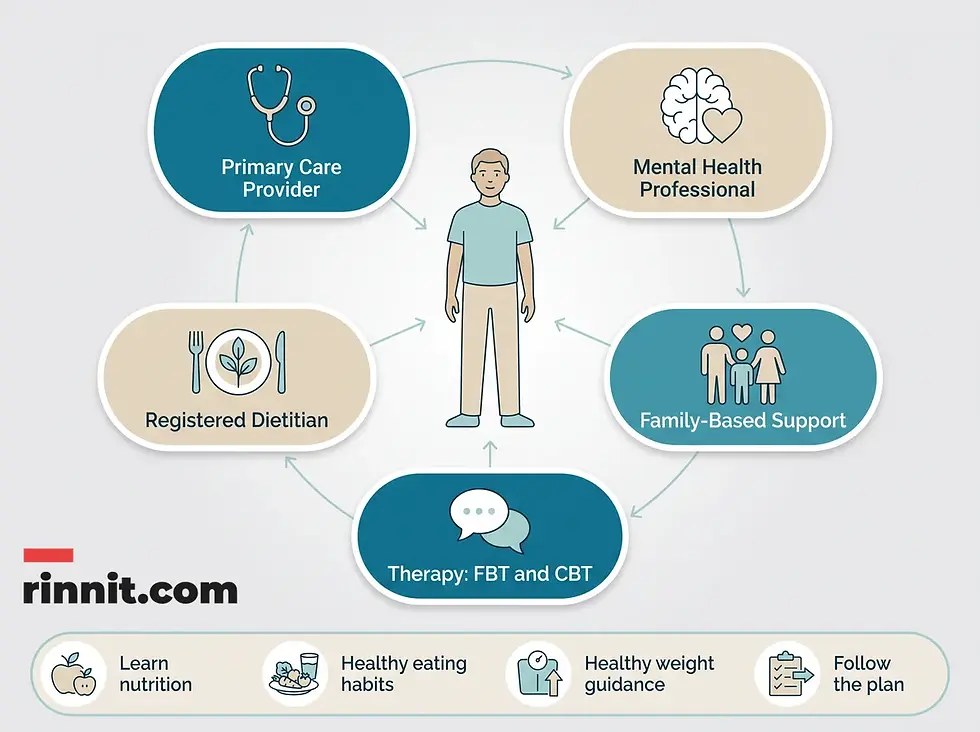
The best treatment for an eating disorder involves a team approach. The team commonly includes your primary healthcare provider, a mental health professional, and sometimes a registered dietitian. Look for professionals with experience in treating eating disorders.
Treatment depends on your specific type of eating disorder. But in general it includes learning about proper nutrition, learning how to develop healthy eating habits, guidance in reaching a healthy weight if you are underweight, behavioral therapy (sometimes called talk therapy), and medicine if needed. If your life is at risk, you may need to go into a hospital right away.
Behavioral therapy
Certain behavioral therapies can be effective in treating eating disorders.
Family-based treatment (FBT) is an outpatient treatment for children and teenagers with anorexia. It is also likely effective for bulimia and other problem eating behaviors. The family is involved in making sure that the child or other family member follows healthy-eating patterns and maintains a healthy weight.
Cognitive behavioral therapy (CBT) is commonly used in eating disorder treatment, especially for bulimia, binge-eating disorder, and some other problem eating behaviors. A type of CBT called enhanced CBT is used most often. You learn how to monitor and improve your eating habits and moods, develop problem-solving skills, and explore healthy ways to cope with stressful situations.
Medicines
Medicine cannot cure an eating disorder. No medicines have been shown to help with weight gain or to treat anorexia. For bulimia or binge-eating disorder, certain medicines may help manage urges to binge or purge, or help manage an extreme focus on food and diet.
Hospital stay or day program
If you have serious health problems related to your eating disorder, your provider may recommend staying in a hospital for a time. Some clinics specialize in treating people with eating disorders, and some offer day programs rather than a hospital stay. Specialized eating disorder programs may offer more intensive treatment over longer periods.
Treatment element | How it helps |
Team approach | Primary care provider + mental health professional + sometimes a registered dietitian, ideally with eating disorder experience [2] |
Family-based treatment (FBT) | Outpatient care for children and teens with anorexia; family supports healthy eating and a healthy weight [2] |
Cognitive behavioral therapy (CBT) | Helps monitor and improve eating habits and moods; enhanced CBT is used most often [2] |
Medicines | Cannot cure; may help manage binge/purge urges or an extreme focus on food and diet [2] |
Hospital or day program | For serious health problems; specialized programs can offer more intensive, longer treatment [2] |
Self-care and staying safe at home
To improve the chances of success in overcoming an eating disorder, find a mental health provider with expertise in eating disorders, as treatment is most effective when delivered by a provider with specialty training in approaches shown to be effective, such as FBT and CBT.
Follow your treatment plan. Do not skip therapy sessions, try to stay close to meal plans, and follow your provider's instructions on physical activity and exercise.
If you are not eating well, your body may be missing nutrients such as vitamin D or iron. Talk to your healthcare provider about appropriate vitamin and mineral supplements. For healthy people, providers commonly recommend getting most vitamins and minerals from food.
Resist urges to weigh yourself, and do not check yourself in the mirror often. This may simply increase the drive to maintain habits that are not healthy. Finally, do not isolate yourself from others; caring family members and friends who have your best interests at heart want to see you get healthy.
What about supplements and herbal weight-loss products?
Dietary supplements and herbal products designed to dampen the appetite or aid in weight loss may be unsafe and misused by people with eating disorders. Such products can have dangerous interactions with other medicines.
Weight-loss and other dietary supplements do not need approval by the U.S. Food and Drug Administration (FDA) to go on the market. The FDA maintains an online list of tainted weight-loss products, some of which can cause serious harm, including irregular heartbeats, increased blood pressure, stroke, and even death.
Some complementary approaches such as acupuncture, massage, yoga, and meditation may help reduce stress and anxiety and increase a sense of well-being. Even so, talk with your healthcare provider before trying any alternative or complementary medicine. Natural does not always mean safe.
Preventing eating disorders
There is no sure way to prevent eating disorders, but you can take steps to develop healthy eating habits. If you have a child, you can help lower their risk.
For adults: choose a healthy diet rich in whole grains, fruits, and vegetables, limiting salt, sugar, alcohol, saturated fat, and trans fats. Avoid extreme dieting; if you need to lose weight, talk to a healthcare provider or dietitian to create a plan. Do not use dietary supplements, laxatives, or herbal products for weight loss. Get at least 150 minutes of aerobic activity each week, such as brisk walking, choosing activities you enjoy. And seek help for mental health issues such as depression, anxiety, or problems with self-esteem and body image.
For children: avoid dieting around your child, since family dining habits may influence the relationship children develop with food. Eating meals together lets you teach about the pitfalls of dieting and watch whether your child is eating enough food and variety. Talk to your child about risks of unhealthy eating choices and correct dangerous ideas promoted online, such as viewing anorexia as a lifestyle choice. Encourage a healthy body image whatever their shape or size, and avoid criticizing your own body in front of your child. Ask your child's provider for help at well-child visits, where height, weight percentiles, and body mass index checks can flag big changes.
If you notice signs in a family member or friend, talking to that person with compassion about your concern may encourage them to seek treatment.
Preparing for your appointment
You may want to bring a relative or friend for support and to help your memory. A family member may give your provider a more complete picture of your home life.
Before your appointment, make a list of any symptoms you are experiencing and when they began, key personal information including major stresses or recent life changes, all medicines including over-the-counter medicines, vitamins, herbal products, or other supplements and their doses, and questions you want to ask.
Your provider is likely to ask about your eating habits, how long you have been worried about your weight, how often you exercise and for how long, whether you have found other ways to lose weight, any physical symptoms, whether you have ever vomited because you were uncomfortably full, whether others have expressed concern about your weight, whether you think about food often or eat in secret, and whether any family members have had symptoms of or been diagnosed with an eating disorder.
Conclusion and next steps
Eating disorders are serious, but they are treatable. The earlier treatment begins, the more likely a full recovery becomes. The pattern to watch is simple: extreme focus on weight, shape, and food, paired with eating behaviors that harm your health, your emotions, and your daily life.
Recovery is a team effort: your doctor, a mental health professional, and often a dietitian working together through family-based treatment, cognitive behavioral therapy, and steady follow-through on the plan. If any of the warning signs in this article sound familiar, for yourself or someone you love, reaching out to a healthcare provider is the most important first step.
Next steps: If you or someone you know is struggling with eating, weight, or body image, talk to a healthcare provider. If you are in crisis or having thoughts of harming yourself, seek urgent help right away by calling your local emergency number or a crisis line.
Frequently asked questions
What are the most common eating disorders?
The most common are anorexia, bulimia, and binge-eating disorder, along with avoidant/restrictive food intake disorder. People with eating disorders can have all different body types and sizes. [1]
What causes an eating disorder?
The exact cause is not known. Genetics may increase risk in some people, and biological factors such as changes in brain chemicals may play a role. Risk factors include family history, other mental health issues, frequent dieting, a history of weight bullying, and stress. [1]
Can you recover from an eating disorder?
Yes. With proper treatment you can return to healthier eating habits, think about food and your body in healthier ways, and often reduce or reverse serious problems caused by the disorder. The earlier treatment begins, the more likely a full recovery. [1] [2]
Do eating disorders require medication to treat?
Medicine cannot cure an eating disorder, and no medicines have been shown to help with weight gain or treat anorexia. For bulimia or binge-eating disorder, certain medicines may help manage urges to binge or purge or an extreme focus on food and diet. Behavioral therapies such as FBT and CBT are central to treatment. [2] [3]
How can I help a loved one with a possible eating disorder?
Express concern and a desire to listen, even if the person is not ready to admit there is an issue with food, and urge them to talk to a healthcare provider. Watch for red flags such as skipping meals, eating in secret, withdrawing from social activities, excessive exercise, or physical signs like knuckle calluses or tooth enamel loss. [1]
This article is for general education and is not a substitute for professional medical advice, diagnosis, or treatment. Always consult a qualified healthcare professional about your individual situation.
References
Mayo Clinic Staff. Eating disorders - Symptoms and causes. Mayo Clinic. March 28, 2023. https://www.mayoclinic.org/diseases-conditions/eating-disorders/symptoms-causes/syc-20353603
Mayo Clinic Staff. Eating disorders - Diagnosis and treatment. Mayo Clinic. March 28, 2023. https://www.mayoclinic.org/diseases-conditions/eating-disorders/diagnosis-treatment/drc-20353609
National Institute of Mental Health. Eating disorders: what you need to know. NIMH. Revised 2024. https://www.nimh.nih.gov/health/publications/eating-disorders
American Psychiatric Association. What are eating disorders? Psychiatry.org. Accessed October 14, 2026. https://www.psychiatry.org/patients-families/eating-disorders/what-are-eating-disorders
Lai ET, Lai B, Wong CS, et al. Systematic review and meta-analysis of mortality in patients with anorexia nervosa. Int J Eat Disord. 2026;59(3):424-449. PMID 41277145. https://doi.org/10.1111/eat.70002
Monteleone AM, Pellegrino F, Croatto G, et al. Treatment of eating disorders: a systematic meta-review of meta-analyses and network meta-analyses. Neurosci Biobehav Rev. 2022;142:104857. PMID 36084848. https://doi.org/10.1016/j.neubiorev.2022.104857
Cuijpers P, Harrer M, Miguel C, et al. Absolute and relative outcomes of cognitive behavior therapy for eating disorders in adults: a meta-analysis. Eat Disord. 2025;33(6):783-804. PMID 39514189. https://doi.org/10.1080/10640266.2024.2421057



Comments