Habit Reversal Training: Steps, Uses and How It Works

Updated: 2 days ago
Written and medically reviewed by Dr. Baraa Alnahhal, MD · Last reviewed: November 2026 · How we review
Quick Answer
Habit reversal training (HRT) is a behavioral therapy that helps you stop or reduce an unwanted habit by replacing it with a different behavior. It's mainly used for body-focused repetitive behaviors such as nail-biting, skin picking and hair pulling, and for tics. The main steps are awareness training and competing response training with a mental health provider.
What the research says
Behavior therapy eased tics in children with Tourette: in a trial of 126 children aged 9 to 17 with Tourette or chronic tic disorder, 8 sessions of a behavioral program built on habit reversal led to much or very much improvement in 52.5% versus 18.5% with supportive therapy, and 87% of responders kept the benefit at 6 months (Piacentini J et al., JAMA, 2010) [2]
Habit reversal worked best for hair pulling: in a review of 24 trials with 857 people with trichotillomania, behavioral therapy with habit reversal training showed the largest benefit, larger than any medicine studied (Farhat LC et al., Depression and Anxiety, 2020) [3]
Key takeaways
HRT replaces an unwanted habit with a harmless behavior.
It helps nail-biting, hair pulling, skin picking and tics.
The main steps are awareness, competing response and support.
Practice between sessions is key.
Results can take months, and some people need ongoing sessions.
What is habit reversal training?
Two psychologists developed HRT in the 1970s. It's a type of behavioral therapy, like cognitive behavioral therapy. Learn about body-focused repetitive behaviors. Sources: [1]
What it treats
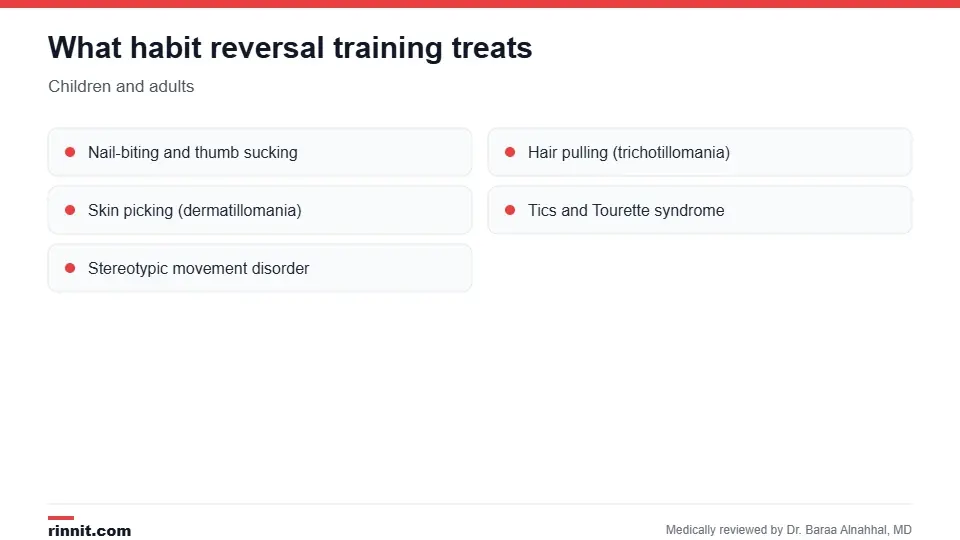
It works for children and adults.
Nail-biting, hair twirling, nose picking, social smoking and thumb sucking.
Skin picking (dermatillomania).
Hair pulling (trichotillomania).
Tics and tic disorders, including Tourette syndrome.
Stereotypic movement disorder. Sources: [1]
HRT may not fully treat complex conditions such as nicotine dependence or obsessive-compulsive disorder. Sources: [1]
The steps of HRT

Practice helps the new behavior become automatic.
Awareness training: describe the habit, notice each time it happens and learn early warning signs and triggers.
Competing response training: learn and practice a replacement behavior.
Intensive training: family or friends praise the new behavior or gently remind you.
Relaxation training: reduce stress, when habits happen most.
Generalization training: practice in different situations until it's automatic. Sources: [1]
Choosing a competing behavior
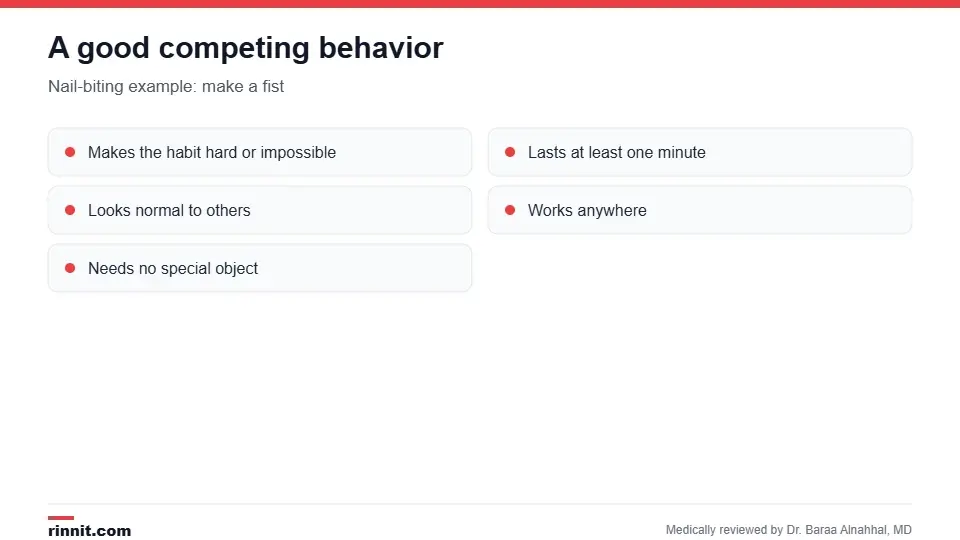
Relaxation can help too.
Makes the habit hard or impossible.
Can be done for at least one minute.
Looks normal to others.
Works anywhere without a special object. Sources: [1]
For nail-biting, examples include making a fist, folding your hands, sitting on your hands or folding your arms. Relaxation options include deep breathing, meditation, mindfulness and progressive muscle relaxation. Sources: [1]
How long it takes
There's no set timeline. Some people succeed in a couple of months; others need a year or more. People with chronic conditions, such as tic disorders or skin picking, may need maintenance sessions throughout life, plus medicine or other therapy. Sources: [1, 2]
Risks
HRT has no notable risks. The main challenge is the effort and practice it takes outside sessions. Sources: [1]
When to talk to your provider
If HRT isn't working, other therapies may help.
If the habit comes back, follow-up sessions may help. Sources: [1]
Conclusion
Habit reversal training teaches you to notice a habit and swap in a harmless behavior. With steady practice and support, many people break habits that have lasted for years.
Keep learning: read about body-focused repetitive behaviors and Tourette syndrome.
Frequently asked questions
What is habit reversal training?
A behavioral therapy that replaces an unwanted habit with another behavior.
What habits can it treat?
Nail-biting, hair pulling, skin picking, thumb sucking, tics and more.
Does it work for Tourette syndrome?
Yes. It's often part of behavioral treatment for tics.
What is a competing response?
A harmless behavior you do instead of the habit.
What is awareness training?
Learning to notice the habit, its movements and its triggers.
Do I need a therapist?
Yes, usually a psychologist or other mental health provider.
Is there homework?
Yes. Practicing between sessions is crucial.
How long does it take?
From a couple of months to a year or more.
Can children do HRT?
Yes. It works for children and adults.
What if the habit comes back?
Follow-up sessions can help.
Related Reading
What Is Body-Focused Repetitive Behavior (BFRB)? Symptoms, Causes, and Treatment Options habits HRT treats.
Trichotillomania: Why People Can't Stop Pulling Their Hair, and What Treatment Can — and Can't — Do hair-pulling disorder.
Tics and Tic Disorders: Symptoms, Types, Causes and Treatment tics and how they're treated.
Tourette Syndrome: Symptoms, Causes, Diagnosis and Treatment — What You Need to Know a tic disorder.
Cognitive Behavioral Therapy (CBT): What It Is, What It Treats and What to Expect a related therapy.
References
Cleveland Clinic. Habit Reversal Training: What It Is & How It Works. Cleveland Clinic. Last updated August 16, 2024. https://my.clevelandclinic.org/health/treatments/habit-reversal-training
Piacentini J, Woods DW, Scahill L, et al. Behavior therapy for children with Tourette disorder: a randomized controlled trial. JAMA. 2010;303(19):1929-1937. PMID 20483969. https://doi.org/10.1001/jama.2010.607
Farhat LC, Olfson E, Nasir M, et al. Pharmacological and behavioral treatment for trichotillomania: an updated systematic review with meta-analysis. Depression and Anxiety. 2020;37(8):715-727. PMID 32390221. https://doi.org/10.1002/da.23028
Medical disclaimer
This article is for general education only and does not replace advice from a qualified healthcare professional. Talk to your doctor about your own diagnosis and treatment, and seek emergency care right away for severe or sudden symptoms.



Comments