Tics and Tic Disorders: Symptoms, Types, Causes and Treatment

Updated: 3 days ago
Medically reviewed by Dr. Baraa Alnahhal, MD · Last reviewed: October 19, 2026
Quick Answer: What are tics?
Tics are sudden, repeated movements or sounds that occur involuntarily, affecting areas such as the eyes, face, shoulders or voice, often preceded by an urge. They are common in children, often starting between ages 5 and 10, and frequently improve or stop on their own after puberty. See a provider if tics become severe, painful or interfere with daily life.
What the research says
Behavior therapy has solid evidence for reducing tics. A meta-analysis of eight randomized trials (438 participants) found a medium to large effect for habit reversal training and CBIT compared with control conditions. People receiving behavior therapy were more likely to respond, with a number needed to treat of three, and effects were comparable to those seen in antipsychotic medication trials. Benefits were larger with older participants, more therapy sessions and less co-occurring ADHD (McGuire et al., J Psychiatr Res, 2014). [1]
Habit reversal training shows a small to medium benefit across more trials. A later meta-analysis of 10 randomized trials including 586 patients with tic disorders found a pooled standardized mean difference of −0.43 (95% CI −0.71 to −0.16) in favor of habit reversal training (Yu et al., Expert Rev Neurother, 2020). [2]
Tics usually decline through adolescence, but related conditions can remain. In a Danish clinic cohort of 314 young people aged 5 to 19 (227 re-assessed after 6 years), tics, OCD and ADHD severity declined significantly. Even so, 63% had comorbid conditions or other coexisting psychopathology at follow-up, while 37% had Tourette syndrome without them (Groth, Dan Med J, 2018). [3]

Tics can involve movement, sound or both. A child may blink repeatedly, shrug their shoulders, clear their throat, sniff or make a grunting sound. Tics can change over time, and a child may be able to delay one briefly even though they cannot simply choose to stop it.
What do tics look like?
Tics are sudden, quick movements or sounds that happen repeatedly and involuntarily. They can occur in many parts of the body and often change over time.
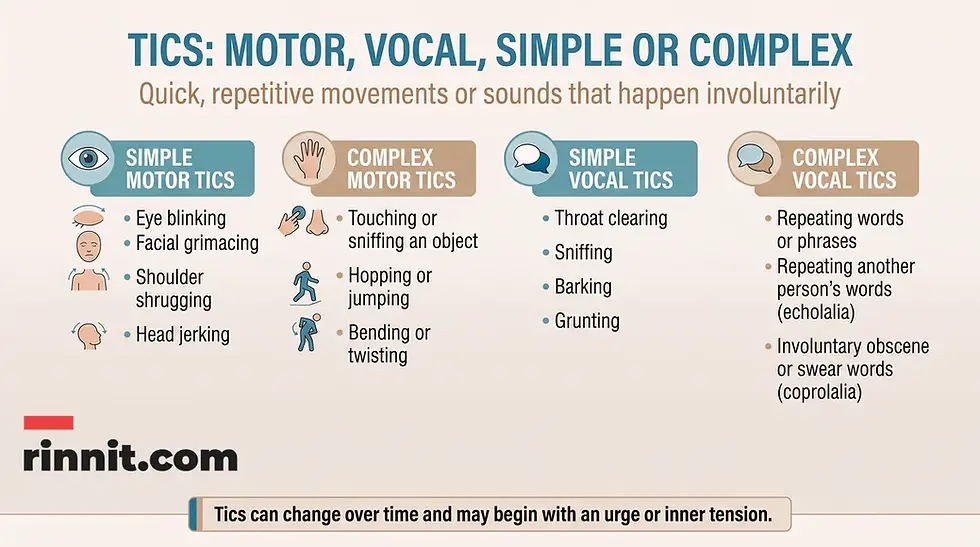
Motor tics involve body movement. Examples include repeated eye blinking, eye rolling, facial grimacing, shoulder shrugging, shoulder jerking or head jerking.
Vocal tics involve sounds or spoken language. Examples include repetitive throat clearing, sniffing, barking and grunting.
Some tics are simple, meaning they are brief and involve only a few muscle groups. Others are complex, meaning they form a coordinated pattern involving several muscle groups or a sequence of words and phrases.
What does a tic feel like?
A tic often begins with an unpleasant sensation or urge. People describe it as a growing tension that resembles the need to scratch an itch or sneeze. Performing the tic may bring momentary relief.
Some people can suppress or postpone a tic for seconds to minutes. Doing so usually requires conscious effort and may increase discomfort. The urge may eventually become difficult or impossible to resist.
Stress and fatigue often make tics worse. Tics may also increase when a person is relaxed or alone. They may lessen when the person is concentrating on schoolwork, work or another task. Tics typically do not occur during sleep. Calling attention to a tic can make it worse.
What are simple and complex tics?
Simple tics are brief, sudden and repetitive. They involve a few muscle groups or a short sound.
Type | Examples |
Simple motor tics | Eye blinking, eye rolling, facial grimacing, shoulder shrugging, shoulder jerking or head jerking. |
Simple vocal tics | Throat clearing, sniffing, barking or grunting. |
Complex motor tics | Touching or sniffing an object, hopping, jumping, bending, twisting or combining several movements. |
Complex vocal tics | Repeating one’s own words or phrases, repeating another person’s words or phrases, or using obscene or swear words. |
Complex vocal tics can include echolalia, or repeating another person’s words or phrases. They can also include coprolalia, or involuntary obscene or swear words. Coprolalia can be misunderstood as deliberate behavior even though it is an uncontrollable impulse.
What are tic disorders?
Tic disorders are neurological conditions that cause tics. They exist on a spectrum from mild to severe. Many children have mild tics that do not require treatment. Others need care to manage tics or related conditions such as ADHD, anxiety or OCD.
The three main types are provisional tic disorder, persistent or chronic tic disorder and Tourette syndrome. The differences are mainly the types of tics involved and how long they have lasted.
Tic disorder | Main pattern | Duration and age criteria |
Provisional tic disorder | One or more motor tics, vocal tics or both. | Tics last no more than one year and begin before age 18. |
Persistent or chronic tic disorder | Motor tics or vocal tics, but not both. | Tics occur for more than 12 months and begin before age 18. |
Tourette syndrome | At least two motor tics and at least one vocal tic, not necessarily at the same time. | Tics last at least one year and begin before age 18. |
For all three diagnoses, symptoms must not be better explained by another medical condition, medicine or drug use. A clinician also considers whether another tic-disorder diagnosis fits better.
How common are tic disorders?
Tics are common in childhood. They typically begin between ages 5 and 10, and children as young as 4 can have them. Tics affect male children more frequently than female children.
About 1 out of every 50 children has Tourette syndrome or another tic disorder. Provisional tic disorder may affect up to 10% of children in their early school years. Persistent tic disorder affects less than 1% of school-age children.
What causes tics?
The exact cause of tics is not known. Researchers believe they may be related to changes in the part of the brain that controls movement. Because tics can run in biological families, genetics may also play a role.
Tic disorders may occur alongside ADHD, anxiety disorder and OCD. People with conditions such as Huntington’s disease or encephalitis may develop tics or movements that resemble tics. Recreational drugs such as cocaine or amphetamines can also cause tics. Movements due to another condition or drug use are not considered a tic disorder.
Can tics be harmful?
Most tics are not dangerous. Some, however, can cause injury or pain. A motor tic may involve hitting the face or repeated large neck movements that lead to soreness or injury.
Vocal tics can also create social and emotional harm. Coprolalia may lead to misunderstanding, punishment or bullying because others may mistake an involuntary tic for intentional offensive behavior. Coprolalia affects 10% to 15% of children with Tourette syndrome.
A child should receive professional support if a tic causes pain, injury, bullying, embarrassment, school problems, depression, anger or self-harm.
How are tic disorders diagnosed?
A healthcare provider evaluates the child’s symptoms and performs a physical exam. The provider considers whether the tics are motor, vocal or both, and how long they have been present.
A short video can be useful. If possible, bring one or two videos of the child’s tics so the provider can see what is happening. The provider may also evaluate for conditions commonly associated with tics, including ADHD and OCD.
Diagnosis depends on the type and duration of symptoms. A child does not need to have a tic at the exact moment of the appointment for the provider to understand the pattern.
How are tic disorders treated?
Treatment depends on the type and severity of the tics and how much they affect daily life. Mild tics may not require treatment and may resolve on their own. Reducing stress and fatigue can help.
When tics are severe or interfere with school, relationships or other daily activities, a provider may recommend behavioral therapy, medication or both.
Behavioral therapy
Habit reversal training teaches a child to recognize the tic and use a different behavior while the urge passes. For example, a therapist may teach a child whose tic is shoulder shrugging to stretch their arms until the urge decreases.
Comprehensive behavioral intervention for tics, or CBIT, includes habit reversal training, education about tics and relaxation techniques. It may help older children learn practical ways to manage symptoms.
A psychiatrist or other qualified professional can also help the family provide support and coordinate educational accommodations.
Medication
When tics persist and interfere with a child’s life, medication may help. For mild tics, clonidine and guanfacine may be used. These medicines may also help ADHD and anxiety that can accompany a tic disorder.
For more severe tics, neuroleptic medicines such as aripiprazole and olanzapine may be effective. These medicines alter the effects of neurotransmitters involved in body movement. Medication decisions should be made with a qualified healthcare provider.

Will tics go away?
Tics often improve on their own and may stop completely. Some last only a few months. Others come and go over several years.
Tics are often most severe between ages 8 and 17. They commonly begin to improve or go away after puberty. The course varies from child to child, so a healthcare provider can help interpret changes over time.
Can tics be prevented?
Tics cannot currently be prevented because researchers do not know exactly why they affect some people and not others.
Although tics cannot be prevented, families can reduce avoidable strain. A regular sleep routine, manageable expectations and a calm response may help a child cope with symptoms and protect daily functioning.
How can parents support a child with tics?
Support should focus on reducing shame and unnecessary pressure. A tic is involuntary and should not be treated as deliberate misbehavior.
Supportive step | What it looks like |
Reduce stress | Offer enjoyable activities such as a sport or hobby, and avoid making the tic the center of attention. |
Reduce fatigue | Help the child get consistent, adequate sleep. |
Do not punish | Do not yell at the child or tell them to stop the tic. |
Reassure | Remind the child that they do not need to feel embarrassed. |
Prepare others | Let friends and loved ones know that the tic is involuntary and does not require a reaction. |
Work with school | Tell teachers and school staff about the tics and collaborate on solutions if symptoms interfere with school. |
Watch for distress | Pay attention to pain, bullying, anger, depression or self-harm. |
When should a child see a healthcare provider?
Schedule a visit if you are concerned about your child’s tics or if the tics:
Happen regularly.
Become more severe or frequent.
Cause pain or discomfort.
Interfere with school or other daily activities.
Cause bullying, embarrassment or other social or emotional problems.
Occur with anger, depression or self-harm.
Mild tics that are not causing problems may not need immediate evaluation, but families can still ask questions if they are uncertain about what they are seeing.
What questions should you ask?
Consider asking:
Are these tics mild or more serious?
Does my child have a tic disorder?
What type of tic disorder could this be?
Should we track the tics or record a video?
What treatment options are appropriate?
Could behavioral therapy or CBIT help?
Could medication help with tics or related ADHD or anxiety?
Are the tics likely to improve on their own?
What support should we request from school?
Conclusion
Tics are quick, repetitive movements or sounds that happen involuntarily. They commonly begin in childhood and may improve or stop over time. Motor tics involve movement, while vocal tics involve sounds or words. Both can be simple or complex.
Tic disorders are defined by the type of tic and how long it lasts. Provisional tic disorder lasts no more than a year. Persistent or chronic tic disorder involves motor or vocal tics, but not both, for more than a year. Tourette syndrome involves both motor and vocal tics for at least a year.
Families can help by reducing stress and fatigue, avoiding punishment, reassuring the child, informing others and working with school staff. Schedule a healthcare visit when tics become more frequent, severe, painful, disruptive or emotionally harmful.
If a child’s tics are interfering with daily life or causing distress, schedule a visit with a qualified healthcare provider. Bring a short video if possible, and write down when the tics occur, what they look like and whether pain, bullying or emotional changes are present.
Frequently Asked Questions
Are tics voluntary?
No. Tics are involuntary movements or sounds. A person may sometimes delay a tic briefly, but doing so usually requires conscious effort and can cause discomfort.
What are common motor tics?
Common motor tics include eye blinking, eye rolling, facial grimacing, shoulder shrugging, shoulder jerking and head jerking.
What are common vocal tics?
Common vocal tics include throat clearing, sniffing, barking and grunting. Complex vocal tics can involve repeating words or phrases.
What is the difference between a simple and complex tic?
Simple tics are brief and involve a few muscle groups or a short sound. Complex tics are coordinated patterns involving several muscle groups or a sequence of words or phrases.
What is Tourette syndrome?
Tourette syndrome is a tic disorder involving at least two motor tics and at least one vocal tic for at least one year. The tics begin before age 18 and are not better explained by another condition, medicine or drug use.
Do children outgrow tics?
Many tics improve or stop over time. They are often most severe between ages 8 and 17 and may improve after puberty. Some tics last a few months, while others come and go over several years.
Can stress make tics worse?
Yes. Stress and fatigue often worsen tics. Tics can also become more noticeable when a person is relaxed or alone, or when attention is drawn to them.
Should I tell my child to stop a tic?
No. Tics are involuntary, and telling a child to stop or punishing them can increase distress without solving the problem. A calm, reassuring response is more supportive.
Can a video help with diagnosis?
Yes. Bringing one or two short videos of the child performing the tics can help a healthcare provider understand the pattern, especially if the tic does not occur during the visit.
What treatments can help tic disorders?
Mild tics may not need treatment. When tics interfere with daily life, behavioral therapy, CBIT, medication or a combination may help.
When should I schedule a visit?
Schedule a visit when tics become regular, more frequent, more severe, painful or disruptive; cause bullying or embarrassment; interfere with school; or occur with anger, depression or self-harm.
Related Reading
Habit Reversal Training: Steps, Uses and How It Works explains habit reversal training.
References
McGuire JF, Piacentini J, Brennan EA, et al. A meta-analysis of behavior therapy for Tourette Syndrome. J Psychiatr Res. 2014;50:106-112. PMID 24398255. https://doi.org/10.1016/j.jpsychires.2013.12.009
Yu L, Li Y, Zhang J, et al. The therapeutic effect of habit reversal training for Tourette syndrome: a meta-analysis of randomized control trials. Expert Rev Neurother. 2020;20(11):1189-1196. PMID 32948114. https://doi.org/10.1080/14737175.2020.1826933
Groth C. Tourette syndrome in a longitudinal perspective. Clinical course of tics and comorbidities, coexisting psychopathologies, phenotypes and predictors. Dan Med J. 2018;65(4):B5465. PMID 29619935. https://pubmed.ncbi.nlm.nih.gov/29619935/
Substance Abuse and Mental Health Services Administration. Find Help & Support. SAMHSA. Last updated April 24, 2023. https://www.samhsa.gov/find-help
U.S. Department of Education. Individuals with Disabilities Education Act (IDEA). U.S. Department of Education. Last reviewed June 11, 2026. https://www.ed.gov/laws-and-policy/individuals-disabilities/individuals-disabilities-education-act-idea
Disclaimer
This article is for general educational purposes and is not a substitute for professional medical advice, diagnosis or treatment. Always seek the advice of a qualified health provider with any questions you may have regarding a medical condition.
It is educational content, not a diagnosis, prognosis or personalized treatment plan. A qualified healthcare professional should interpret symptoms, duration, related conditions, treatment options and school-support needs. If a child is experiencing self-harm or immediate danger, seek urgent help through local emergency services or a crisis resource.



Comments