Caregiver Burnout: Signs, Causes, Recovery, and How to Take Care of Yourself First

Updated: 2 days ago
Medically reviewed by Dr. Baraa Alnahhal, MD · Last reviewed: October 17, 2026
Quick answer
Caregiver burnout is physical, emotional and mental exhaustion from caring for someone else, and more than 60% of caregivers experience symptoms. [1] Signs include exhaustion, withdrawing from loved ones, irritability and hopelessness. [1] There is no single solution; professional support, self-care, asking for help and respite care work together, and recovery can take days, weeks or months. [1]
What the research says
According to PubMed:
The mental health toll on caregivers is large. In a meta-analysis of 38 studies with 6,593 caregivers of children with epilepsy across 18 countries, the pooled prevalence was 34% for anxiety, 31% for depression, and 21% for posttraumatic stress disorder. The authors noted rates well above the general population and very high variation between studies. This group is one specific type of caregiver, but it shows how heavy the load can be. (Li et al., Epilepsy Behav, 2025) [10].
Several support approaches help, and different ones help different problems. A network meta-analysis of 85 randomized trials of 11 non-drug interventions for informal caregivers of people with dementia found that acceptance and commitment therapy, behavioral activation, mindfulness, multicomponent programs, psychoeducation, and cognitive behavioral therapy might reduce depression. Psychoeducation was the only one effective for anxiety, support groups were the only one with a significant effect on quality of life, and case management, psychoeducation, and multicomponent programs reduced caregiver burden. (Sun et al., Int J Nurs Stud, 2022) [11].
Study details are from PubMed abstracts.
What is caregiver burnout?
A caregiver is a person who provides physical or psychological care to someone else — someone who is not able to help themselves fully because of declining health, an illness, an injury, or a condition such as Alzheimer's disease or dementia, cancer, chronic illness, mental health conditions, multiple sclerosis, Parkinson's disease, stroke, or traumatic brain injury. [1]
A caregiver's day can include helping with daily routines like toileting, bathing, dressing, and brushing hair, preparing meals, completing housework, managing medications and finances, providing transportation, monitoring health, and speaking up for the person's needs with healthcare providers. [1] The main job is simple: keep the person in your care safe and healthy. [1]
Caregiver burnout is the exhaustion that can happen along the way. It is a state of physical, emotional, and mental exhaustion that occurs when you devote your time and energy to managing the health and safety of someone else — and do not get the help you need personally. [1]
One medical source describes it this way:
Burnout feels like a candle that ran out of a wick — it doesn't have what it needs to continue to provide light.
Burnout can also happen when you try to do more than you are able to, emotionally, physically, or financially. It can affect you physically, psychologically, financially, and socially — and it is very common. Studies show that more than 60% of caregivers experience symptoms of burnout. [1]
Your health and well-being matter just as much as the person you are caring for. That is why knowing the signs matters.
What does caregiver burnout look and feel like?
Caregiver burnout looks and feels different for everyone, but its signs are similar to those of stress and depression and signal a need to reach out for help.
What are the signs and symptoms?
The signs of caregiver burnout are similar to those of stress and depression. [1] They include:
Sign or symptom | What it means in daily life |
Emotional and physical exhaustion | Feeling drained even after rest [1] |
Withdrawing from friends and family | Pulling away from loved ones and other relationships [1] |
Loss of interest in activities once enjoyed | |
Feeling hopeless and helpless | Believing nothing you do makes a difference [1] |
Changes in appetite or weight | Eating too little or too much [1] |
Changes in sleep patterns | Sleeping too much or not enough [1] |
Unable to concentrate | Trouble focusing on tasks [1] |
Getting sick more often | Body run down from constant stress [1] |
Irritability, frustration, or anger |

What does it feel like inside?
Everyone's experience is different. Burnout may show up as several difficult feelings. None of these make you a bad caregiver — but they are signals to reach out for help.
Feeling | What caregivers commonly experience |
Anxiety or fear | Worry that doing something wrong will harm the person in your care [1] |
Anger or frustration | The person in your care does not accept, want, or appreciate your care [1] |
Denial | Telling yourself the person's condition “isn't that bad” [1] |
Guilt | Feeling that caring for yourself is less important than caring for them [1] |
Negativity | The journey started positive, but now feels like a dark cloud [1] |
Seclusion or loneliness | Feeling unsupported; believing asking for help is weakness [1] |
When should I get help right away?
Call or text 988 to reach the Suicide and Crisis Lifeline (U.S.) if you feel overwhelmed, need someone to talk to, or are thinking about hurting yourself. Help is available 24/7. [1] [9]
If burnout ever causes resentment toward the person you are caring for, or you feel you might hurt that person, reach out for help immediately — a friend, family member, healthcare provider, social worker, or mental health professional. [1]
What causes caregiver burnout?
Burnout happens when you devote most of your time, energy, and resources to caring for others — so much so that you neglect, forget, or are not able to care for yourself. [1] Not caring for your physical, emotional, and mental health severely affects how you feel and your ability to handle your own responsibilities.
Beyond that core cause, several contributing factors push caregivers toward burnout.
Contributing factor | What it looks like |
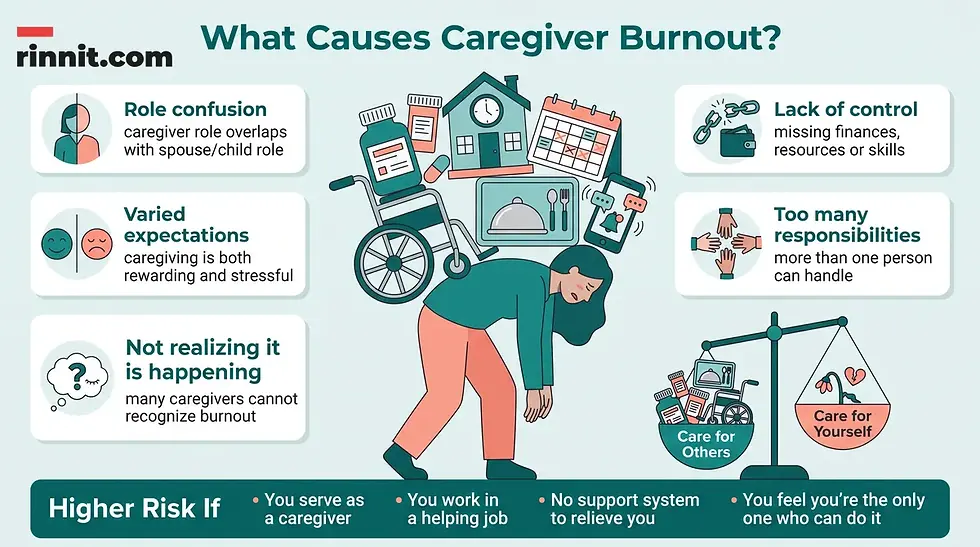
Role confusion | Stepping into caregiving quickly makes it hard to separate your caregiver role from being a spouse, friend, or child; multiple family members helping can create unclear roles and more stress [1] |
Varied expectations | Expecting your care to improve the person's health and happiness, when caregiving is actually both rewarding and stressful [1] |
Lack of control | Frustration from missing finances, resources, or skills to plan and manage care [1] |
Too many responsibilities | Treating caregiving as your sole responsibility even when it is too much for one person; others adding unwanted pressure on you as the primary caregiver [1] |
Not realizing it is happening | Many caregivers cannot recognize burnout when it happens, which can affect the quality of care they provide [1] |
Who is most at risk?
You may be more at risk of burnout if you serve as a caregiver, work in a helping job (such as a school, medical or dental clinic, or hospital), lack a support system that can relieve you when you are tired, or feel like you are the only one who can do the job successfully. [1]
How can caregiver burnout affect you over time?
Burnout can affect your ability to care for yourself and for the person in your care. Long caregiving periods raise the risk of burnout and your vulnerability to physical and mental health conditions. You may delay preventive check-ups — or worse, delay needed treatment for your own chronic condition — because of caregiving duties. [1]
If mental health symptoms like depression or anxiety go untreated, quality of life drops for both you and your loved one, and the loved one's well-being can also decline. [1] In rare and severe cases, extreme stress and depression from burnout can be life-threatening to the caregiver. [1]
How is caregiver burnout assessed?
If you feel burned out, you can visit a healthcare provider or mental health professional for assessment and treatment options. A comprehensive assessment includes an evaluation of your mental and physical health symptoms. [1]
The most important part is honesty. Be open with your provider. If you downplay or deny your feelings, your provider will not be aware of them — and will not be able to help you fully.
How is caregiver burnout treated?
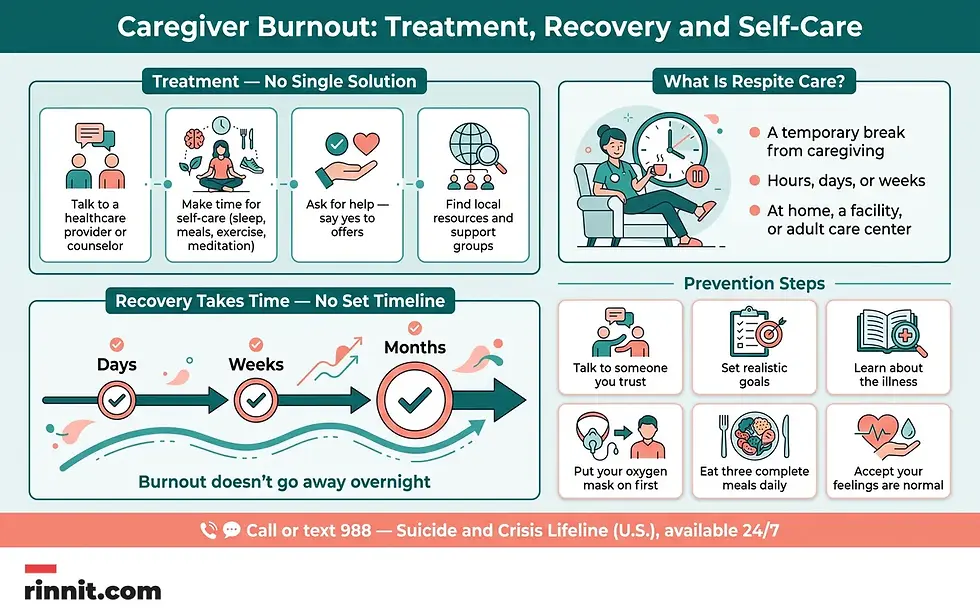
Caregiver burnout has no single solution, but strategies such as respite care can help you recover. You will likely need to try more than one strategy to feel well again. [1]
Treatment approach | What it involves |
Talk to a healthcare provider | Discuss your feelings with a provider, psychologist, social worker, or mental health professional; your care team, friends, and family support you through the journey [1] |
Make time for self-care | Do not skip personal appointments like the dentist; eat balanced meals, get enough sleep; exercise to improve mood; unwind with meditation or yoga [1] |
Ask for help | Practice saying “yes” when help is offered and “no” when too much falls on you; let others help with groceries or dog walking [1] |
Find local resources | In-home care, adult day care centers, and community meal programs; support groups connect you with people facing similar situations [1] |
What is respite care?
Respite care is a temporary break for primary caregivers. You can schedule it for a few hours, a few days, or even several weeks, at home, in a healthcare facility, or at an adult care center. [1] [8] It is extremely beneficial — it helps you relax and find balance between caregiving responsibility and personal life. Community organizations offer respite care, and the ARCH National Respite Network and Resource Center (U.S.) can point you to resources in your area. [1] [8]
How long does recovery take?
Recovery takes time and patience, and every person's experience is different. You may need to try several different strategies before finding what helps. Many people join group or talk therapy alongside self-care techniques like meditation and respite care. [1]
There is no set amount of time for burnout to fade. It can take several days, weeks, or months before you feel well again. [1] You can reduce your stress sooner by taking care of yourself — like asking for help so you have time for yourself. Burnout does not go away overnight.
Can caregiver burnout be prevented?
Prevention is possible, and it is built on six practical habits.
Prevention step | Why it helps |
Find someone you trust | Talking about your feelings with a friend, family member, or professional helps; local support groups exist for families of people with cancer or Alzheimer's disease [1] |
Set realistic goals | Accept that you may need assistance; you cannot carry everything alone; set a routine, know your limits, and assess your burnout risk [1] |
Learn more | Understanding the illness makes care easier; be realistic about progressive diseases and the possible future need for nursing or assisted living [1] |
Take care of yourself | Put your oxygen mask on before helping others; even an hour or two for yourself counts; self-care is a necessity, not a luxury [1] |
Eat well | Three complete meals a day keep your energy up so you perform at your best [1] |
Accept your feelings |
How do I get help and resources?
If you experience severe stress and depression, seek medical attention. Stress and depression are treatable, but they can get worse alongside caregiver burnout.
Resource | What it offers |
Home health services | Home health aides and nurses for short-term care; some offer short-term respite care [1] |
Adult day care | Programs for adults over 65 to socialize, do activities, and receive care [1] |
Nursing homes or assisted living | Sometimes offer short-term respite stays for caregiver breaks [1] |
Private care aides | Professionals who assess needs and coordinate care and services [1] |
Caregiver support services | Support groups and programs to recharge, meet others, and find information [1] |
Agency on Aging / AARP | Local adult day care, support groups, and respite care services [1] |
National organizations | Local chapters (e.g., cancer, Parkinson's) with resources and support groups [1] |
When should I see a healthcare provider?
Visit a healthcare provider, social worker, or mental health professional if you experience signs or symptoms of caregiver burnout. They can help you take the first step toward feeling better — so you can provide the best care for yourself and your loved ones.
What questions should I ask my provider?
Ask how to minimize stress, how to better manage emotions and expectations in your caregiving situation, how to reduce guilt about self-care, what community resources or organizations exist for caregivers, whether financial resources are available, and who to reach out to when friends and family cannot help.
Caregiver burnout vs. compassion fatigue: what's the difference?
Both conditions affect caregivers, and both can happen at the same time.
Caregiver burnout is a feeling of deep exhaustion and stress after caring for another person. [1]
Compassion fatigue happens when a caregiver takes on the emotional stress and trauma of the person in their care, leading to a lack of empathy — or a lack of care — for the person. [1]
What is the bottom line on caregiver burnout?
Caregiving is rewarding and challenging, and it is easy to push your own feelings and needs aside to give your full attention to the person in your care. That is exactly why burnout is extremely common — and why it can impact your mental and physical health and your ability to provide good care. One of the most important things you can do as a caregiver is to make time for yourself. Asking for help is difficult, but remember that you are not alone. Resources are available to help you.
Need support now? Call or text 988 for the Suicide and Crisis Lifeline (U.S.), available 24/7. [1] [9] If burnout causes resentment toward the person you care for, reach out for help immediately.
If you are experiencing caregiver burnout, explore caring resources and support at Rinnit.com.
Frequently asked questions
What is caregiver burnout?
Caregiver burnout is a state of physical, emotional, and mental exhaustion that happens while you are taking care of someone else. Stressed caregivers may experience fatigue, anxiety, and depression.
How common is caregiver burnout?
Very common. Studies show that more than 60% of caregivers experience symptoms of burnout.
Is caregiver burnout a medical diagnosis?
It is not a formal diagnosis itself. Healthcare providers and mental health professionals assess it by evaluating your mental and physical health symptoms.
What are the first warning signs of caregiver burnout?
Emotional and physical exhaustion, withdrawal from friends and family, loss of interest in activities you once enjoyed, and feeling hopeless or helpless are common early signs.
Can caregiver burnout cause physical health problems?
Yes. Burnout can make you get sick more often, change your appetite and weight, disrupt your sleep, and increase your vulnerability to physical and mental health conditions.
Why do I feel guilty for taking care of myself?
Guilt is one of the most common feelings in burnout. But taking care of yourself is not a luxury — it is an absolute necessity for caregivers. Putting your own oxygen mask on first helps you care for others better.
How is caregiver burnout different from stress or depression?
The symptoms are similar to stress and depression, which is why burnout should be assessed by a professional. Untreated depression or anxiety reduces quality of life for both you and your loved one.
What is the difference between caregiver burnout and compassion fatigue?
Burnout is deep exhaustion and stress after caring for another person. Compassion fatigue happens when you take on the person's emotional stress and trauma, causing a lack of empathy or care for them. Both can happen at the same time.
Does caregiver burnout ever go away?
Yes, but there is no set timeline. It can take several days, weeks, or months before you feel well again, and burnout does not go away overnight.
Can caregiver burnout be life-threatening?
In rare and severe cases, extreme stress and depression from burnout can be life-threatening to caregivers. Severe stress and depression should always get medical attention.
What is respite care?
Respite care is a temporary break for primary caregivers — a few hours, a few days, or several weeks — provided at home, in a healthcare facility, or at an adult care center. It helps you relax and balance caregiving with your personal life.
Who should I talk to about caregiver burnout?
A healthcare provider, psychologist, social worker, or mental health professional. If you are in crisis, call or text 988 to reach the Suicide and Crisis Lifeline (U.S.), available 24/7.
What can I do about the anger and resentment I feel toward my loved one?
These feelings are normal and do not make you a bad caregiver — but never act on feelings in a way that could hurt yourself or someone else. Reach out for help when you notice them.
Can professionals who help others get caregiver burnout too?
Yes. People who work in healthcare or education — jobs where helping others is the work — may also experience caregiver burnout.
How do I find local caregiver support resources?
Your healthcare provider is a great first resource. You can also contact your local Agency on Aging or AARP chapter, home health services, adult day care centers, and the ARCH National Respite Network and Resource Center (U.S.) for respite care near you.
This article is for general informational purposes only and does not constitute medical advice. Caregiver burnout symptoms can overlap with clinical depression and other health conditions, which require evaluation by a qualified healthcare professional. If you are in crisis or thinking about hurting yourself, call or text 988 (U.S. Suicide and Crisis Lifeline) or seek emergency care immediately. Always consult your healthcare provider for diagnosis and treatment decisions related to your individual situation.
Related Reading
Resilience Training: How It Works, Skills and Benefits explains resilience training.
References
Cleveland Clinic. Caregiver Burnout. Cleveland Clinic. Last updated August 16, 2023. https://my.clevelandclinic.org/health/diseases/9225-caregiver-burnout
AgingWell Hub. Caregiver Journey Map: Supporting Those With Alzheimer's and Other Dementias. Caregiving.org. November 2017. https://www.caregiving.org/wp-content/uploads/2020/05/Journey-Map_Book_v1.3.pdf
American Heart Association. What Is Caregiver Burnout? American Heart Association. 2024. https://www.heart.org/-/media/files/health-topics/answers-by-heart/what-is-caregiver-burnout.pdf
DeAngelis T. By the numbers: Stress and caregiving. Monitor on Psychology (American Psychological Association). November 1, 2020. https://www.apa.org/monitor/2020/11/numbers-stress-caregivers
Family Caregiver Alliance. A Guide to Taking Care of Yourself. Family Caregiver Alliance. Accessed October 14, 2026. https://www.caregiver.org/resource/guide-taking-care-yourself/
National Cancer Institute. Support for Caregivers of Cancer Patients. National Cancer Institute. Updated February 3, 2025. https://www.cancer.gov/about-cancer/coping/caregiver-support
National Institute on Aging. Taking Care of Yourself: Tips for Caregivers. National Institute on Aging. Last reviewed October 12, 2023. https://www.nia.nih.gov/health/caregiving/taking-care-yourself-tips-caregivers
National Institute on Aging. What Is Respite Care? National Institute on Aging. Accessed October 14, 2026. https://www.nia.nih.gov/health/caregiving/what-respite-care
988 Suicide & Crisis Lifeline. Home page. 988lifeline.org. Accessed October 30, 2026. https://988lifeline.org
Li Y, Rao X, Yang C, et al. Prevalence of anxiety, depression, and posttraumatic stress disorder in caregivers of children with epilepsy: a meta-analysis. Epilepsy Behav. 2025;164:110301. PMID 39923720. https://doi.org/10.1016/j.yebeh.2025.110301
Sun Y, Ji M, Leng M, et al. Comparative efficacy of 11 non-pharmacological interventions on depression, anxiety, quality of life, and caregiver burden for informal caregivers of people with dementia: a systematic review and network meta-analysis. Int J Nurs Stud. 2022;129:104204. PMID 35247788. https://doi.org/10.1016/j.ijnurstu.2022.104204



Comments