Transcendental Meditation (TM): How It Works, Benefits and How to Learn It

Updated: 6 days ago
Written and medically reviewed by Dr. Baraa Alnahhal, MD · Last reviewed: October 2026 · How we review
Quick Answer: What is Transcendental Meditation?
Transcendental Meditation is a meditation technique in which you silently repeat a mantra, a sound chosen for you by a certified teacher, to quiet your mind and reach a state of restful alertness. You practice twice a day, starting with about 10 minutes. Possible benefits include lower blood pressure, less stress and better sleep. [1]
What the research says
Transcendental Meditation lowers blood pressure slightly, and the effect may fade. A meta-analysis of 18 studies (1,207 adults) found Transcendental Meditation lowered systolic blood pressure by 3.3 mm Hg and diastolic blood pressure by 1.8 mm Hg compared with comparison groups, but the effect waned after 3 months. Adults 65 and older saw a larger drop in systolic pressure than younger adults. (Schneider et al., J Cardiovasc Nurs, 2022) [2]
In stressed health care workers, Transcendental Meditation eased burnout, anxiety and insomnia. In a randomized trial of 80 health care workers practicing 20 minutes twice daily for 3 months, overall psychological distress did not differ significantly from usual care (−5.6 vs −3.8 points; P = .13). The meditation group did have greater drops in emotional exhaustion (−8.0 vs −2.6), insomnia (−4.1 vs −1.9) and anxiety (−3.1 vs −0.9), and 92.7% kept up home practice. (Joshi et al., JAMA Netw Open, 2022) [3]
For veterans with PTSD, Transcendental Meditation held up against a standard trauma therapy. In a randomized trial of 203 veterans, Transcendental Meditation was non-inferior to prolonged exposure therapy over 3 months. Clinically significant improvement occurred in 61% of the meditation group, 42% of the exposure therapy group and 32% of the health education group. (Nidich et al., Lancet Psychiatry, 2018) [4]
Transcendental Meditation at a glance
Feature | Details |
What it is | A meditation technique built on silently repeating a mantra [1] |
Goal | Restful alertness: a relaxed body and a quiet mind while you stay wide awake [1] |
How often | Twice a day, about 10 minutes each to start [1] |
Equipment | None. No app is needed to guide you [1] |
How it's learned | From a certified teacher, over four sessions [1] |
Developed by | Maharishi Mahesh Yogi, in the 1950s [1] |
Possible benefits | Physical, mental, cognitive and emotional [1] |
Before you start | Talk with your healthcare provider, especially if you have a health condition [1] |
What is Transcendental Meditation?
Transcendental Meditation is a type of meditation in which you silently repeat a mantra in your head to quiet your mind. A mantra is a word or phrase you focus on intently. [1]
The aim is to settle your body into a state of restful alertness. Your body relaxes deeply and your mind quiets, yet you stay fully awake. [1]
Over time, the goal is to transcend, or go beyond, to a state of pure awareness that lies past your personal self or ego. That is where the word "transcendental" comes from. [1]
Like other forms of meditation, the technique may support your physical health, mental health and emotional well-being. If you are interested in trying it as a complementary therapy, your healthcare provider can help you decide whether it fits your needs. [1]
Who developed Transcendental Meditation?
Transcendental Meditation was developed in the 1950s by Maharishi Mahesh Yogi, an Indian teacher who studied consciousness. He based the program on ancient meditative yoga practices. [1]
The technique does not involve any religion, philosophy or lifestyle. Maharishi introduced it as a science, and he helped establish the meditative state as a fourth state of consciousness. [1]
State of consciousness | Description |
1. Waking | Everyday alert awareness |
2. Sleeping | Deep rest |
3. Dreaming | Sleep with dream activity |
4. Meditative state | The state Transcendental Meditation aims for [1] |
How does Transcendental Meditation work?
Transcendental Meditation works by having you sit comfortably with your eyes closed and silently repeat a mantra, twice a day for about 10 minutes to start. Any amount of time is beneficial, and the more consistently you practice, the longer you will eventually be able to meditate. [1]
You do not need an app or a guided recording. Your only tool is the mantra, which becomes the object of your attention. You steer your awareness toward it, again and again. [1]

What is a Transcendental Meditation mantra?
A Transcendental Meditation mantra is a sound your teacher selects for you, not an English word for an object, feeling or experience. [1]
These sounds help move your attention away from active thinking and toward a deeper level of self-awareness. You receive your mantra after your first one-on-one session. [1]
How do you learn Transcendental Meditation?
You learn Transcendental Meditation from a certified teacher, either fully in person or through a mix of in-person and online training. [1]
Step | Format | What happens |
Session 1 | Always in person, one-on-one | You learn about the technique, learn how to meditate and receive your mantra [1] |
Sessions 2–4 | In person or online | You meditate under your teacher's observation and learn more about the technique [1] |
Daily practice | On your own | You meditate every day, twice a day [1] |
Ongoing support | Whenever you need it | Certified teachers offer individual support, group sessions and other resources [1] |

Can you learn Transcendental Meditation on your own?
Transcendental Meditation is meant to be learned from a certified teacher, even though books, videos, online forums and apps offer information about it. [1]
Certified teachers complete five months of in-residence training. They keep their certification through continuing education, and they give you personal attention while you learn. [1]
What are the benefits of Transcendental Meditation?
Research supports the benefits of Transcendental Meditation in several areas, which fall into four groups: physical, mental, cognitive and emotional. [1]
Benefit type | What research supports |
Physical | Better sleep, lower high blood pressure, and pain management or distraction from pain [1] |
Mental health | Better self-esteem, help managing post-traumatic stress disorder, and less stress, anxiety and depression [1] |
Cognitive | More creativity, intelligence and awareness; better energy, focus and memory; higher productivity, performance and problem-solving [1] |
Emotional | Clearer thoughts and feelings, better quality of life and inner peace, and more compassion and gratitude [1] |
If stress shows up in your body, our guide to tension headaches covers how stress management fits into relief.
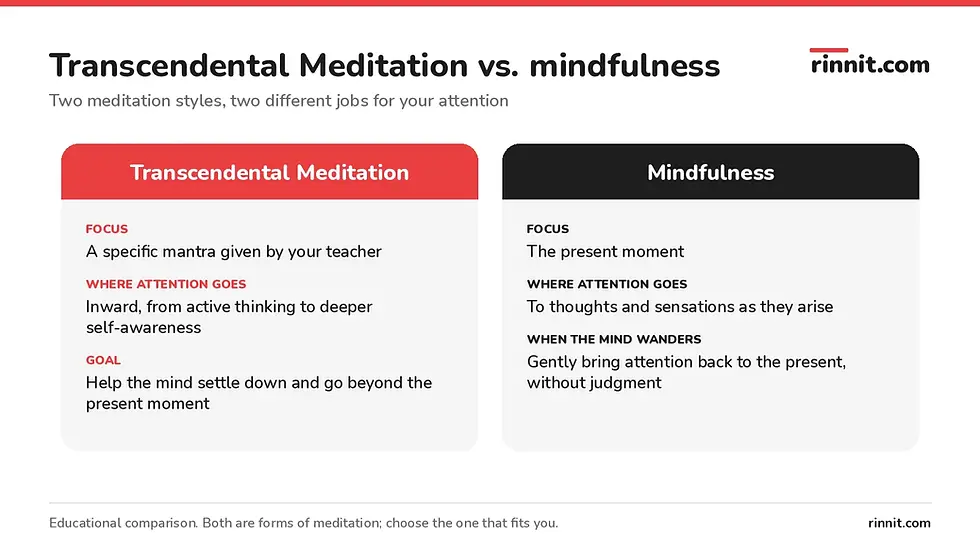
How is Transcendental Meditation different from mindfulness?
Transcendental Meditation directs your attention inward with a specific mantra, while mindfulness keeps your attention on the present moment. [1]
Feature | Transcendental Meditation | Mindfulness meditation |
Point of focus | A specific mantra [1] | The present moment [1] |
What you do with thoughts | Move attention from active thinking toward deeper self-awareness [1] | Notice thoughts and sensations as they arise [1] |
When the mind wanders | Return to the mantra [1] | Gently bring attention back to the present, without judgment [1] |
Aim | Help the mind settle and go beyond the present moment [1] | Stay with the present moment [1] |
Interested in other mind-body practices? Read our guide to yoga therapy.
When should you talk to a healthcare provider about Transcendental Meditation?
You should talk to your healthcare provider before starting Transcendental Meditation or any new treatment or therapy. This matters most if you have high blood pressure, chronic pain, depression or anxiety. [1]
Your provider may suggest other options, including other evidence-based complementary therapies. They may also point you to useful resources, such as a certified teacher near you. [1] For a broad look at how meditation is studied, see this overview of meditation and mindfulness effectiveness and safety. [5]
Conclusion
Transcendental Meditation is a simple daily practice with a clear structure: a personal mantra, two short sessions a day and guidance from a certified teacher. You do not need any experience with meditation to try it. [1]
Research points to possible benefits for blood pressure, stress, sleep and mood, and early trials in health care workers and veterans with PTSD are encouraging. [2] [3] [4] It works best as part of a wider health plan, not as a replacement for medical care.
Your next step: If better sleep, calmer days or clearer focus is your goal, talk with your healthcare provider about whether Transcendental Meditation fits your plan. Then explore more evidence-based mental health guides on rinnit.com.
FAQ
What is Transcendental Meditation?
Transcendental Meditation is a meditation technique in which you silently repeat a mantra to quiet your mind and reach restful alertness. You stay wide awake while your body relaxes deeply. [1]
How long do you practice Transcendental Meditation each day?
Transcendental Meditation is practiced twice a day, starting with about 10 minutes per session. Any amount of time helps, and consistent practice lets you meditate longer over time. [1]
What is a Transcendental Meditation mantra?
A Transcendental Meditation mantra is a sound your certified teacher selects for you. It is not an English word for an object or feeling; it helps move your attention from active thinking to deeper self-awareness. [1]
Can you learn Transcendental Meditation on your own?
Transcendental Meditation is meant to be learned from a certified teacher, who completes five months of in-residence training. Books, videos and apps exist, but personal teaching is how the technique is properly learned. [1]
Is Transcendental Meditation religious?
Transcendental Meditation does not involve any religion, philosophy or lifestyle. Its founder introduced it as a science, though it is based on ancient meditative yoga practices. [1]
Can Transcendental Meditation lower blood pressure?
Transcendental Meditation may lower high blood pressure slightly. A meta-analysis of 18 studies found average drops of 3.3 mm Hg systolic and 1.8 mm Hg diastolic, with the effect fading after 3 months. [2]
How is Transcendental Meditation different from mindfulness?
Transcendental Meditation uses a specific mantra to turn attention inward and go beyond the present moment. Mindfulness focuses on the present moment and gently returns attention there, without judgment, when the mind wanders. [1]
Should I talk to my doctor before starting Transcendental Meditation?
Talking to your healthcare provider before starting Transcendental Meditation is recommended, as with any new therapy. This is especially important if you have high blood pressure, chronic pain, depression or anxiety. [1]
Is Transcendental Meditation safe?
For most people, Transcendental Meditation is safe. Some people notice uncomfortable thoughts or feelings during meditation, so if you have a mental health condition, talk with your provider before starting.
Can Transcendental Meditation help with anxiety?
Some studies suggest it may help ease stress and anxiety, but it is not a replacement for treating an anxiety disorder. See a healthcare provider if anxiety affects your daily life.
Related Reading
Stress Management: Techniques, Benefits and When to Get Help explains practical ways to manage stress.
References
Cleveland Clinic. What Is Transcendental Meditation (TM)? Cleveland Clinic. Last updated April 16, 2025. https://my.clevelandclinic.org/health/treatments/22292-transcendental-meditation
Schneider JK, Reangsing C, Willis DG. Effects of Transcendental Meditation on Blood Pressure: A Meta-analysis. J Cardiovasc Nurs. 2022;37(3):E11-E21. PMID 35412731. https://doi.org/10.1097/JCN.0000000000000849
Joshi SP, Wong AI, Brucker A, et al. Efficacy of Transcendental Meditation to Reduce Stress Among Health Care Workers: A Randomized Clinical Trial. JAMA Netw Open. 2022;5(9):e2231917. PMID 36121655. https://doi.org/10.1001/jamanetworkopen.2022.31917
Nidich S, Mills PJ, Rainforth M, et al. Non-trauma-focused meditation versus exposure therapy in veterans with post-traumatic stress disorder: a randomised controlled trial. Lancet Psychiatry. 2018;5(12):975-986. PMID 30449712. https://doi.org/10.1016/S2215-0366(18)30384-5
National Center for Complementary and Integrative Health. Meditation and Mindfulness: Effectiveness and Safety. NCCIH. Last updated June 2022. https://www.nccih.nih.gov/health/meditation-and-mindfulness-effectiveness-and-safety
Medical disclaimer
This article is for general educational purposes only and is not a substitute for professional medical advice, diagnosis or treatment. Always seek the advice of a qualified healthcare provider before starting any new therapy, including meditation, and with any questions about a medical condition.



Comments