Tension Headache: Why the Most Common Head Pain Feels Like a Tight Band, and What Actually Helps

Updated: 10 hours ago
Medically reviewed by Dr. Baraa Alnahhal, MD · Last reviewed: October 2026
A tension-type headache is the most common type of headache, causing mild to moderate pain that feels like a tight band around the head. Its exact cause is not fully understood, but stress is the most commonly reported trigger, and a sensitized pain system is thought to play a role [1]. Over-the-counter pain relievers are the first-line treatment, but repeated use can cause medication-overuse headaches [2]. Prevention combines regular exercise, stress management, biofeedback or cognitive behavioral therapy, and healthy lifestyle habits like good sleep, hydration, and posture.
Quick Answer
A tension headache is the most common headache type, causing dull, aching pain with tightness or pressure across the forehead or the sides and back of the head, often with sore neck muscles. It is frequently triggered by stress and usually responds to pain relievers, heat or cold, rest and stress management. See a provider if your headache pattern changes.
What the research says
Tension-type headache is the most prevalent neurological disorder, and simple painkillers are the first-line treatment. A review in Nature Reviews Disease Primers describes it as the most prevalent neurological disorder worldwide, notes that simple analgesics have evidence-based effectiveness for acute treatment, and recommends amitriptyline, venlafaxine and mirtazapine, plus some non-drug therapies, when preventive treatment is needed (Ashina et al., Nature Reviews Disease Primers, 2021 [3]).
Tricyclic antidepressants reduce headache days but cause more side effects. A meta-analysis of 37 randomized trials found that tricyclics significantly reduced the number of tension-type headache days compared with placebo (standardized mean difference -1.29; 95% CI -2.18 to -0.39) and were more likely to cut headache intensity by at least 50% (relative risk 1.41; 95% CI 1.02 to 1.89), but caused more adverse effects such as dry mouth, drowsiness and weight gain (relative risk 1.53; 95% CI 1.11 to 2.12) (Jackson et al., BMJ, 2010 [4]).
Acupuncture may help, but the evidence is limited. A meta-analysis of 30 randomized trials with 2,742 participants found that acupuncture improved the responder rate compared with sham acupuncture (relative risk 1.30; 95% CI 1.13 to 1.50; moderate certainty) and reduced pain intensity more than medication (standardized mean difference -0.62; 95% CI -0.86 to -0.38; low certainty), with no serious adverse events, though the authors call for more rigorous trials (Kang et al., Frontiers in Neurology, 2023 [5]).
Tension-type headache is extremely common worldwide, though it causes less disability than migraine. The Global Burden of Disease 2016 analysis estimated that 1.89 billion people (95% uncertainty interval 1.71-2.10 billion) had tension-type headache, compared with 1.04 billion with migraine. Because migraine carries a higher disability weight, tension-type headache accounted for 7.2 million years lived with disability versus 45.1 million for migraine, and headaches were most burdensome in women aged 15 to 49 (GBD 2016 Headache Collaborators, Lancet Neurol, 2018 [6]).
Overusing pain medicine has been linked to measurable brain changes, some of which may be reversible. A meta-analysis of five imaging studies (344 participants) found that people with medication-overuse headache had altered gray-matter density in the reward system and prefrontal cortex compared with healthy controls, and withdrawal of analgesics was associated with changes in the pain network. The analysis was small and cannot establish cause (Chen et al., Brain Imaging Behav, 2022 [7]).
What Is a Tension Headache?
A tension-type headache causes mild to moderate pain that is often described as feeling like a tight band around the head [1]. It is the most common type of headache — yet its causes are not well understood [1].
Managing a tension-type headache is often a balance between practicing healthy habits, using medicines appropriately, and finding other effective treatments. There is no single fix, but there is a wide range of options that work for most people.
Key point: tension-type headaches are the most common headache type, and stress is the most commonly reported trigger — but muscle contraction, once thought to be the cause, is not [1].
What are the symptoms of a tension headache?
Symptoms of a tension-type headache include the following.
Symptom | What to expect |
Pain quality | Dull, aching head pain |
Sensation | Feeling of tightness or pressure across the forehead or on the sides and back of the head |
Tenderness | Tenderness in the scalp, neck, and shoulder muscles |
Tension-type headaches fall into two main categories — episodic and chronic. Understanding which one applies to you matters, because chronic tension-type headaches need a preventive plan rather than just pain relievers.
Category | How it behaves |
Infrequent episodic | Occurs less than one day a month |
Frequent episodic | Occurs less than 15 days a month for at least three months; can last from 30 minutes to a week |
Chronic | Occurs 15 or more days a month for at least three months; lasts hours and may be constant |
A frequent episodic headache can become chronic, which is another reason to address patterns early rather than letting them build.

How is a tension headache different from a migraine?
Tension-type headaches can be hard to tell apart from migraines. It is particularly hard to distinguish mild migraine headaches from tension-type headaches [1].
The table below highlights the differences that help separate them.
Feature | Tension-type headache | Migraine |
Visual disturbances | Usually not associated with seeing bright spots or flashes of light | May include visual aura |
Nausea or vomiting | Usually not experienced with head pain | Common |
Effect of physical activity | Doesn’t affect the pain | Tends to make pain worse |
Light or sound sensitivity | Sometimes present, but not common | Common |
Background pain | — | People with chronic migraine often have background headaches similar to tension-type headaches |
One important overlap to understand: people with chronic migraine often have background headaches that may be similar to tension-type headaches. If you are unsure which type you have, that uncertainty is a reason to see a provider rather than a reason to self-treat indefinitely.
What Causes Tension Headaches?
The cause of tension-type headaches is not known. In the past, experts thought they were caused by muscle contractions in the face, neck, and scalp resulting from emotions, tension, or stress. But research suggests that muscle contraction is not the cause of these headaches [1].
The most common theory is that people who have tension-type headaches have increased sensitivity to pain. The muscle tenderness that is common with these headaches may result from this sensitized pain system [1].
Triggers. Stress is the most commonly reported trigger for tension-type headaches [1].
Other factors linked to tension-type headaches include poor posture and neck strain, eye strain, arthritis in the neck, temporomandibular joint (TMJ) disorders, sleep problems such as lack of sleep, sleep apnea and insomnia, and depression or anxiety [8].

What are the risk factors for tension headaches?
Most people have a tension-type headache at some point in their lives. Some research has found that women are more likely to have frequent episodic tension-type headaches and chronic tension-type headaches [1].
Age also might be a factor. One study found that episodic tension-type headaches were more likely to affect people in their 40s [1].
Risk factor | What the research shows |
Sex | Women are more likely to have frequent episodic and chronic tension-type headaches |
Age | One study found episodic tension-type headaches more likely in people in their 40s |
Stress | The most commonly reported trigger |
What complications can tension headaches cause?
Because tension-type headaches are so common, they can affect job productivity and quality of life, particularly if they are chronic. Frequent headache pain may make it hard to attend activities. You might need to stay home from work, and if you do go, it may be hard to function as usual.
This is a legitimate health issue, not an inconvenience to push through — and it is one of the main reasons chronic patterns deserve a preventive treatment plan.
When should you see a doctor for a tension headache?
See your healthcare professional if you need to take medicine for tension-type headaches more than twice a week [1]. Also make an appointment if tension-type headaches disrupt your life.
Even if you have a history of headaches, see your healthcare professional if the headache pattern changes or your headaches suddenly feel different. Occasionally, headaches may be caused by a serious medical condition, including a brain tumor or rupture of a weakened blood vessel known as an aneurysm.
Also talk with a healthcare professional about a headache with pain or tenderness in the jaw when chewing or at the temple, or a headache that happens only in certain positions, such as standing up or lying down [8]. The same applies if headaches feel different or happen more often than usual, especially if you have cancer or an autoimmune disease [8].
When to Seek Emergency Care
Get emergency care if you have any of the following.
Emergency sign | Why it matters |
A sudden, very bad headache | Can signal a serious acute problem |
Headache with fever, stiff neck, mental confusion, seizures, double vision, weakness, numbness or trouble speaking | These combined signs point to a medical emergency |
Headache after a head injury, especially if it gets worse | Worsening post-injury pain needs immediate evaluation |
How are tension headaches diagnosed?
If you have regular headaches, your healthcare professional may give you a physical and a neurological exam. The provider works to pinpoint the type and cause of your headaches using a few key approaches.
Your Pain Description
Your healthcare professional can learn a lot about your headaches from the information you provide about the pain. Be sure to include these details.
Detail to describe | Questions to think about |
Pain description | Is the pain throbbing? Constant and dull? Sharp or stabbing? |
Pain intensity | How much are you able to do during the headache? Can you work? Do headaches wake you or prevent sleep? |
Pain location | All over the head? One side? Only the forehead or behind the eyes? |
Imaging Tests
Your healthcare professional may order tests to rule out serious causes of head pain, such as a tumor. Two common imaging tests are used.
Imaging test | How it works |
MRI (magnetic resonance imaging) | Uses a powerful magnet and computer-generated radio waves to create images of your brain |
CT (computerized tomography) | Combines a series of X-ray images taken from different angles to create cross-sectional images that provide a detailed view of your brain |
What are the treatment options for tension headaches?
Some people with tension-type headaches do not see a healthcare professional and try to treat the pain on their own. But repeated use of pain relievers you can buy without a prescription can cause another type of headache known as medication overuse headache [2]. Your healthcare professional can work with you to find the right treatment.
Some guidance is to limit pain reliever use to 10 days in any given month, because more frequent use raises the risk of medication overuse headaches [8].
Medicines to Take During a Headache
Medicine type | What to know |
Pain relievers | Over-the-counter pain relievers are usually the first line of treatment, including aspirin, ibuprofen (Advil, Motrin IB and others), and naproxen sodium (Aleve); do not give aspirin to children or teenagers because of the risk of Reye's syndrome |
Combination medicines | Aspirin, acetaminophen (Tylenol and others), or both are often combined with caffeine or a sedative in a single medicine. These may be more effective than single-ingredient pain relievers, and many are available without a prescription |
Triptans | Recommended for migraine but not typically effective for tension-type headaches. However, people may have mild migraines without typical features, and triptans may help relieve pain during those attacks |
Prescription opioids are rarely used for tension-type headaches because of their side effects and potential for dependency [2].
Preventive Medicines
Your healthcare professional may prescribe medicines that help you have fewer headaches or less painful ones. Preventive medicines may help if you have regular headaches that are not relieved by pain medicine and other therapies.
Preventive medicine | Notes |
Tricyclic antidepressants | The most commonly used medicines to prevent tension-type headaches; include amitriptyline, nortriptyline (Pamelor), and protriptyline. Can cause side effects such as constipation, drowsiness, and dry mouth |
Other antidepressants | Venlafaxine (Effexor XR) and mirtazapine (Remeron) also can help prevent tension-type headaches |
Anti-seizure medicines | Gabapentin (Gralise, Horizant, Neurontin) and topiramate (Topamax, Qsymia and others) may help prevent headache pain and are commonly used for prevention |
Muscle relaxants | Tizanidine (Zanaflex) may be an option for people who cannot prevent headaches with other medicines, though research shows mixed results on its effectiveness |
It can take several weeks or more for preventive medicines to build up in your system and take effect [2]. Your healthcare professional monitors your treatment to see how the preventive medicine is working. In the meantime, overusing pain relievers may interfere with the effects of the preventive medicines.
Alternative Medicine
These nontraditional therapies may help if you have tension-type headache pain.
Therapy | What to know |
Acupuncture | May provide temporary relief from chronic headache pain. Uses very thin, disposable needles that generally cause little pain or discomfort. Typically safe when performed by an experienced acupuncturist using sterile needles |
Massage | Can reduce stress and relieve tension, especially for tight, tender muscles in the back of the head, neck, and shoulders. May provide relief from headache pain for some people |
Deep breathing, biofeedback, and behavior therapies | Useful techniques for coping with tension-type headaches |
What lifestyle and home remedies help tension headaches?
Rest, ice packs, or a long, hot shower may be all you need to relieve a tension-type headache [2]. If you experience chronic tension-type headaches, these strategies can help reduce how many you have or how painful they are.
Strategy | How to apply it |
Manage your stress level | Plan ahead and organize your day; allow more time to relax |
Go hot or cold | Apply heat or ice — whichever you prefer — to sore muscles. For heat, use a heating pad set on low, a hot-water bottle, a warm compress, or a hot towel; a hot bath or shower may also help. For cold, use ice, an ice pack, or frozen vegetables wrapped in a cloth to protect your skin |
Perfect your posture | Good posture keeps muscles from tensing. Standing: hold your shoulders back and head level, pull in your abdomen and buttocks. Sitting: make sure your thighs are parallel to the ground and your head is not slumped forward |
How can you prevent tension headaches?
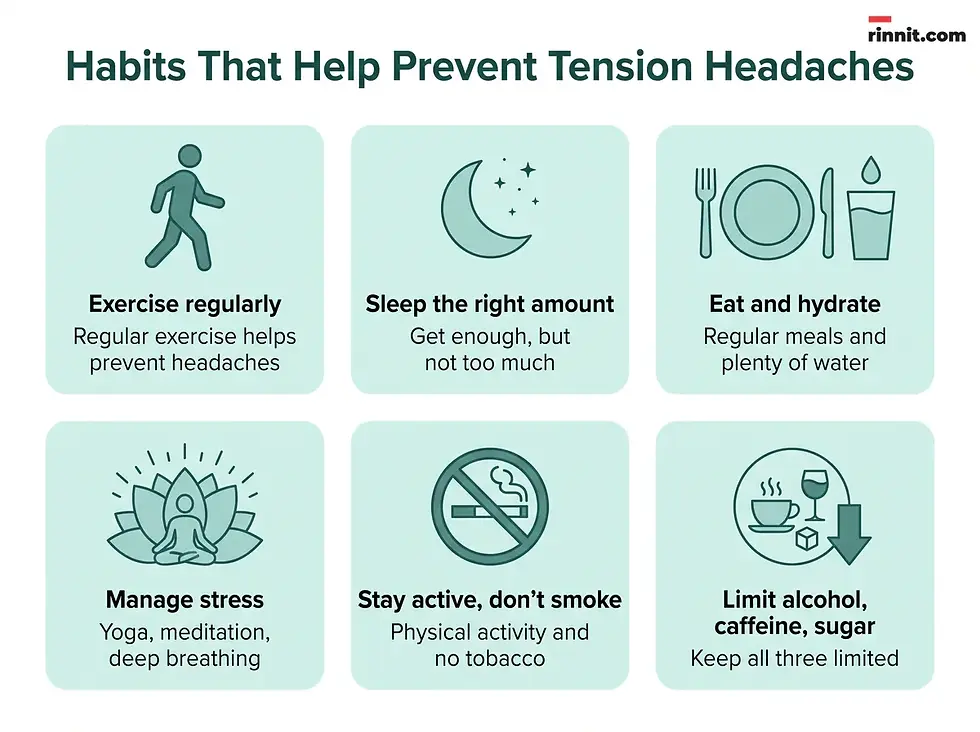
Regular exercise can help prevent tension-type headaches [1]. Other techniques can help as well.
Prevention technique | How it works |
Biofeedback training | Teaches you to manage certain body responses that reduce pain. A device monitors and gives you feedback on muscle tension, heart rate, and blood pressure; you learn to reduce muscle tension and slow your heart rate and breathing |
Cognitive behavioral therapy | This talk therapy may help you learn to manage stress, which may lead to fewer or less painful headaches |
Relaxation techniques | Anything that helps you relax may help your headaches — deep breathing, yoga, meditation, and progressive muscle relaxation. You can learn these in classes or at home using books or apps |
Using medicines along with stress management may be more effective than any one treatment alone in reducing tension-type headaches [1].
Living a healthy lifestyle may also help prevent headaches.
Healthy habit | Why it matters |
Sleep | Get enough, but not too much |
Smoking | Don’t smoke |
Activity | Stay physically active |
Meals | Eat regular, balanced meals |
Hydration | Drink plenty of water |
Alcohol, caffeine, sugar | Limit all three |
How can people cope with tension headaches and find support?
Chronic pain can cause anxiety and depression. It can also affect your relationships, your productivity, and the quality of your life.
Talking to a counselor or therapist may help you cope with the effects of chronic pain. Support groups can be good sources of information and comfort, and group members often know about the latest treatments. Your healthcare professional may be able to recommend a group in your area.
Conclusion: Get Ahead of the Pattern
Tension-type headaches are the most common headache in the world, and they are also among the most manageable. The pain feels like a tight band around your head, but the answer to it is rarely just another pain reliever.
Understanding your pattern — episodic or chronic, stress-triggered, possibly overlapping with migraine — is the foundation. From there, a healthcare professional can build a plan that combines appropriate medicines, proven relaxation therapies, and daily habits that genuinely reduce both the number and severity of headaches.
Next step: If tight-band head pain is becoming a regular part of your life, see a healthcare professional for an evaluation.
Frequently Asked Questions
What does a tension headache feel like?
A tension-type headache causes dull, aching pain with a feeling of tightness or pressure across the forehead or on the sides and back of the head, often described as a tight band around the head. Scalp, neck, and shoulder muscles may be tender.
What causes tension headaches?
The exact cause is not known. The most common theory is increased sensitivity to pain, which may also explain the common muscle tenderness. Stress is the most commonly reported trigger.
How common are tension headaches?
Tension headaches are the most common type of headache. Most people have one at some point in their lives, and research suggests women and people in their 40s are more likely to have frequent episodes.
How long does a tension headache last?
Episodic tension-type headaches last from 30 minutes to a week. Chronic tension-type headaches occur 15 or more days a month for at least three months, last hours, and may be constant.
How is a tension headache different from a migraine?
Tension-type headaches usually are not associated with visual disturbances, nausea, or vomiting, and physical activity does not worsen the pain. Migraines commonly include nausea, light sensitivity, and worsening with activity.
What is the best treatment for a tension headache?
Over-the-counter pain relievers such as aspirin, ibuprofen, and naproxen sodium are usually the first line. Combination medicines with caffeine or a sedative may be more effective. Heat or cold, rest, and a hot shower can also help.
Can tension headaches be prevented?
Yes. Regular exercise, biofeedback training, cognitive behavioral therapy, relaxation techniques like yoga and meditation, and healthy habits — enough sleep, not smoking, regular meals, hydration, and limiting alcohol, caffeine, and sugar — all help.
When should I see a doctor for a tension headache?
See a provider if you need pain medicine more than twice a week, headaches disrupt your life, or your headache pattern changes. Seek emergency care for a sudden very bad headache, headache with fever or neurological symptoms, or headache after a head injury that gets worse.
Can pain relievers make headaches worse?
Yes. Repeated use of over-the-counter pain relievers can cause a separate condition called medication overuse headache, and overusing pain relievers can interfere with the effects of preventive medicines.
Do preventive medicines work for tension headaches?
Tricyclic antidepressants like amitriptyline are the most commonly used preventives and can reduce headache frequency and severity. Other antidepressants, anti-seizure medicines, and muscle relaxants may also help, though preventive medicines can take several weeks or more to build up and take effect.
Related Reading
Migraine Headaches: What Causes Them and How to Treat Them explains migraine symptoms, triggers and treatments, and how they differ from other headaches.
Medication-Overuse Headache: When Your Headache Medicine Becomes the Problem, and How to Break the Cycle explains how frequent pain reliever use can cause rebound headaches.
Cervicogenic Headache: When the Pain You Feel in Your Head Actually Starts in Your Neck explains headaches that start from problems in the neck.
Neck Pain: Symptoms, Causes, Diagnosis, and Treatment covers common causes of neck pain and how it is treated.
References
Mayo Clinic. Tension headache: symptoms and causes. Mayo Clinic. Last updated May 2, 2026. https://www.mayoclinic.org/diseases-conditions/tension-headache/symptoms-causes/syc-20353977
Mayo Clinic. Tension headache: diagnosis and treatment. Mayo Clinic. Last updated May 2, 2026. https://www.mayoclinic.org/diseases-conditions/tension-headache/diagnosis-treatment/drc-20353982
Ashina S, Mitsikostas DD, Lee MJ, et al. Tension-type headache. Nature Reviews Disease Primers. 2021;7(1):24. PMID 33767185. https://doi.org/10.1038/s41572-021-00257-2
Jackson JL, Shimeall W, Sessums L, et al. Tricyclic antidepressants and headaches: systematic review and meta-analysis. BMJ. 2010;341:c5222. PMID 20961988. https://doi.org/10.1136/bmj.c5222
Kang WL, Xiao XJ, Fan R, et al. Acupuncture for tension-type headache: a systematic review and meta-analysis of randomized controlled trials. Frontiers in Neurology. 2023;13:943495. PMID 37234488. https://doi.org/10.3389/fneur.2022.943495
GBD 2016 Headache Collaborators. Global, regional, and national burden of migraine and tension-type headache, 1990-2016: a systematic analysis for the Global Burden of Disease Study 2016. Lancet Neurol. 2018;17(11):954-976. PMID 30353868. https://doi.org/10.1016/S1474-4422(18)30322-3
Chen W, Li H, Hou X, et al. Gray matter alteration in medication overuse headache: a coordinates-based activation likelihood estimation meta-analysis. Brain Imaging Behav. 2022;16(5):2307-2319. PMID 35143020. https://doi.org/10.1007/s11682-022-00634-9
Cleveland Clinic. Tension Headache. Cleveland Clinic. Last updated October 5, 2026. https://my.clevelandclinic.org/health/diseases/8257-tension-headaches
Medical disclaimer
The information provided in this article is for educational purposes only and should not be used as a substitute for professional medical advice, diagnosis, or treatment. Always seek the advice of your physician or other qualified health provider with any questions you may have regarding a medical condition.



Comments