
Cervicogenic Headache: When the Pain You Feel in Your Head Actually Starts in Your Neck

Updated: 3 days ago
Medically reviewed by Dr. Baraa Alnahhal, MD · Last reviewed: October 2026
Quick Answer
Cervicogenic headache is one-sided head pain that actually starts in the neck and is referred to the head from the cervical spine. Unlike migraine, it lacks light and sound sensitivity, nausea or vomiting. Causes include arthritis, a pinched nerve and whiplash. Treatment includes physical therapy, medications, radiofrequency ablation and, as a last resort, surgery.

What the research says
Manual therapy helps in the short term; neck exercise may help longer. In a meta-analysis of 14 trials, manual therapy reduced headache frequency compared with sham treatment (mean difference −0.93 episodes per week, 95% CI −1.40 to −0.46; 265 participants) but did not give a greater reduction than sham at 12 months, while neck exercise lowered long-term headache intensity compared with no treatment in one high-quality trial (−1.51 points on a 0–10 scale, 95% CI −2.52 to −0.50; 100 participants) (Demont et al., PM&R, 2023 [1]).
The evidence is promising but not yet strong. A review of 20 randomized trials (1,439 patients) found moderate-to-large short-term benefits of manual therapy over sham for headache intensity and frequency in the six trials that could be pooled, but the overall risk of bias in most trials was high and the authors called for higher-quality studies (Bini et al., Chiropractic & Manual Therapies, 2022 [2]).
A hands-on neck test helps separate it from other headaches. In four studies (182 participants), the cervical flexion-rotation test distinguished cervicogenic headache from lower cervical facet-induced headache, migraine, concomitant headaches or no headache, with a sensitivity and specificity of 83% each (Demont et al., Musculoskeletal Science and Practice, 2022 [3]).
What Is a Cervicogenic Headache?
A cervicogenic headache is head pain caused by a cervical spine (neck) issue. The pain you feel is referred pain — this happens when you feel pain in a part of your body that is different from the pain source. With a cervicogenic headache, the pain you feel in your head originates from the bony structures or soft tissues in your neck.
It is a type of secondary headache, which is a headache caused by an underlying condition. For example, it could be caused by a nerve impingement (pinched nerve) in your neck.
Is a Cervicogenic Headache Serious?
Some causes of a cervicogenic headache are serious. They may happen after an injury, like a broken bone in your neck or an underlying condition. Feeling pain can significantly affect your ability to function and move.
When to seek care: Contact a healthcare provider if you experience a headache after an injury, or if you have a headache that does not go away or gets worse. Call 911 or go to the emergency room for a sudden, severe headache, or a headache after a serious head or neck injury, especially with numbness, weakness, confusion or trouble speaking.
How Common Is a Cervicogenic Headache?
While it is common to experience headaches, cervicogenic headaches are not as common. They affect between 0.4% and 4% of people who have headaches worldwide.
What Are the Symptoms of a Cervicogenic Headache?
The symptoms of a cervicogenic headache include:
Symptom | What it involves |
|---|---|
One-sided head pain | May start at the bottom of your head and radiate up one side, or start at the back of your head and radiate to the front, behind your eyes |
Limited neck movement | Restricted range of motion in your neck; your headache may get worse with neck movement |
You may or may not have neck pain at the same time as head pain.
When do symptoms happen? Cervicogenic headaches can happen at any age or after certain events like an injury. Studies show that symptoms usually begin after age 30, but many people do not seek care for these headaches until their late 40s.
What Causes a Cervicogenic Headache?
A cervicogenic headache is caused by an injury or condition that affects your cervical spine or neck. Specifically, anything that affects the following pain-sensitive areas of your cervical spine can cause symptoms:
Pain-sensitive area | What it is |
|---|---|
Bones | The C1 to C3 vertebrae (the top three neck bones) |
Joints | The connections between neck bones |
Ligaments | The bands of tissue that connect bones |
Nerve roots | The nerves branching out from the spinal cord in your neck |
Vertebral arteries | The arteries that run through your neck to supply your brain |
Common conditions potentially associated with cervicogenic headaches include arthritis, fracture (broken vertebra), pinched nerve, slipped disk, sprained muscles, tumor, and whiplash.

How Is a Cervicogenic Headache Diagnosed?
A healthcare provider will review your symptoms during a physical exam and offer testing to confirm a diagnosis.
It is difficult to diagnose cervicogenic headaches due to referred pain. In addition, symptoms can easily be mistaken for other types of headaches, like tension headaches or migraines, for example.
Your provider will offer tests to rule out conditions with similar symptoms. The most common tests are imaging tests like an X-ray, CT scan (computed tomography scan), or an MRI (magnetic resonance imaging). These may pinpoint injuries or conditions that affect the cervical spine.
However, an unremarkable scan does not always rule out a potential cervicogenic contribution to your headache. The reason for this, in part, is that the scan only looks at structure and not function or mobility and range of movement. Your provider will assess these factors by a manual (hands-on) examination.
Your provider will also verify if your symptoms match the diagnostic criteria provided by the International Classification of Headache Disorders (ICHD-3).
How Do You Get Rid of a Cervicogenic Headache?
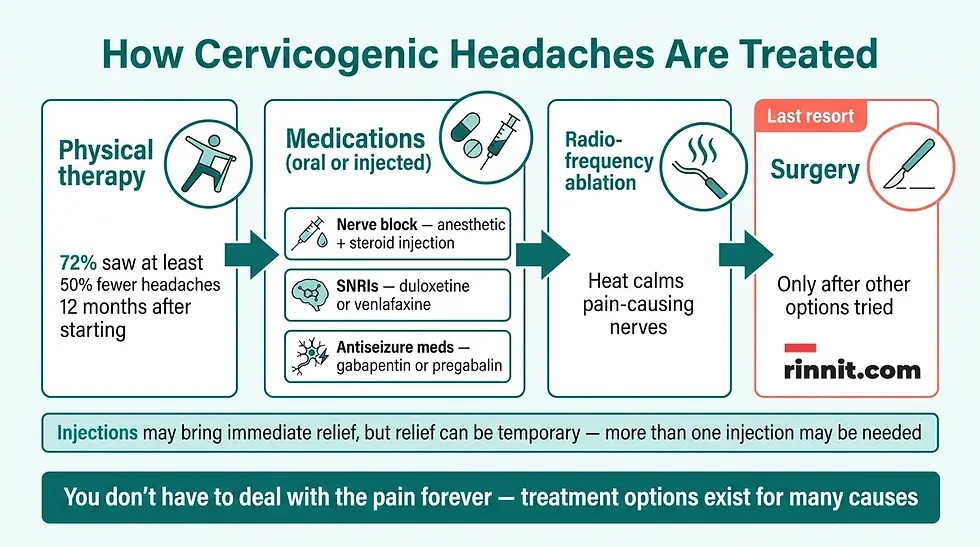
Your healthcare provider will offer different treatment options to manage the cause of cervicogenic headaches. These could include physical therapy, medications (oral or injected), radiofrequency ablation, and surgery. Your provider will try different treatment options before surgery, since it is a last-resort measure.
Treatment | What it does |
|---|---|
Physical therapy | Exercises and stretching paced by a therapist; one study reported that 72% of people saw at least 50% fewer headaches 12 months after starting physical therapy |
Medications (oral or injected) | Local anesthetic and steroid injections (nerve blocks) can bring immediate — though sometimes temporary — relief; SNRIs (duloxetine or venlafaxine); antiseizure medications (gabapentin and pregabalin) |
Radiofrequency ablation | A procedure that uses heat to calm pain-causing nerves |
Surgery | A last resort, only after other options have been tried |
Your healthcare provider will recommend medications specific to your symptoms. They will also let you know if there are any side effects so you can make an informed decision about your health.
How long can it last? This varies depending on the type of treatment you receive. You may feel immediate relief after medication injections — relief with injections may be temporary, so it is possible to need more than one injection to treat the pain.
What Can I Expect if I Have a Cervicogenic Headache?
Cervicogenic headaches can interfere with how you go about your day, but you do not have to deal with the pain forever. There are treatment options available for many different causes. Your provider will help you find one or a combination specific to your situation.
One thing to know about physical therapy: a lot of people find success in it. One study reported that 72% of people saw at least 50% fewer headaches 12 months after starting physical therapy. While physical therapy may be beneficial, you may notice worsening headaches when treatment begins. Your physical therapist will pace exercises and stretching in a way to prevent this from happening.
Can a Cervicogenic Headache Be Prevented?
Cervicogenic headache cannot be prevented in every case, because not all of its causes can be avoided. But you can reduce your risk by:
Risk-reduction step | What it involves |
|---|---|
Safety precautions | Prevent injuries, falls, and accidents |
Posture | Adjust your posture to avoid slouching |
Sleep setup | Sleep on a supportive pillow and mattress |
Massage | Getting a massage |
Exercise | Exercising regularly |
When Should I See a Healthcare Provider?
See a healthcare provider about cervicogenic headache if you have headaches without a known cause, since frequent headaches may signal an underlying condition. Visit a healthcare provider if you experience headaches without a known cause. Let your provider know right away if these headaches get worse or you experience other symptoms with headaches, like pain in another part of your body.
Questions you may want to ask your provider:
What is the cause of the headaches?
What type of treatment do you recommend?
Are there side effects of the treatment?
How long before I feel pain relief?
Is a Cervicogenic Headache the Same as a Migraine?
No. A cervicogenic headache may feel like a migraine with one-sided head pain. But you will not have additional symptoms common with a migraine, like light sensitivity, sound sensitivity, nausea, or vomiting.
Conclusion
A cervicogenic headache is head pain that starts in your neck and gets “referred” to your head — so when one side of your head aches, the real problem may be hiding in your cervical spine. It affects roughly 0.4% to 4% of people with headaches, typically begins after age 30, and shows up as one-sided pain that worsens with neck movement.
Diagnosis takes a physical exam, hands-on testing, and imaging to rule out other causes. The good news: you do not have to live in pain. Physical therapy, targeted medications, nerve-block injections, radiofrequency ablation, and — only as a last resort — surgery can all help. Most people can find lasting relief without ever needing an operation.
A note of hope: No one wants their day ruined by a headache, and you do not have to just deal with the pain. A healthcare provider can help determine what is causing your headaches, and several treatment options exist to fit your needs and reduce how often these headaches affect you.
If you experience a headache after an injury, or a headache that does not go away or gets worse, contact a healthcare provider right away.
Frequently Asked Questions
What is a cervicogenic headache?
A cervicogenic headache is head pain caused by an issue in your neck. The pain is referred pain — you feel it in your head, but it originates from the bony structures or soft tissues in your cervical spine.
What does referred pain mean?
Referred pain happens when you feel pain in a part of your body that is different from the pain source. With a cervicogenic headache, the pain source is your neck, but the pain is felt in your head.
What is a secondary headache?
A secondary headache is a headache caused by an underlying condition. A cervicogenic headache is one type — for example, it could be caused by a pinched nerve in your neck.
Is a cervicogenic headache serious?
Some causes are serious, especially those that happen after an injury (like a broken neck bone) or from an underlying condition. Contact a healthcare provider if you have a headache after an injury, or one that does not go away or gets worse.
How common are cervicogenic headaches?
Cervicogenic headaches are uncommon relative to other headaches — they affect between 0.4% and 4% of people who have headaches worldwide.
What does a cervicogenic headache feel like?
A cervicogenic headache causes one-sided head pain. It may start at the bottom of your head and radiate up one side, or start at the back of your head and radiate to the front, behind your eyes.
Can I still have neck pain with a cervicogenic headache?
You may or may not have neck pain at the same time as head pain — neck pain does not always accompany the headache.
Does neck movement affect the headache?
Yes. You may have limited movement or range of motion in your neck, and your headache may get worse with neck movement.
At what age do cervicogenic headaches usually start?
Studies show that symptoms usually begin after age 30, though they can happen at any age or after events like an injury. Many people do not seek care until their late 40s.
What parts of the neck can cause these headaches?
Anything that affects the pain-sensitive areas of your cervical spine: the bones (C1 to C3 vertebrae), joints, ligaments, nerve roots, and vertebral arteries.
What conditions are associated with cervicogenic headaches?
Common conditions include arthritis, a fracture (broken vertebra), a pinched nerve, a slipped disk, sprained muscles, a tumor, and whiplash.
Is a cervicogenic headache the same as a migraine?
No. A cervicogenic headache may feel like a migraine with one-sided head pain, but you will not have additional migraine symptoms like light sensitivity, sound sensitivity, nausea, or vomiting.
Could it be a tension headache instead?
It is possible — symptoms can easily be mistaken for tension headaches or migraines. That is why a proper evaluation matters.
How is a cervicogenic headache diagnosed?
Through a physical exam, a manual (hands-on) assessment of neck function and range of movement, and imaging tests like an X-ray, CT scan, or MRI. Your provider will also check whether your symptoms match the ICHD-3 diagnostic criteria.
What is ICHD-3?
The International Classification of Headache Disorders — a set of diagnostic criteria your provider uses to verify that your symptoms match a cervicogenic headache.
What if my scan comes back normal?
An unremarkable scan does not always rule out a cervicogenic contribution to your headache. Scans look at structure, not function, mobility, or range of movement — your provider assesses those factors through a hands-on examination.
What treatments are available?
Physical therapy, medications (oral or injected), radiofrequency ablation, and surgery. Your provider will try options other than surgery first, since surgery is a last-resort measure.
What medications treat cervicogenic headaches?
Local anesthetic and steroid injections (nerve blocks), serotonin and norepinephrine reuptake inhibitors (SNRIs — duloxetine or venlafaxine), and antiseizure medications (gabapentin and pregabalin). Your provider will choose based on your symptoms and explain any side effects.
Do injections work right away?
You may feel immediate relief after medication injections, but relief may be temporary — it is possible to need more than one injection to treat the pain.
Does physical therapy really help?
A lot of people find success with it. One study reported that 72% of people saw at least 50% fewer headaches 12 months after starting physical therapy. Headaches may temporarily worsen when treatment begins — your therapist will pace exercises and stretching to prevent this.
When is surgery needed?
Only as a last resort, after other treatment options have been tried.
Can a cervicogenic headache be prevented?
You cannot prevent all causes, but you can reduce your risk by using safety precautions to prevent injuries, falls, and accidents; adjusting your posture to avoid slouching; sleeping on a supportive pillow and mattress; getting a massage; and exercising regularly.
When should I see a healthcare provider?
If you have headaches without a known cause, if they get worse, or if you experience other symptoms alongside them — like pain in another part of your body. Also seek care right away after any head or neck injury.
How long does a cervicogenic headache last?
It varies depending on the treatment you receive. Some people feel immediate relief from injections (though it may be temporary), while physical therapy typically shows results over months.
Related Reading
References
Demont A, Lafrance S, Gaska C, et al. Efficacy of physiotherapy interventions for the management of adults with cervicogenic headache: a systematic review and meta-analyses. PM&R. 2023;15(5):613-628 (published online August 4, 2022). PMID 35596553. https://doi.org/10.1002/pmrj.12856
Bini P, Hohenschurz-Schmidt D, Masullo V, Pitt D, Draper-Rodi J. The effectiveness of manual and exercise therapy on headache intensity and frequency among patients with cervicogenic headache: a systematic review and meta-analysis. Chiropractic & Manual Therapies. 2022;30(1):49. PMID 36419164. https://doi.org/10.1186/s12998-022-00459-9
Demont A, Lafrance S, Benaissa L, Mawet J. Cervicogenic headache, an easy diagnosis? A systematic review and meta-analysis of diagnostic studies. Musculoskeletal Science and Practice. 2022;62:102640. PMID 36088782. https://doi.org/10.1016/j.msksp.2022.102640
Cleveland Clinic. Cervicogenic Headache. Medically reviewed; last updated July 11, 2024. https://my.clevelandclinic.org/health/diseases/cervicogenic-headache
American Migraine Foundation. What Is Cervicogenic Headache? October 24, 2016. https://americanmigrainefoundation.org/resource-library/cervicogenic-headache/
Al Khalili Y, Ly N, Murphy PB. Cervicogenic Headache. Updated October 3, 2022. In: StatPearls [Internet]. Treasure Island (FL): StatPearls Publishing; 2024 Jan-. https://www.ncbi.nlm.nih.gov/books/NBK507862/
Headache Classification Committee of the International Headache Society. The International Classification of Headache Disorders, 3rd edition (ICHD-3). International Headache Society. Accessed October 14, 2026. https://ichd-3.org/
Medical disclaimer
This article is for informational purposes only and is not a substitute for professional medical advice, diagnosis, or treatment. If you experience a headache after an injury, or a headache that does not go away or gets worse, contact a healthcare provider promptly. Always seek the advice of your physician or other qualified health provider with any questions you may have regarding a medical condition. Never disregard professional medical advice or delay seeking it because of something you have read on Rinnit.



Comments