Benzodiazepines (Benzos): Uses, Side Effects and Risks

Updated: 2 days ago
Written and medically reviewed by Dr. Baraa Alnahhal, MD · Last reviewed: November 2026 · How we review
Quick Answer
Benzodiazepines ("benzos") are prescription medicines that calm the brain and nervous system by boosting GABA, a chemical messenger that slows nerve activity. They're used for anxiety, panic disorder, insomnia and seizures. They can be habit-forming, even when taken as prescribed. Taking them with opioids or alcohol can be deadly. Never stop suddenly without talking to your provider.
What the research says
In older adults, risks can outweigh benefits: in 24 trials of 2,417 people aged 60 and older with insomnia, sedatives added only about 25 minutes of sleep but made memory and thinking problems almost 5 times and daytime tiredness almost 4 times more common (Glass J et al., BMJ, 2005) [2]
Benzodiazepine use has been linked to dementia: in 15 studies with 159,090 cases, people who had ever used benzodiazepines had a 39% higher risk of dementia, and the link remained (30% higher) when use was at least 5 years before diagnosis (Penninkilampi R and Eslick GD, CNS Drugs, 2018) [3]
Key takeaways
Benzodiazepines calm the brain by boosting the chemical GABA.
They treat anxiety, insomnia, seizures, muscle spasms and alcohol withdrawal.
They can be habit-forming, even when taken as prescribed.
Never mix them with opioids or alcohol.
Don't stop suddenly; your provider will lower the dose slowly.
What are benzodiazepines?
Benzodiazepines have been used since the 1960s, when the first one, chlordiazepoxide, was developed as a safer alternative to barbiturates. They're prescription-only and tightly regulated. In the U.S., more than 30 million people took a prescribed benzodiazepine in one year, and about 5 million misused them. Related "Z-drugs," such as zolpidem (Ambien), work on the same brain receptors and are used mainly for sleep. Sources: [1]
How they work
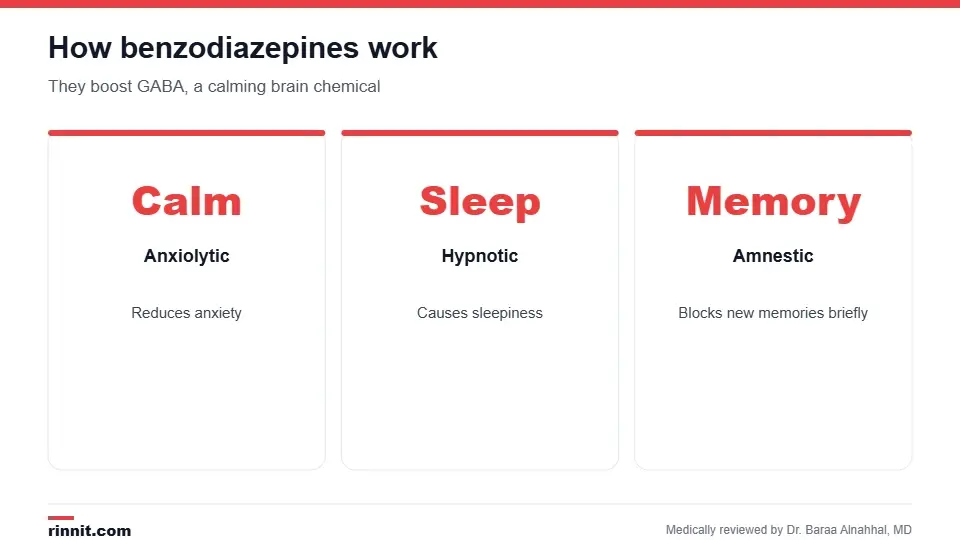
Their calming effects start quickly.
Effect | What it means |
Anxiolytic | Reduces anxiety |
Hypnotic | Causes sleepiness |
Sedative | Calms and relaxes |
Amnestic | Blocks new memories for a short time |
Sources: [1]
What they treat

Providers often prescribe the lowest dose for the shortest time.
Anxiety disorders, including panic disorder and social anxiety.
Insomnia and other sleep problems.
Seizures and epilepsy, including seizures that won't stop (status epilepticus).
Muscle spasms.
Alcohol withdrawal.
Sedation before surgery or procedures, and for people on ventilators.
Agitation, phobias, catatonia, PMDD and chemotherapy nausea. Sources: [1]
Common benzodiazepines
Medicine | Brand | Common uses |
Alprazolam | Xanax | Anxiety, panic disorder |
Clonazepam | Klonopin | Anxiety, seizures |
Diazepam | Valium | Alcohol withdrawal, seizures, muscle spasms |
Lorazepam | Ativan | Anxiety, seizures, before procedures |
Chlordiazepoxide | Librium | Alcohol withdrawal, anxiety |
Midazolam | Versed | Seizures, sedation |
Temazepam | Restoril | Insomnia |
Clobazam | Onfi | Seizures |
Some are short-acting and wear off in hours; others are long-acting and last for days. Sources: [1]
Side effects and risks
Risk | What it means |
Drowsiness and slow reflexes | Driving and using machinery can be unsafe |
Memory problems | Short-term memory loss |
Falls | Higher risk, especially in older adults |
Dependence and withdrawal | Can happen even with prescribed use |
Misuse and addiction | Benzodiazepine use disorder |
Overdose | Can slow or stop breathing |
Pregnancy | Can harm a developing baby |
Taking benzodiazepines with opioids such as oxycodone or hydrocodone, or with alcohol, can slow breathing to a dangerous or deadly level. Store them securely, since family members' medicine cabinets are a common source of misuse. Sources: [1, 2, 3]
How to take them safely

Your provider will lower the dose slowly if you need to stop.
Take them exactly as prescribed; your provider may prescribe them only as needed.
Don't drive, work or use heavy machinery until you know how they affect you.
Avoid alcohol and tell your provider about every medicine you take.
Keep them locked away from others.
Keep all follow-up visits. Sources: [1]
Stopping benzodiazepines
Don't stop suddenly. If you've taken them for a while, your body may depend on them, and stopping can cause withdrawal. Your provider may lower your dose slowly or switch you to a longer-acting medicine to reduce withdrawal. Other treatments, such as cognitive behavioral therapy for insomnia, can help long-term. Sources: [1]
When to call your provider
You're worried about dependence or need more of the medicine to get the same effect.
You have side effects or questions about your dose.
You want to stop taking it.
Get help right away if someone may have been given a benzodiazepine without knowing, such as in a drink. Sources: [1]
Conclusion
Benzodiazepines work quickly and help many conditions, but they carry real risks of dependence, falls and dangerous drug interactions. Use them exactly as prescribed and talk with your provider about the safest plan for you.
Keep learning: read about antiseizure medications and generalized anxiety disorder.
Frequently asked questions
What are benzodiazepines?
Prescription medicines that calm the brain and nervous system.
What are benzodiazepines used for?
Anxiety, insomnia, seizures, muscle spasms and alcohol withdrawal.
What are common examples?
Alprazolam (Xanax), clonazepam (Klonopin), diazepam (Valium) and lorazepam (Ativan).
How do they work?
They boost GABA, a calming chemical in the brain.
Are benzodiazepines addictive?
They can be habit-forming, even when taken as prescribed.
Can I drink alcohol with them?
No. The combination can dangerously slow breathing.
Can I take them with opioids?
Only if your provider says so; together they can be deadly.
Can I stop taking them suddenly?
No. Your provider will lower the dose slowly.
Are they safe in pregnancy?
They're generally avoided because they can harm the baby.
Can I drive on benzodiazepines?
Not until you know how they affect you; ask your provider.
Related Reading
Sleeping Pills: Types, How They Work and Side Effects explains the types and risks of sleeping pills.
Anxiety Disorders: Symptoms, Types, Causes, Treatment & Complete Guide a main condition benzodiazepines treat.
Antiseizure Medications: A Comprehensive Guide to Anticonvulsants other medicines used for seizures.
Cognitive Behavioral Therapy for Insomnia (CBT-I): How It Works, How Long It Takes, and Results a drug-free treatment for insomnia.
Epilepsy: Seizures, Symptoms, Causes, and Treatment a condition treated with some benzodiazepines.
Generalized Anxiety Disorder: Symptoms, Causes, Treatment & Complete Guide long-lasting worry and its treatment.
References
Cleveland Clinic. Benzodiazepines: What They Are, Uses, Side Effects & Risks. Cleveland Clinic. Last updated January 3, 2023. https://my.clevelandclinic.org/health/treatments/24570-benzodiazepines-benzos
Glass J, Lanctôt KL, Herrmann N, et al. Sedative hypnotics in older people with insomnia: meta-analysis of risks and benefits. BMJ. 2005;331(7526):1169. PMID 16284208. https://doi.org/10.1136/bmj.38623.768588.47
Penninkilampi R, Eslick GD. A systematic review and meta-analysis of the risk of dementia associated with benzodiazepine use, after controlling for protopathic bias. CNS Drugs. 2018;32(6):485-497. PMID 29926372. https://doi.org/10.1007/s40263-018-0535-3
Medical disclaimer
This article is for general education only and does not replace advice from a qualified healthcare professional. Talk to your doctor about your own diagnosis and treatment, and seek emergency care right away for severe or sudden symptoms.



Comments