Lumbar Puncture (Spinal Tap): Purpose, Procedure, Recovery and Results

Updated: 2 days ago
Written and medically reviewed by Dr. Baraa Alnahhal, MD · Last reviewed: November 2026 · How we review
Quick Answer: What is a lumbar puncture (spinal tap)?
A lumbar puncture, or spinal tap, is a procedure in which a doctor places a needle in the lower back to collect a sample of cerebrospinal fluid, the fluid around the brain and spinal cord. Testing the fluid helps diagnose meningitis, brain bleeding, encephalitis and multiple sclerosis. The area is numbed first, and it takes 15 to 30 minutes. [1]
What the research says
Pencil-point (atraumatic) needles halve the headache risk. A Cochrane review of 36 trials with 9,378 people found that traditional cutting needles carried about twice the risk of post-dural puncture headache compared with atraumatic needles (risk ratio 2.14), without more back pain or tingling. (Arevalo-Rodriguez et al., Cochrane Database of Systematic Reviews, 2017) [2]
Needle choice matters more than simple rules. A network meta-analysis of 61 spinal anesthesia trials with 14,961 people found the 26-gauge atraumatic needle most likely to avoid post-dural puncture headache while still allowing successful insertion. (Maranhao et al., Anaesthesia, 2021) [3]
Key takeaways
A lumbar puncture removes a small sample of spinal fluid from the lower back for testing. [1]
It can help diagnose infections, bleeding in the brain, some cancers and autoimmune conditions. [1]
You stay awake; a local anesthetic numbs the area, so you feel pressure but not pain. [1]
The procedure takes about 15 to 30 minutes, and the needle is in place for only a few minutes. [1]
About 10% of people get a spinal headache afterward, which usually eases on its own. [1]
Why is a lumbar puncture done?
A lumbar puncture lets your care team test the fluid that surrounds your brain and spinal cord. It can help diagnose conditions that affect your brain, nerves and spinal cord, including: [1]
Bleeding in the brain (intracranial hemorrhage)
Dementia
Excess cerebrospinal fluid
Inflammation of brain tissue (encephalitis)
Leukemia and some other cancers
Meningitis (an infection of the membranes around the brain)
Multiple sclerosis and other autoimmune conditions
Myelitis (spinal cord inflammation)
A lumbar puncture is also used to treat or support other tests. It can deliver regional anesthesia such as an epidural, inject dye for a myelogram, give cancer medicines or muscle relaxers, and relieve pressure inside the skull. [1]
How do you prepare for a lumbar puncture?
Before the procedure, your provider reviews your health history and examines you. They may also recommend: [1]
A CT scan or MRI
Blood tests
Changing or stopping blood thinners such as warfarin or aspirin, only if your provider tells you to
These steps help make sure the procedure is safe for you and lower the risk of complications. Your provider will give you specific instructions. If you go home the same day, arrange for someone to drive you. [1]
What happens during a lumbar puncture?
You will lie on your side, usually the left, with your knees pulled up to your chest. Or you may sit and lean forward with your arms and head resting on a table. Staying as still as you can is important, even if the position feels awkward. [1]

Your provider cleans your lower back and numbs it with a local anesthetic. You may feel a brief burning sting.
A thin, hollow needle goes between two vertebrae in your lower back, usually the third and fourth lumbar vertebrae, into the fluid-filled space around the spinal cord. X-ray guidance (fluoroscopy) may help place it.
Your provider measures the spinal fluid pressure and collects a sample of fluid.
The needle comes out and a bandage goes on.
Sources: [1]
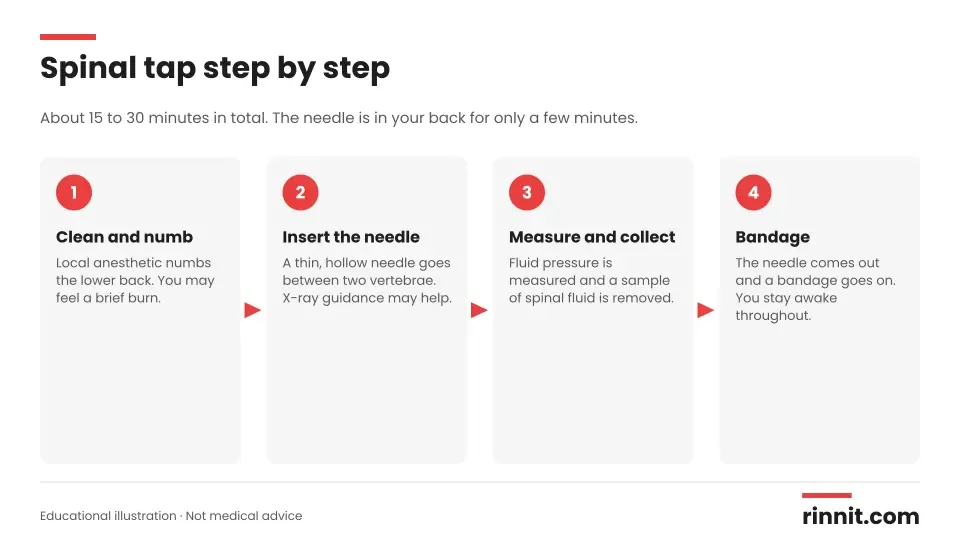
The whole procedure takes about 15 to 30 minutes, and the needle is in your back for only a few minutes. You get local anesthesia, not general anesthesia, so you stay awake but should not feel pain, only pressure. It may be done as an outpatient procedure in a medical office or in the hospital. [1]
Can a spinal tap damage the spinal cord?
No. The spinal cord ends higher up than the part of the lower spine where the needle goes in, so there is no risk of spinal cord damage from a lumbar puncture. [1]
What is recovery like after a lumbar puncture?
Your provider will give you aftercare instructions. These often include: [1]
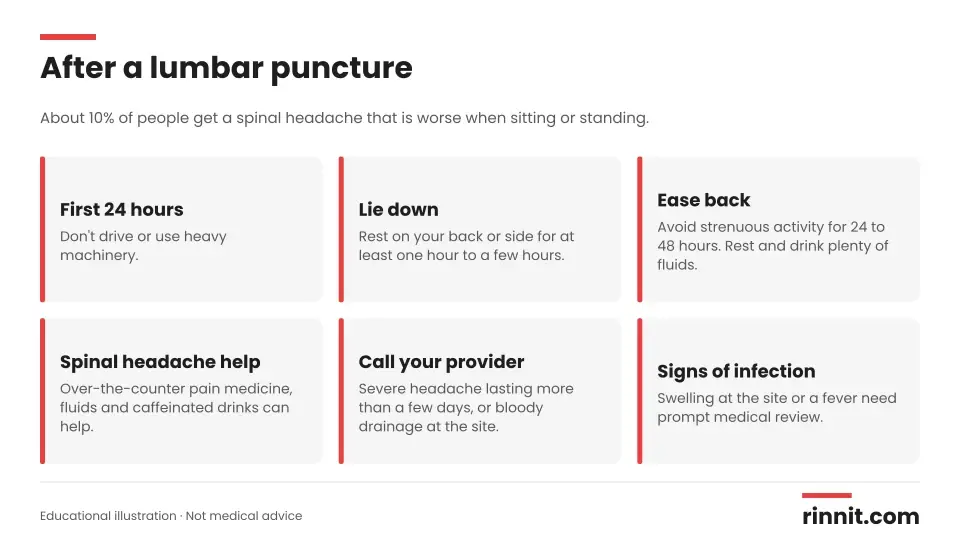
No driving or using heavy machinery for 24 hours
Lying on your back or side for at least one hour to a few hours
Avoiding strenuous activity or exercise for 24 to 48 hours
Getting plenty of rest
Drinking plenty of fluids
With your provider's approval, you may be able to return to work after the procedure. [1]
Spinal headache and other side effects
About 10% of people develop a spinal headache after a lumbar puncture. It causes intense pain when sitting or standing and can start within hours or days. It usually clears up in a couple of days but can last a week or more. It may come with a fast heart rate, low blood pressure or nausea. Over-the-counter pain medicine, fluids and caffeinated drinks can help. [1]
Side effect | How common or what to know |
Spinal headache | About 1 in 10 people; worse when upright, better lying down |
Infection, swelling or bleeding | Rare |
Lower back pain | Rare |
Spinal cord damage | No risk; the cord sits higher than the needle site |
Sources: [1]
Results and next steps
A lab tests the fluid for bacteria, fungi or abnormal cells, glucose (sugar), protein and white blood cells. These results help your provider rule conditions in or out. [1]
Results usually take two to three days. If the test was done urgently to check for a brain bleed or meningitis, results come back sooner. Next steps depend on what is found; for example, a high white blood cell count may point to an infection that antibiotics can treat. [1]
When should you call your doctor?
Call your healthcare provider if you have: [1]
A very painful headache that lasts more than a few days
Bloody discharge or drainage at the puncture site
Signs of infection, such as swelling or a fever
Conclusion
A lumbar puncture sounds frightening, but it is a short, common procedure with little risk. It gives your care team direct information about the fluid around your brain and spinal cord, which can be essential for diagnosing infections, bleeding and nerve conditions. [1]
Before your procedure, tell your provider about any blood thinners you take, and plan to rest and drink plenty of fluids afterward. If a headache becomes severe or lasts more than a few days, call your provider. Get emergency care right away for new numbness or weakness in your legs, loss of bladder or bowel control, or a headache with fever, stiff neck or confusion.
Keep learning: Read our guide to spinal headache after a lumbar puncture or learn about meningitis. For more background, see the lumbar puncture guide from the NHS.
FAQ
What is a lumbar puncture?
It is a procedure in which a thin needle in the lower back collects a sample of the fluid around your brain and spinal cord for testing. [1]
Is a lumbar puncture the same as a spinal tap?
Yes. Spinal tap is another name for a lumbar puncture. [1]
What can a lumbar puncture diagnose?
It can help diagnose meningitis, encephalitis, bleeding in the brain, multiple sclerosis, leukemia and other conditions. [1]
Does a lumbar puncture hurt?
A local anesthetic numbs the area, so you shouldn't feel pain, though you may feel pressure and a brief sting from the numbing shot. [1]
Will I be awake during a spinal tap?
Yes. You get local anesthesia, not general anesthesia, so you stay awake. [1]
How long does a lumbar puncture take?
It takes about 15 to 30 minutes, and the needle is in place for only a few minutes. [1]
How common is a headache after a lumbar puncture?
About 10% of people get a spinal headache, which usually goes away in a couple of days. [1]
Can a lumbar puncture damage the spinal cord?
No. The spinal cord sits higher than the area where the needle goes in. [1]
What should I avoid after a lumbar puncture?
Avoid driving for 24 hours and strenuous activity for 24 to 48 hours, and rest and drink plenty of fluids. [1]
When should I call my doctor after a lumbar puncture?
Call for a severe headache lasting more than a few days, bloody drainage at the site, or swelling or fever. [1]
Related Reading
Cisternogram Scan: Tracking Spinal Fluid Flow and Leaks explains the nuclear scan that tracks spinal fluid flow.
Cerebrospinal Fluid (CSF) Analysis: What It Tests, Procedure and Results explains the lab tests done on spinal fluid and what the results mean.
Spinal Headache After a Lumbar Puncture: Causes and Treatment explains the most common side effect after a spinal tap and how it's treated.
Understanding Meningitis: Symptoms, Causes, and Emergency Care covers the brain infection a lumbar puncture is most often used to confirm.
Subarachnoid Hemorrhage: Symptoms, Causes, Diagnosis, and Treatment Explained explains a type of brain bleed that spinal fluid testing can help detect.
What Is Multiple Sclerosis? A Plain-Language Guide to Symptoms, Types, and How It's Treated covers an autoimmune condition where spinal fluid tests support the diagnosis.
Guillain-Barré Syndrome: When the Immune System Turns on Your Nerves, and How Treatment Helps You Recover explains a nerve condition often checked with a spinal tap.
References
Cleveland Clinic. Lumbar Puncture (Spinal Tap): What It Is, Purpose & Procedure. Cleveland Clinic. Last updated January 26, 2024. https://my.clevelandclinic.org/health/diagnostics/12544-lumbar-puncture-spinal-tap
Arevalo-Rodriguez I, Muñoz L, Godoy-Casasbuenas N, et al. Needle gauge and tip designs for preventing post-dural puncture headache (PDPH). Cochrane Database Syst Rev. 2017;4:CD010807. PMID 28388808. https://doi.org/10.1002/14651858.CD010807.pub2
Maranhao B, Liu M, Palanisamy A, et al. The association between post-dural puncture headache and needle type during spinal anaesthesia: a systematic review and network meta-analysis. Anaesthesia. 2021;76(8):1098-1110. PMID 33332606. https://doi.org/10.1111/anae.15320
Medical disclaimer
This article is for general education only and does not replace advice from a qualified healthcare professional. Talk to your doctor about your own diagnosis and treatment, and seek emergency care right away for severe or sudden symptoms.



Comments