Cisternogram Scan: Tracking Spinal Fluid Flow and Leaks

Updated: 2 days ago
Written and medically reviewed by Dr. Baraa Alnahhal, MD · Last reviewed: November 2026 · How we review
Quick Answer
A cisternogram scan is a nuclear medicine imaging test that shows how cerebrospinal fluid (CSF) flows around the brain and spinal cord. A radioactive tracer is injected into the spinal fluid during a lumbar puncture, and images are taken over 1 to 3 days. It's used to find a CSF leak or a buildup of CSF, such as hydrocephalus.
What the research says
It finds spinal leaks: in 30 people with low-pressure headaches, cisternography showed a spinal fluid leak in 80%, and a blood patch relieved headaches in 71% vs. 14% with other care (Hyun SH et al., Clin Neurol Neurosurg, 2008) [2]
It's less useful for shunt decisions: in 76 people with normal-pressure hydrocephalus, cisternography didn't improve the accuracy of choosing who would benefit from a shunt (Vanneste J et al., Arch Neurol, 1992) [3]
Key takeaways
A cisternogram shows how spinal fluid flows around the brain and spine.
A tracer is injected during a spinal tap.
Images are taken over 1 to 3 days.
It helps find CSF leaks, hydrocephalus and shunt problems.
Spinal headache is the most common side effect.
What is a cisternogram?
CSF cushions your brain and spinal cord and normally flows in a steady pattern before being absorbed. A cisternogram tracks this flow. If fluid leaks out, tracer appears outside its normal path. If fluid doesn't drain properly, tracer may collect in the brain's fluid spaces (ventricles). It differs from a myelogram, which uses X-ray contrast to show the spinal canal's shape. Sources: [1]
Why it's done

The scan tracks how spinal fluid moves.
Suspected CSF leak, with too little pressure.
Suspected CSF buildup, with too much pressure.
Checking a shunt that drains fluid.
Symptoms such as balance problems, dizziness, headaches, hearing loss, nausea and vomiting, neck pain, light or sound sensitivity or trouble concentrating. Sources: [1]
How to prepare
Most people need no special preparation; follow any eating or drinking instructions.
Arrange for someone to drive you home.
Tell your provider about allergies to local anesthetic or anesthesia.
Tell your provider if you might be pregnant.
Share all medicines and supplements, as some raise bleeding risk. Sources: [1]
What happens during the test

Imaging continues over 1 to 3 days.
A local anesthetic numbs your lower back; some people also get a sedative.
A lumbar puncture is done with X-ray guidance, and the tracer is injected into your spinal fluid.
You lie still for about an hour.
Images are taken with a special camera, often with CT, 1 to 6 hours later.
More images are taken at 24 hours and sometimes at 48 and 72 hours. Sources: [1]
Risks
Common side effects are pain at the injection site and headache, including a spinal headache from fluid leaking where the needle went in. Rare risks include allergic reaction, bleeding, infection, nerve damage and brain herniation. The radiation dose is very low. Spinal headaches usually go away on their own within a few hours or days. Sources: [1]
What the results mean
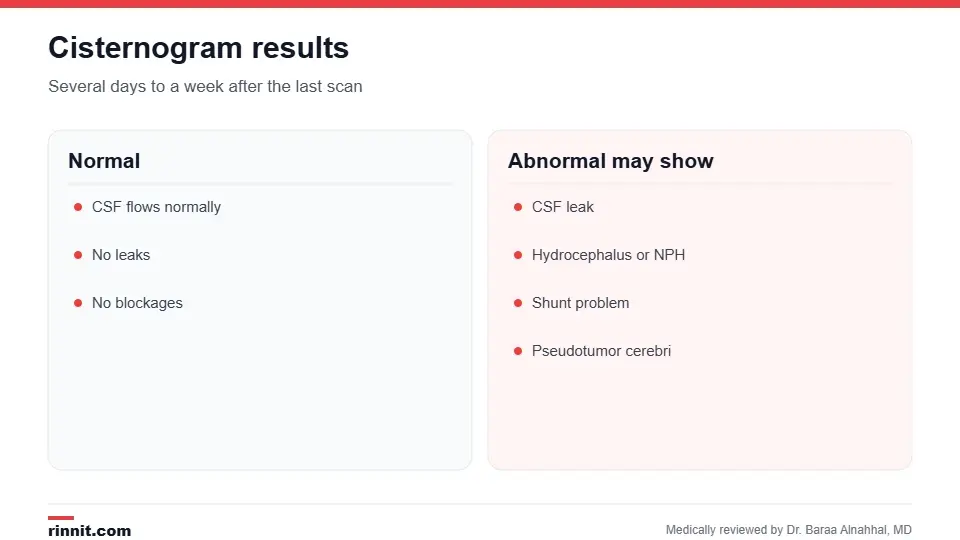
Results take several days to a week after the last scan.
Result | What it may mean |
Normal | CSF flows normally with no leaks or blockages |
Tracer outside the normal path | CSF leak |
Tracer collecting in the brain's ventricles | Hydrocephalus or normal-pressure hydrocephalus |
Abnormal shunt flow | Shunt problem |
Other possible findings include pseudotumor cerebri. Results come back several days to a week after the last scan. Research shows cisternography can locate spinal leaks in most people with low-pressure headaches, but it adds little when choosing who will benefit from a shunt for normal-pressure hydrocephalus. Sources: [1, 2, 3]
Conclusion
A cisternogram tracks how your spinal fluid moves over several days. It helps find leaks and drainage problems that can cause headaches, balance trouble and other symptoms, guiding treatment such as a blood patch or shunt.
Keep learning: read about CSF leaks and cerebrospinal fluid analysis.
Frequently asked questions
What is a cisternogram?
A nuclear scan that shows how spinal fluid flows.
How is the tracer given?
It's injected into your spinal fluid during a spinal tap.
How long does the test take?
Imaging continues over 1 to 3 days.
Does it hurt?
The spinal tap may be uncomfortable; your back is numbed.
What is a spinal headache?
A headache from fluid leaking at the needle site.
Will I be awake?
Usually yes, sometimes with a sedative.
Can I drive home?
No. Arrange a ride.
Is the radiation safe?
Yes. The dose is very low.
What can a cisternogram find?
CSF leaks, hydrocephalus and shunt problems.
When will I get results?
Several days to a week after the last scan.
Related Reading
Lumbar Puncture (Spinal Tap): Purpose, Procedure, Recovery and Results the procedure used to inject the tracer.
CSF Leak: Symptoms, Causes, Diagnosis, and Treatment — Complete Guide a condition the scan helps find.
Cerebrospinal Fluid (CSF) Analysis: What It Tests, Procedure and Results lab testing of spinal fluid.
Hydrocephalus: Symptoms, Causes & Treatment — What You Need to Know a CSF buildup the scan can show.
Nuclear Medicine Imaging: How Tracer Scans Work, Safety and Results an overview of tracer-based tests.
References
Cleveland Clinic. Cisternogram Scan: Radionuclide, Side Effects, Risks, Nuclear Medicine. Cleveland Clinic. Last updated March 22, 2022. https://my.clevelandclinic.org/health/diagnostics/16873-cisternogram-scan
Hyun SH, Lee KH, Lee SJ, et al. Potential value of radionuclide cisternography in diagnosis and management planning of spontaneous intracranial hypotension. Clin Neurol Neurosurg. 2008;110(7):657-661. PMID 18457913. https://doi.org/10.1016/j.clineuro.2008.03.014
Vanneste J, Augustijn P, Davies GA, et al. Normal-pressure hydrocephalus: is cisternography still useful in selecting patients for a shunt? Arch Neurol. 1992;49(4):366-370. PMID 1558516. https://doi.org/10.1001/archneur.1992.00530280046021
Medical disclaimer
This article is for general education only and does not replace advice from a qualified healthcare professional. Talk to your doctor about your own diagnosis and treatment, and seek emergency care right away for severe or sudden symptoms.



Comments