Cerebrospinal Fluid (CSF) Analysis: What It Tests, Procedure and Results

Updated: 2 days ago
Written and medically reviewed by Dr. Baraa Alnahhal, MD · Last reviewed: November 2026 · How we review
Quick Answer
Cerebrospinal fluid (CSF) analysis is a group of lab tests on the clear fluid that surrounds the brain and spinal cord. The fluid is usually collected with a lumbar puncture (spinal tap). It helps diagnose meningitis, encephalitis, multiple sclerosis, Guillain-Barré syndrome and bleeding around the brain. Some results are ready quickly, while others take about a week.
What the research says
Simple CSF values strongly point to bacterial meningitis: a JAMA systematic review found a CSF-to-blood glucose ratio of 0.4 or less (likelihood ratio 18), a CSF white cell count of 500/µL or more (likelihood ratio 15) and a CSF lactate of 3.5 mmol/L or more (likelihood ratio 21) accurately identified bacterial meningitis; small atraumatic needles may lower the risk of headache after the tap (Straus SE et al., JAMA, 2006) [2]
Oligoclonal bands support an MS diagnosis: a meta-analysis of 71 studies found 87.7% of people with multiple sclerosis had CSF oligoclonal bands, and people with a first episode (clinically isolated syndrome) who were band-positive had about 10-fold higher odds of going on to develop MS (Dobson R et al., J Neurol Neurosurg Psychiatry, 2013) [3]
Key takeaways
CSF analysis tests the fluid around your brain and spinal cord.
The sample usually comes from a lumbar puncture in your lower back.
The lab checks pressure, appearance, glucose, protein, cells, germs and antibodies.
It helps diagnose infections, MS, Guillain-Barré syndrome, bleeding and some cancers.
Headache is the most common side effect; lying down afterward may help.
What is CSF analysis?
Cerebrospinal fluid cushions your brain and spinal cord and carries nutrients and waste. Because it bathes the nervous system, changes in the fluid can reveal infection, inflammation, bleeding or cancer that blood tests can't show. Sources: [1]
What the lab checks
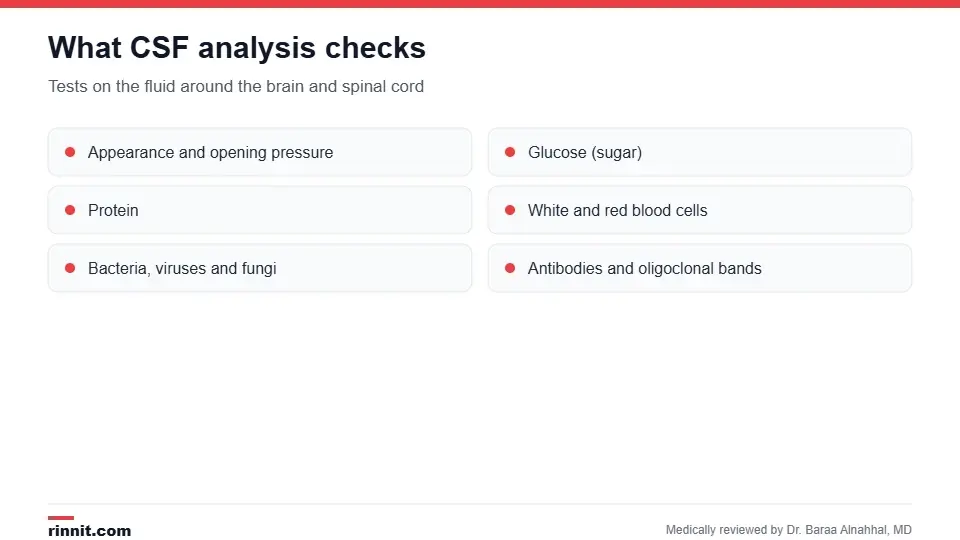
Each part of the analysis answers a different question.
Test | What it shows |
Appearance and opening pressure | Cloudiness, blood or raised pressure |
Glucose | Low levels often mean infection |
Protein | High levels suggest inflammation, infection or nerve damage |
Cell count | White cells suggest infection or inflammation; red cells suggest bleeding |
Microbes | Bacteria, viruses, fungi or tuberculosis |
Antibodies and oligoclonal bands | Immune activity in the nervous system, as in MS |
Conditions it helps diagnose
Infections such as bacterial meningitis and encephalitis.
Multiple sclerosis and other inflammatory conditions.
Bleeding around the brain.
Cancers that spread to the brain or spinal cord.
Markers that support a diagnosis of Alzheimer's disease. Sources: [1, 3]
How the sample is collected

A lumbar puncture usually takes less than 30 minutes.
You lie on your side with knees pulled up, or sit leaning forward.
The provider cleans and numbs the skin on your lower back.
A thin needle is placed between two lower vertebrae, below the end of the spinal cord, and a small amount of fluid is collected.
The needle is removed, a bandage is applied and you lie down for 30 to 60 minutes. Sources: [1]
Avoid heavy lifting and strenuous activity for about 24 hours. Sources: [1]
Risks
The most common side effect is a spinal headache, along with back pain or bruising. Bleeding, infection or brief leg tingling are rare. Smaller, atraumatic needles lower the headache risk. Sources: [1, 2]
Understanding results
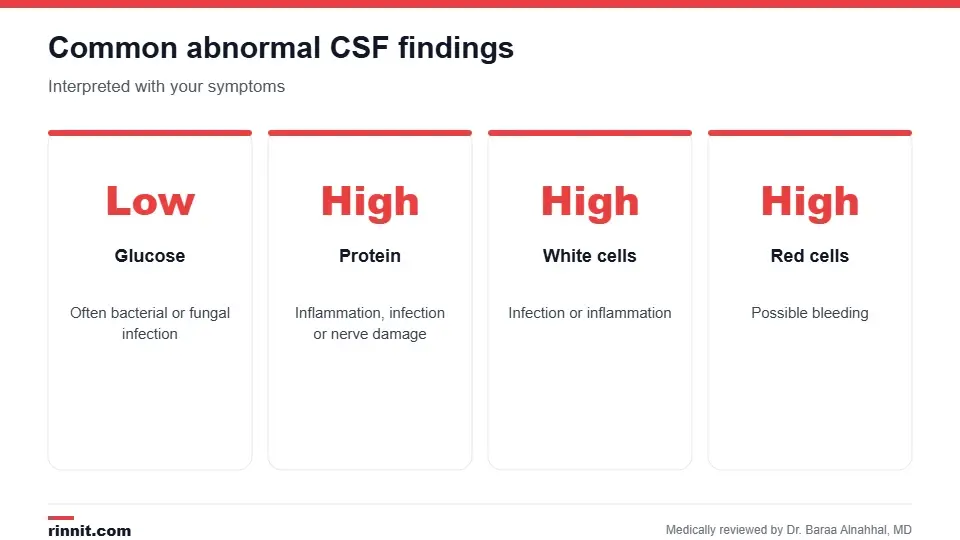
Patterns are interpreted together with your symptoms.
Low glucose often suggests a bacterial or fungal infection. High protein suggests inflammation or infection. Many white blood cells suggest infection, while red blood cells can mean bleeding. Oligoclonal bands support MS. Basic results can be ready within hours, but cultures and specialized tests can take about a week. Sources: [1, 2, 3]
Conclusion
CSF analysis gives a direct look at what's happening around the brain and spinal cord. It's a key test for serious infections and neurological conditions, and the collection is usually quick with mild, short-lived side effects.
Keep learning: read about the lumbar puncture and meningitis.
Frequently asked questions
What is cerebrospinal fluid?
The clear fluid that surrounds and protects your brain and spinal cord.
How is CSF collected?
Usually with a lumbar puncture (spinal tap) in the lower back.
Does a spinal tap hurt?
The skin is numbed; you may feel pressure and brief discomfort.
How long does it take?
The procedure usually takes under 30 minutes.
What can CSF analysis diagnose?
Meningitis, encephalitis, MS, Guillain-Barré syndrome, bleeding and some cancers.
What do oligoclonal bands mean?
They show immune activity in the nervous system and support an MS diagnosis.
What is the most common side effect?
A headache that's worse when sitting or standing.
What should I do afterward?
Lie down for 30 to 60 minutes and avoid heavy lifting for 24 hours.
How long do results take?
Basic results may be quick; full results can take about a week.
Does low CSF glucose mean infection?
It often suggests bacterial or fungal infection.
Related Reading
Cisternogram Scan: Tracking Spinal Fluid Flow and Leaks explains the nuclear scan that tracks spinal fluid flow.
Lumbar Puncture (Spinal Tap): Purpose, Procedure, Recovery and Results the procedure used to collect CSF.
Cerebrospinal Fluid (CSF): Functions, Anatomy, and Clinical Importance what CSF is and what it does.
Bacterial Meningitis: What It Is, Why It's a Medical Emergency, and How Vaccines and Antibiotics Fight It a medical emergency diagnosed with CSF analysis.
What Is Multiple Sclerosis? A Plain-Language Guide to Symptoms, Types, and How It's Treated a condition supported by CSF oligoclonal bands.
Spinal Headache After a Lumbar Puncture: Causes and Treatment the most common side effect and how to treat it.
References
Cleveland Clinic. Cerebrospinal Fluid Analysis. Cleveland Clinic. Last updated October 9, 2025. https://my.clevelandclinic.org/health/diagnostics/cerebrospinal-fluid-csf-analysis
Straus SE, Thorpe KE, Holroyd-Leduc J. How do I perform a lumbar puncture and analyze the results to diagnose bacterial meningitis? JAMA. 2006;296(16):2012-2022. PMID 17062865. https://doi.org/10.1001/jama.296.16.2012
Dobson R, Ramagopalan S, Davis A, et al. Cerebrospinal fluid oligoclonal bands in multiple sclerosis and clinically isolated syndromes: a meta-analysis of prevalence, prognosis and effect of latitude. J Neurol Neurosurg Psychiatry. 2013;84(8):909-914. PMID 23431079. https://doi.org/10.1136/jnnp-2012-304695
Medical disclaimer
This article is for general education only and does not replace advice from a qualified healthcare professional. Talk to your doctor about your own diagnosis and treatment, and seek emergency care right away for severe or sudden symptoms.



Comments