Autoimmune Encephalitis: Complete Guide to Symptoms, Causes & Treatment

Updated: 2 days ago
Medically reviewed by Dr. Baraa Alnahhal, MD · Last reviewed: October 2026
Quick Answer
Autoimmune encephalitis (AE) is a group of conditions that cause brain inflammation because the immune system mistakenly attacks brain cells, leading to memory loss, behavior changes and seizures. It can be triggered by certain cancers, infections or medicines. Without treatment it can be fatal, but many people make a full recovery, and earlier treatment means faster recovery.
What the research says
Most people with the best-studied type respond to immunotherapy, and earlier treatment predicts better recovery. In a cohort of 577 patients with anti-NMDA receptor encephalitis (211 of them children), 94% of the 501 assessable patients received first-line immunotherapy or tumor removal, and 53% improved within 4 weeks. Of 221 who did not improve, 57% received second-line therapy, which led to better outcomes (odds ratio 2.69, 95% CI 1.24–5.80). At 24 months, 81% of 252 patients with that follow-up had a good outcome, recovery continued for up to 18 months, early treatment predicted good outcomes, relapses occurred in 12% within 2 years, and 30 patients died during the first 24 months. (Titulaer et al., Lancet Neurol, 2013) [3]
Autoimmune and viral encephalitis can look alike, and both depend on early diagnosis and treatment. A review of clinical presentation notes that population-based studies show autoimmune and viral causes of encephalitis have similar prevalence and incidence rates, that the two can resemble one another, and that autoimmune encephalitis is sometimes triggered by a viral infection. It stresses that early diagnosis and treatment is key and that clinical diagnosis matters before laboratory confirmation. (Dubey et al., Curr Opin Crit Care, 2018) [4]
Autoimmune Encephalitis at a Glance
At a Glance | Details |
What it is | A group of conditions causing brain inflammation (swelling) because the immune system attacks brain cells |
Core mechanism | Antibodies target and attack receptors in the brain instead of viruses and bacteria |
Key symptoms | Memory loss, changes in thinking, changes in behavior, seizures, headaches, fever |
How it differs | Not caused by an infection — treated with different medicines than infectious encephalitis |
Number of types | Seven recognized types, each attacking a different brain receptor |
Most common type | Anti-NMDA-receptor autoimmune encephalitis |
Triggers | Certain cancers, infections (e.g., herpes simplex), certain medicines |
Risk factors | Autoimmune disease, family history of autoimmune disease, prior AE, prior herpes simplex encephalitis, tumors (especially small-cell lung cancer) |
Diagnosis | Symptom review, physical exam, antibody tests (blood and spinal fluid), MRI, EEG |
Treatment | Immunotherapy (IV methylprednisolone or IVIg), oral corticosteroids, plasma exchange, second-line medicines |
Outlook | Most people recover; earlier treatment means faster recovery and fewer lasting symptoms |
Note: This article is for general information only and is not a substitute for professional medical advice. Always consult a qualified healthcare professional for diagnosis and treatment.
What Is Autoimmune Encephalitis?
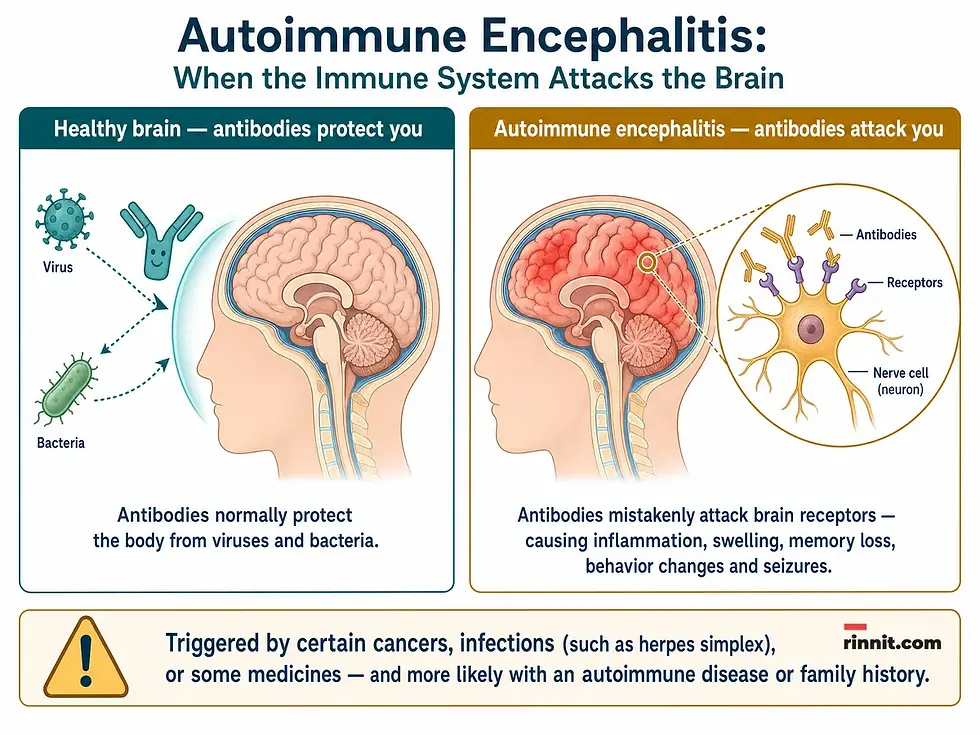
Autoimmune encephalitis (AE) is a group of conditions that causes swelling in the brain. This happens because the immune system mistakenly attacks brain cells. The resulting symptoms can vary but may include memory loss, changes in thinking, changes in behavior, and seizures.
It is important to understand how AE differs from the encephalitis people more commonly know about. Encephalitis caused by viral or bacterial infections is called infectious encephalitis. It is not caused by an immune reaction, and it is treated with different medicines. Interestingly, research has found that the number of people with autoimmune encephalitis is comparable to the number of people with infectious encephalitis — a reminder that this "rare" disease is more common than its reputation suggests.
Without treatment, autoimmune encephalitis can cause serious complications, including death. But treatments can lead to recovery. Many people with AE make a full recovery, but some can have lasting symptoms.
What are the symptoms of autoimmune encephalitis?
Symptoms can vary from person to person, but they can occur in a pattern that is predictable depending on the type of AE. The onset often begins deceptively: many people have a headache, fever, and other symptoms of an infection, followed by the neurological picture:
Symptom | What It Looks Like |
Psychiatric symptoms | Anxiety, panic attacks, changes in behavior, agitation, hallucinations, delusions, and trouble organizing thoughts |
Memory trouble | Difficulty remembering; memory loss |
Language trouble | Talking less, or repeating words or phrases |
Involuntary movements | Movements that are not voluntary; facial movements |
Seizures | From single seizures to severe episodes requiring emergency care |
Changes in consciousness | Altered awareness of surroundings |
Sleep changes | Less sleep at the beginning of the disease, followed by excess sleep during recovery |
The Dangerous Seizures: Status Epilepticus
Sometimes AE causes serious seizures that need emergency care, known as status epilepticus. These seizures last more than five minutes or occur one after another while the person is not conscious. This is a medical emergency.
Two Possible Disease Courses
AE symptoms can get worse over time — a course known as progressive. Alternatively, symptoms might alternate between getting better and getting worse, a course known as relapsing-remitting. These courses are similar to those people experience with multiple sclerosis.
When should you see a doctor about autoimmune encephalitis?
Get emergency medical care if you or someone you're with has serious symptoms of AE. This includes seizures that last more than five minutes or that happen one after another with a loss of consciousness. Also seek emergency care for high fevers or trouble breathing.
See your healthcare professional right away if you have any other symptoms of autoimmune encephalitis. AE can become serious quickly if not treated.
What Causes Autoimmune Encephalitis?
The causes are not known. What is known is the mechanism: in AE, the immune system mistakenly attacks healthy brain cells.
Antibodies are part of the immune system. They normally help protect the body from viruses, bacteria, and other illness-causing substances. But in autoimmune encephalitis, the antibodies target and attack certain receptors in the brain. This leads to swelling in the brain (inflammation) and the other symptoms.
Known triggers include:
Trigger | Details |
Certain cancers | When AE is triggered by cancer, it is known as paraneoplastic AE |
Infections | Such as from the herpes simplex virus |
Certain medicines | Such as monoclonal antibodies and medicines that suppress the immune system after a transplant |
People with an autoimmune disease or a family history of autoimmune disease may be more likely to develop AE.
What are the types of autoimmune encephalitis?
There are several different types of AE. Each type is caused by the immune system attacking different receptors in the brain — the receptor name is built into the type's name:
Type | Who It Affects | What It Causes |
Anti-NMDA-receptor AE | The most common type; often affects young women and children | Seizures, facial movements, psychosis, and other symptoms |
Anti-GABA-B receptor encephalitis | Related to a tumor, often small-cell lung cancer; average diagnosis age 60 | Seizures, confusion, memory loss |
Anti-GABA-A receptor encephalitis | Usually diagnosed around age 40; children can also have it | Seizures, movement disorders, changes in thinking and behavior |
Anti-AMPA receptor encephalitis | Usually affects women; average diagnosis age 62 | Confusion, memory loss |
Anti-LGI1 limbic encephalitis | Tends to affect men; average diagnosis age 60 | Memory loss, confusion, seizures |
Anti-CASPR2 associated encephalitis | Men more likely; average diagnosis age 60; can cause Morvan syndrome (hallucinations, memory loss, blood pressure changes, painful cramps) | Confusion, memory loss, sleep trouble, nerve pain |
Anti-IgLON5 disease | Average diagnosis age 64 | Sleep symptoms, including behaviors and movements after falling asleep |
What are the risk factors for autoimmune encephalitis?
Risk factors for AE include having had AE in the past (especially if it wasn't treated), having had herpes simplex virus encephalitis, taking monoclonal antibodies or medicines that suppress the immune system after a transplant, and having a tumor — especially small-cell lung cancer. Researchers are also studying whether certain genes may be related to AE.
What are the complications of autoimmune encephalitis?
Serious AE can lead to several dangerous complications:
Complication | What Happens |
Status epilepticus | Seizures needing emergency care; AE's attack on the brain can also lead to seizures and a condition called autoimmune epilepsy |
Respiratory failure | Not enough air entering the lungs; people may need mechanical ventilation (a machine that helps them breathe) |
Heart rate and blood pressure trouble | AE can affect heart rate, blood pressure, digestion, and urination — all autonomic functions |
High fevers | People with AE may have high fevers |
Relapse | The condition may come back after recovery; more likely after anti-LGI1 limbic encephalitis or anti-CASPR2 associated encephalitis |
Can autoimmune encephalitis be prevented?
AE can't always be prevented. But getting cancer screenings can help your healthcare professional find tumors and treat them early — which could prevent AE triggered by cancers. Talk with your healthcare professional about your cancer risk and whether cancer screening is recommended.

How is autoimmune encephalitis diagnosed?
Diagnosis involves a review of your symptoms, a physical exam, and several tests. Getting an accurate diagnosis matters because AE can be mistaken for other diseases — and sometimes people are incorrectly diagnosed with AE. Healthcare professionals use established criteria, looking for patterns of symptoms that signal AE and testing for signs that antibodies are attacking receptors in the brain. Tests also rule out other causes, such as infections or other autoimmune conditions.
Diagnostic Test | What It Does |
Lab tests (blood and spinal fluid) | Check for the antibodies that attack proteins and receptors in the brain. Spinal fluid — the cerebrospinal fluid surrounding the brain and spinal cord — is removed through a lumbar puncture: the lower back is numbed and a hollow needle removes fluid for testing |
Brain imaging (MRI) | Looks for signs of AE or rules out other causes; other imaging may look for a cancer that may have triggered AE |
EEG (electroencephalogram) | Tests the electrical activity of the brain; may show seizure activity, help diagnose AE, and rule out other conditions |
How is autoimmune encephalitis treated by calming the immune system?
Treatment focuses on the immune system, which is mistakenly attacking brain cells. If a tumor is causing AE, the first step is to diagnose and treat the tumor.
Immunotherapy
Immunotherapy works by reducing the immune system's activity and improving inflammation. Two types are given through an IV in the arm, usually in a hospital:
First-Line IV Immunotherapy | Schedule |
Methylprednisolone (Solu-Medrol) | A high-dose steroid given daily for 3 to 7 days |
Immunoglobulin (IVIg) | May be given daily for 2 to 5 days |
Other Treatment Options
Treatment | How It Works |
Oral corticosteroids | Start with a larger dose, then slowly lower the dose over weeks to months (tapering) |
Plasma exchange | Gets rid of the antibodies causing the attack: the liquid part of the blood is removed and separated from blood cells; the cells go back into the body and it makes more plasma |
If symptoms respond, doses are slowly lowered over time — an oral corticosteroid at a lower dose for several weeks, or monthly IV methylprednisolone or immunoglobulin for several months.
If Symptoms Don't Improve
If symptoms aren't improving, your provider may recommend rituximab (Rituxan, Truxima, others), cyclophosphamide, or tocilizumab (Actemra, Tofidence, Tyenne). These medicines can improve symptoms and lower the chances of AE coming back.
Recovery and the Long-Term Outlook
Most people recover with treatment, and the earlier treatment is received, the more quickly recovery may come — with lower chances of lasting symptoms or another bout of AE. Recovery is a marathon, not a sprint: full recovery may take months or years, and many people continue to have thinking and behavior symptoms longer than a year. But treatment continues to improve symptoms for 18 months to two years.
Rehabilitation may be needed if AE affected memory, thinking skills, or speech. Occupational and speech therapists, along with mental health professionals and other specialists, can help in recovery. Complications such as epilepsy, sleep conditions, and movement trouble may also need dedicated treatment. If cancer triggered the AE, you are treated for the cancer and monitored to check if it returns.
Be aware that some people who have recovered from certain types — such as anti-NMDA receptor encephalitis and anti-LGI1 encephalitis — are at risk of symptoms coming back, sometimes after several years.
How should you prepare for an autoimmune encephalitis appointment?
AE can cause serious symptoms that need emergency medical care. Your healthcare team includes specialists — doctors who specialize in the brain and nervous system are called neurologists. If your symptoms aren't as serious, you might start with your regular provider, who may refer you to a neurologist.
What You Can Do
When you make the appointment, ask if anything is needed in advance, such as fasting before a test. Make a list of:
Your symptoms (including any that seem unrelated)
Key personal information (major stresses, recent life changes, family medical history)
All medicines, vitamins, and supplements with doses
The questions you want to ask
Bring a family member or friend along, if possible.
Helpful questions include:
What's likely causing my symptoms, and what are other possible causes?
What tests do I need?
Is my condition likely short term or lasting?
What's the best course of action and what are the alternatives?
How can I manage this alongside my other health conditions?
Are there restrictions, and should I see a specialist?
What to Expect From Your Doctor
Your healthcare professional is likely to ask: When did your symptoms begin? Do they occur all the time or off and on? How bad are they? What seems to improve them, and what seems to worsen them?
Frequently Asked Questions (FAQ)
What is autoimmune encephalitis?
Autoimmune encephalitis (AE) is a group of conditions that causes swelling in the brain because the immune system mistakenly attacks brain cells. Symptoms can vary but may include memory loss, changes in thinking and behavior, and seizures.
How is it different from infectious encephalitis?
Infectious encephalitis is caused by viruses or bacteria, not by an immune reaction, and it is treated with different medicines. Research has found that the number of people with AE is comparable to the number with infectious encephalitis.
What causes autoimmune encephalitis?
The exact cause is unknown. Antibodies that normally protect the body instead attack receptors in the brain, causing inflammation. Known triggers include certain cancers, infections such as herpes simplex, and some medicines like monoclonal antibodies or post-transplant immunosuppressants.
What are the types of AE?
There are seven recognized types, each named for the brain receptor the antibodies attack: anti-NMDA (the most common), anti-GABA-B, anti-GABA-A, anti-AMPA, anti-LGI1, anti-CASPR2, and anti-IgLON5. They differ in who they affect, average age of diagnosis, and which symptoms they cause.
When is autoimmune encephalitis an emergency?
Get emergency care for seizures lasting more than five minutes, seizures occurring back-to-back with lost consciousness, high fevers, or trouble breathing. For any other AE symptoms, see a healthcare professional right away — the disease can become serious quickly if not treated.
How is it treated, and what is the outlook?
Treatment targets the immune system: IV methylprednisolone or immunoglobulin, oral corticosteroids with slow tapering, plasma exchange, and — if needed — rituximab, cyclophosphamide, or tocilizumab. Most people recover with treatment; earlier treatment means faster recovery and fewer lasting symptoms, though full recovery can take months or years.
Conclusion
Three lessons anchor this guide: the body's defenders have become the enemy — the same antibodies that shield you from germs can turn on brain receptors, so AE is not an infection and needs different medicines; it wears many masks — from psychosis and panic attacks to seizures and sleep upheaval, AE can imitate psychiatric illness, which is why accurate diagnosis through antibody testing, MRI, and EEG is so important; and time is recovery — most people recover with treatment, and the earlier immunotherapy starts, the faster the recovery and the smaller the chance of lasting symptoms or relapse.
This guide walked you through what AE is, the full symptom picture, the seven types, the triggers and risk factors, the dangerous complications, every diagnostic test, and the complete treatment path from IV immunotherapy to rehabilitation. If you or someone you love shows unexplained behavior changes with memory loss and seizures, the single most valuable step you can take is to seek medical care without delay.
What to do next: If you found this guide useful, explore more in-depth health guides on rinnit.com — including our guide to autoimmune epilepsy, the seizure condition that can arise from this same immune attack on the brain, and our guide to petit mal seizures, which covers another seizure type and its treatment.
This content is provided for general informational purposes only and is not a substitute for professional medical advice, diagnosis, or treatment. Always seek the advice of a qualified healthcare provider with any questions about a medical condition.
Related Reading
Electroencephalogram (EEG): Types, How to Prepare and What Results Mean explains how an EEG records brain activity and what to expect.
References
Mayo Clinic Staff. Autoimmune encephalitis — Symptoms and causes. Mayo Clinic. December 13, 2024. https://www.mayoclinic.org/diseases-conditions/autoimmune-encephalitis/symptoms-causes/syc-20576380
Mayo Clinic Staff. Autoimmune encephalitis — Diagnosis and treatment. Mayo Clinic. December 13, 2024. https://www.mayoclinic.org/diseases-conditions/autoimmune-encephalitis/diagnosis-treatment/drc-20576406
Titulaer MJ, McCracken L, Gabilondo I, et al. Treatment and prognostic factors for long-term outcome in patients with anti-NMDA receptor encephalitis: an observational cohort study. Lancet Neurol. 2013;12(2):157-165. PMID 23290630. https://doi.org/10.1016/S1474-4422(12)70310-1
Dubey D, Toledano M, McKeon A. Clinical presentation of autoimmune and viral encephalitides. Curr Opin Crit Care. 2018;24(2):80-90. PMID 29401173. https://doi.org/10.1097/MCC.0000000000000483



Comments