NIH Stroke Scale (NIHSS): What It Checks and What Your Score Means

Updated: 2 days ago
Written and medically reviewed by Dr. Baraa Alnahhal, MD · Last reviewed: November 2026 · How we review
Quick Answer: What is the NIH Stroke Scale?
The NIH Stroke Scale (NIHSS) is a quick test of stroke severity. A provider checks your awareness, consciousness, coordination, language and speech, movement and senses in about 15 parts, then adds up the points. Scores run from 0 to 42, and it takes less than 10 minutes and does not hurt. [1]
A score of 0 means no symptoms were found, 0 to 5 is a minor stroke, 6 to 15 moderate, 16 to 20 moderate to severe and 21 to 42 severe. [1]
What the research says
The scale is reliable across clinicians. In its original validation, the 15-item scale showed high interrater reliability (mean kappa 0.69), test-retest reliability did not differ among neurologists, residents and nurses, and scores correlated with infarct size on CT (r = 0.68) and with 3-month outcome (r = 0.79). (Brott et al., Stroke, 1989) [2]
The baseline score strongly predicts recovery. In 1,281 people with ischemic stroke, each extra NIHSS point lowered the chance of an excellent outcome by 24% at 7 days and 17% at 3 months; a score of 16 or more forecast a high chance of death or severe disability, while 6 or less forecast good recovery. (Adams et al., Neurology, 1999) [3]
Key takeaways
The NIH Stroke Scale measures how severe a stroke is. [1]
It checks awareness, consciousness, coordination, speech, movement and senses. [1]
Scores range from 0 to 42; higher scores mean more stroke-related problems. [1]
It takes under 10 minutes and is usually done in the emergency room. [1]
Repeat scores show whether symptoms are improving or worsening. [1]
What is the NIH Stroke Scale?
The NIH Stroke Scale, or NIHSS, is a quick assessment that measures how severe a stroke is. It checks how well your brain and nerves are working through about 15 parts, each testing a different skill. The higher your score, the more stroke-related problems you have. [1]
What does the NIH Stroke Scale check?
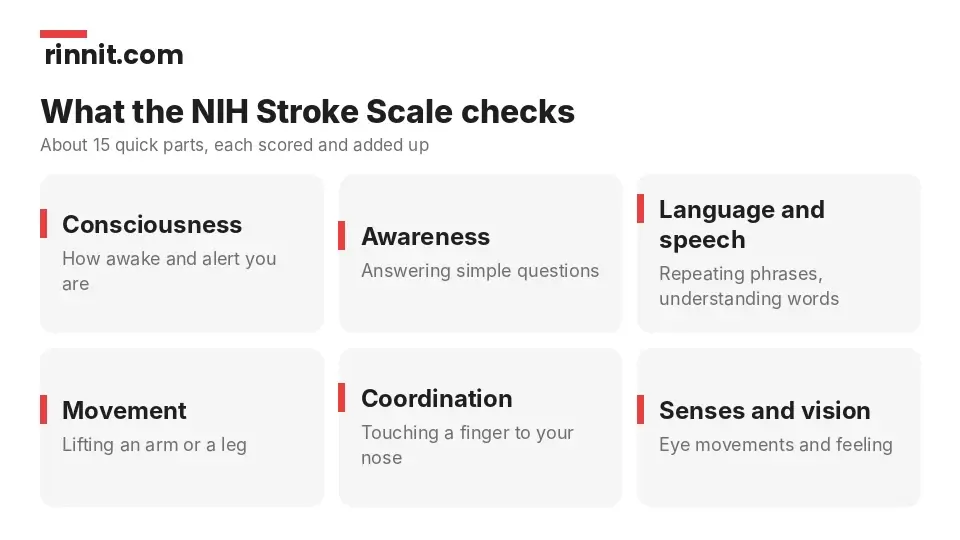
About 15 quick tasks across six skill areas.
The assessment looks at your: [1]
Awareness
Consciousness
Coordination
Language and speech
Movement
Senses
What will you be asked to do?
Your provider may ask you to: [1]
Follow simple instructions
Answer questions
Repeat phrases
Move your eyes
Lift a leg
Touch a finger to your nose
When is the NIH Stroke Scale used?
A healthcare provider does the assessment soon after a stroke is suspected or diagnosed, usually right away in the emergency room. This first score sets a baseline. [1]
Your care team may repeat it later, for example after starting a new treatment, to see whether your symptoms are getting better or worse. [1]
What happens during the assessment?
You do not need to prepare or fill out any forms. Your provider asks you to do each task and may write down your answers. The test does not hurt and takes less than 10 minutes. [1]
Your provider scores each part and adds them up. There is no partial credit, and your provider will not give hints. If you cannot respond, they can still score you by watching your movements. Not being able to do part of the test is not your fault. [1]
What does an NIH Stroke Scale score mean?
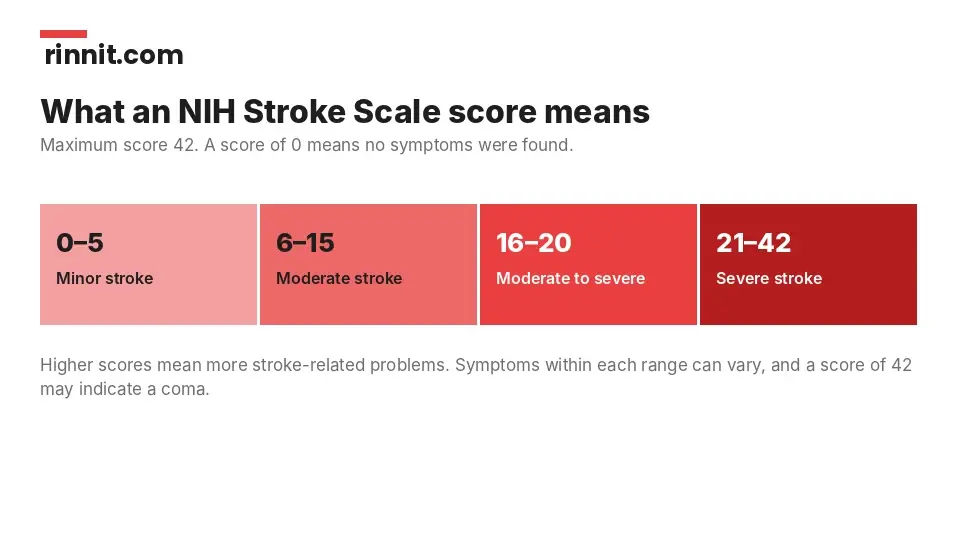
Higher scores mean a more severe stroke.
You get your results right after the assessment. The maximum score is 42, and a score of 0 means everything tested normally with no symptoms. [1]
NIHSS score | Stroke severity |
0 to 5 | Minor stroke |
6 to 15 | Moderate stroke |
16 to 20 | Moderate to severe stroke |
21 to 42 | Severe stroke |
Sources: [1]
Symptoms within each range can vary from person to person. A score of 42 may mean a person is in a coma. [1]
What happens after the assessment?
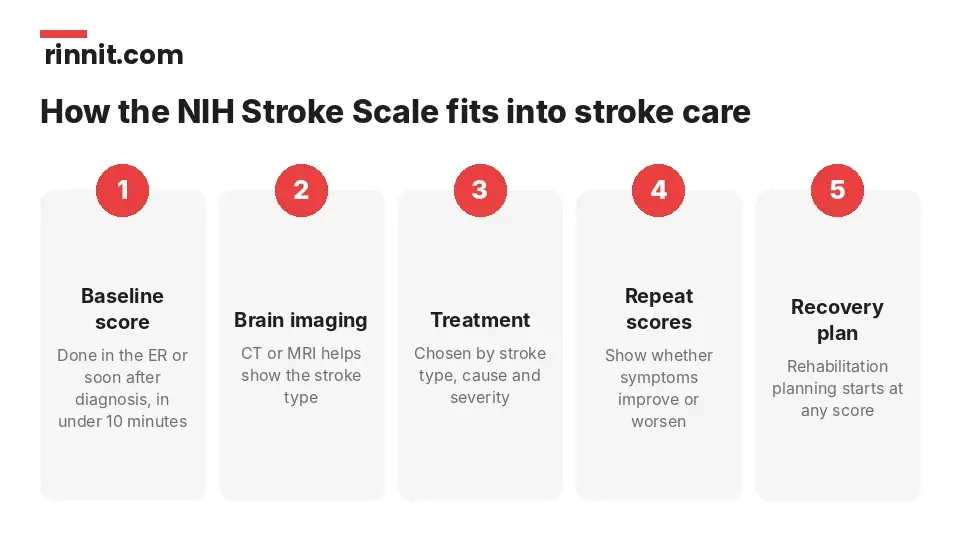
Your score guides the next steps of care.
Next steps depend on how severe your stroke is and what type it is. Your care team may order more tests, such as a CT scan or MRI of your brain. [1]
Treatment, such as clot-busting medicine or a procedure to remove a clot, depends on the type of stroke, how long ago symptoms started and how disabling they are, not just the score. Treatment also depends on what caused the stroke. Planning for recovery and rehabilitation starts no matter what your score is. [1]
Conclusion
The NIH Stroke Scale gives your care team a fast, shared way to measure how a stroke is affecting you. Your score guides which tests and treatments come next, and repeat scores show how you are responding. [1]
Whatever the number, recovery planning starts early. Ask your team to explain your score and how it shapes your treatment and rehabilitation. [1]
Keep learning: Read our stroke guide, learn about tPA for stroke, or see how the Glasgow Coma Scale rates consciousness. For more background, see MedlinePlus on stroke.
FAQ
What is the NIH Stroke Scale?
A quick exam that measures stroke severity by checking brain and nerve function. [1]
What does the NIHSS check?
Awareness, consciousness, coordination, language and speech, movement and senses. [1]
How many items are on the NIH Stroke Scale?
About 15 parts, each measuring a different skill. [1]
What is the highest NIHSS score?
42, which may indicate a coma. [1]
What does an NIHSS score of 0 mean?
Everything tested normally, with no stroke symptoms found. [1]
What NIHSS score is a minor stroke?
A score of 0 to 5. [1]
What NIHSS score is a severe stroke?
A score of 21 to 42. [1]
How long does the NIH Stroke Scale take?
Less than 10 minutes. [1]
Is the NIH Stroke Scale painful?
No. It involves simple tasks like answering questions and moving your limbs. [1]
Why is the NIHSS repeated?
To see whether symptoms improve or worsen, such as after a new treatment. [1]
Related Reading
Stroke: Symptoms, Causes, Diagnosis, and Treatment — A Complete Guide explains the condition the NIH Stroke Scale measures.
Transient Ischemic Attack (TIA): The Mini-Stroke That Is Actually a Warning covers the warning "mini-stroke" that can come before a stroke.
Thrombotic Stroke: Symptoms, Treatment, and Recovery explains strokes caused by a clot that forms in a brain artery.
Embolic Stroke (Brain Embolism): Symptoms, Causes, and Treatment explains strokes caused by a clot that travels to the brain.
Hemorrhagic Stroke: Emergency Recognition and Critical Care covers strokes caused by bleeding in the brain.
tPA for Stroke: The Clot-Busting Treatment Where Every Minute Counts explains a clot-busting treatment chosen partly by stroke severity.
Neurological Exam: What It Checks, What to Expect and What Happens Next explains the hands-on exam of the brain, spinal cord and nerves.
References
Cleveland Clinic. NIH Stroke Scale (NIHSS): What It Is & How To Use It. Cleveland Clinic. Last updated October 31, 2025. https://my.clevelandclinic.org/health/diagnostics/nih-stroke-scale
Brott T, Adams HP, Olinger CP, et al. Measurements of acute cerebral infarction: a clinical examination scale. Stroke. 1989;20(7):864-870. PMID 2749846. https://doi.org/10.1161/01.str.20.7.864
Adams HP, Davis PH, Leira EC, et al. Baseline NIH Stroke Scale score strongly predicts outcome after stroke: A report of the Trial of Org 10172 in Acute Stroke Treatment (TOAST). Neurology. 1999;53(1):126-131. PMID 10408548. https://doi.org/10.1212/wnl.53.1.126
Medical disclaimer
This article is for general education only and does not replace advice from a qualified healthcare professional. Talk to your doctor about your own diagnosis and treatment, and seek emergency care right away for severe or sudden symptoms.



Comments