Transient Ischemic Attack (TIA): The Mini-Stroke That Is Actually a Warning

Updated: 2 days ago
Medically reviewed by Dr. Baraa Alnahhal, MD · Last reviewed: September 2026
Editorial note: This article is based on two authoritative clinical reference pages on transient ischemic attack (TIA), combined with peer-reviewed and guideline-based epidemiology. It is written for general readers and does not replace professional medical care. Every claim below is traceable to a numbered reference at the end of the article.
TL;DR
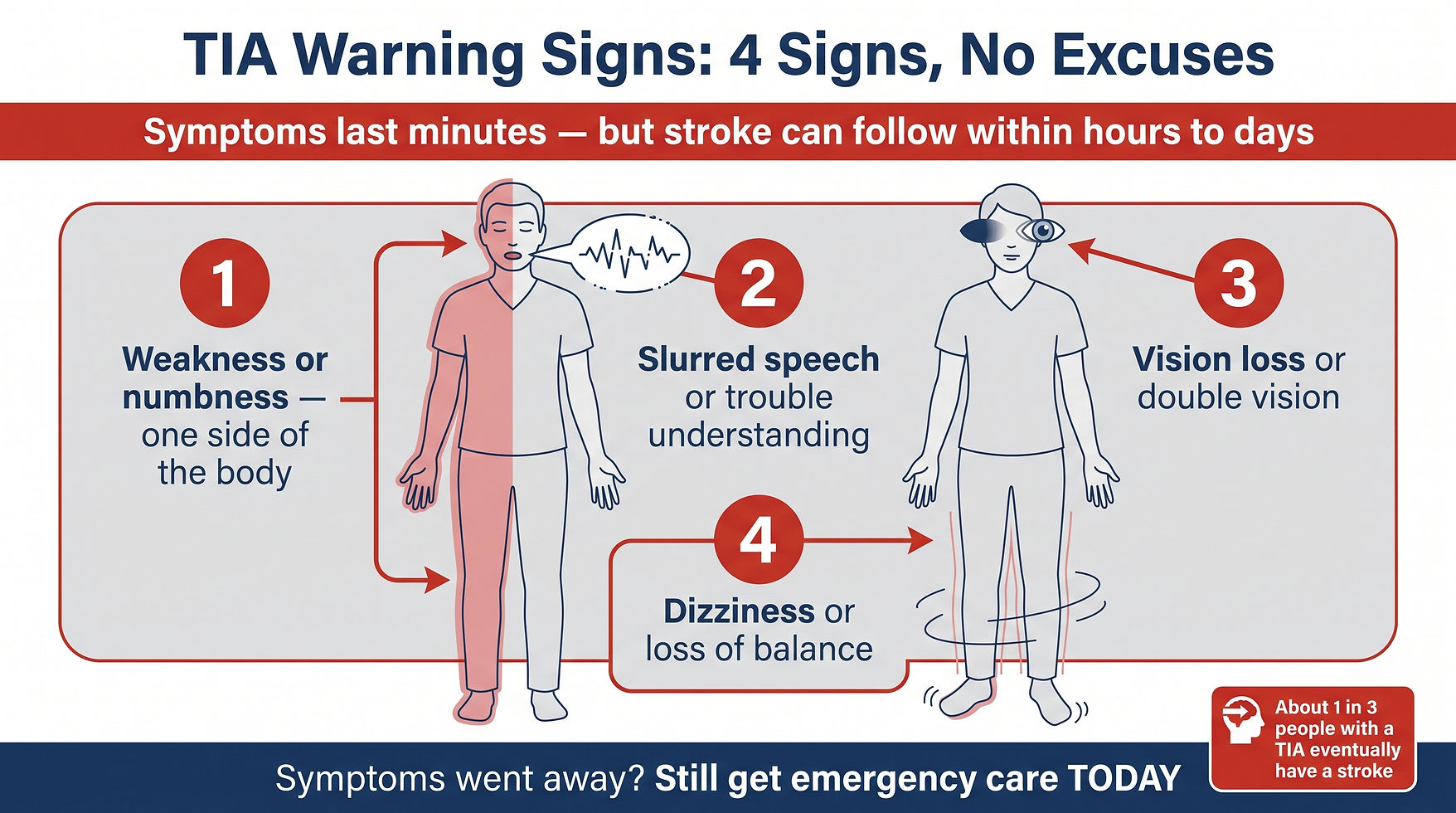
A transient ischemic attack (TIA) is a brief blockage of blood flow to the brain that causes stroke-like symptoms that typically resolve within minutes to an hour. It does not cause permanent damage — but it is one of the strongest warnings a body can send: roughly 1 in 3 people who have a TIA eventually have a stroke. Getting evaluated the same day allows doctors to find and treat the cause before a stroke occurs.
Quick Answer
A transient ischemic attack (TIA) is a "mini-stroke" caused by a temporary blockage of blood flow to the brain. Symptoms — such as one-sided weakness, slurred speech, or vision loss — usually last only minutes and leave no permanent damage. However, about 1 in 3 people who have a TIA will eventually have a stroke. Symptoms that resolve on their own still require immediate medical evaluation, because early treatment dramatically reduces the risk of a future stroke.
What Exactly Is a Transient Ischemic Attack?
A TIA is a short period of symptoms similar to those of a stroke, caused by a brief blockage of blood flow to part of the brain [1]. Unlike an ischemic stroke — the most common type of stroke — the blockage in a TIA is temporary, so it does not cause lasting brain damage [1].
Because the symptoms look like a stroke but disappear, people often call a TIA a ministroke. Clinicians think of it differently: a TIA is both a warning of a future stroke and, more importantly, a chance to prevent one [1].
The urgency comes from the numbers. About 1 in 3 people who has a TIA will eventually have a stroke, with roughly half of those strokes occurring within a year after the TIA [1]. Estimates suggest between 200,000 and 500,000 TIAs are diagnosed in the United States each year [3][4].
Quick facts | Detail |
|---|---|
What it is | A temporary blockage of blood flow to the brain |
Nickname | "Mini-stroke" |
Typical duration | A few minutes; most resolve within an hour; rarely up to 24 hours [1] |
Permanent damage | No — the blockage is brief [1] |
Long-term stroke risk | About 1 in 3 people eventually have a stroke; half within a year [1] |
Estimated annual U.S. cases | 200,000–500,000 [3][4] |
What to do | Seek emergency medical attention immediately [1] |
What Does a TIA Feel Like? The Four Warning Signs
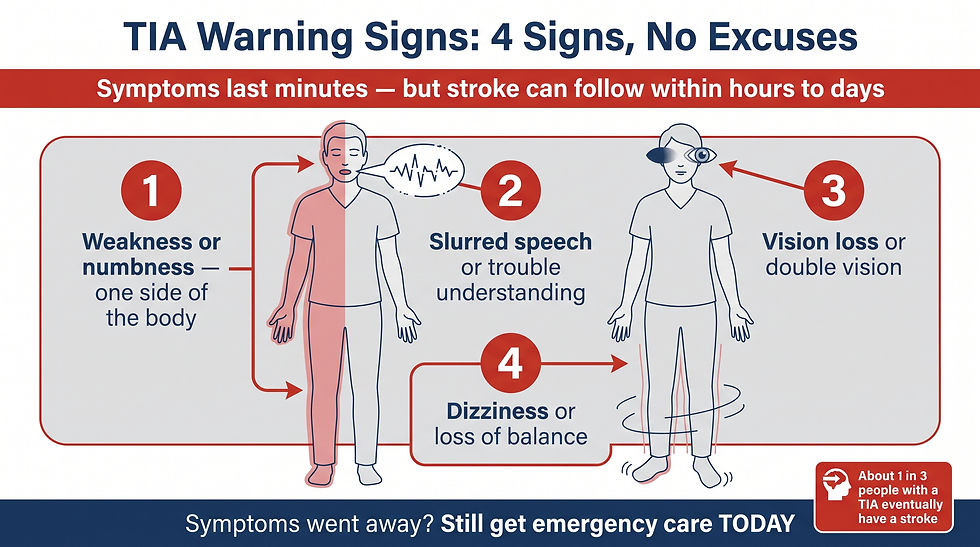
TIA symptoms begin suddenly and look just like early stroke symptoms. They usually last only a few minutes, and most disappear within an hour; rarely, symptoms may last up to 24 hours [1].
The four hallmark signs are weakness or numbness (typically on one side), speech problems, vision changes, and balance problems [1].
Symptom | How it typically presents |
|---|---|
Weakness, numbness, or paralysis | Affects the face, arm, or leg — usually on one side of the body [1] |
Speech difficulty | Slurred speech or trouble understanding what others are saying [1] |
Vision changes | Blindness in one or both eyes, or double vision [1] |
Balance problems | Dizziness or loss of balance or coordination [1] |
Because a TIA comes from whichever brain area briefly loses blood flow, you may have more than one TIA, and the symptoms of each episode may be similar or different depending on the area involved [1].
How Is a TIA Different from a Regular Stroke?

The mechanism is the same; the outcome is not. In both conditions, a blood clot blocks the blood supply to part of the brain. In an ischemic stroke, the blockage persists and brain tissue is damaged. In a TIA, the blockage is brief and the brain recovers [1].
Feature | Transient ischemic attack (TIA) | Ischemic stroke |
|---|---|---|
Cause | Brief clot or blockage in a brain artery | Clot blocks the brain artery and stays |
Duration | Minutes; most resolve within an hour; rarely up to 24 hours [1] | Symptoms are ongoing and persistent |
Brain damage | None — the blockage resolves [1] | Permanent damage to brain tissue |
Stroke risk afterward | About 1 in 3 people eventually have a stroke [1] | The stroke has already occurred |
Same treatment urgency | Yes — both need emergency evaluation [1] | Yes — both need emergency evaluation [1] |
This table matters for one practical reason: you cannot tell whether current symptoms are a TIA or the start of a stroke while they are happening. That is why every TIA warning sign deserves emergency attention, even if the symptoms fade on their own.
Why Did the TIA Happen? The Blockage Behind the Symptoms
The cause of a TIA is the same as the cause of an ischemic stroke. A brief blockage interrupts blood flow to part of the brain, but because it clears quickly, no permanent damage occurs [1].
Two mechanisms account for most TIAs. The first is atherosclerosis: cholesterol-containing fatty deposits called plaques build up in an artery — or in its branches that supply oxygen and nutrients to the brain — narrowing the passage and sometimes triggering a clot [1]. The second is a traveling clot: a blood clot that forms elsewhere in the body, most often the heart, and moves into an artery that supplies the brain [1].
Who Is at Higher Risk? Factors You Can and Cannot Change
TIA and stroke share a common set of risk factors. Some cannot be changed; knowing they exist helps you focus on the ones you can control [1].
Risk factor you cannot change | What it means |
|---|---|
Family history | Greater risk if a family member has had a TIA or stroke [1] |
Age | Risk rises with age, especially after 55 [1] |
Sex | Men have slightly higher risk; women's stroke risk increases with age [1] |
Prior TIA | Having had one or more TIAs makes a future stroke much more likely [1] |
Sickle cell disease | Stroke is a frequent complication; treating the disease lowers the risk [1] |
The controllable side of the list is long — and that is good news, because most of these are treatable.
Risk factor you can control — health conditions | What it means |
|---|---|
High blood pressure | Stroke risk begins to increase at readings of 140/90 mm Hg and higher [1] |
High cholesterol | Less cholesterol and fat — especially saturated and trans fat — can reduce arterial plaques; medicines such as statins help when diet is not enough [1] |
Cardiovascular disease | Includes heart failure, a heart defect, a heart infection, or a rhythm condition [1] |
Carotid artery disease | The blood vessels in the neck that lead to the brain become clogged [1] |
Peripheral artery disease (PAD) | Vessels carrying blood to the arms and legs become clogged [1] |
Diabetes | Speeds up and worsens the artery-narrowing process of atherosclerosis [1] |
High homocysteine | Elevated levels thicken and scar arteries, making them more clot-susceptible [1] |
Excess weight | Especially weight carried around the stomach [1] |
COVID-19 | Evidence suggests the virus may raise stroke risk [1] |
Risk factor you can control — lifestyle choices | What it means |
|---|---|
Cigarette smoking | Raises clot risk, blood pressure, and atherosclerosis; quitting lowers TIA and stroke risk [1] |
Physical inactivity | 30 minutes of moderate-intensity exercise most days helps lower risk [1] |
Poor nutrition | Less fat and salt decreases TIA and stroke risk [1] |
Heavy drinking | Limit to up to one drink a day for women, two for men [1] |
Illicit drug use | Avoid cocaine and other illicit drugs [1] |
Is a TIA an Emergency If the Symptoms Go Away?
Yes — and this is the single most important message in this article. TIAs most often occur hours or days before a stroke [1]. Being evaluated quickly means healthcare professionals can pinpoint treatable conditions and address them before a stroke happens [1].
Waiting for symptoms to return is the riskiest strategy. The historical data behind the 1-in-3 figure showed about 10–15% of TIA patients having a stroke within 90 days [3][6]. Modern studies show lower long-term rates — about a 6% three-year stroke risk in cohorts treated with today's preventive care [7][8] — which is exactly the point: the risk is high, but it drops sharply when evaluation and treatment begin quickly.
How Is a TIA Diagnosed?
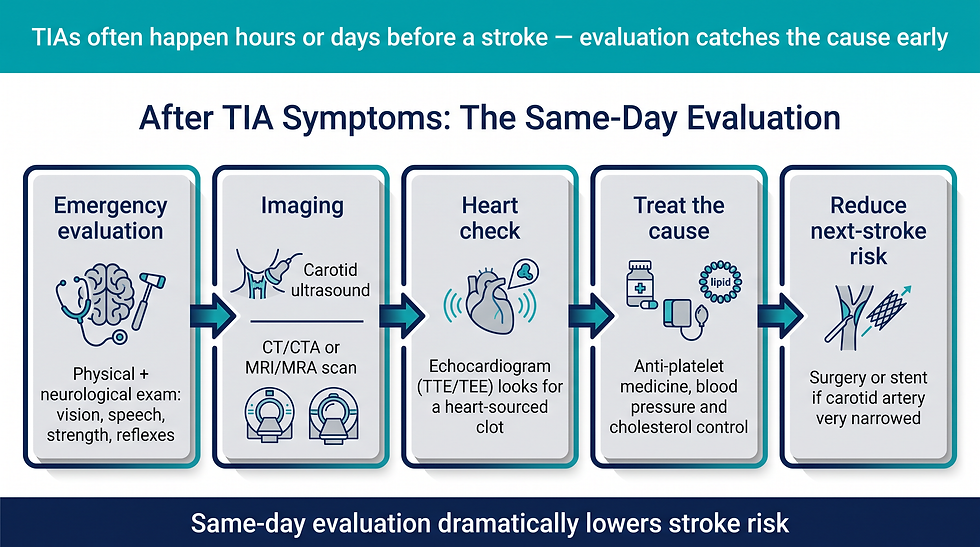
A prompt evaluation does double duty: it identifies the cause of the TIA and assesses your personal risk of a stroke [2]. The workup combines a physical exam with a set of imaging and heart tests [2].
Diagnostic step | What it looks for |
|---|---|
Physical and neurological exam | Vision, eye movements, speech and language, strength, reflexes, and the sensory system [2] |
Carotid listen (stethoscope) | A whooshing sound called a bruit may indicate atherosclerosis in the neck artery [2] |
Ophthalmoscope exam | Cholesterol or platelet fragments (emboli) in the tiny blood vessels of the retina [2] |
Risk factor check | Blood pressure, cholesterol, diabetes, and sometimes homocysteine levels [2] |
Carotid ultrasonography | Sound waves create images showing narrowing or clotting in the neck arteries [2] |
CT or CTA scan | X-ray-based 3D images of the brain and the arteries in the neck and head; CTA uses injected contrast and sees more vessels than ultrasound [2] |
MRI or MRA scan | Magnetic-field 3D views of the brain (MRI) and its arteries (MRA) [2] |
Echocardiography | TTE looks at the heart through the chest wall; TEE uses a probe down the esophagus for clearer images of clots that TTE can miss [2] |
Arteriography | A catheter guided from the groin into the neck arteries, with dye, to see vessels not visible on X-ray [2] |
The practical takeaway: diagnosis is fast, non-invasive in its first steps, and designed to find the specific cause — because the cause determines the treatment.
How Is a TIA Treated? Medicines That Prevent the Next Clot
Once the cause is known, the goal of treatment is to correct the issue and prevent a stroke [2]. The two main tracks are clot-preventing medicines and, in some cases, surgery to open a narrowed neck artery.
Anti-platelet drugs
Anti-platelet drugs make platelets — the blood cells that start clotting — less likely to stick together [2].
Medicine | Role after a TIA |
|---|---|
Aspirin | The most commonly used anti-platelet medicine; also the least expensive with the fewest potential side effects [2] |
Clopidogrel (Plavix) | An alternative to aspirin [2] |
Aspirin + clopidogrel | Prescribed together for about a month after the TIA; research shows the combination reduces future stroke risk more than aspirin alone in certain situations; sometimes continued longer when the cause is narrowing of a blood vessel in the head [2] |
Cilostazol | May be added with aspirin or clopidogrel when there is a serious blockage of a major artery [2] |
Ticagrelor (Brilinta) + aspirin | A 30-day combination shown to decrease recurrent stroke risk [2] |
Aspirin + dipyridamole | Low-dose combination that reduces blood clotting through two slightly different mechanisms [2] |
Anticoagulants
Anticoagulants lower clot risk by acting on the proteins in the clotting system rather than on platelets [2].
Medicine | Notes |
|---|---|
Heparin | Used short-term; rarely used in TIA management [2] |
Warfarin (Jantoven) | Effective but requires careful monitoring [2] |
Direct oral anticoagulants (DOACs) | For atrial fibrillation: apixaban (Eliquis), rivaroxaban (Xarelto), edoxaban (Savaysa), or dabigatran (Pradaxa); may be safer than warfarin because of lower bleeding risk [2] |
Surgery and procedures
When the problem is a very narrowed carotid artery in the neck, a procedure may be recommended [2].
Procedure | What it does |
|---|---|
Carotid endarterectomy | The surgeon opens the carotid artery, removes the fatty plaques blocking it, and closes the artery — preventive surgery performed before another TIA or stroke can occur [2] |
Carotid angioplasty with stent | A balloon-like device opens the clogged artery, and a small wire tube (stent) is placed inside to keep it open [2] |
What Can You Do to Prevent a TIA or a Second One?
Knowing your risk factors and living healthfully are the best prevention available — including regular medical checkups [1].
Prevention step | Detail |
|---|---|
Don't smoke | Quitting reduces TIA and stroke risk [1] |
Limit cholesterol and fat | Less saturated and trans fat may reduce arterial plaque buildup [1] |
Eat fruits and vegetables | Potassium, folate, and antioxidants may protect against TIA and stroke [1] |
Limit sodium | Helpful for people with high blood pressure; excess sodium raises blood pressure in some people [1] |
Exercise regularly | One of the few ways to lower blood pressure without medicine [1] |
Limit alcohol | No more than one drink daily for women, two for men [1] |
Maintain a healthy weight | Losing weight can lower blood pressure and improve cholesterol [1] |
Avoid illicit drugs | Cocaine and similar drugs raise TIA and stroke risk [1] |
Control diabetes and blood pressure | Managed with diet, exercise, weight control, and medicine when necessary [1] |
How Do I Prepare for a Doctor's Appointment About Stroke Risk?
A TIA is often diagnosed in an emergency situation, but you can plan ahead if you are concerned about stroke risk [2].
Prepare to discuss | Bring |
|---|---|
Stroke risk factors | Family history of stroke [2] |
Medical history | A list of all medicines, vitamins, and supplements [2] |
Key personal information | Lifestyle habits and major stressors [2] |
Your symptoms | Whether you think you've had a TIA, and what you experienced [2] |
Questions | Written in advance, ranked from most to least important [2] |
Expect your doctor to order tests to check your risk factors; you will get instructions on how to prepare, such as fasting before blood is drawn to check cholesterol and blood sugar [2].
Conclusion: A Disappearing Symptom Is Not a Disappearing Risk
A TIA can feel almost too brief to worry about — minutes of numbness, a minute of garbled speech, a flash of lost vision, and then normal life resumes. But the evidence is consistent: a TIA is the body's clearest available warning of an approaching stroke, and roughly 1 in 3 people who has one will eventually have a stroke.
The encouraging flip side is equally clear. Diagnosis is quick and non-invasive in its first steps, treatment options are effective at cutting clot risk, and the long-term stroke risk drops sharply when evaluation and prevention begin promptly. The window for acting is the same day the symptoms happen — not after a second episode.
Your next steps: if you or someone near you has had stroke-like symptoms that went away, get medical attention immediately — today, not next week. Control the risk factors you can: blood pressure, cholesterol, blood sugar, weight, smoking, and alcohol. If you've been told you have carotid artery narrowing, ask whether anti-platelet treatment or a procedure is right for you.
Frequently Asked Questions
Is a TIA the same as a mini-stroke? Yes. A transient ischemic attack (TIA) is commonly called a mini-stroke. It is a brief blockage of blood flow to the brain that causes stroke-like symptoms but no permanent damage [1].
How long does a TIA last? A TIA usually lasts only a few minutes. Most symptoms disappear within an hour; rarely, they may last up to 24 hours [1].
Can a TIA cause permanent brain damage? No. Unlike a stroke, the blockage in a TIA is brief, and there is no permanent damage [1]. However, the stroke risk afterward is significant, which is why urgent evaluation matters.
What are the first signs of a TIA? The key signs are weakness, numbness, or paralysis on one side of the body (face, arm, or leg); slurred speech or trouble understanding speech; blindness in one or both eyes or double vision; and dizziness or loss of balance or coordination [1].
Should I go to the ER if my TIA symptoms went away? Yes. TIAs most often occur hours or days before a stroke, and quick evaluation allows doctors to find and treat the cause before a stroke happens [1].
What are the chances of having a stroke after a TIA? About 1 in 3 people who has a TIA will eventually have a stroke, with about half of those occurring within a year [1]. Modern treatment lowers this long-term risk substantially, which is why early care is so important.
What tests will I get after a TIA? Expect a physical and neurological exam, blood pressure and lab checks, and imaging such as carotid ultrasound, CT/CTA, or MRI/MRA scans, plus heart testing (echocardiography) if a heart-sourced clot is suspected [2].
How do doctors prevent a stroke after a TIA? Most people receive anti-platelet medicine — often aspirin, sometimes combined with clopidogrel for about a month — and treatment of the underlying cause. People with a very narrowed carotid artery may be offered surgery (endarterectomy) or a stent procedure [2].
References
1. Transient ischemic attack (TIA) — Symptoms & causes — Mayo Clinic (updated February 9, 2024)
2. Transient ischemic attack (TIA) — Diagnosis & treatment — Mayo Clinic (updated February 9, 2024)
4. Transient Ischemic Attack: Part I. Diagnosis and Evaluation — American Academy of Family Physicians
8. Incidence of Transient Ischemic Attack and Association With Long-term Risk of Stroke — JAMA, 2021
Health information, not medical advice. This article is for general education and is not a substitute for professional diagnosis or treatment. Always consult a qualified healthcare provider about your own health, and seek emergency care for urgent symptoms.
Comments