Parathyroid Scan (Sestamibi): Finding Overactive Glands Before Surgery

Updated: 2 days ago
Written and medically reviewed by Dr. Baraa Alnahhal, MD · Last reviewed: November 2026 · How we review
Quick Answer
A parathyroid scan is an imaging test that finds enlarged, overactive parathyroid glands, the four tiny glands in the neck that control blood calcium. It's done when blood tests show hyperparathyroidism and surgery is planned, so the surgeon knows which gland to remove. The most common types are a neck ultrasound and a nuclear sestamibi (MIBI) scan.
What the research says
SPECT/CT improves accuracy: a review of 24 studies with 1,276 patients found that sestamibi scans combined with SPECT/CT correctly located the overactive gland in 86% of patients, compared with 74% for SPECT and 70% for standard planar images (Wong KK et al., Nuclear Medicine Communications, 2015) [2]
Several imaging tests work well: a review of 43 studies found sestamibi-SPECT located the gland with 78.9% sensitivity and ultrasound with 76.1%, with both highly accurate when positive (Cheung K et al., Annals of Surgical Oncology, 2012) [3]
Key takeaways
A parathyroid scan locates overactive parathyroid glands before surgery.
Common types are neck ultrasound and the sestamibi nuclear scan.
Overactive glands appear as "hot spots" that hold onto the tracer.
A sestamibi scan can take 2 to 5 hours, with a wait between pictures.
No side effects are expected, and you can drive home afterward.
What is a parathyroid scan?
Most people have four parathyroid glands behind the thyroid. When one or more becomes overactive, it releases too much parathyroid hormone, raising calcium levels. Blood tests diagnose the problem, but they can't show which gland is responsible. A parathyroid scan helps find it, including glands in unusual (ectopic) places such as the chest. Sources: [1]
Types of parathyroid scans
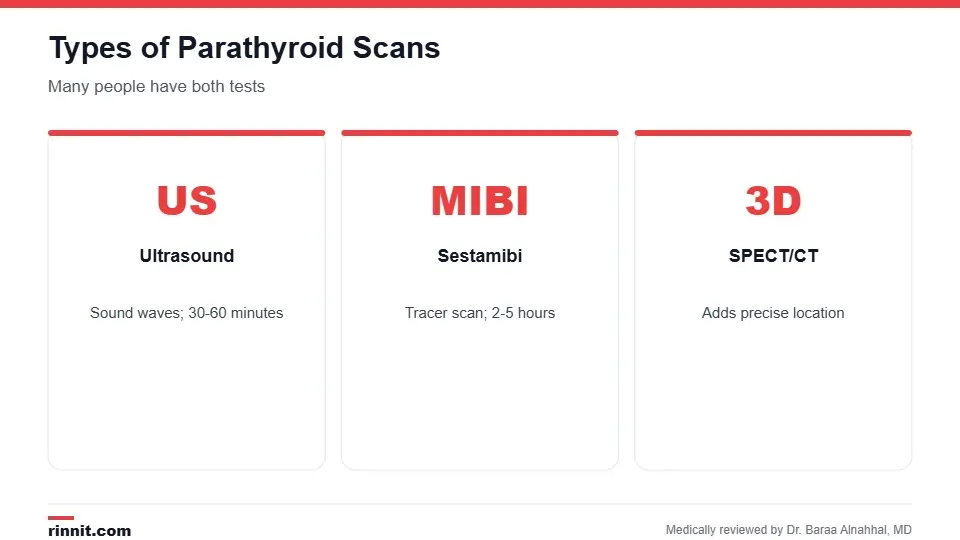
Many people have both tests.
Type | How it works | Time |
Neck ultrasound | Sound waves show an enlarged gland | 30 to 60 minutes |
Sestamibi (MIBI) nuclear scan | A tracer is taken up by overactive glands, which stay bright on later images | 2 to 5 hours |
SPECT or SPECT/CT | 3D images added to a sestamibi scan for more precise location | Added to the nuclear scan |
Sources: [1]
Why it's done
Blood tests show primary hyperparathyroidism, and surgery is the chosen treatment.
To find a gland in an unusual location.
To plan minimally invasive surgery through a small incision.
To look for a remaining overactive gland after earlier surgery. Sources: [1]
How to prepare
Follow any eating and drinking instructions.
Remove jewelry and neck accessories.
Tell your provider if you're pregnant, might be pregnant or are breastfeeding before a nuclear scan.
Bring a list of your medicines. Sources: [1]
What happens during the test

The total visit takes 2 to 5 hours.
Ultrasound: you lie on your back with a pillow under your neck, gel is spread on your skin and a probe is moved over your neck.
Sestamibi scan: a small amount of tracer is injected into a vein; you may feel a slight pinch.
A special camera takes pictures about 10 to 15 minutes after the injection.
More pictures are taken 90 minutes to 3 hours later. By then, normal thyroid tissue has cleared the tracer, but overactive parathyroid glands still hold it. Sources: [1]
Risks
No side effects are expected after a sestamibi scan, and the radiation dose is low. The ultrasound gel won't harm your skin or stain clothes. You can drive yourself home after the test. Sources: [1]
Results
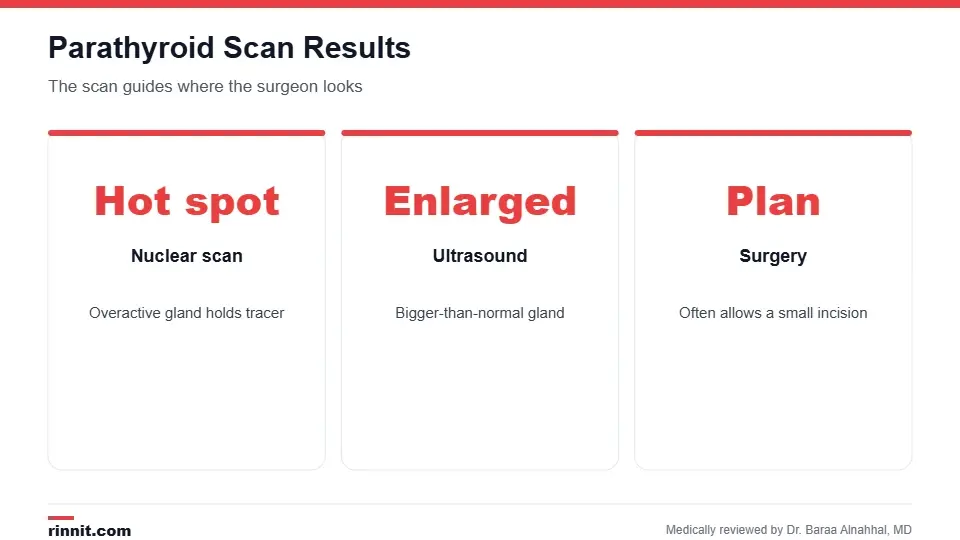
The scan guides where the surgeon looks.
A radiologist or nuclear medicine specialist interprets the images and sends a report to your provider and surgeon, usually with a follow-up visit within several days to a week. A hot spot on a nuclear scan, or an enlarged gland on ultrasound, usually marks the gland that needs to be removed. If no gland is seen, surgery may still be possible with a broader neck exploration. Sources: [1, 2, 3]
Conclusion
A parathyroid scan acts like a map for your surgeon. By finding the overactive gland before surgery, it often allows a smaller operation, a faster recovery and a better chance of curing hyperparathyroidism.
Keep learning: read about hyperparathyroidism and the thyroid ultrasound.
Frequently asked questions
What is a parathyroid scan?
An imaging test that finds overactive parathyroid glands.
What is a sestamibi scan?
A nuclear scan that uses a tracer to highlight overactive parathyroid glands.
Why do I need a parathyroid scan?
To show your surgeon which gland to remove.
How long does a sestamibi scan take?
About 2 to 5 hours, including the wait between pictures.
Does it hurt?
Only a slight pinch from the injection.
Are there side effects?
None are expected, and the radiation dose is low.
Can I drive home?
Yes.
What is a hot spot?
An area that holds the tracer, usually an overactive gland.
What if the scan doesn't find the gland?
Surgery may still be possible with a broader neck exploration.
When will I get results?
Usually within several days to a week.
Related Reading
Parathyroidectomy: Surgery, Success Rate and Recovery explains parathyroid surgery and recovery.
Hyperparathyroidism and High Calcium: What Overactive Parathyroid Glands Do to Your Bones and Kidneys the condition a parathyroid scan helps treat.
Parathyroid Glands: Function, Location, Calcium Balance and Common Conditions how the parathyroid glands work.
Thyroid Ultrasound: What It Shows, What to Expect and TI-RADS Results ultrasound of the neck and thyroid.
SPECT Scan: How It Works, What It Shows and What to Expect 3D nuclear imaging sometimes added to the scan.
Nuclear Medicine Imaging: How Tracer Scans Work, Safety and Results an overview of tracer-based scans.
References
Cleveland Clinic. Parathyroid Scan: What It Is, Results & Types. Cleveland Clinic. Last updated May 1, 2025. https://my.clevelandclinic.org/health/diagnostics/17322-parathyroid-scan
Wong KK, Fig LM, Gross MD, et al. Parathyroid adenoma localization with 99mTc-sestamibi SPECT/CT: a meta-analysis. Nuclear Medicine Communications. 2015;36(4):363-375. PMID 25642803. https://doi.org/10.1097/MNM.0000000000000262
Cheung K, Wang TS, Farrokhyar F, et al. A meta-analysis of preoperative localization techniques for patients with primary hyperparathyroidism. Annals of Surgical Oncology. 2012;19(2):577-583. PMID 21710322. https://doi.org/10.1245/s10434-011-1870-5
Medical disclaimer
This article is for general education only and does not replace advice from a qualified healthcare professional. Talk to your doctor about your own diagnosis and treatment, and seek emergency care right away for severe or sudden symptoms.



Comments