Thyroid Ultrasound: What It Shows, What to Expect and TI-RADS Results

Updated: 2 days ago
Written and medically reviewed by Dr. Baraa Alnahhal, MD · Last reviewed: November 2026 · How we review
Quick Answer: What is a thyroid ultrasound?
A thyroid ultrasound is a quick, painless imaging test that uses sound waves to show pictures of the thyroid and the tissue around it. It helps diagnose goiter, thyroid nodules and thyroid cancer, although it can't diagnose cancer by itself. It takes about 30 minutes and has no risks. [1]
What the research says
No single ultrasound feature can confirm thyroid cancer. A meta-analysis of 52 studies with 12,786 thyroid nodules found that features such as a taller-than-wide shape, tiny calcium specks (microcalcifications) and irregular edges were strongly linked with cancer, with specificities of 96.6%, 87.8% and 83.1%. On their own, though, none was reliable enough to decide which nodules need a biopsy. (Remonti et al., Thyroid, 2015) [2]
Scoring systems help decide which nodules need a biopsy. A meta-analysis of 12 studies covering 18,750 nodules compared five ultrasound risk systems and found that ACR TI-RADS performed better than the ATA and K-TIRADS systems at selecting nodules for fine-needle aspiration. (Castellana et al., The Journal of Clinical Endocrinology & Metabolism, 2020) [3]
Key takeaways
A thyroid ultrasound uses harmless sound waves to show your thyroid and the tissue around it in real time. [1]
It helps diagnose goiter, thyroid nodules or cysts, swollen neck lymph nodes and thyroid cancer. [1]
Most people have one as a follow-up after a scan finding, unusual lab results or symptoms. [1]
You don't need any special preparation, and the test usually takes about 30 minutes. [1]
Your report may include a TI-RADS score, which helps classify thyroid nodules and plan next steps. [1]
A thyroid ultrasound can't diagnose cancer; a thyroid biopsy may be needed. [1]
What is a thyroid ultrasound?

A thyroid ultrasound is a painless imaging test that lets your provider look at your thyroid and the tissue around it in your neck. Providers sometimes call it a sonogram or echogram. Thyroid ultrasounds are the most common thyroid imaging tests. [1]
It can help diagnose: [1]
Goiter, an enlarged thyroid
Swollen lymph nodes in your neck (cervical lymphadenopathy)
Thyroid cancer
Thyroid nodules or cysts
Why would you need a thyroid ultrasound?
Most of the time, your provider orders a thyroid ultrasound as a follow-up test. For example, you might need one if: [1]
Your provider sees a nodule on your thyroid during a CT scan
You have unusual lab test results
You have symptoms that can be signs of a thyroid problem
Your provider needs new pictures of a thyroid nodule they diagnosed in the past
Less often, your provider orders an ultrasound after feeling your thyroid during a physical exam. If they see something unusual on the ultrasound, they'll suggest other tests or treatments. [1]
How does a thyroid ultrasound work?
An ultrasound machine bounces sound waves off your thyroid, so your provider can see real-time pictures or video of what's happening under your skin. Thyroid ultrasounds work well because your thyroid is easy to reach: it sits only about an inch and a half under the skin of your neck, so the handheld wand (transducer) can scan it easily. [1]
How do you prepare for a thyroid ultrasound?
There's no special preparation. Your provider may even do the test right away if they feel something they want to examine during your checkup. If you have a separate appointment, you won't need to change your daily routine: you can eat, drink and take your usual medicines on the day of your ultrasound. [1]
Because your provider needs access to your neck, wear loose, comfortable clothing and avoid neck jewelry you can't easily remove. [1]
What happens during a thyroid ultrasound?
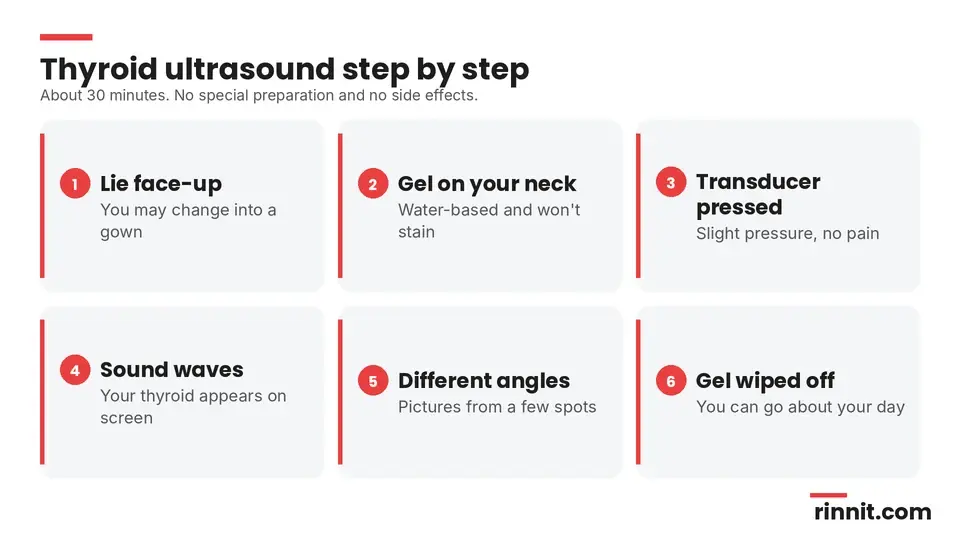
A thyroid ultrasound is quick and easy. It involves a few steps: [1]
You may take off your shirt and change into a hospital gown, then lie face-up on an exam table.
Your provider puts a small amount of water-based gel on your neck near your thyroid and places a towel around your neck to protect your clothes. The gel won't stain.
Your provider presses a handheld wand (transducer) over the gel. It might feel slightly uncomfortable, but it shouldn't hurt.
The transducer sends sound waves into your neck, and as they bounce off your thyroid, the image appears on the machine's screen.
Your provider may move the transducer to a few spots to take pictures from different angles.
When they have all the pictures they need, they wipe the gel off your neck.
How long does a thyroid ultrasound take?
It usually takes around 30 minutes from start to finish. The exact time depends on what your provider is looking for and how many pictures they need. [1]
Are there any risks?
There are no risks or side effects. The sound waves are harmless; you won't hear or feel them, and they can't damage your body. The gel may feel cold at first, but it's nontoxic and won't hurt your skin. [1]
What do thyroid ultrasound results mean?

A thyroid ultrasound shows your thyroid and any growths or changes around it, including whether your thyroid is larger than usual. Your provider will tell you if your results are normal or abnormal. [1]
Result | What it means |
Normal | Everything around your thyroid looks as it should, and your thyroid is its usual size |
Growths on or around the thyroid | Nodules or cysts that may need monitoring or more tests |
Inflammation (thyroiditis) | Signs that the thyroid is inflamed |
Enlarged thyroid | Your thyroid is larger than it should be, as in goiter |
Sources: [1]
An abnormal result doesn't automatically mean something serious; it means your provider needs to check on something. [1]
What is a TI-RADS score?
Your report may include a TI-RADS score. It helps doctors classify thyroid nodules and decide what to do next. Your provider will explain your score and any other tests or treatments you need. [1]
Can a thyroid ultrasound show cancer?
A thyroid ultrasound can't diagnose cancer. But it does show your provider whether there are new or changing growths on your thyroid. If anything on the ultrasound might be thyroid cancer, your provider may suggest a thyroid biopsy. [1]
When should you call your provider?
Call your provider if you notice pain or changes in your neck, or if you can see swelling around your thyroid. Other signs of a thyroid condition may include: [1]
An unusual heartbeat
Depression or anxiety
Irregular periods
Heat or cold bothering you more than usual
Unexplained weight loss or weight gain
Questions to ask your provider
Why do I need a thyroid ultrasound?
Did you find any nodules, and how big are they?
What is my TI-RADS score, and what does it mean?
Do I need a thyroid biopsy or a repeat ultrasound?
Should I also have thyroid blood tests?
Conclusion
A thyroid ultrasound is one of the simplest tests in medicine: no preparation, no needles, no radiation and no side effects. In about half an hour, it shows your provider the size and shape of your thyroid and any nodules, cysts or inflammation.
It can't diagnose cancer on its own, but it guides what comes next, whether that's watching a nodule over time or doing a biopsy. Your provider will help you understand your results and any TI-RADS score.
Keep learning: Read our guides to the thyroid panel, the thyroid antibodies test, ultrasound and biopsy.
FAQ
What is a thyroid ultrasound?
A thyroid ultrasound is a painless imaging test that uses sound waves to show real-time pictures of your thyroid and the tissue around it in your neck. [1]
What does a thyroid ultrasound look for?
It looks at your thyroid's size and shape and checks for nodules, cysts, inflammation and swollen neck lymph nodes. [1]
Do I need to prepare for a thyroid ultrasound?
No. You can eat, drink and take your usual medicines. Wear loose clothing and avoid neck jewelry. [1]
How long does a thyroid ultrasound take?
It usually takes around 30 minutes. [1]
Does a thyroid ultrasound hurt?
No. The transducer may feel slightly uncomfortable, but it shouldn't hurt, and the gel may feel cold. [1]
Are there risks from a thyroid ultrasound?
No. There are no risks or side effects, and the sound waves can't damage your body. [1]
Can a thyroid ultrasound detect cancer?
It can't diagnose cancer, but it shows new or changing growths. A thyroid biopsy may be needed. [1]
What is a TI-RADS score?
TI-RADS is a scoring system on your report that helps doctors classify thyroid nodules and decide what to do next. [1]
What does an abnormal thyroid ultrasound mean?
It may show growths, inflammation (thyroiditis) or an enlarged thyroid. It means your provider needs to check on something, not that it's serious. [1]
Why would a doctor order a thyroid ultrasound?
Usually as a follow-up after a nodule seen on another scan, unusual lab results, thyroid symptoms or to recheck a known nodule. [1]
Related Reading
Parathyroid Scan (Sestamibi): Finding Overactive Glands Before Surgery explains the scan that finds overactive parathyroid glands before surgery.
Learn more in our guide to Thyroid Nodules: Symptoms, Causes, Diagnosis and Treatment — What You Need to Know.
Learn more in our guide to Goiter: What a Neck Bulge Means, the 7 Causes, and How Treatment Protects Your Thyroid.
Learn more in our guide to Thyroid Cancer: Symptoms, Causes, Diagnosis and Treatment — What You Need to Know.
Learn more in our guide to Papillary Thyroid Cancer (PTC): Symptoms, Diagnosis, and Treatment.
Learn more in our guide to Thyroiditis: Types, Symptoms, Phases, Diagnosis and Treatment.
References
Cleveland Clinic. Thyroid Ultrasound: What It Is & What It Shows. Cleveland Clinic. Last updated May 6, 2025. https://my.clevelandclinic.org/health/diagnostics/thyroid-ultrasound
Remonti LR, Kramer CK, Leitão CB, et al. Thyroid ultrasound features and risk of carcinoma: a systematic review and meta-analysis of observational studies. Thyroid. 2015;25(5):538-550. PMID 25747526. https://doi.org/10.1089/thy.2014.0353
Castellana M, Castellana C, Treglia G, et al. Performance of Five Ultrasound Risk Stratification Systems in Selecting Thyroid Nodules for FNA. J Clin Endocrinol Metab. 2020;105(5):dgz170. PMID 31690937. https://doi.org/10.1210/clinem/dgz170
Medical disclaimer
This article is for general education only and does not replace advice from a qualified healthcare professional. Talk to your doctor about your own diagnosis and treatment, and seek emergency care right away for severe or sudden symptoms.



Comments