Thyroid Panel Blood Test: TSH, T3, T4 and Antibodies Explained

Updated: 4 days ago
Written and medically reviewed by Dr. Baraa Alnahhal, MD · Last reviewed: November 2026 · How we review
Quick Answer: What is a thyroid panel?
A thyroid panel is a blood test that measures hormones your thyroid makes and antibodies that can affect it. It usually checks TSH, T4 or free T4, T3 or free T3, and sometimes thyroid antibodies such as TPO. The results help diagnose an underactive or overactive thyroid and show whether thyroid medicine is working. [1]
What the research says
Thyroid problems are common and often hidden. In a U.S. sample of 17,353 people, hypothyroidism was found in 4.6% and hyperthyroidism in 1.3%, and many people did not know they had a thyroid problem. (Hollowell et al., The Journal of Clinical Endocrinology & Metabolism, 2002) [2]
Antibodies are common too. The same survey found TgAb in 10.4% and TPOAb in 11.3% of people, more often in women and with age. (Hollowell et al., The Journal of Clinical Endocrinology & Metabolism, 2002) [2]
Many cases go undiagnosed. A European meta-analysis estimated undiagnosed thyroid dysfunction at 6.71%: 4.94% hypothyroidism and 1.72% hyperthyroidism. (Garmendia Madariaga et al., The Journal of Clinical Endocrinology & Metabolism, 2014) [3]
Key takeaways
A thyroid panel measures thyroid hormones and, in some panels, thyroid antibodies. [1]
A standard panel checks TSH, T3 and T4; a full panel adds antibodies and thyroglobulin. [1]
It is a quick blood draw with minimal risk. [1]
Results can take up to a week. [1]
Your provider reads all the results together, not one number alone. [1]
What does a thyroid panel measure?
Your thyroid is a gland in your neck that makes hormones that control how your body uses energy. A thyroid panel shows how well it is working and can point to a thyroid disorder. [1]
There are different types of panels, and your provider chooses the one that fits your symptoms and history. [1]
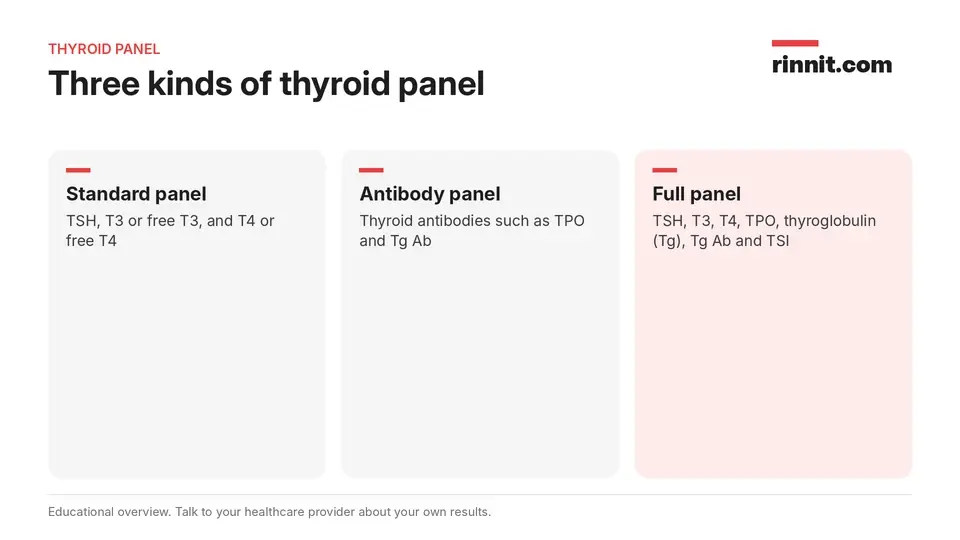
Panel type | What it measures |
Standard thyroid panel | TSH, T3 or free T3, and T4 or free T4 |
Thyroid antibody panel | Thyroid antibodies such as TPO and Tg Ab |
Full thyroid panel | TSH, T3 or free T3, T4 or free T4, TPO, thyroglobulin (Tg), Tg Ab and TSI |
Sources: [1]
Who needs a thyroid panel?
You may need a thyroid panel if you have symptoms of a thyroid disorder. [1]
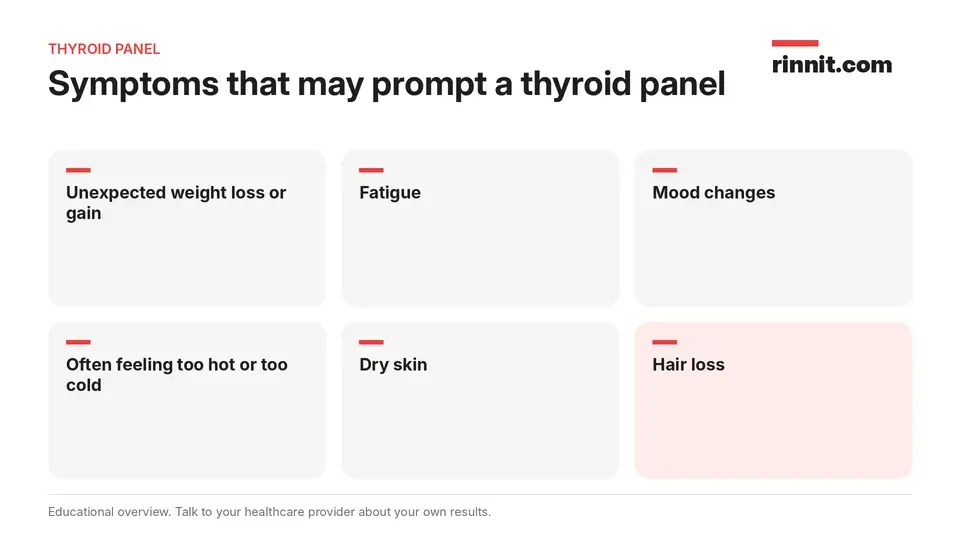
Unexpected weight loss or weight gain
Fatigue
Mood changes
Often feeling too hot or too cold
Dry skin or hair loss
Providers also use thyroid panels to: [1]
Check overall thyroid function
Diagnose an underactive or overactive thyroid
See whether thyroid medicine is working
Screen people with risk factors for thyroid disease
Diagnose autoimmune thyroid conditions such as Graves' disease or Hashimoto's disease
How is a thyroid panel done?
A healthcare provider takes a blood sample from a vein in your arm, which takes just a few minutes. Tell your provider if you take biotin supplements, because biotin can make thyroid test results falsely high or low. The sample goes to a lab, and your provider receives a report of your hormone and antibody levels. [1]
The only risks are those of any blood draw. They are minimal and usually minor, such as bruising, swelling or mild pain where the needle went in. [1]
What are normal thyroid panel results?
Each hormone and antibody is measured separately and compared with its normal range. Then your provider looks at how all the results fit together. In general, providers prefer these results: [1]
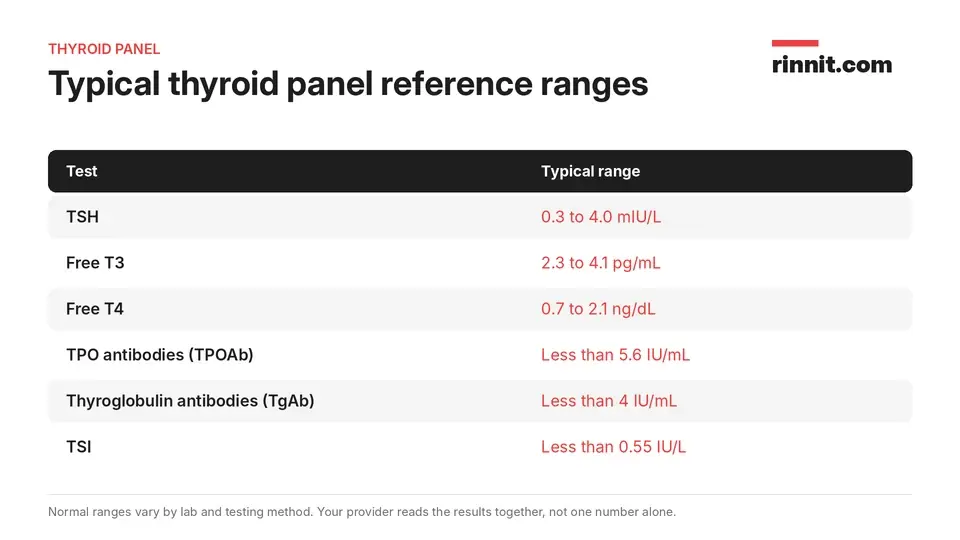
Test | Typical range |
TSH | 0.3 to 4.0 mIU/L |
Free T3 | 2.3 to 4.1 pg/mL |
Free T4 | 0.7 to 2.1 ng/dL |
Thyroid peroxidase antibodies (TPOAb) | Less than 5.6 IU/mL |
Thyroglobulin antibodies (TgAb) | Less than 4 IU/mL |
TSH receptor antibodies (TRAb) | Less than 1.75 IU/L or less than 3.3 IU/L, depending on the test |
Thyroid-stimulating immunoglobulin (TSI) | Less than 0.55 IU/L |
Sources: [1]
Normal ranges can vary depending on where the test is done because labs use different methods. [1]
What happens after a thyroid panel?
Results can take up to a week. Your provider will explain what they mean for your thyroid health and may suggest more tests or a repeat thyroid panel later. [1]
Contact your provider with any questions, and avoid trying to interpret your results on your own. [1]
Conclusion
A thyroid panel gives your provider a broad picture of how your thyroid is working. By looking at TSH, T3, T4 and antibodies together, they can find the cause of symptoms like fatigue and weight change and check whether treatment is working.
If you have symptoms of a thyroid problem, ask your provider which thyroid panel is right for you.
Keep learning: Read our guide to thyroid antibodies or learn about thyroid disease types and treatment. For more background, see the American Thyroid Association's guide to thyroid function tests.
FAQ
What is a thyroid panel?
It is a blood test that measures thyroid hormones and sometimes thyroid antibodies to check how your thyroid works. [1]
What tests are included in a thyroid panel?
A standard panel checks TSH, T3 and T4; a full panel also checks TPO, thyroglobulin, Tg antibodies and TSI. [1]
What is a normal TSH level?
In general, providers prefer a TSH between 0.3 and 4.0 mIU/L, though ranges vary by lab. [1]
What are normal free T3 and free T4 levels?
Typical ranges are 2.3 to 4.1 pg/mL for free T3 and 0.7 to 2.1 ng/dL for free T4. [1]
What symptoms mean I need a thyroid panel?
Unexpected weight change, fatigue, mood changes, feeling too hot or cold, dry skin and hair loss can all prompt testing. [1]
How is a thyroid panel done?
A provider draws a small blood sample from a vein in your arm, which takes a few minutes. [1]
How long do thyroid panel results take?
Results can take up to a week. [1]
Can a thyroid panel diagnose Hashimoto's or Graves' disease?
Yes. Panels that include antibodies help diagnose autoimmune thyroid conditions like Hashimoto's and Graves' disease. [1]
Can a thyroid panel check if my medicine is working?
Yes. Providers use thyroid panels to monitor whether thyroid medication is working. [1]
Are there risks to a thyroid panel?
Only the minor risks of a blood draw, such as bruising, swelling or mild pain at the needle site. [1]
Related Reading
T3 (Triiodothyronine) Test: Normal Levels and What Results Mean explains the blood test for T3, a key thyroid hormone.
T4 (Thyroxine) Test: Free T4 Normal Range and What Results Mean explains the thyroxine blood test and how it's read with TSH.
Hypothyroidism: Symptoms, Causes & Treatment Guide explains the underactive thyroid a thyroid panel can diagnose.
Hyperthyroidism: Symptoms, Causes & Treatment covers the overactive thyroid a thyroid panel can detect.
Graves' Disease: How an Overactive Immune System Drives an Overactive Thyroid, and What Treatment Can Do describes an autoimmune cause of abnormal thyroid panel results.
Thyroid Disease: Types, Symptoms, Tests and Treatment gives an overview of the conditions a thyroid panel helps find.
Thyroid Tests: Blood Tests, Imaging Scans and What Your Results Mean explains the blood tests and scans used to check your thyroid.
References
Cleveland Clinic. Thyroid Panel: What It Is & Results. Cleveland Clinic. Last updated January 7, 2026. https://my.clevelandclinic.org/health/diagnostics/thyroid-panel
Hollowell JG, Staehling NW, Flanders WD, et al. Serum TSH, T(4), and thyroid antibodies in the United States population (1988 to 1994): National Health and Nutrition Examination Survey (NHANES III). J Clin Endocrinol Metab. 2002;87(2):489-499. PMID 11836274. https://doi.org/10.1210/jcem.87.2.8182
Garmendia Madariaga A, Santos Palacios S, Guillén-Grima F, et al. The incidence and prevalence of thyroid dysfunction in Europe: a meta-analysis. J Clin Endocrinol Metab. 2014;99(3):923-931. PMID 24423323. https://doi.org/10.1210/jc.2013-2409
Medical disclaimer
This article is for general education only and does not replace advice from a qualified healthcare professional. Talk to your doctor about your own diagnosis and treatment, and seek emergency care right away for severe or sudden symptoms.



Comments