T3 (Triiodothyronine) Test: Normal Levels and What Results Mean

Updated: 3 days ago
Written and medically reviewed by Dr. Baraa Alnahhal, MD · Last reviewed: November 2026 · How we review
Quick Answer
A triiodothyronine (T3) test is a blood test that measures T3, one of the two main hormones the thyroid makes. It's mainly used to help diagnose hyperthyroidism (an overactive thyroid) and to monitor people taking thyroid hormone medicine. It's usually ordered with a T4 test and a TSH test. T3 isn't typically used to diagnose an underactive thyroid.
What the research says
Low T3 predicts risk in heart disease: in 573 heart patients, 1-year death was 14.4% in those with low free T3 vs. 3% with normal levels, making low T3 the strongest predictor (Iervasi G et al., Circulation, 2003) [2]
Low T3 is common in illness: a review of 41 studies found low T3 in 21.7% of people with heart disease, linked to about 2.5 times the risk of death (Wang B et al., Int J Cardiol, 2017) [3]
Key takeaways
The T3 test measures one of the two main thyroid hormones.
It's mainly used to diagnose and assess hyperthyroidism.
Adult total T3 is about 79 to 165 ng/dL; free T3 is about 2.3 to 4.1 pg/mL.
High T3 usually means an overactive thyroid.
Severe illness and some medicines can lower T3.
What is T3?
Your thyroid makes mostly thyroxine (T4) and a smaller amount of T3. Much of your T3 comes from T4 being converted in other tissues. T3 is the more active form and helps control your metabolism, heart rate, body temperature and energy. In the blood, most T3 is bound to proteins; free T3 is the unbound, active part. A total T3 test measures both. Sources: [1]
Why it's done
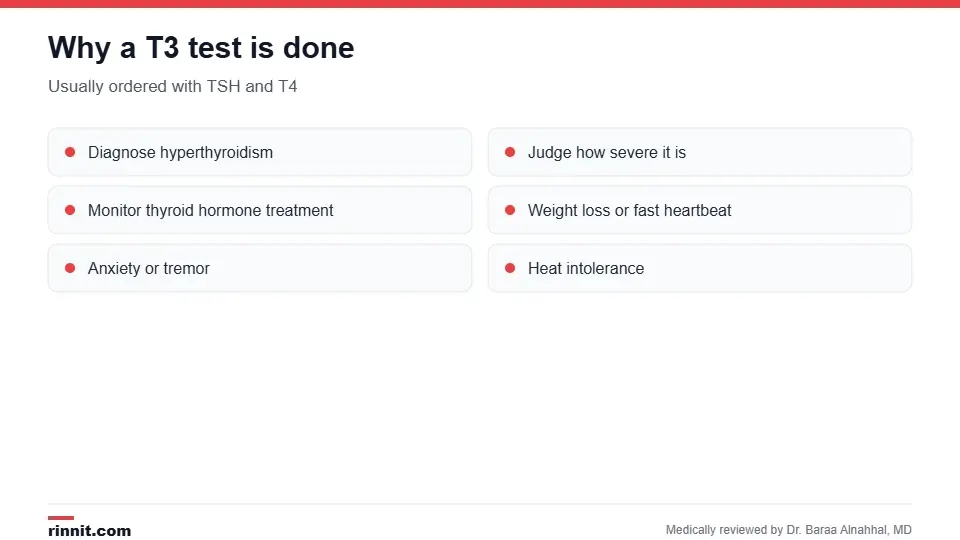
T3 is usually checked with TSH and T4.
Diagnose hyperthyroidism or judge how severe it is.
Monitor T3 levels in people taking thyroid hormone replacement.
Evaluate symptoms such as weight loss, fast heartbeat, anxiety, heat intolerance or tremor. Sources: [1]
T3 is often part of a thyroid panel. Sources: [1]
How to prepare
Usually no special preparation is needed.
Your provider may ask you to stop certain medicines or supplements, such as biotin, beforehand.
Don't stop any medicine unless your provider tells you to. Sources: [1]
What happens during the test
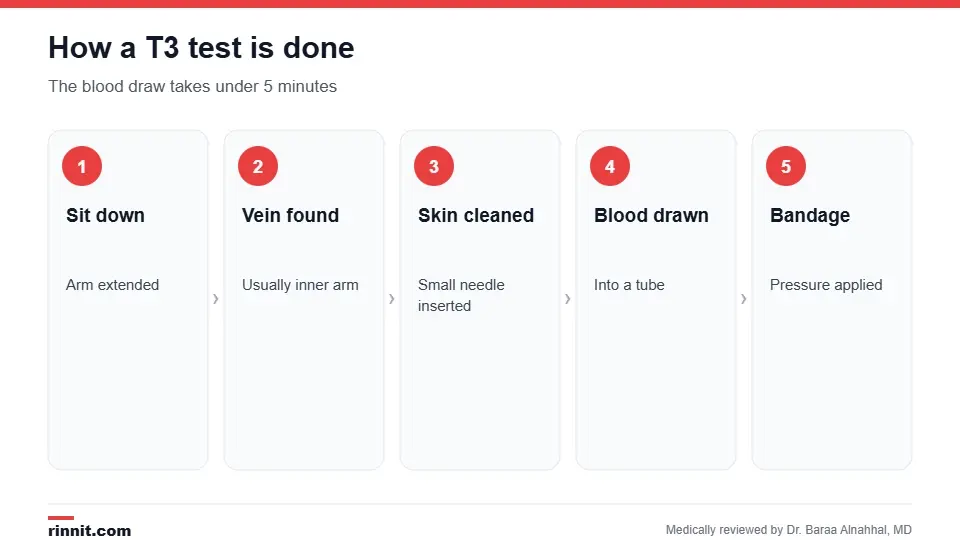
The blood draw takes under 5 minutes.
You sit in a chair.
A phlebotomist finds a vein, usually in your inner arm, and cleans the skin.
A small needle is inserted and blood is collected in a tube.
The needle is removed, and pressure and a bandage are applied. Sources: [1]
Risks
Risks are very small. You may have slight tenderness or a bruise that goes away quickly. Sources: [1]
What the results mean

Ranges vary by lab and age.
Group | Total T3 range |
Adults (18 to 99) | 79 to 165 ng/dL |
Ages 1 to 5 | 106 to 203 ng/dL |
Ages 6 to 10 | 104 to 183 ng/dL |
Ages 11 to 14 | 68 to 186 ng/dL |
Ages 15 to 17 | 71 to 175 ng/dL |
Free T3 in adults is about 2.3 to 4.1 pg/mL. Your report shows your value, the lab's reference range and whether it's high or low. Sources: [1]
Result | What it may mean |
High | Hyperthyroidism, such as Graves' disease, thyroid nodules or thyroiditis; higher levels generally mean more severe disease |
Low | Possible hypothyroidism, but more often severe illness or medicines such as steroids or amiodarone |
Low T3 during serious illness, called non-thyroidal illness or low-T3 syndrome, is common in hospitalized and heart patients and is linked to worse outcomes. Results usually take 1 to 2 business days. Sources: [1, 2, 3]
Conclusion
The T3 test helps confirm an overactive thyroid and gauge its severity. Combined with TSH and T4, it gives your provider a clear picture of your thyroid function and guides treatment.
Keep learning: read about the T4 test and thyroid tests.
Frequently asked questions
What is a T3 test?
A blood test that measures triiodothyronine, a thyroid hormone.
What is a normal T3 level?
Total T3 is about 79 to 165 ng/dL in adults.
What does high T3 mean?
Usually hyperthyroidism.
What does low T3 mean?
It may reflect illness or medicines; it isn't usually used to diagnose hypothyroidism.
What's the difference between free and total T3?
Free T3 is the active, unbound part; total T3 includes bound T3.
Do I need to fast?
Usually not.
Is T3 tested alone?
It's usually tested with TSH and T4.
Can biotin affect results?
Some supplements can; ask your provider.
How long does the test take?
Under 5 minutes.
When will I get results?
Usually in 1 to 2 business days.
Related Reading
T4 (Thyroxine) Test: Free T4 Normal Range and What Results Mean the main thyroid hormone test.
Thyroid Panel Blood Test: TSH, T3, T4 and Antibodies Explained a group of thyroid blood tests.
Thyroid Tests: Blood Tests, Imaging Scans and What Your Results Mean an overview of thyroid blood tests and scans.
Hyperthyroidism: Symptoms, Causes & Treatment the condition T3 helps diagnose.
Thyroid Uptake and Scan (RAIU): How It Works, How to Prepare and What Results Mean a scan of thyroid activity.
References
Cleveland Clinic. Triiodothyronine (T3) Test: What It Is, Function & Levels. Cleveland Clinic. Last updated February 14, 2022. https://my.clevelandclinic.org/health/diagnostics/22425-triiodothyronine-t3
Iervasi G, Pingitore A, Landi P, et al. Low-T3 syndrome: a strong prognostic predictor of death in patients with heart disease. Circulation. 2003;107(5):708-713. PMID 12578873. https://doi.org/10.1161/01.cir.0000048124.64204.3f
Wang B, Liu S, Li L, et al. Non-thyroidal illness syndrome in patients with cardiovascular diseases: a systematic review and meta-analysis. Int J Cardiol. 2017;226:1-10. PMID 27776249. https://doi.org/10.1016/j.ijcard.2016.10.039
Medical disclaimer
This article is for general education only and does not replace advice from a qualified healthcare professional. Talk to your doctor about your own diagnosis and treatment, and seek emergency care right away for severe or sudden symptoms.



Comments