Thyroid Tests: Blood Tests, Imaging Scans and What Your Results Mean

Updated: 6 days ago
Written and medically reviewed by Dr. Baraa Alnahhal, MD · Last reviewed: November 2026 · How we review
Quick Answer: What are thyroid tests?
Thyroid tests (thyroid function tests) check how well your thyroid gland works. They fall into two groups: blood tests that measure thyroid hormones and antibodies, such as TSH, T4 and T3, and imaging or nuclear medicine scans that show your thyroid's size, shape and function. Together they help diagnose hypothyroidism, hyperthyroidism, Graves' disease, Hashimoto's disease and thyroid cancer. [1]
What the research says
Thyroid problems often go unnoticed without a blood test. In a US survey of 17,353 people aged 12 and older, 4.6% had hypothyroidism (mostly mild) and 1.3% had hyperthyroidism, and many didn't know it; about 11% had thyroid peroxidase antibodies. (Hollowell et al., The Journal of Clinical Endocrinology & Metabolism, 2002) [2]
Undiagnosed thyroid dysfunction is common in Europe too. A meta-analysis found undiagnosed thyroid dysfunction in about 6.7% of people, made up of 4.9% undiagnosed hypothyroidism and 1.7% undiagnosed hyperthyroidism. (Garmendia Madariaga et al., The Journal of Clinical Endocrinology & Metabolism, 2014) [3]
Key takeaways
Thyroid tests include blood tests and imaging or nuclear medicine scans. [1]
TSH is usually the first blood test, often followed by T4 and T3. [1]
Thyroid antibody tests can point to an autoimmune thyroid disorder. [1]
Most thyroid blood tests need no special preparation, but contrast scans may require fasting. [1]
Results usually come back within a few days, and abnormal levels may lead to monitoring, more tests or treatment. [1]
What are thyroid tests?
Thyroid tests check whether your thyroid gland is working as it should. There are many types, but they all fall into two categories: [1]
Blood tests, which measure certain hormones and antibodies in your blood
Imaging and nuclear medicine scans, which show your thyroid's size and shape; nuclear scans also show how well it works
If you want a closer look at the standard blood panel, see our thyroid panel guide.
Why would you need a thyroid test?
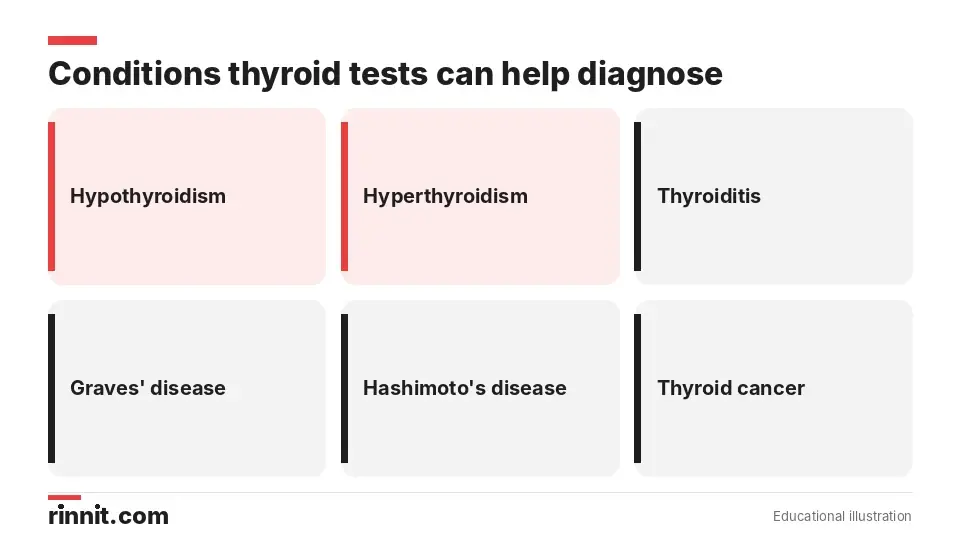
Thyroid tests help sort out conditions that cause an overactive, underactive or enlarged thyroid.
You might need a thyroid test if you have symptoms like fatigue, restlessness, irritability or unexplained weight changes. Thyroid tests can help diagnose: [1]
Hypothyroidism
Hyperthyroidism
Thyroiditis
Graves' disease
Hashimoto's disease
Thyroid cancer
Which test your provider recommends depends on your symptoms and what they want to learn. Ask what each test does if you're not sure. [1]
What are the main thyroid blood tests?

TSH is usually the starting point, with other tests added as needed.
During a thyroid blood test, a provider takes a blood sample and sends it to a lab. Too many or too few of certain hormones or antibodies may mean you have thyroid disease. [1]
Test | What it tells your provider |
TSH (thyroid-stimulating hormone) | Usually the first test. TSH tells your thyroid to make T3 and T4. |
T4 or free T4 (thyroxine) | One of the two main hormones your thyroid makes. |
T3 or free T3 (triiodothyronine) | The other main thyroid hormone. |
Thyroid antibody panel | Whether thyroid antibodies are in your blood, which may mean an autoimmune disorder. |
Calcitonin | Not routine. High levels can be a sign of a certain type of thyroid cancer. |
Thyroglobulin | Not routine. May be used after thyroid cancer treatment to see if the cancer has returned. |
Sources: [1]
Read more about antibody testing in our thyroid antibodies guide.
How do you prepare for a thyroid blood test?
Most of the time you don't need to do anything special. Tell your provider if you take biotin (vitamin B7) supplements, because high doses can make thyroid blood test results falsely high or low. Your provider will tell you if you need to stop eating or drinking beforehand. [1]
What thyroid imaging tests are there?
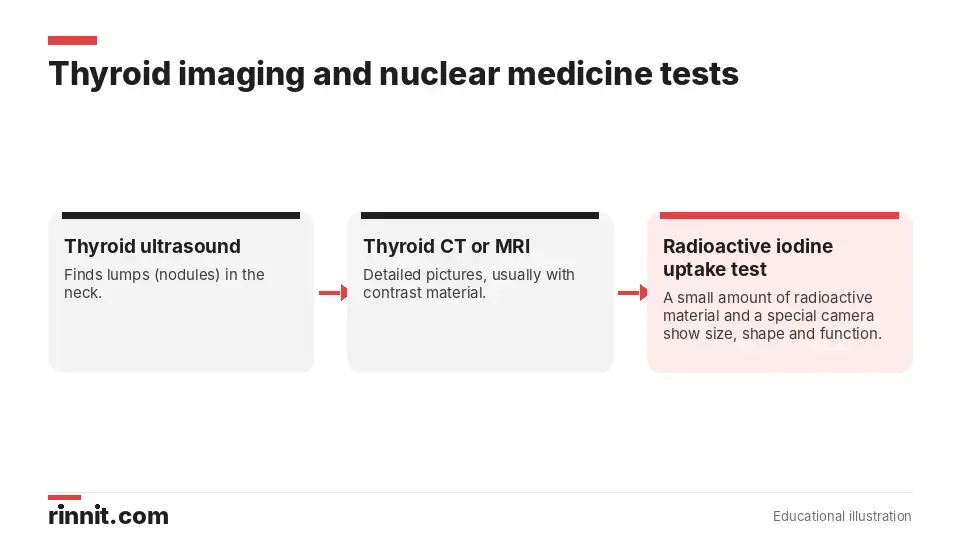
Imaging usually comes after blood tests, to look at the gland itself.
Imaging tests give more information about your thyroid's size, shape and function. Providers might recommend them after blood tests, sometimes with contrast material for more detailed pictures. Examples include: [1]
Thyroid ultrasound, which detects lumps (nodules) in your neck
Thyroid CT or MRI scan, usually with contrast material to highlight areas of concern
Radioactive iodine uptake test, which uses a small amount of radioactive material and a special camera to show your thyroid's size, shape and function, and can give more information than an ultrasound
How do you prepare for a thyroid imaging test?
If your provider plans to use contrast material, you might need to stop eating or drinking for a few hours beforehand. Always share your full medical history, including your medicines, any allergies and whether you're pregnant or breastfeeding. [1]
What are the risks of thyroid tests?
A thyroid blood test carries little to no risk; you may get a small bruise where the blood was drawn. Imaging and nuclear medicine scans can carry a risk of an allergic reaction to contrast material, such as itching or a rash, and exposure to low doses of radiation. [1]
What do thyroid test results mean?
Your provider usually gets results within a few days, then calls you or schedules a follow-up visit. Blood tests show whether your thyroid hormone levels are typical for your age and sex, while imaging focuses on the thyroid's appearance and function. [1]
Because thyroid problems are common and often undiagnosed, a simple blood test can catch them early. [2] [3]
Conclusion
Thyroid tests range from a quick TSH blood test to ultrasound and radioactive iodine scans. Most people start with blood tests, and imaging follows when a provider needs to see the gland itself or check a lump. [1]
If you have symptoms like fatigue, weight changes or restlessness, ask your provider whether thyroid testing makes sense, and which test fits your situation. [1]
Keep learning: Read our hypothyroidism guide or our hyperthyroidism guide. For more background, see the American Thyroid Association page on thyroid function tests.
FAQ
What are thyroid tests?
Blood tests and imaging or nuclear medicine scans that check how well your thyroid gland works. [1]
What is the first thyroid test doctors usually order?
TSH (thyroid-stimulating hormone) is usually the first test. [1]
What do T3 and T4 tests measure?
They measure the two main hormones your thyroid makes, triiodothyronine (T3) and thyroxine (T4). [1]
Why would I need a thyroid antibody test?
To check for thyroid antibodies, which may mean you have an autoimmune thyroid disorder. [1]
Do I need to fast for a thyroid blood test?
Usually not. Your provider will tell you if you need to stop eating or drinking. [1]
What imaging tests check the thyroid?
Thyroid ultrasound, CT or MRI, and the radioactive iodine uptake test. [1]
What conditions can thyroid tests diagnose?
Hypothyroidism, hyperthyroidism, thyroiditis, Graves' disease, Hashimoto's disease and thyroid cancer. [1]
Are thyroid tests risky?
Blood tests carry little to no risk. Scans may cause contrast reactions or low-dose radiation exposure. [1]
How long do thyroid test results take?
Usually a few days. [1]
What happens if my thyroid scan shows a lump?
Your provider may recommend a fine needle aspiration biopsy to check whether it's cancerous. [1]
Related Reading
T3 (Triiodothyronine) Test: Normal Levels and What Results Mean explains the blood test for T3, a key thyroid hormone.
T4 (Thyroxine) Test: Free T4 Normal Range and What Results Mean explains the thyroxine blood test and how it's read with TSH.
Hypothyroidism: Symptoms, Causes & Treatment Guide explains the underactive thyroid that thyroid tests often find.
Hyperthyroidism: Symptoms, Causes & Treatment covers the overactive thyroid these tests can confirm.
Graves' Disease: How an Overactive Immune System Drives an Overactive Thyroid, and What Treatment Can — and Can't — Do explains an autoimmune cause of hyperthyroidism diagnosed with thyroid tests.
Thyroiditis: Types, Symptoms, Phases, Diagnosis and Treatment covers thyroid inflammation that changes hormone levels.
Thyroid Cancer: Symptoms, Causes, Diagnosis and Treatment — What You Need to Know explains the cancer that thyroid scans and biopsies help find.
Thyroid Panel Blood Test: TSH, T3, T4 and Antibodies Explained goes deeper into the standard thyroid blood panel.
References
Cleveland Clinic. Thyroid Test: Types, Purpose & Results. Cleveland Clinic. Last updated July 2, 2026. https://my.clevelandclinic.org/health/diagnostics/17556-thyroid-blood-tests
Hollowell JG, Staehling NW, Flanders WD, et al. Serum TSH, T(4), and thyroid antibodies in the United States population (1988 to 1994): National Health and Nutrition Examination Survey (NHANES III). J Clin Endocrinol Metab. 2002;87(2):489-499. PMID 11836274. https://doi.org/10.1210/jcem.87.2.8182
Garmendia Madariaga A, Santos Palacios S, Guillén-Grima F, et al. The incidence and prevalence of thyroid dysfunction in Europe: a meta-analysis. J Clin Endocrinol Metab. 2014;99(3):923-931. PMID 24423323. https://doi.org/10.1210/jc.2013-2409
Medical disclaimer
This article is for general education only and does not replace advice from a qualified healthcare professional. Talk to your doctor about your own diagnosis and treatment, and seek emergency care right away for severe or sudden symptoms.



Comments