Thyroiditis: Types, Symptoms, Phases, Diagnosis and Treatment

Updated: 3 days ago
Medically reviewed by Dr. Baraa Alnahhal, MD · Last reviewed: October 2026
Quick Answer: What is thyroiditis?
Thyroiditis is inflammation of the thyroid gland. It is not one single disease; it is a group of conditions that can have different causes and effects. Some types are temporary, while others lead to long-term hypothyroidism that requires ongoing treatment. [1]
Question | Short answer |
What is the most common type? | Hashimoto’s thyroiditis, an autoimmune condition and the most common cause of hypothyroidism. |
What are the phases? | Thyrotoxic (too much hormone), hypothyroid (too little) and euthyroid (normal). |
Is it permanent? | Hashimoto’s and radiation-induced thyroiditis usually cause permanent hypothyroidism; other types often recover. |
How is it diagnosed? | Exam plus thyroid function tests, antibodies, ultrasound, inflammation markers or iodine uptake testing. |
Is it treatable? | Yes. Treatment depends on the type and symptoms. |

What the research says
Steroids and NSAIDs for subacute thyroiditis have different trade-offs. A systematic review and meta-analysis of 10 comparative cohort studies (1,337 participants) found that permanent hypothyroidism was less common after glucocorticoid treatment than after NSAID treatment (OR 0.56, 95% CI 0.36–0.88), but recurrence was more common with glucocorticoids (OR 1.98, 95% CI 1.12–3.5). The authors suggest the findings may help clinicians weigh the two options (Yuan et al., Front Endocrinol, 2024). [2]
The link between thyroid antibodies and postpartum depression is not settled. A meta-analysis of five longitudinal studies (449 women with and 2,483 without thyroid peroxidase antibodies) found a higher risk of postpartum depression in antibody-positive women (RR 1.49, 95% CI 1.11–2.00) (Minaldi et al., J Endocrinol Invest, 2020). A later cohort study with meta-analysis found no statistically significant association (OR 1.93, 95% CI 0.91–4.10) and highly variable results; its authors advised monitoring antibody-positive women for postpartum thyroiditis but did not support routine depression screening on that basis (Sileo et al., Eur J Endocrinol, 2023). [3] [4]
What does the thyroid do?
The thyroid is a small, butterfly-shaped gland at the front of the neck under the skin. It is part of the endocrine system, which includes organs that produce and release hormones. Thyroid hormones help control many important body functions. See our guides to the thyroid gland and to thyroid disease. [1]
The thyroid produces triiodothyronine, called T3, and thyroxine, called T4. Thyroid function is also regulated by thyroid-stimulating hormone, or TSH, which comes from the pituitary gland and stimulates the thyroid to produce T3 and T4. [1]
What are the phases of thyroiditis?
In most types of thyroiditis, symptoms and hormone levels can change in phases. Not every person experiences every phase, and the timeline varies by type. [1]
Phase | What happens | Possible result |
Thyrotoxic phase | Inflammation causes the thyroid to release too many stored hormones | Temporary thyrotoxicosis, meaning too much thyroid hormone in the body |
Hypothyroid phase | After weeks or months of excess release, the thyroid does not have enough hormone to release | Hypothyroidism, or too little thyroid hormone |
Euthyroid phase | Thyroid hormone levels return to the normal range | This may occur temporarily between phases or after the thyroid recovers |
Hashimoto’s thyroiditis and radiation-induced thyroiditis usually remain permanently in the hypothyroid phase. [1]

What are the types of thyroiditis?
The type matters because it helps explain the likely cause, symptoms, testing and treatment.
Type | Key features |
Hashimoto’s thyroiditis | An autoimmune condition caused by antithyroid antibodies; the most common type and the most common cause of hypothyroidism |
Silent or painless thyroiditis | An autoimmune condition caused by antithyroid antibodies |
Postpartum thyroiditis | An autoimmune condition that can occur within one year after giving birth; relatively rare |
Radiation-induced thyroiditis | Caused by radiation therapy for certain cancers or radioactive iodine used to treat hyperthyroidism |
Subacute thyroiditis | Often painful, thought to be caused by a virus and usually preceded by an upper respiratory infection |
Acute infectious thyroiditis | Rare; caused by an infectious organism or bacterium |
Drug-induced thyroiditis | Caused by medicines such as amiodarone, interferons, lithium or cytokines; occurs in a small fraction of people who use these medicines |
Riedel thyroiditis | Rare; involves chronic inflammation and fibrosis, or thickening and scarring of tissue |
Hashimoto’s thyroiditis affects approximately 1% to 2% of people in the United States and is four to 10 times more common in women, most often developing between ages 30 and 50. Silent or painless thyroiditis is also common in women and is the next most common cause after Hashimoto’s. The other types are rarer. [1]
What symptoms can thyroiditis cause?
Symptoms vary by the type of thyroiditis and by the hormone phase. Thyroiditis can lead to either overproduction or underproduction of thyroid hormone. [1]
Symptoms during a thyrotoxic phase
The thyrotoxic phase is usually short, lasting one to three months. When inflamed thyroid tissue releases too much hormone, symptoms of hyperthyroidism may include a fast heart rate or palpitations, increased appetite, unexplained weight loss, anxiety and nervousness, irritability, trouble sleeping, increased sweating and heat sensitivity, and tremors. Learn more about hyperthyroidism. [1]
Symptoms during a hypothyroid phase
The hypothyroid phase can be long-lasting and may become permanent. Possible symptoms include fatigue, unexplained weight gain, constipation, depression, dry skin, sensitivity to cold, muscle weakness and decreased ability to concentrate. Symptoms may be mild or significant, and some people with mild hypothyroidism and few symptoms may not need medication. Learn more about hypothyroidism. [1]
Pain and swelling
Subacute thyroiditis is often painful. Acute infectious thyroiditis can also cause pain and may involve an abscess. Some people with thyroiditis have an enlarged thyroid gland, called a goiter. Riedel thyroiditis involves chronic inflammation and fibrosis. A clinician should evaluate new, persistent or worsening neck symptoms. [1]
What causes thyroiditis?
The cause depends on the type. Thyroiditis is caused by an attack on the thyroid that triggers inflammation and damages thyroid cells. The most common cause is autoimmune disease, in which the immune system produces antibodies that affect the thyroid. Other forms are linked to infection, medication, radiation, radioactive iodine or chronic inflammation and fibrosis. [1]
Subacute thyroiditis is thought to be caused by a virus and usually follows an upper respiratory infection. Acute infectious thyroiditis is caused by an infectious organism, most commonly bacteria. Drug-induced thyroiditis can occur with certain medications, but it affects only a small fraction of the people using them. [1]
How is thyroiditis diagnosed?
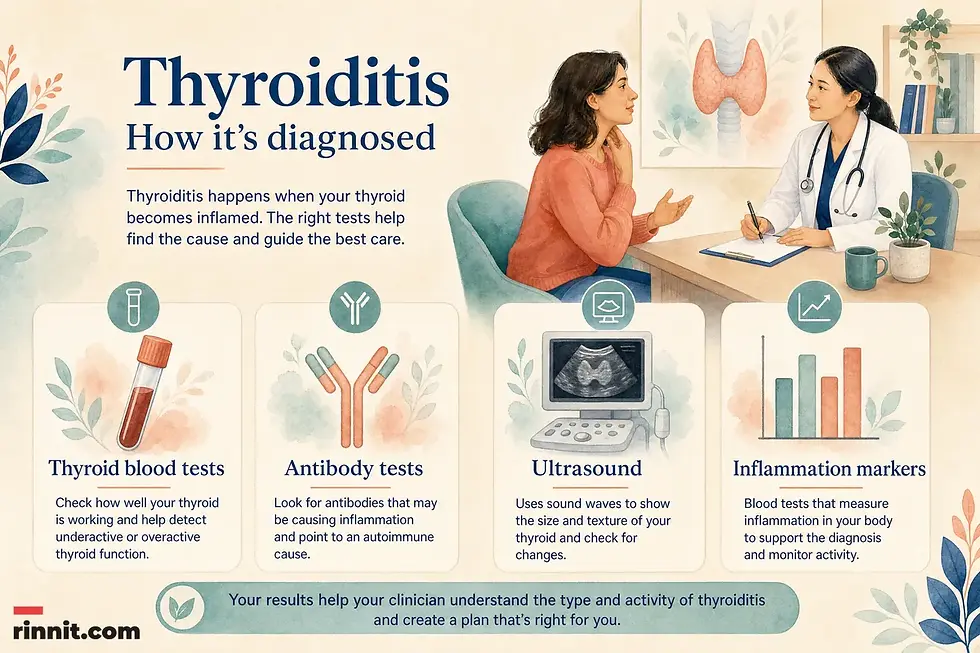
A healthcare provider asks about symptoms and medical history and performs a physical examination that includes assessing the thyroid. If thyroiditis is suspected, the provider may order one or more tests. [1]
Test | What it can help assess |
Thyroid function tests | Levels of TSH, T3 and T4 |
Thyroid ultrasound | Thyroid anatomy, nodules, blood flow and gland density |
Thyroid antibody tests | Antibodies such as TPO or TRAb that may signal autoimmune thyroiditis |
ESR or sed rate | Inflammation; ESR is high in subacute thyroiditis |
CRP | Inflammation; it is usually significantly elevated in acute infectious thyroiditis |
Radioactive iodine uptake test | How much radioactive iodine the thyroid absorbs; uptake is always low during the thyrotoxic phase of thyroiditis |
Key thyroid test terms
Term | Plain-language meaning |
TSH | Thyroid-stimulating hormone from the pituitary gland |
T3 | Triiodothyronine, one of the thyroid hormones |
T4 | Thyroxine, one of the thyroid hormones |
TPO antibodies | Antithyroid or thyroid peroxidase-related antibodies that may signal autoimmune thyroiditis |
TRAb | Thyroid receptor-stimulating antibodies that may signal autoimmune thyroid disease |
ESR | Erythrocyte sedimentation rate, a blood test that helps detect inflammation |
CRP | C-reactive protein, a blood test that measures inflammation |
RAIU | Radioactive iodine uptake, a test measuring how much radioactive iodine the thyroid absorbs |
How is thyroiditis treated?
Treatment depends on the type of thyroiditis and the person’s symptoms. Some treatments target fast heart rate and tremors during the thyrotoxic phase. Others replace thyroid hormone, treat infection, reduce pain or address structural inflammation. [1]
Treatment during the thyrotoxic phase
A provider may prescribe beta-blockers to reduce palpitations and tremors. As symptoms improve, the provider tapers the medication because the thyrotoxic phase is temporary. [1]
Treatment during the hypothyroid phase
For Hashimoto’s thyroiditis, a provider may prescribe thyroid hormone replacement such as levothyroxine. Because hypothyroidism from Hashimoto’s is usually permanent, treatment may be lifelong. [1]
For subacute, painless or postpartum thyroiditis with hypothyroid symptoms, a provider may prescribe thyroid hormone replacement for approximately six to 12 months. The medication may then be tapered to see whether hypothyroidism is permanent. Mild hypothyroidism with few symptoms may not require medication. [1]
Treatment for infectious thyroiditis
Acute infectious thyroiditis needs treatment for the infection, which will likely involve antibiotics. If an abscess forms in the thyroid, a provider may need to drain fluid and pus with fine-needle aspiration. [1]
Treatment for drug-induced thyroiditis
Drug-induced thyroiditis usually lasts as long as the causative medicine is being taken. A provider may switch to a different but similar medication or prescribe levothyroxine while the causative medicine continues. Do not stop a prescribed medication without discussing it with the prescribing clinician. [1]
Treatment for pain
Pain from acute infectious and subacute thyroiditis can usually be managed with nonsteroidal anti-inflammatory drugs (NSAIDs), such as aspirin or ibuprofen. Severe pain may require steroid therapy. Medication choices should be discussed with a healthcare professional. [1]
Treatment for Riedel thyroiditis
Riedel thyroiditis requires surgical treatment.
What is the outlook for thyroiditis?
The overall outlook for thyroiditis is generally good, but recovery depends on the type. Hashimoto’s thyroiditis usually causes permanent hypothyroidism, which is treatable with lifelong thyroid hormone replacement. [1]
Type or phase | Timeline or long-term outlook |
Subacute thyroiditis | Symptoms usually last one to three months; full thyroid function recovery can take 12 to 18 months; about a 5% chance of permanent hypothyroidism |
Postpartum thyroiditis | Full thyroid function recovery can take about 12 to 18 months; about a 20% chance of permanent hypothyroidism |
Silent or painless thyroiditis | Full thyroid function recovery can take about 12 to 18 months; about a 20% chance of permanent hypothyroidism |
Hashimoto’s thyroiditis | Resulting hypothyroidism is generally permanent but treatable with lifelong thyroid hormone replacement |
These are general patterns, not a prediction for any individual. Follow-up testing helps determine whether thyroid function has recovered or whether hypothyroidism is lasting.
When should you contact a healthcare provider?
Contact a healthcare provider for persistent or worsening symptoms that may involve the thyroid, such as neck pain, palpitations, tremors or symptoms of hypothyroidism. Medical evaluation is especially important after giving birth, after radiation or radioactive iodine treatment, after an upper respiratory infection when painful thyroid symptoms develop, or when symptoms begin after starting a medicine associated with thyroiditis.
Seek emergency care for signs of thyroid storm, a life-threatening condition that can develop with long-term untreated or undertreated hyperthyroidism. Symptoms include a high fever (often 104 to 106 °F), a rapid heart rate that can exceed 140 beats per minute, agitation, irritability or anxiety, and delirium. Also seek urgent care for trouble breathing, severe swallowing difficulty, fainting, severe chest symptoms, confusion or a rapidly worsening illness.
How can people live well with thyroiditis?
Living with thyroiditis may involve monitoring symptoms and repeating thyroid function tests as hormone levels change. The care plan can change between phases. Some people need temporary treatment, while others need long-term thyroid hormone replacement.
Keep follow-up appointments and ask which symptoms should prompt an earlier call. If a medication may be contributing to thyroiditis, ask the prescribing provider about options rather than stopping it independently. Most cases of thyroiditis cannot be prevented, but if you need radioactive iodine or radiation therapy, ask your provider about your risk (see our guide to radioactive iodine therapy).
Conclusion: thyroiditis is treatable, but type and phase matter
Thyroiditis is a group of conditions that cause thyroid inflammation. It can temporarily produce too much thyroid hormone, later cause too little, or recover to normal levels. Hashimoto’s thyroiditis and radiation-induced thyroiditis usually cause permanent hypothyroidism, while several other types may recover over time. [1]
Diagnosis may involve thyroid function tests, antibody tests, ultrasound, inflammation markers and radioactive iodine uptake testing. Treatment is based on the type and symptoms, so follow-up helps determine whether hormone changes are temporary or lasting. Read about thyroid nodules and Graves’ disease for related thyroid conditions. [1]
This article cannot replace an examination, testing or individualized medical advice. If you have symptoms, arrange a thyroid evaluation.
Frequently Asked Questions
Is thyroiditis the same as hypothyroidism?
No. Thyroiditis means inflammation of the thyroid. It can cause a temporary thyrotoxic phase, a hypothyroid phase or a return to normal hormone levels. Some types lead to permanent hypothyroidism, but not all do.
What is the most common type of thyroiditis?
Hashimoto’s thyroiditis is the most common type. It is an autoimmune condition caused by antithyroid antibodies and is also the most common cause of hypothyroidism.
Can thyroiditis cause too much thyroid hormone?
Yes. During the thyrotoxic phase, inflammation can cause the thyroid to release too many hormones, leading to temporary thyrotoxicosis.
Can thyroiditis later cause low thyroid hormone?
Yes. After weeks or months of excessive hormone release, the thyroid may not have enough hormone to release, causing hypothyroidism. Some types later recover to normal levels, while Hashimoto’s and radiation-induced thyroiditis usually remain permanently hypothyroid.
Can thyroiditis be painful?
Subacute thyroiditis is often painful. Acute infectious thyroiditis can also cause pain and may involve an abscess. Silent or painless thyroiditis does not usually cause thyroid pain.
Can thyroiditis happen after pregnancy?
Yes. Postpartum thyroiditis is an autoimmune condition that can occur within one year after giving birth. It is relatively rare and can have a recovery period of about 12 to 18 months, with about a 20% chance of permanent hypothyroidism.
What tests are used for thyroiditis?
Testing may include thyroid function tests for TSH, T3 and T4; thyroid antibodies; ultrasound; ESR; CRP; and radioactive iodine uptake testing. The combination depends on symptoms and the suspected type.
Is thyroiditis treated with antibiotics?
Antibiotics are likely used when the thyroiditis is acute infectious thyroiditis. They are not the general treatment for every type of thyroiditis.
How long does thyroiditis last?
The timeline depends on the type. Subacute thyroiditis symptoms usually last one to three months, but full thyroid recovery can take 12 to 18 months. Postpartum and silent thyroiditis may also take about 12 to 18 months for full recovery.
Does Hashimoto’s thyroiditis go away?
The resulting hypothyroidism from Hashimoto’s thyroiditis is generally permanent, but it is treatable with lifelong thyroid hormone replacement.
Can medicine cause thyroiditis?
Yes. Drug-induced thyroiditis can be caused by medicines such as amiodarone, interferons, lithium and cytokines. It occurs in a small fraction of people who use these drugs.
Should I stop a medicine if I think it caused thyroiditis?
No. Discuss the concern with the prescribing healthcare provider. Options include switching to a different but similar medicine or using thyroid hormone replacement while the causative medicine continues.
Related reading
Learn more in our guide to Thyroid Ultrasound: What It Shows, What to Expect and TI-RADS Results.
Thyroid Tests: Blood Tests, Imaging Scans and What Your Results Mean explains the blood tests and scans used to check your thyroid.
Thyroid Uptake and Scan (RAIU): How It Works, How to Prepare and What Results Mean explains the nuclear medicine test used to find the cause of an overactive thyroid.
References
Cleveland Clinic. Thyroiditis. Cleveland Clinic. Last updated June 7, 2022. https://my.clevelandclinic.org/health/diseases/15455-thyroiditis
Yuan A, Wu J, Huang H. Comparison of treatment outcome between glucocorticoids and non-steroidal anti-inflammatory drugs in subacute thyroiditis patients: a systematic review and meta-analysis. Front Endocrinol (Lausanne). 2024;15:1384365. PMID 38715797. https://doi.org/10.3389/fendo.2024.1384365
Minaldi E, D’Andrea S, Castellini C, et al. Thyroid autoimmunity and risk of post-partum depression: a systematic review and meta-analysis of longitudinal studies. J Endocrinol Invest. 2020;43(3):271-277. PMID 31552596. https://doi.org/10.1007/s40618-019-01120-8
Sileo F, Osinga JAJ, Visser WE, et al. Association of gestational thyroid function and thyroid peroxidase antibody positivity with postpartum depression: a prospective cohort study and systematic literature review with meta-analysis. Eur J Endocrinol. 2023;189(2):S26-S36. PMID 37486224. https://doi.org/10.1093/ejendo/lvad092
Disclaimer
This article is for general educational purposes and is not a substitute for professional medical advice, diagnosis or treatment. Always seek the advice of a qualified healthcare professional with any questions about a medical condition or treatment.



Comments