Thyroid Uptake and Scan (RAIU): How It Works, How to Prepare and What Results Mean

Updated: 2 days ago
Written and medically reviewed by Dr. Baraa Alnahhal, MD · Last reviewed: November 2026 · How we review
Quick Answer
A thyroid uptake and scan is a nuclear medicine test that shows how well the thyroid works. You swallow a pill of radioactive iodine, and the test measures how much the thyroid absorbs and takes pictures. It's used to find the cause of an overactive thyroid and assess thyroid nodules. Tell your provider if you're pregnant or breastfeeding.
What the research says
Normal values depend on iodine in the diet: in a study of 110 healthy adults after decades of iodized salt, the normal 24-hour uptake was 7–18% and the 2-hour uptake 1–7%, far lower than older reference ranges; untreated Graves disease averaged about 62% at 24 hours, while Hashimoto thyroiditis averaged about 12% (Ballal S et al., Indian Journal of Medical Research, 2017) [2]
Uptake readings are reproducible: in 36 patients measured twice at 24 hours with a thyroid probe, readings differed by an average of only 0.1%, with a reproducibility of 1.1%, so a change larger than about 3.2% is likely to be real (Pelletier-Galarneau M et al., Journal of Applied Clinical Medical Physics, 2018) [3]
Key takeaways
Two parts: an uptake test (how much iodine the thyroid absorbs) and a scan (pictures of the gland).
Mainly used to find the cause of hyperthyroidism and to assess thyroid nodules.
Swallow a pill; uptake is checked at 4–6 hours and often at 24 hours; the scan takes 30 minutes or less.
High uptake suggests Graves disease or overactive nodules; low uptake suggests thyroiditis or excess iodine or hormone.
Tell your provider about pregnancy, breastfeeding, thyroid medicines and recent iodine contrast.
What is a thyroid uptake and scan?
Your thyroid uses iodine to make thyroid hormone. Because it absorbs iodine from the blood, a tiny amount of radioactive iodine can show how active the gland is. The uptake test uses a probe, not a camera, to measure the percentage of the tracer the gland absorbs. The scan uses a gamma camera to create images of the thyroid; areas that absorb more tracer look bright. Most people have both together. A radiologist who specializes in nuclear medicine performs and reads the test. Sources: [1]
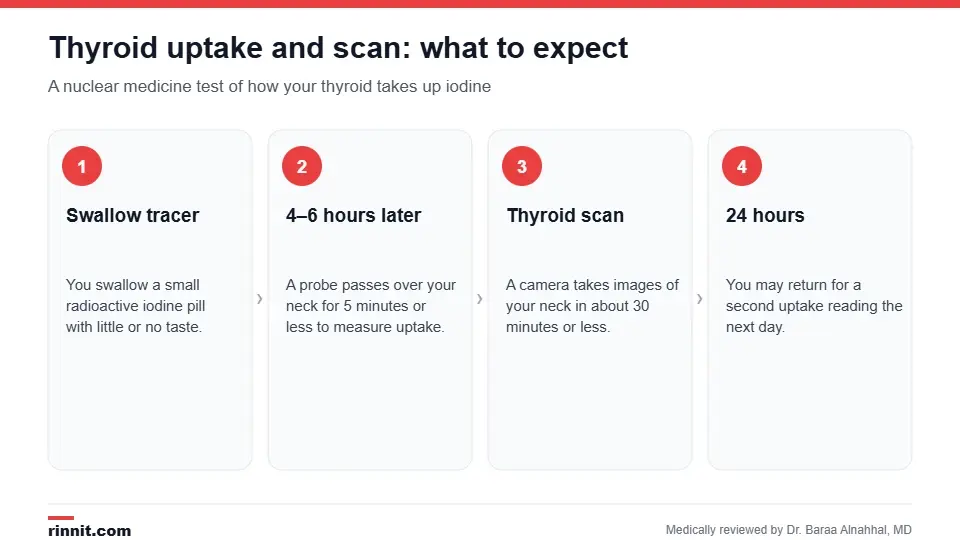
The uptake and scan are usually done together.
Why is it done?
To find the cause of hyperthyroidism (overactive thyroid), such as Graves disease, toxic nodules or thyroiditis.
To assess a thyroid nodule found on ultrasound, especially when thyroid hormone levels are high.
To check the thyroid after medicine or surgery for hyperthyroidism.
To help plan the dose of radioactive iodine therapy. Sources: [1]
How do I prepare?
Tell your provider if you are or might be pregnant, or are breastfeeding.
List all your medicines and supplements; thyroid medicines such as methimazole or propylthiouracil (PTU) may need to be stopped for a time before the test.
Tell your provider if you've had iodine-based contrast, such as for a CT scan, in the last two months, because it can block uptake.
You may be asked not to eat for several hours before swallowing the tracer. Sources: [1]
What happens during the test?
Swallow the tracer: you take a radioactive iodine pill, which has little or no taste.
Uptake reading: you return after 4–6 hours and lie on a table while a probe is held over your neck for 5 minutes or less.
Scan: you lie on a movable table with your neck tilted back while a camera takes images from several angles; it takes about 30 minutes or less.
24-hour reading: you may return the next day for a second uptake measurement. Sources: [1]
Afterward you can usually return to normal activities. Drinking plenty of water helps flush the tracer from your body. Sources: [1]
Understanding your results

The uptake pattern helps explain an overactive thyroid.
The radiologist reports the uptake as a percentage and describes the pattern on the scan. Your provider interprets these with your thyroid blood tests. Typical patterns include: Sources: [1]
Finding | What it may mean |
High uptake, evenly spread | Graves disease |
High uptake in one or more spots ("hot" nodules) | Toxic nodule or toxic multinodular goiter |
Low uptake with high thyroid hormone | Thyroiditis, recent iodine exposure or taking too much thyroid hormone |
"Cold" nodule (takes up little tracer) | Needs further evaluation, often with a fine-needle biopsy |
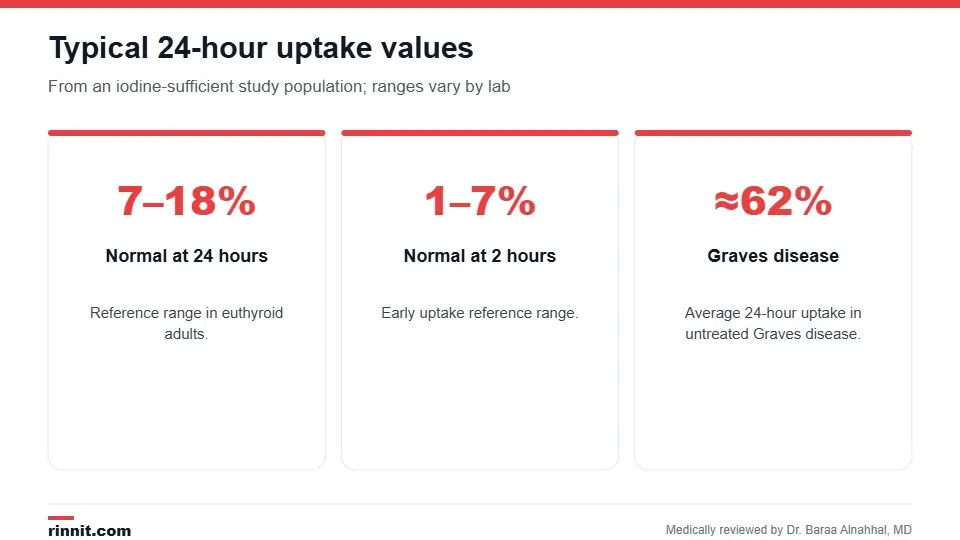
Reference ranges vary by lab and by iodine in the local diet.
Normal ranges differ between labs and regions because dietary iodine affects uptake. In one iodine-sufficient population, the normal 24-hour uptake was 7–18%, and people with untreated Graves disease averaged about 62%. Sources: [2, 3]
Risks
The radiation dose is low, and the benefit usually outweighs the very small risk.
Radiation can affect a fetus or a breastfeeding baby, so the test is generally avoided in pregnancy and breastfeeding may need to pause.
Allergic reactions are rare and usually mild. Sources: [1]
Conclusion
A thyroid uptake and scan answers a key question when your thyroid is overactive: is the gland making too much hormone, or is hormone leaking from an inflamed gland? That answer guides treatment, from antithyroid medicines and radioactive iodine to simply waiting out thyroiditis. Follow the preparation instructions carefully, especially about medicines and iodine.
Keep learning: read about thyroid blood tests and Graves disease.
Frequently asked questions
What does a thyroid uptake test measure?
The percentage of a small radioactive iodine dose that your thyroid absorbs over several hours.
What is the difference between the uptake and the scan?
The uptake uses a probe to measure absorption; the scan uses a camera to create pictures of the gland.
How long does the test take?
You return 4–6 hours after the pill for a short reading, and often again at 24 hours; the scan takes about 30 minutes or less.
Is the radiation dangerous?
The dose is low, but the test is generally avoided in pregnancy and may require pausing breastfeeding.
Do I need to stop my thyroid medicine?
Possibly. Methimazole or PTU may need to be stopped beforehand; follow your provider's instructions.
What does high uptake mean?
The thyroid is overactive, as in Graves disease or toxic nodules.
What does low uptake mean?
Often thyroiditis, recent iodine exposure or taking extra thyroid hormone.
What is a hot or cold nodule?
A hot nodule takes up more tracer and is usually overactive; a cold nodule takes up little and may need a biopsy.
Can I eat before the test?
You may be asked not to eat for several hours before swallowing the pill.
Why does recent CT contrast matter?
Iodine in contrast can fill the thyroid and block the tracer, giving a falsely low result.
Related Reading
T3 (Triiodothyronine) Test: Normal Levels and What Results Mean explains the blood test for T3, a key thyroid hormone.
Hyperthyroidism: Symptoms, Causes & Treatment the overactive thyroid this test helps explain.
Graves' Disease: How an Overactive Immune System Drives an Overactive Thyroid, and What Treatment Can — and Can't — Do the most common cause of high uptake.
Thyroiditis: Types, Symptoms, Phases, Diagnosis and Treatment inflammation that typically causes low uptake.
Thyroid Nodules: Symptoms, Causes, Diagnosis and Treatment — What You Need to Know nodules the scan shows as hot or cold.
Radioactive Iodine Therapy: A Targeted Treatment for Thyroid Conditions treatment that uptake results help plan.
References
Cleveland Clinic. Thyroid Uptake & Scan: What It Is, Purpose, Procedure & Results. Cleveland Clinic. Last updated July 12, 2024. https://my.clevelandclinic.org/health/diagnostics/thyroid-uptake-scan
Ballal S, Soundararajan R, Bal C. Re-establishment of normal radioactive iodine uptake reference range in the era of universal salt iodization in the Indian population. Indian Journal of Medical Research. 2017;145(3):358-364. PMID 28749399. https://doi.org/10.4103/ijmr.IJMR_1158_14
Pelletier-Galarneau M, Martineau P, Klein R, et al. Reproducibility of radioactive iodine uptake (RAIU) measurements. Journal of Applied Clinical Medical Physics. 2018;19(1):239-242. PMID 29165912. https://doi.org/10.1002/acm2.12217
Medical disclaimer
This article is for general education only and does not replace advice from a qualified healthcare professional. Talk to your doctor about your own diagnosis and treatment, and seek emergency care right away for severe or sudden symptoms.



Comments