Papillary Thyroid Cancer (PTC): Symptoms, Diagnosis, and Treatment

Updated: 3 days ago
Medically reviewed by Dr. Baraa Alnahhal, MD · Last reviewed: October 2026
Papillary thyroid cancer (PTC) is the most common type of thyroid cancer, accounting for 80% to 85% of all thyroid cancer cases. It is usually found as a lump (nodule) in the neck. Treatment is tailored to the risk of the individual tumor and may include surgery to remove part or all of the thyroid, radioactive iodine therapy, and thyroid hormone replacement [1] [2].
Quick Answer: What is papillary thyroid cancer?
Papillary thyroid cancer (PTC) is a cancer that starts in the thyroid gland at the base of the neck and accounts for 80% to 85% of thyroid cancer cases. It is more common in women and is the most common thyroid cancer in children. Treatment includes lobectomy or thyroidectomy and radioiodine therapy, matched to the cancer's risk level. [1] [2]
What the research says
Treatment is now matched to risk. A 2026 New England Journal of Medicine review describes modern management of differentiated thyroid cancer as risk-adapted, with risk stratification beginning at the detection of a thyroid nodule and continuing through follow-up. It discusses active surveillance of low-risk papillary thyroid cancer and minimalist treatment options for low- and intermediate-risk disease (Hegedüs et al., N Engl J Med, 2026).
Thermal ablation is emerging for selected low-risk tumors. A North American Society for Interventional Thyroidology statement describes thermal ablation as a minimally invasive strategy for low-risk thyroid cancers, with efficacy comparable to surgical resection in select patients and low recurrence over extended follow-up, provided patients are carefully selected and the treating physician is experienced (Baldwin et al., Endocr Pract, 2026).
Preparing for radioactive iodine has more than one option. A 2026 review compared thyroid hormone withdrawal with recombinant human TSH before radioiodine therapy and found comparable ablation success, with similar outcomes in low- and intermediate-risk patients; recombinant TSH was safer and better tolerated (Sunny and Hephzibah, Curr Opin Endocrinol Diabetes Obes, 2026).
Research summaries are based on article abstracts retrieved from PubMed.
What Is Papillary Thyroid Cancer?
PTC starts in the thyroid, a butterfly-shaped gland at the base of the neck that makes hormones controlling metabolism. It is the most common thyroid cancer, making up 80% to 85% of cases [1]. Several subtypes exist. The follicular subtype is the most common, while the columnar, tall cell, and insular subtypes tend to grow and spread more quickly [1].
Feature | What to know |
|---|---|
Share of thyroid cancers | 80% to 85% of all thyroid cancer cases |
Most common subtype | Follicular |
More aggressive subtypes | Columnar, tall cell, and insular tend to grow and spread more quickly |
Spread | PTC often spreads to nearby neck lymph nodes, but spread to distant organs is uncommon (fewer than about 1 in 10 people) |
Who gets it | More common in women than in men; the most common thyroid cancer in children |
Genetic link | About 5% of cases are associated with inherited conditions such as Gardner syndrome, Werner syndrome, and Carney complex type 1 |
Source: Cleveland Clinic [1].
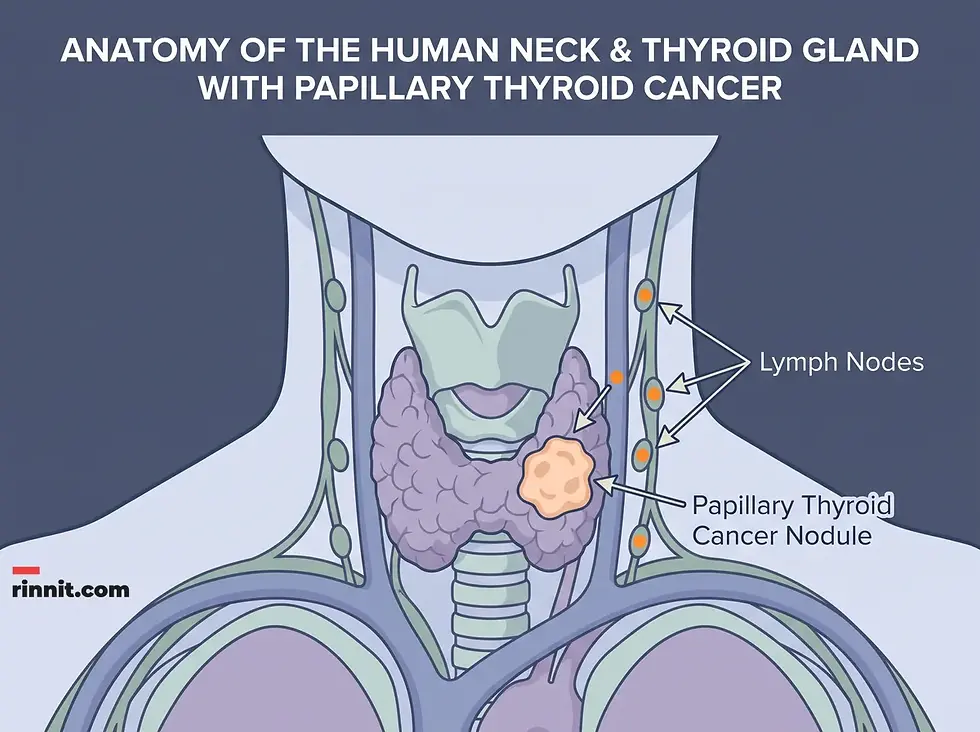
Anatomical overview of the thyroid gland showing a papillary thyroid cancer nodule and possible lymph node involvement.
What are the symptoms of papillary thyroid cancer (PTC)?
Many people have no symptoms, and PTC is often found when a lump in the neck is noticed or seen on imaging done for another reason. Larger tumors can occasionally cause neck discomfort or press on the windpipe or swallowing tube, leading to trouble breathing or swallowing. A new neck lump or swelling that doesn't go away is a reason to see a healthcare provider.
What causes papillary thyroid cancer, and who is at risk?
Papillary thyroid cancer risk factors include being a woman, certain inherited conditions and exposure to ionizing radiation, especially to the head and neck.
Sex: Women are more likely to develop PTC than men [1].
Genetics: About 5% of cases are associated with inherited conditions, including Gardner syndrome (familial adenomatous polyposis), Werner syndrome, and Carney complex type 1 [1].
Radiation: Exposure to ionizing radiation, especially to the head and neck, is a well-established risk factor for thyroid cancer.
How is papillary thyroid cancer diagnosed?
Evaluation usually begins with a neck exam and a thyroid ultrasound. A fine needle aspiration (FNA) biopsy, in which a thin needle collects cells from the nodule for examination under a microscope, is used to look for cancer. Additional imaging such as CT or MRI may be used if spread is suspected. Risk assessment starts when the nodule is first detected and continues through treatment and follow-up [2].

Visual guide to the diagnostic pathway for thyroid nodules, including ultrasound and fine needle aspiration biopsy.
How is papillary thyroid cancer treated?
Cleveland Clinic lists these treatments for PTC [1]:
Surgery: a lobectomy (removing half of the thyroid) or a thyroidectomy (removing the whole gland)
Radioiodine (radioactive iodine) therapy
External radiation therapy
Thyroid hormone replacement medication, which you will need for the rest of your life if the whole thyroid is removed
The plan depends on the tumor's risk. For some low-risk tumors, active surveillance, minimally invasive options such as thermal ablation in selected patients, or less extensive surgery may be considered [2] [3]. When radioiodine is planned, either thyroid hormone withdrawal or recombinant human TSH can be used to prepare [4].
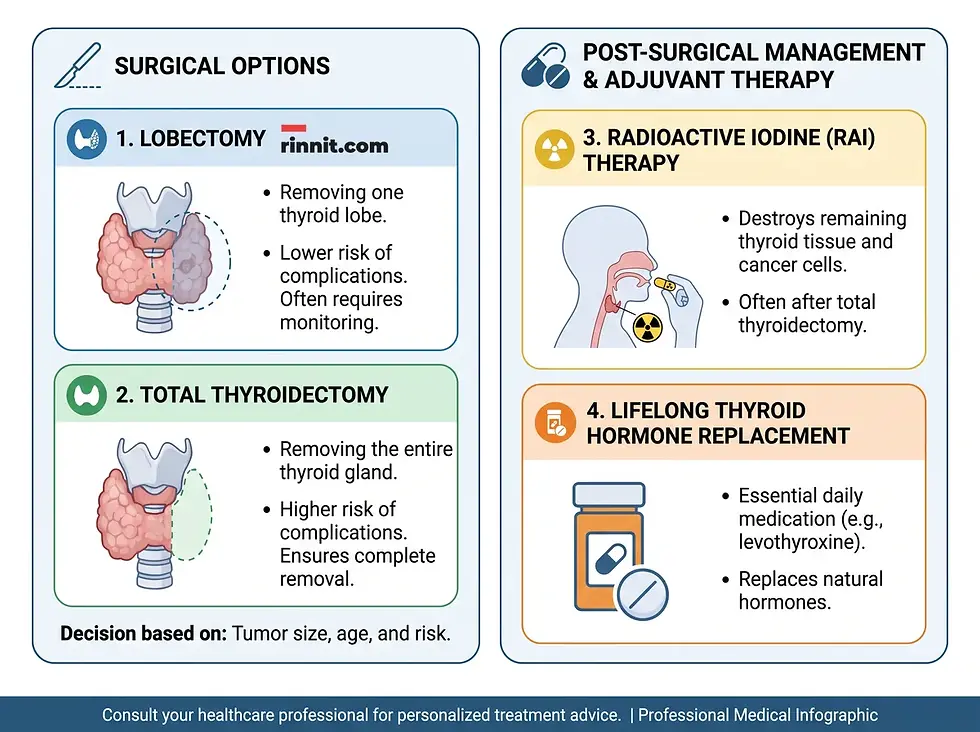
Infographic of the treatment spectrum for PTC, from surgical options to radioactive iodine therapy.
What is the outlook and follow-up for papillary thyroid cancer?
Follow-up continues after treatment because risk is reassessed over time based on how the cancer responds to therapy [2]. Ask your care team what monitoring schedule is right for you.
When should you see a doctor about papillary thyroid cancer?
See a healthcare provider if you notice a new lump or persistent swelling in your neck, or if you have trouble swallowing or breathing.
What is the bottom line on papillary thyroid cancer?
Papillary thyroid cancer is the most common thyroid cancer and is treated with a plan matched to its risk, from surgery and radioactive iodine to, in selected low-risk cases, surveillance or ablation. Women are more often affected, only about 5% of cases are linked to inherited conditions, and lifelong thyroid hormone replacement is needed if the whole thyroid is removed [1] [2].
Frequently Asked Questions
What is papillary thyroid cancer?
Papillary thyroid cancer (PTC) is the most common type of thyroid cancer. It accounts for 80% to 85% of all thyroid cancer cases.
Who gets papillary thyroid cancer?
Women are more likely to develop PTC than men. It is also still the most common thyroid cancer in children.
Is papillary thyroid cancer genetic?
Only about 5% of cases are associated with inherited conditions, such as Gardner syndrome, Werner syndrome, and Carney complex type 1.
What are the symptoms of papillary thyroid cancer?
Many people have no symptoms. PTC is often found as a lump in the neck or on imaging done for another reason.
How is papillary thyroid cancer diagnosed?
Diagnosis usually involves a neck exam, thyroid ultrasound, and a fine needle aspiration biopsy of the nodule. CT or MRI may be used if spread is suspected.
How is papillary thyroid cancer treated?
Options include a lobectomy or thyroidectomy, radioiodine therapy, and external radiation. The plan depends on the tumor's risk.
Do I need my whole thyroid removed?
Not always. Surgery may remove half of the thyroid (lobectomy) or the whole gland (thyroidectomy), depending on the case.
Will I need medication for life after surgery?
If the whole thyroid is removed, you will need to take thyroid hormone replacement medication for the rest of your life.
Can low-risk papillary thyroid cancer be monitored instead of treated right away?
Active surveillance is one of the options discussed for low-risk papillary thyroid cancer in current expert reviews. Whether it is right for you is a decision to make with your care team.
Does papillary thyroid cancer need follow-up after treatment?
Yes. Risk is reassessed over time, so ongoing follow-up with your care team is part of treatment.
Related Resources
External resource for deeper reading:
Cleveland Clinic. Papillary Thyroid Cancer (PTC). Cleveland Clinic. Medically reviewed; last updated June 28, 2022. https://my.clevelandclinic.org/health/diseases/23382-papillary-thyroid-cancer-ptc
Related Reading
Learn more in our guide to Thyroid Ultrasound: What It Shows, What to Expect and TI-RADS Results.
Thyroid Biopsy: Procedure, Side Effects and What Your Results Mean explains how thyroid nodules are sampled with a needle and what the results mean.
References
Cleveland Clinic. Papillary Thyroid Cancer (PTC). Cleveland Clinic Health Library. Last updated June 28, 2022. https://my.clevelandclinic.org/health/diseases/23382-papillary-thyroid-cancer-ptc
Hegedüs L, Wirth LJ, Tuttle RM. Management of differentiated thyroid cancer. N Engl J Med. 2026;394(23):2340-2355. PMID: 42308485. DOI: 10.1056/NEJMra2416814
Baldwin CK, Frazier KM, Kuo JH, et al. North American Society for Interventional Thyroidology statement on directed ablative therapy for the management of low risk papillary thyroid carcinoma. Endocr Pract. 2026;32(10):1531-1538. PMID: 42362053. DOI: 10.1016/j.eprac.2026.05.037
Sunny S, Hephzibah J. Thyroxine withdrawal prior to radioiodine therapy in papillary thyroid carcinoma - current scenarios. Curr Opin Endocrinol Diabetes Obes. 2026;33(5):187-192. PMID: 42590940. DOI: 10.1097/MED.0000000000000977
Medical disclaimer
This article is for informational purposes only and is not a substitute for professional medical advice, diagnosis, or treatment. Always seek the advice of your physician or other qualified health provider with any questions you may have about a medical condition.



Comments