Thyroid Biopsy: Procedure, Side Effects and What Your Results Mean

Updated: 6 days ago
Written and medically reviewed by Dr. Baraa Alnahhal, MD · Last reviewed: November 2026 · How we review
Quick Answer: What is a thyroid biopsy?
A thyroid biopsy removes a small sample of cells and fluid from your thyroid gland, usually from a nodule, so a specialist can check it for cancer and other problems. Nearly all are fine-needle aspiration (FNA) biopsies guided by ultrasound. [1]
The procedure takes about 10 to 20 minutes with local numbing, and you go home the same day. Most results come back within a week, and about 70% are benign (noncancerous). [1]
What the research says
Indeterminate results carry real cancer risk. In a meta-analysis covering 145,928 thyroid FNA specimens, nodules with surgical follow-up were cancerous in 27% of AUS/FLUS results and 31% of follicular neoplasm results. (Straccia et al., Cancer Cytopathology, 2015) [2]
Cancer risk differs by region and practice. Across 38 studies and 145,066 FNAs, Western centers removed more indeterminate nodules (51.3% vs 37.6%) but found cancer less often in them (25.4% vs 41.9%) than Asian centers. (Vuong et al., Cancer Cytopathology, 2020) [3]
Key takeaways
A thyroid biopsy samples cells from a thyroid nodule to check for cancer. [1]
About 5% to 15% of thyroid nodules are cancerous. [1]
Providers are more likely to biopsy nodules larger than 1 centimeter. [1]
Fine-needle aspiration takes about 10 to 20 minutes, with soreness and bruising the most common side effects. [1]
Results fall into six categories, from benign to malignant. [1]
What is a thyroid biopsy?
A thyroid biopsy is a procedure that removes a small sample of cells and fluid from your thyroid gland to help diagnose certain thyroid conditions. Not every thyroid problem needs a biopsy; blood tests and imaging are often enough. [1]
Why is a thyroid biopsy done?
Providers mainly recommend a biopsy for thyroid nodules, small solid or fluid-filled bumps in the thyroid. Most nodules are benign, but about 5% to 15% can be cancerous. Your provider is more likely to biopsy a nodule larger than 1 centimeter (0.39 inches). [1]
Types of thyroid biopsy

Fine-needle aspiration is used for nearly all nodules.
Type | How it's done | When it's used |
Fine-needle aspiration (FNA) | A long, thin needle (22-gauge or smaller) guided by ultrasound draws out cells and fluid | Nearly all thyroid nodule biopsies |
Core-needle biopsy (CNB) | A larger 14- to 20-gauge needle | When a larger, more intact tissue sample is needed |
Surgical biopsy | A small cut in the neck to remove nodules or tissue | Rarely |
Sources: [1]
How do you prepare?
For a needle biopsy, you can usually eat and drink normally unless your provider tells you otherwise. Ask whether you should stop any medicines in the days before. If you are having a surgical biopsy, you will get separate instructions. [1]
What happens during a thyroid biopsy?

A needle biopsy takes about 10 to 20 minutes.
A local anesthetic numbs your neck.
Your provider places an ultrasound transducer on your neck to find the nodule.
A long, thin needle goes into the nodule.
Fluid and tissue are drawn out while you stay very still.
The needle is removed and a bandage is placed.
The sample goes to a cytologist, a specialist who studies cells.
Your provider may repeat these steps for more than one nodule. A needle biopsy usually takes about 10 to 20 minutes, and you go home the same day. [1]
What are the side effects and risks?
Soreness and bruising where the needle went in are common. Over-the-counter acetaminophen (Tylenol) or ibuprofen (Motrin) can help. Rare complications include bleeding, infection and cyst formation. [1]
Call your provider if you notice signs of infection, such as fever, chills, redness, swelling or pus at the needle or incision site. [1]
What do thyroid biopsy results mean?
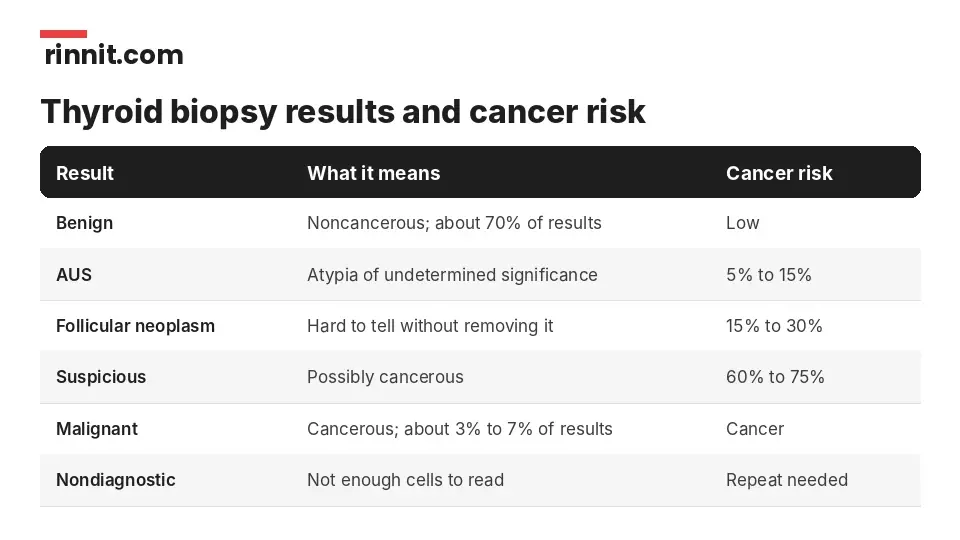
Six result categories and their cancer risk.
Most people get results within one week. Results fall into six categories: [1]
Result | What it means | Chance of cancer |
Benign | Noncancerous; about 70% of all results | Low |
Atypia of undetermined significance (AUS) | Has both benign and cancerous features | 13% to 30% |
Follicular neoplasm | Hard to tell benign from cancerous without removing it | 23% to 34% |
Suspicious | Possibly cancerous | 67% to 83% |
Malignant | Cancerous; about 3% to 7% of all results | Cancer |
Nondiagnostic | Not enough cells for a reliable diagnosis | Not applicable |
Sources: [1]
What happens next?
Benign: often watchful waiting, with a follow-up ultrasound in 12 months.
Malignant: almost always needs surgery to remove it.
Suspicious: may need surgery, depending on molecular profiling of the cells.
Your provider will explain your results and whether you need treatment. If cancer is found, your care team will explain its stage. [1]
Conclusion
A thyroid biopsy is a quick, low-risk way to find out whether a thyroid nodule is benign or needs treatment. Most results are benign, and you usually go home the same day with only mild soreness or bruising. [1]
If your result is indeterminate, ask your provider about next steps such as molecular testing, repeat biopsy or surgery. [1]
Keep learning: Read our guides to thyroid nodules and thyroid cancer, or learn what a thyroid panel measures. For more background, see MedlinePlus on thyroid cancer.
FAQ
What is a thyroid biopsy?
A procedure that removes a small sample of thyroid cells and fluid, usually from a nodule, to check for cancer. [1]
Why would I need a thyroid biopsy?
Usually to check a thyroid nodule, especially one larger than 1 centimeter. [1]
What is a fine-needle aspiration of the thyroid?
A biopsy using a thin needle guided by ultrasound; it is used for nearly all nodule biopsies. [1]
Does a thyroid biopsy hurt?
Your neck is numbed first; soreness and bruising afterward are common. [1]
How long does a thyroid biopsy take?
About 10 to 20 minutes, and you go home the same day. [1]
What are the risks of a thyroid biopsy?
Soreness and bruising are common; bleeding, infection and cyst formation are rare. [1]
How long do thyroid biopsy results take?
Most people get results within one week. [1]
What percentage of thyroid biopsies are benign?
About 70% of results are benign. [1]
What does a suspicious thyroid biopsy mean?
The cells may be cancerous, with about a 67% to 83% chance; surgery may be needed. [1]
What happens after a benign thyroid biopsy?
Often watchful waiting with a follow-up ultrasound in 12 months. [1]
Related Reading
Thyroid Nodules: Symptoms, Causes, Diagnosis and Treatment — What You Need to Know explains the thyroid bumps a biopsy checks.
Thyroid Cancer: Symptoms, Causes, Diagnosis and Treatment — What You Need to Know covers the cancer a thyroid biopsy can confirm or rule out.
Papillary Thyroid Cancer (PTC): Symptoms, Diagnosis, and Treatment explains the most common type of thyroid cancer.
Goiter: What a Neck Bulge Means, the 7 Causes, and How Treatment Protects Your Thyroid covers thyroid enlargement that can contain nodules.
References
Cleveland Clinic. Thyroid Biopsy: Purpose, Procedure, Side Effects & Results. Cleveland Clinic. Last updated June 28, 2024. https://my.clevelandclinic.org/health/diagnostics/thyroid-biopsy
Straccia P, Rossi ED, Bizzarro T, et al. A meta-analytic review of the Bethesda System for Reporting Thyroid Cytopathology: Has the rate of malignancy in indeterminate lesions been underestimated? Cancer Cytopathol. 2015;123(12):713-722. PMID 26355876. https://doi.org/10.1002/cncy.21605
Vuong HG, Ngo HTT, Bychkov A, et al. Differences in surgical resection rate and risk of malignancy in thyroid cytopathology practice between Western and Asian countries: A systematic review and meta-analysis. Cancer Cytopathol. 2020;128(4):238-249. PMID 31883438. https://doi.org/10.1002/cncy.22228
Medical disclaimer
This article is for general education only and does not replace advice from a qualified healthcare professional. Talk to your doctor about your own diagnosis and treatment, and seek emergency care right away for severe or sudden symptoms.



Comments