Parathyroidectomy: Surgery, Success Rate and Recovery

Updated: 2 days ago
Written and medically reviewed by Dr. Baraa Alnahhal, MD · Last reviewed: November 2026 · How we review
Quick Answer
A parathyroidectomy is surgery to remove one or more parathyroid glands, the small glands behind the thyroid that control blood calcium. It treats hyperparathyroidism, when a gland makes too much parathyroid hormone, and is the only cure, with a success rate over 95%. Surgery usually takes about an hour, and most people recover in one to three weeks.
What the research says
Surgery lowered fracture risk: in 35 studies covering 238,188 people with primary hyperparathyroidism, parathyroidectomy lowered fractures at any site by 20% and hip fractures by 37% compared with observation (Kongsaree N et al., Journal of Clinical Endocrinology and Metabolism, 2024) [2]
Minimally invasive surgery worked as well with fewer problems: across 42 studies of 12,832 patients, minimally invasive parathyroidectomy cured as often as full neck exploration while cutting operating time by about 33 minutes and roughly halving temporary low calcium (Yang G et al., Surgery, 2026) [3]
Key takeaways
A parathyroidectomy removes overactive parathyroid glands.
It's the only cure for hyperparathyroidism.
Success is over 95%.
Surgery takes about an hour.
Full recovery takes one to three weeks.
What is a parathyroidectomy?
Most people have four parathyroid glands on the back of the thyroid. They make PTH, which keeps blood calcium in balance. Parathyroidectomy is also called parathyroid surgery. Sources: [1]
Why it's done
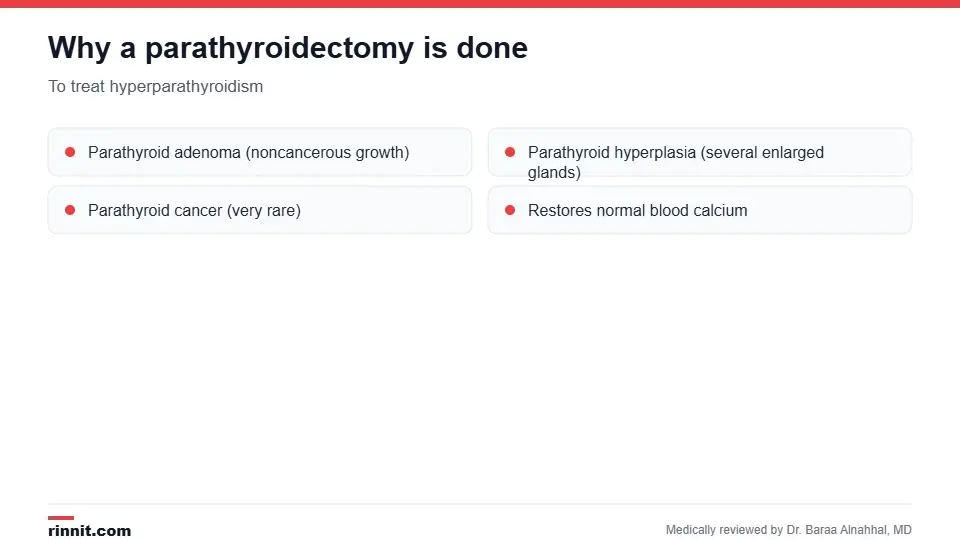
Restoring normal calcium can ease symptoms and protect bones and kidneys.
A parathyroid adenoma, a noncancerous growth on one or two glands.
Parathyroid hyperplasia, when several glands are enlarged.
Parathyroid cancer, which is very rare. Sources: [1]
Hyperparathyroidism can also be secondary to another condition, such as kidney disease. Sources: [1]
Surgical approaches
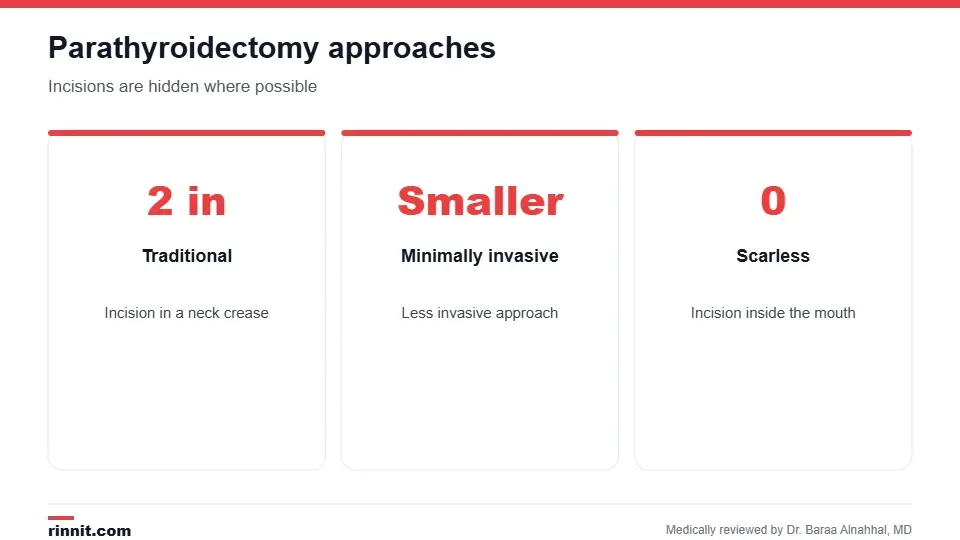
Neck incisions are placed in natural creases to hide scars.
Approach | How it's done |
Traditional | An incision of about 2 inches (5 centimeters) in a neck crease |
Minimally invasive | Less invasive than traditional surgery |
Scarless | An incision inside the mouth |
Sources: [1, 3]
How to prepare
Ask whether to fast the morning of surgery.
Ask whether to take your usual medicines and supplements.
Find out whether you need someone to drive you home. Sources: [1]
What happens during surgery

Most people go home the same day or the next day.
You get anesthesia.
The surgeon makes a small incision to find the glands.
The affected glands are removed.
The incision is closed with sutures. Sources: [1]
Surgery takes about one hour in most cases. Sources: [1]
Risks
Timing | Possible risks |
Short term | Sore throat, hoarseness, infection, a blood collection (hematoma) |
Long term | Hungry bone syndrome (long-term low calcium); hyperparathyroidism coming back |
Temporary low calcium with cramping or tingling usually lasts a few weeks, and you may take calcium supplements. Sources: [1, 3]
Recovery
Most people go home the same day or the next day.
Eat and drink normally; soft foods may help a sore throat for a day or two.
Avoid strenuous exercise until your surgeon says it's OK.
Return to normal activities within a few days.
Full recovery takes one to three weeks. Sources: [1]
Outlook
Parathyroidectomy has a success rate over 95%, and hyperparathyroidism comes back in less than 2%. Normal calcium can ease joint pain, muscle weakness, nausea, fatigue and brain fog and lowers your risk of kidney stones, osteoporosis and heart problems. Sources: [1, 2]
When to call your provider
Fever over 101 degrees Fahrenheit (38.3 degrees Celsius).
Pain that medicine doesn't relieve.
Trouble swallowing.
Signs of infection: redness, discharge or warmth.
Low-calcium symptoms: numbness, cramps or fatigue.
Call 911 if you have trouble breathing. Sources: [1]
Conclusion
A parathyroidectomy is a short, highly successful surgery that cures hyperparathyroidism for most people. Watching for low-calcium symptoms in the first weeks helps your recovery go smoothly.
Keep learning: read about hyperparathyroidism and the parathyroid glands.
Frequently asked questions
What is a parathyroidectomy?
Surgery to remove one or more parathyroid glands.
Why is a parathyroidectomy done?
To treat hyperparathyroidism.
Is it a major surgery?
No. It usually takes about an hour.
How successful is it?
The success rate is over 95%.
Will I have a scar?
Neck incisions are hidden in natural creases; a scarless approach goes through the mouth.
How long is the hospital stay?
Most go home the same day or the next day.
How long is recovery?
One to three weeks.
Why do I feel tingling after surgery?
Temporary low calcium is common and usually lasts a few weeks.
Can hyperparathyroidism come back?
Yes, in less than 2% of people.
Does surgery help my bones?
Studies show it lowers fracture risk.
Related Reading
Hyperparathyroidism and High Calcium: What Overactive Parathyroid Glands Do to Your Bones and Kidneys the condition this surgery treats.
Parathyroid Glands: Function, Location, Calcium Balance and Common Conditions how the glands work.
Parathyroid Scan (Sestamibi): Finding Overactive Glands Before Surgery imaging to find an overactive gland.
Hypocalcemia: Understanding Low Blood Calcium Levels low calcium after surgery.
Kidney Stones: Symptoms, Causes, and Treatment Guide a complication of high calcium.
References
Cleveland Clinic. Parathyroidectomy: What It Is, Side Effects & Recovery. Cleveland Clinic. Last updated September 8, 2023. https://my.clevelandclinic.org/health/treatments/7015-parathyroid-surgery
Kongsaree N, Thanyajaroen T, Dechates B, et al. Skeletal effect of parathyroidectomy on patients with primary hyperparathyroidism: a systematic review and meta-analysis. J Clin Endocrinol Metab. 2024;109(10):e1922-e1935. PMID 38739762. https://doi.org/10.1210/clinem/dgae326
Yang G, Zheng X, Xu T, et al. Comparison of efficacy and safety between minimally invasive parathyroidectomy and bilateral neck exploration for primary hyperparathyroidism: a systematic review and meta-analysis. Surgery. 2026;199:110502. PMID 42623898. https://doi.org/10.1016/j.surg.2026.110502
Medical disclaimer
This article is for general education only and does not replace advice from a qualified healthcare professional. Talk to your doctor about your own diagnosis and treatment, and seek emergency care right away for severe or sudden symptoms.



Comments