DOT Physical: What to Bring, What Happens and How Your Medical Card Results Work

Updated: 2 days ago
Written and medically reviewed by Dr. Baraa Alnahhal, MD · Last reviewed: November 2026 · How we review
Quick Answer: What is a DOT physical?
A DOT physical is a medical exam that shows whether you meet federal health standards to safely drive a commercial motor vehicle. A certified medical examiner reviews your health history and checks your vision, hearing, blood pressure, urine, heart and lungs. If you pass, you receive a medical certificate that is usually valid for two years. [1]
What the research says
Untreated sleep apnea sharply raises serious crash risk. In a trucking firm's mandated program, 360 drivers with sleep apnea who did not use their prescribed airway pressure therapy had a preventable crash rate about five times that of matched drivers (incidence rate ratio 4.97), while fully adherent drivers had a rate similar to controls. (Burks et al., Sleep, 2016) [2]
Conditions that may affect driving safety became more common among truckers. Across commercial driver medical exams of 95,567 drivers from 2005 to 2012, 8 of 13 conditions flagged as possibly raising crash risk became more common, and having four or more conditions was about seven times more likely by 2012. (Thiese et al., Journal of Occupational and Environmental Medicine, 2015) [3]
Key takeaways
A DOT physical confirms you are healthy enough to drive a commercial motor vehicle safely. [1]
Only a certified medical examiner listed on the federal National Registry can perform it. [1] [4]
The exam covers vision, hearing, blood pressure, pulse, a urine test and a hands-on physical exam. [1]
A passing result usually gives a two-year medical card, though some drivers need shorter certificates for monitoring. [1]
Many health conditions do not stop you from driving, especially when they are well treated. [1]
What is a DOT physical?
A DOT physical is a fitness-to-drive exam for people who operate commercial motor vehicles. Driving a CMV safely means you need to hear what is around you, see road signs clearly and stay alert. Some health conditions and medicines can interfere with these abilities, and others carry a risk of a sudden medical emergency behind the wheel. [1]
Federal transportation rules generally require the exam for anyone who drives a CMV across state lines. Each state sets its own rules for drivers who stay within that state. [1]
How long is a DOT medical card valid?
A medical certificate is typically good for two years. Your examiner may issue it for a shorter time if your health history calls for closer monitoring. [1]
Federal guidance states that a certificate lasts up to 24 months and that a shorter one may be issued to keep watch on a condition such as high blood pressure. [4]
Who performs a DOT physical?
The exam must be done by a certified medical examiner, a healthcare provider with added training in judging fitness to drive a CMV. Examiners must pass a certification test, complete refresher training every five years and retake the certification test every 10 years. [1]
You can find an examiner through the National Registry of Certified Medical Examiners, which you can search by city, state or ZIP code. [1] [4]
How do you prepare for a DOT physical?
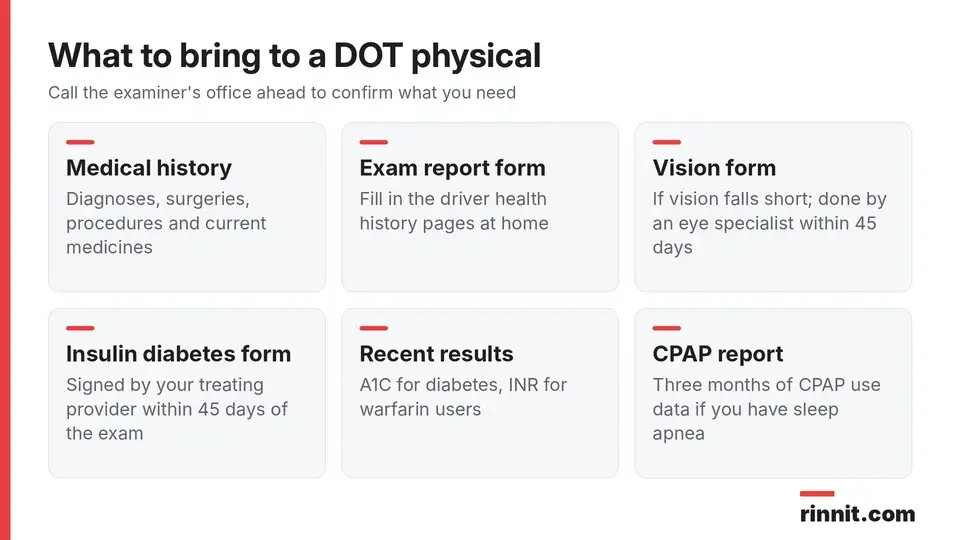
Gather your records before the exam to avoid delays.
Call the examiner's office ahead of time to ask what you should bring. Then: [1]
Gather your medical history: symptoms, diagnoses, surgeries, procedures and medicines, which you can get from your health record or your providers
Download the medical examination report form: the first two pages contain a driver health history checklist with space to explain answers, and you can fill it in at home
Ask your providers for any extra forms you may need
Which extra forms might you need?
Form | Who needs it | Key details |
Vision evaluation form | Drivers whose vision does not meet the standard | Needed at least once a year; completed by an ophthalmologist or optometrist no more than 45 days before the exam |
Insulin-treated diabetes assessment form | Drivers who use insulin | Covers when insulin started, self-monitoring, severe low blood sugar episodes, A1C, complications and diabetic eye disease; signed no more than 45 days before the exam |
CMV driver medication form | Drivers whose medicines need checking | Lists medicines, doses and what they treat; may be requested after the exam |
Sources: [1]
What to bring for specific conditions
What happens during a DOT physical?
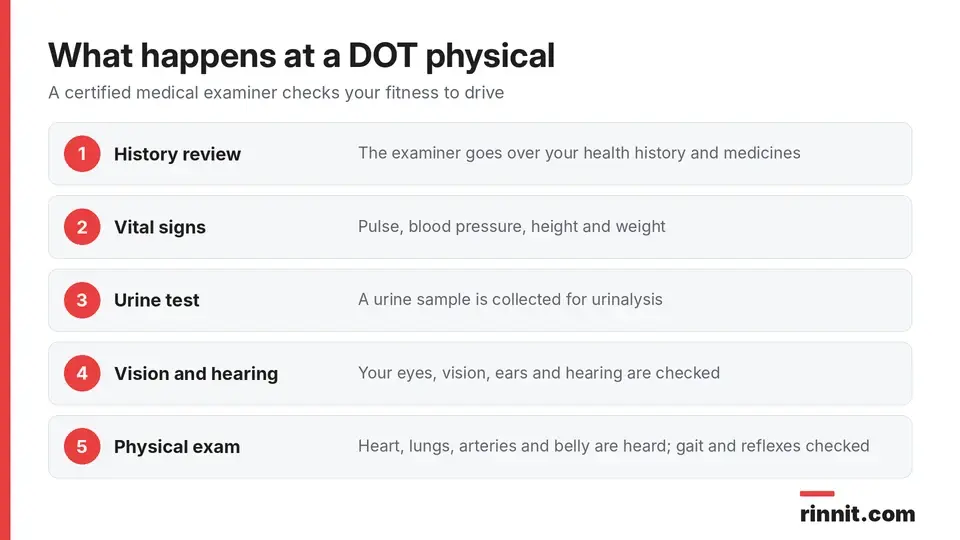
A DOT physical moves from your history to a hands-on exam.
The examiner starts by going over your health history and then: [1]
Checks your pulse and blood pressure
Measures your height and weight
Collects a urine sample for urinalysis
Checks your eyes and vision
Checks your ears and hearing
Listens to your heart, lungs, arteries and belly with a stethoscope
Watches how you walk (your gait)
Tests your reflexes
Some conditions or medicines may disqualify a driver or call for more evaluation before a certificate can be issued. [1]
What do DOT physical results mean?
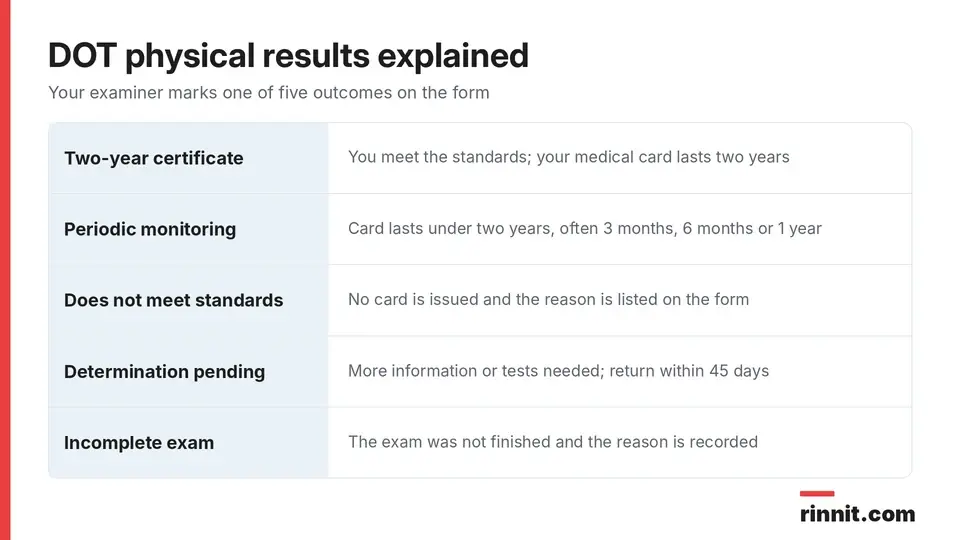
Your examiner marks one of five outcomes on the form.
Your examiner explains your result and any next steps. Some problems need follow-up care, testing or paperwork first, and you may still qualify once they are sorted out. [1]
Result | What it means |
Meets standards, two-year certificate | You receive a medical card that is valid for two years |
Meets standards, periodic monitoring | Your card lasts less than two years, usually three months, six months or one year, and you need another exam when it expires |
Does not meet standards | It is not safe for you to drive a CMV, no card is issued and the reason is listed on the form |
Determination pending | More information or testing is needed, and you return for follow-up within 45 days |
Incomplete examination | The exam was not finished, and the reason is listed |
Sources: [1]
Why is a DOT physical needed?
The exam protects you and everyone else on the road, and it lets employers confirm that drivers are fit for the work. CMV jobs can be physically and mentally demanding, including: [1]
Long, rotating or irregular schedules and disrupted sleep
Quick decisions in complex traffic
Handling large steering wheels or manual transmissions and maneuvering in busy areas
Lifting heavy loads, attaching trailers or climbing ladders
Dealing with passengers and long stretches away from family
Many health conditions do not affect your ability to drive a CMV or are easy to treat. [1]
When should you talk to your regular provider?
Reach out to your usual healthcare provider before the exam to collect your medical history, talk through any worry about meeting the standards or get forms filled in. Addressing a health issue ahead of time can make certification smoother. [1]
Conclusion
A DOT physical is a routine but important check that you can drive a commercial vehicle safely. Coming prepared with your history, forms and condition-specific results is the best way to avoid delays.
If you have a condition such as diabetes, sleep apnea or high blood pressure, work with your provider to keep it well controlled, since many drivers with treated conditions still qualify.
Keep learning: Read our drug test guide or our eye exam guide. For official rules, see the FMCSA page on the DOT medical exam.
FAQ
Who needs a DOT physical?
Generally anyone who drives a commercial motor vehicle across state lines; states set rules for in-state drivers.
How long is a DOT physical good for?
Usually two years, though some drivers get a shorter certificate for monitoring.
Who can perform a DOT physical?
Only a certified medical examiner listed on the National Registry of Certified Medical Examiners.
What should I bring to a DOT physical?
Your medical history, the exam report form, any required provider forms and condition-specific results such as A1C or a CPAP report.
Is there a urine test in a DOT physical?
Yes. A urine sample is collected for urinalysis.
What is checked during a DOT physical?
Pulse, blood pressure, height, weight, urine, vision, hearing, heart, lungs, belly, gait and reflexes.
Can I pass a DOT physical with diabetes?
Many people with diabetes can; insulin users need an assessment form signed within 45 days before the exam.
What do I need for sleep apnea at a DOT physical?
Bring a three-month CPAP compliance report.
What does determination pending mean?
The examiner needs more information or testing, and you return for follow-up within 45 days.
What happens if I fail a DOT physical?
No certificate is issued and the reason is recorded; some problems can be addressed so you can qualify later.
Related Reading
Obstructive Sleep Apnea: Symptoms, Causes, and What Actually Helps explains a condition that requires a CPAP compliance report at the exam.
High Blood Pressure: Silent Symptoms, Serious Risks, and Proven Ways to Lower It covers a common reason for a shorter medical certificate.
Diabetes: Symptoms, Types, Causes, Diagnosis & Treatment — Complete Guide describes a condition that needs A1C results and, with insulin, an extra form.
References
Cleveland Clinic. DOT Physical: What To Expect. Cleveland Clinic. Last updated February 13, 2024. https://my.clevelandclinic.org/health/diagnostics/dot-physical
Burks SV, Anderson JE, Bombyk M, et al. Nonadherence with Employer-Mandated Sleep Apnea Treatment and Increased Risk of Serious Truck Crashes. Sleep. 2016;39(5):967-975. PMID 27070139. https://doi.org/10.5665/sleep.5734
Thiese MS, Moffitt G, Hanowski RJ, et al. Repeated Cross-Sectional Assessment of Commercial Truck Driver Health. J Occup Environ Med. 2015;57(9):1022-1027. PMID 26340292. https://doi.org/10.1097/JOM.0000000000000522
Federal Motor Carrier Safety Administration. DOT Medical Exam and Commercial Motor Vehicle Certification. Federal Motor Carrier Safety Administration. Last updated December 16, 2019. https://www.fmcsa.dot.gov/medical/driver-medical-requirements/dot-medical-exam-and-commercial-motor-vehicle-certification
Medical disclaimer
This article is for general education only and does not replace advice from a qualified healthcare professional. Talk to your doctor about your own diagnosis and treatment, and seek emergency care right away for severe or sudden symptoms.



Comments