The Diaphragm: Understanding Your Body’s Primary Breathing Muscle

Updated: 3 days ago
Medically reviewed by Dr. Baraa Alnahhal, MD | Last reviewed: October 7, 2026
Quick Answer: What is the diaphragm?
The diaphragm is a thin, dome-shaped muscle that separates the chest cavity from the abdomen and drives breathing: when it contracts, it flattens and moves down, pulling air into the lungs. [1] It also helps increase abdominal pressure for bodily functions and helps prevent acid reflux by exerting pressure on the esophagus. [1] Its health is vital for respiratory efficiency.
What the research says
Breathing exercises ease breathlessness in serious lung disease. A systematic review of 73 randomized trials with 5,479 participants, mostly with COPD or asthma, found that pursed-lip and/or diaphragmatic breathing lowered breathlessness on the modified Medical Research Council scale versus usual care (mean difference −0.40 points, 95% CI −0.70 to −0.11; 8 studies, n=323). The effect did not exceed the minimal important difference, but quality of life improved consistently and no adverse events were reported (Burge et al., European Respiratory Review, 2024) [2].
Diaphragmatic breathing may lower stress, though evidence is small. A systematic review found only three eligible studies (one randomized trial and two quasi-experimental studies); all three showed lower stress, measured by respiratory rate and salivary cortisol, blood pressure, or the DASS-21 stress score, but the data could not be pooled (Hopper et al., JBI Database of Systematic Reviews and Implementation Reports, 2019) [3].
Diaphragm paralysis after heart surgery is uncommon but serious. In a database study of 191,463 children having heart surgery, 2,214 (1.2%) developed diaphragm paralysis, and those children had higher mortality (5.6% vs 3.5%) and more prolonged mechanical ventilation (38.0% vs 7.8%) (Fraser et al., Annals of Thoracic Surgery, 2020) [4].

The Mechanics of Breathing
The respiratory cycle is heavily dependent on the rhythmic movement of the diaphragm. During inhalation, the muscle contracts and flattens, which expands the chest cavity and allows the lungs to fill with air. [1] Conversely, during exhalation, the diaphragm relaxes and returns to its dome shape, pushing air out of the lungs. [1] This process is controlled by the phrenic nerve, which sends the necessary signals for the muscle to move. [1]
Action | Diaphragm Movement | Chest Cavity Effect | Result |
Inhalation | Contracts and flattens | Expands | Air is pulled into the lungs |
Exhalation | Relaxes and curves up | Contracts | Air is pushed out of the lungs |
Beyond Respiration: Digestive and Structural Roles
While breathing is its most famous job, the diaphragm also serves several other critical functions. It acts as a physical barrier that separates the thoracic cavity (containing the heart and lungs) from the abdominal cavity. [1] Additionally, it contains specialized openings that allow essential structures—such as the aorta, esophagus, and various nerves—to pass through. [1]
One of its lesser-known roles is assisting in digestive processes. By increasing pressure within the abdomen, the diaphragm helps the body eliminate waste. [1] It also plays a key role in preventing gastroesophageal reflux by putting pressure on the lower esophagus, acting as a functional barrier against stomach acid. [1]
Common Conditions and Symptoms
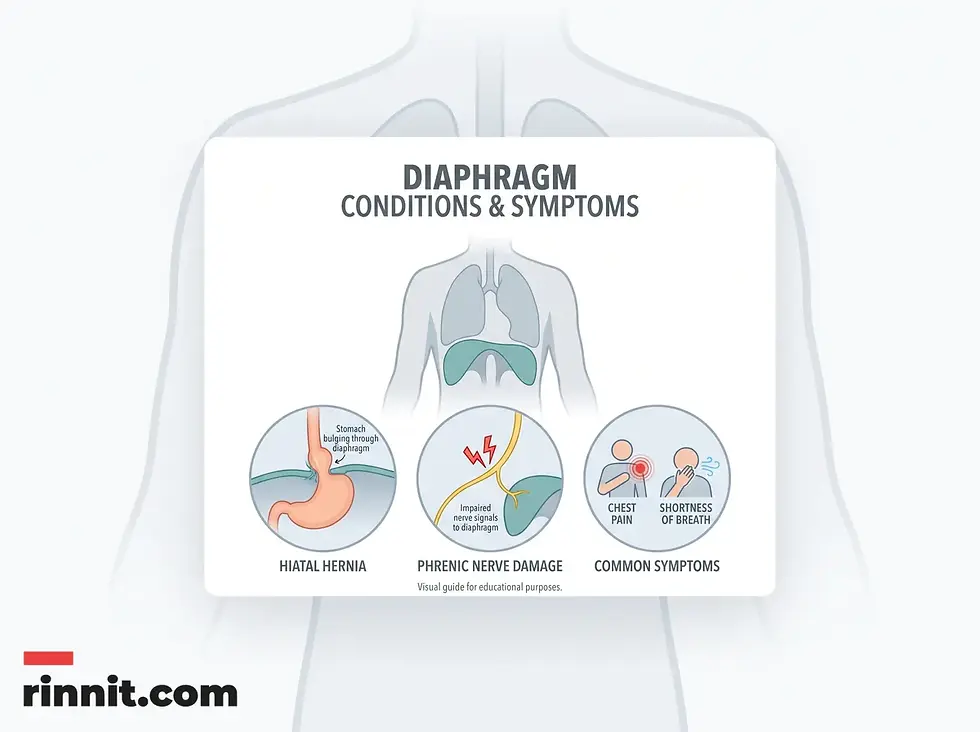
Many factors can influence how well the diaphragm functions, ranging from traumatic injuries to chronic diseases. Hernias are among the most common issues, occurring when organs bulge through the diaphragm’s natural openings, as in a hiatal hernia. Nerve damage, particularly to the phrenic nerve, is another significant concern and can occur during surgeries like heart bypasses. [1]
Condition Category | Examples | Typical Symptoms |
Hernias | Hiatal hernia, Diaphragmatic hernia | Heartburn, chest pain, difficulty swallowing |
Nerve Damage | Phrenic nerve palsy | Shortness of breath, especially when lying down |
Muscle Issues | Spasms (side stitches), ALS, MS | Cramping, muscle weakness, chronic breathing issues |
Chronic Disease | COPD, obesity, lupus | Reduced lung capacity, persistent cough |
Care and Prevention Strategies
Maintaining a healthy diaphragm involves both protecting the muscle from injury and strengthening it through specific techniques. Diaphragmatic breathing, often called “belly breathing,” is a powerful tool for improving muscle efficiency and reducing overall stress levels.
Lifestyle choices also play a significant role. Maintaining a healthy weight reduces the pressure on the diaphragm, while eating smaller meals can prevent the discomfort associated with hiatal hernias. For those at higher risk due to underlying conditions like COPD or autoimmune disorders, regular medical checkups are essential to monitor muscle function and address any issues early. [1]

Conclusion
The diaphragm is an essential yet often overlooked muscle that powers every breath we take. Its complex role in both the respiratory and digestive systems makes it a cornerstone of human physiology. By understanding its function and adopting healthy habits—such as proper breathing techniques and weight management—you can ensure this vital muscle continues to support your health for a lifetime.
When to See a Healthcare Professional
If you experience persistent shortness of breath, unexplained chest pain, or chronic hiccups, consult a healthcare professional. A thorough evaluation can determine if your symptoms are related to your diaphragm and help you develop a plan to restore your respiratory health.
Frequently Asked Questions
Where is the diaphragm located?
The diaphragm is a dome-shaped muscle located directly below the lungs and heart, separating the chest from the abdomen.
What is the main function of the diaphragm?
The diaphragm's primary job is to help you breathe by contracting and relaxing to move air in and out of the lungs.
What nerve controls the diaphragm?
The phrenic nerve is responsible for controlling the movement and contraction of the diaphragm.
Can you strengthen your diaphragm?
Yes, specific exercises like diaphragmatic breathing can help strengthen the muscle and improve its efficiency.
What is a hiatal hernia?
A hiatal hernia occurs when the upper part of the stomach bulges through the opening in the diaphragm where the esophagus passes.
Why do I get a “side stitch” when exercising?
A side stitch is usually a temporary diaphragm spasm caused by strenuous physical activity.
Can a damaged diaphragm cause acid reflux?
Yes, because the diaphragm helps put pressure on the esophagus to keep stomach acid down.
What are the symptoms of a weak diaphragm?
Common signs include trouble breathing (especially when lying down), chest tightness, and a persistent cough.
How common is nerve damage to the diaphragm after surgery?
In some heart bypass surgeries, the risk of phrenic nerve damage can be as high as 20%.
Does obesity affect the diaphragm?
Yes, excess weight can put additional pressure on the diaphragm and increase the risk of hernias.
Can stress affect my breathing muscle?
Yes, stress often leads to shallow breathing; diaphragmatic exercises can help reverse this and reduce stress.
What is diaphragmatic breathing?
Diaphragmatic breathing is a technique that involves deep breathing into the belly rather than shallow breathing into the upper chest.
Can lung diseases like COPD affect the diaphragm?
Yes, chronic lung issues can lead to a weakened diaphragm over time.
What structures pass through the diaphragm?
The aorta, esophagus, inferior vena cava, and several nerves pass through openings in the muscle.
When should I see a doctor about diaphragm pain?
You should seek medical help if you have persistent chest pain, difficulty swallowing, or severe shortness of breath.
Related reading on Rinnit
Sniff Test: Diaphragm Fluoroscopy for Weakness and Paralysis explains the X-ray test that checks how the diaphragm moves.
Sources
Cleveland Clinic. Diaphragm. Cleveland Clinic. Last updated June 11, 2021. https://my.clevelandclinic.org/health/body/21578-diaphragm
Burge AT, Gadowski AM, Jones A, et al. Breathing techniques to reduce symptoms in people with serious respiratory illness: a systematic review. Eur Respir Rev. 2024;33(174):240012. PMID 39477355. https://doi.org/10.1183/16000617.0012-2024
Hopper SI, Murray SL, Ferrara LR, et al. Effectiveness of diaphragmatic breathing for reducing physiological and psychological stress in adults: a quantitative systematic review. JBI Database System Rev Implement Rep. 2019;17(9):1855-1876. PMID 31436595. https://doi.org/10.11124/JBISRIR-2017-003848
Fraser CD, Ravekes W, Thibault D, et al. Diaphragm paralysis after pediatric cardiac surgery: an STS Congenital Heart Surgery Database study. Ann Thorac Surg. 2020;112(1):139-146. PMID 32763270. https://doi.org/10.1016/j.athoracsur.2020.05.175
Medical disclaimer
This article is for informational purposes only and does not constitute medical advice. Consult a healthcare professional for diagnosis and treatment.



Comments