Kidney Ultrasound: Why It's Done, How to Prepare and What It Shows

Updated: 2 days ago
Written and medically reviewed by Dr. Baraa Alnahhal, MD · Last reviewed: November 2026 · How we review
Quick Answer: What is a kidney ultrasound?
A kidney ultrasound, also called a renal ultrasound, is an imaging test that uses sound waves to make pictures of your kidneys and bladder. It helps providers find problems such as kidney stones, cysts, blockages, infection and tumors. It is safe, painless and uses no radiation. [1]
The test usually takes 20 to 30 minutes, you may be asked to come with a full bladder, and results are typically ready within 24 to 48 hours. [1]
What the research says
Starting with ultrasound for kidney stones is safe. In 2,759 emergency patients with suspected kidney stones, starting with ultrasound instead of CT lowered 6-month radiation exposure, while high-risk diagnoses with complications stayed low (0.4%) and serious adverse events, pain scores, return visits and hospitalizations did not differ. (Smith-Bindman et al., The New England Journal of Medicine, 2014) [2]
Risk factors predict who will have a blockage. Among 797 adults hospitalized with acute kidney injury who had a renal ultrasound, 10.6% had hydronephrosis; in the low-risk group only 3.1% did, and just 0.4% needed an intervention. (Licurse et al., Archives of Internal Medicine, 2010) [3]
Key takeaways
A kidney ultrasound uses sound waves, not radiation, to image the kidneys and bladder. [1]
It can show stones, cysts, abscesses, blockages, tumors, infection and injury. [1]
You may need a full bladder; usually no other preparation is needed. [1]
The test takes about 20 to 30 minutes and is painless. [1]
Results are usually ready within 24 to 48 hours. [1]
What is a kidney ultrasound?
A kidney ultrasound, also called a renal ultrasound, is an imaging test that lets your provider look at your kidneys and bladder. Sound waves create pictures of the organs, which appear on a screen. [1]
Your kidneys filter waste from your blood, and that waste leaves your body as urine. Your bladder holds urine until you urinate. Images of both give your provider information about your kidney health. [1]
Why would you need a kidney ultrasound?
Providers order a kidney ultrasound when they need more information about a possible kidney problem. It can also be used during a kidney biopsy or to check a transplanted kidney. [1]
What can a kidney ultrasound show?

What the images can reveal.
A kidney ultrasound can help diagnose: [1]
Kidney stones
Kidney infection
Blockage or obstruction
Kidney tumors or other masses
Kidney cysts
Abscesses
Hydronephrosis (urine building up in the kidney)
Kidney disease
Injury or trauma
Unusual kidney size or shape
Problems with blood flow to the kidneys
Sound waves cannot bounce off liquid or non-solid material, so a dark spot on the image may point to a cyst or abscess. [1]
How do you prepare for a kidney ultrasound?
Usually you do not need to prepare, and you can eat and drink as normal. In some cases, you may be asked not to eat after midnight before the test. [1]
In most cases, your provider asks you to arrive with a full bladder. If you also need a post-void residual (PVR) test, which checks how well your bladder works and how much it holds, you will drink 30 to 32 ounces of water an hour before the ultrasound and not use the restroom until afterward. If you are not sure, call your provider or arrive with a full bladder. [1]
What happens during a kidney ultrasound?

The scan from start to finish.
You change into a hospital gown and lie on a padded exam table.
A water-based gel goes on your skin. It is safe, does not stain and may feel cold at first.
A provider gently presses a transducer (a handheld wand) on your belly and moves it slowly, taking images.
You may be asked to hold your breath several times or roll onto your side.
You may be asked to leave the room to urinate, so images can be taken with your bladder full and empty.
An ultrasound technician usually performs the test, and a radiologist reviews the images and shares the findings with your provider. [1]
How long does it take, and does it hurt?
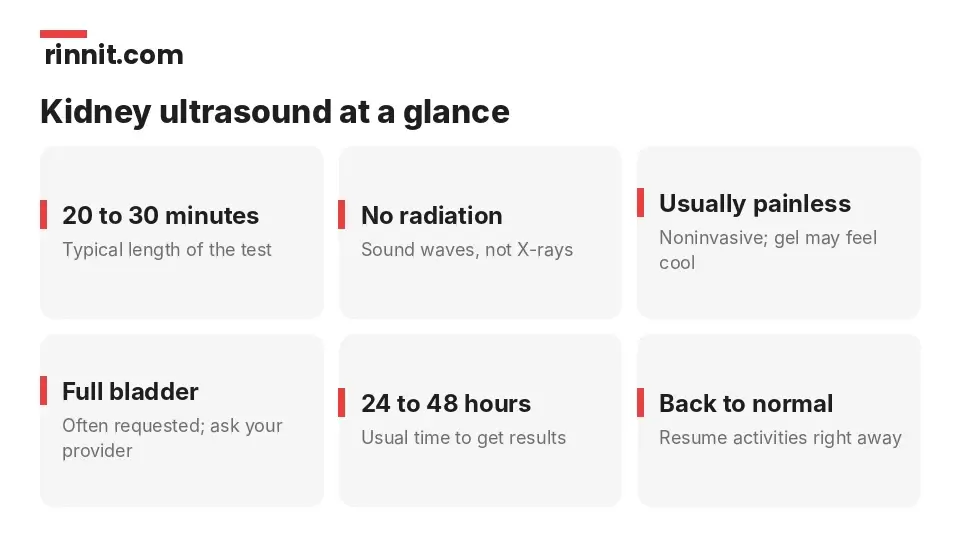
Quick facts before your scan.
The test typically takes about 20 to 30 minutes. It is noninvasive and does not hurt. Because it uses sound waves instead of radiation, there is no risk involved. [1]
When will you get your results?
Results are usually ready within 24 to 48 hours, depending on how quickly your care team reviews the images. Your provider will share them at a follow-up visit or by phone. You can return to your normal activities right after the test. [1]
There is a small chance your provider will order more imaging, kidney function tests or a kidney biopsy. [1]
Conclusion
A kidney ultrasound is a quick, safe, radiation-free way to look at your kidneys and bladder. It can reveal stones, cysts, blockages, infection and other problems that blood and urine tests alone cannot show. [1]
Check whether you need a full bladder before you go, and ask your provider when and how you will get your results. [1]
Keep learning: Read our guides to kidney stones and hydronephrosis, or learn how a general ultrasound works. For more background, see MedlinePlus on kidney diseases.
FAQ
What is a kidney ultrasound?
An imaging test that uses sound waves to make pictures of your kidneys and bladder. [1]
What can a kidney ultrasound detect?
Kidney stones, cysts, abscesses, blockages, hydronephrosis, tumors, infection, injury and blood flow problems. [1]
Do I need a full bladder for a kidney ultrasound?
In most cases, yes; ask your provider or arrive with a full bladder if unsure. [1]
Can I eat before a kidney ultrasound?
Usually yes, though some people are asked not to eat after midnight. [1]
How long does a kidney ultrasound take?
About 20 to 30 minutes. [1]
Is a kidney ultrasound painful?
No. It is noninvasive and typically painless. [1]
Does a kidney ultrasound use radiation?
No. It uses sound waves, so it is considered very safe. [1]
What does a dark spot on a kidney ultrasound mean?
It may point to a cyst or abscess, because sound waves do not bounce off fluid. [1]
How soon do kidney ultrasound results come back?
Usually within 24 to 48 hours. [1]
Who performs a kidney ultrasound?
Usually an ultrasound technician; a radiologist reviews the images. [1]
Related Reading
Nephroscopy: Kidney Scope Procedure for Stones, Recovery and Risks explains the kidney scope used to remove large stones.
Contrast-Enhanced Ultrasound (CEUS): Uses, Safety and What to Expect explains the microbubble ultrasound that shows blood flow without radiation.
Kidney Stones: Symptoms, Causes, and Treatment Guide explains one of the most common problems a kidney ultrasound finds.
Hydronephrosis: What Causes Kidney Swelling, How It Is Found, and How It Is Treated covers the urine buildup a kidney ultrasound can show.
Kidney Cysts: Symptoms, Causes, Diagnosis, and Treatment Options explains the fluid-filled spots seen on ultrasound.
Polycystic Kidney Disease (PKD): Symptoms, Types, and Treatment Options Explained covers an inherited condition that causes many kidney cysts.
Kidney Cancer: Symptoms, Causes & Treatment Guide explains kidney tumors an ultrasound can help detect.
References
Cleveland Clinic. Kidney Ultrasound: Purpose, Procedure & Results. Cleveland Clinic. Last updated March 11, 2024. https://my.clevelandclinic.org/health/diagnostics/15764-kidney-ultrasound
Smith-Bindman R, Aubin C, Bailitz J, et al. Ultrasonography versus computed tomography for suspected nephrolithiasis. N Engl J Med. 2014;371(12):1100-1110. PMID 25229916. https://doi.org/10.1056/NEJMoa1404446
Licurse A, Kim MC, Dziura J, et al. Renal ultrasonography in the evaluation of acute kidney injury: developing a risk stratification framework. Arch Intern Med. 2010;170(21):1900-1907. PMID 21098348. https://doi.org/10.1001/archinternmed.2010.419
Medical disclaimer
This article is for general education only and does not replace advice from a qualified healthcare professional. Talk to your doctor about your own diagnosis and treatment, and seek emergency care right away for severe or sudden symptoms.



Comments