Epispadias (Urethral Birth Defect): Causes, Diagnosis, and Treatment — A Complete Guide

Updated: 2 days ago
Medically reviewed by Dr. Baraa Alnahhal, MD · Last reviewed: October 17, 2026
Quick Answer
Epispadias is a rare congenital condition in which the urethra does not fully develop, so its opening sits on top of the penis, or toward the clitoris in girls, instead of its normal location [1]. It is usually diagnosed at birth [1]. Treatment is surgery, ideally done early [1], and most children achieve excellent results, including urinary control [1].
What the research says
Bladder control after repair depends heavily on the type of epispadias. In a single-center series of 67 boys with isolated epispadias (26 glanular, 23 penile, and 18 penopubic), repaired with either the modified Cantwell-Ransley technique (35 boys) or the Thiersch-Duplay technique (32 boys), complications occurred in 5 of 35 and 5 of 32 boys. Among those aged 5 or older, incontinence persisted in 14 of 26 (53.8%) and 12 of 27 (44.4%), and the penopubic type carried the highest risk for incontinence and further surgery (PubMed: Yu et al., J Pediatr Urol, 2026 [2]).
When epispadias occurs with bladder exstrophy, earlier surgery and bladder neck reconstruction predict better continence. In a multicenter study of 59 patients with bladder exstrophy-epispadias complex treated between 2000 and 2020, acceptable continence was reached in 54.3% after complete primary repair, 50% after radical soft-tissue mobilization, and 30% after modern staged repair; earlier surgery and bladder neck reconstruction were independent predictors of better continence (PubMed: Rathod et al., J Indian Assoc Pediatr Surg, 2026 [3]).
What Is Epispadias (Urethral Birth Defect)?
Epispadias is a rare birth defect, meaning a condition a baby is born with. It affects the urethra — the tube that carries urine outside of the body from the bladder [1]. In a baby with epispadias, the urethra does not fully develop [1].
The condition usually happens in males, though epispadias in females is rarer [1]. Pediatric urologists — doctors who specialize in problems of the urinary system in babies and children — can fix the problem with surgery [1].
What is bladder exstrophy?
Most of the time, epispadias occurs with other congenital urological problems, including bladder exstrophy [1]. Children with bladder exstrophy are born with the bladder outside the abdomen instead of inside [1].

How Does Epispadias Affect Males?
A baby boy with epispadias has two characteristic features:
The meatus is the hole or opening of the urethra. With epispadias, a deep groove often runs between the meatus and the tip of the penis [1].
The Three Types of Epispadias in Males
Providers classify epispadias based on the meatus' exact location [1]. Its location affects how well the bladder can store urine. The closer the meatus is to the base of the penis, the more likely the condition also affects the bladder sphincter and urine control [1]. The bladder sphincter opens and closes to release or hold urine.
Type | Where the meatus is | What it means for the bladder |
Glanular epispadias | On top of the glans (head of the penis) | The most common type [1] |
Penile epispadias | Along the penis shaft | Intermediate position |
Penopubic epispadias | Near the pubic bone | Pelvic bones don't come together, and the sphincter can't close completely [1] |
How Does Epispadias Affect Females?
Baby girls may have several signs of the condition:
Feature | What it looks like |
Urethral opening | Toward the clitoris, or even in the lower abdomen (belly) [1] |
Pubic bones | Separated, so the clitoris can't connect in the middle [1] |
Labia | The folds of skin outside the vagina don't form properly [1] |
Bladder neck | Problems with the bladder neck, resulting in urine control issues [1] |

Symptoms: What Does Epispadias Look Like?
Healthcare providers usually diagnose epispadias at one of the first newborn exams while the baby is still in the hospital [1]. The diagnosis usually occurs before anyone even notices symptoms. If the case is very mild, providers may not see it in the hospital. Parents may not notice anything until they are toilet training their child and see some urine leaking [1]. Girls are more likely to go undiagnosed [1].
When it is usually noticed | What you might see |
At birth (most cases) | Unusually shaped penis in a boy; unusual clitoris or labia in a girl [1] |
If the case is very mild | Not seen in the hospital at all [1] |
During toilet training (mild cases) | Urine leaking [1] |
More likely outcome for girls | Going undiagnosed for longer [1] |
Causes: What Causes Epispadias?
Researchers don't know exactly what causes epispadias, but it occurs when a developing baby has a problem with the cloacal membrane [1]. This membrane covers the cloaca, which normally develops into the gastrointestinal, urinary, and reproductive organs [1].
How common is epispadias?
Epispadias is a rare disease [1], affecting about 1 in 117,000 male babies and about 1 in 484,000 female babies [1].
Epispadias vs. Hypospadias: What's the Difference?
Both epispadias and hypospadias are birth defects involving the urethra. Both describe the position of the urethral opening [1]. The prefixes tell the story: epi- means above, and hypo- means below.
Feature | Epispadias | Hypospadias |
Meaning of the name | "Above" | "Below" |
Position of the urethral opening | On the top of the penis [1] | Along the bottom of the penis [1] |
Who it primarily affects | Boys, but can also affect girls [1] | Primarily boys |
What happens to the urethra | Doesn't fully develop; opening on top [1] | Doesn't fully develop and reach the penis tip |
Diagnosis: How Is Epispadias Diagnosed?
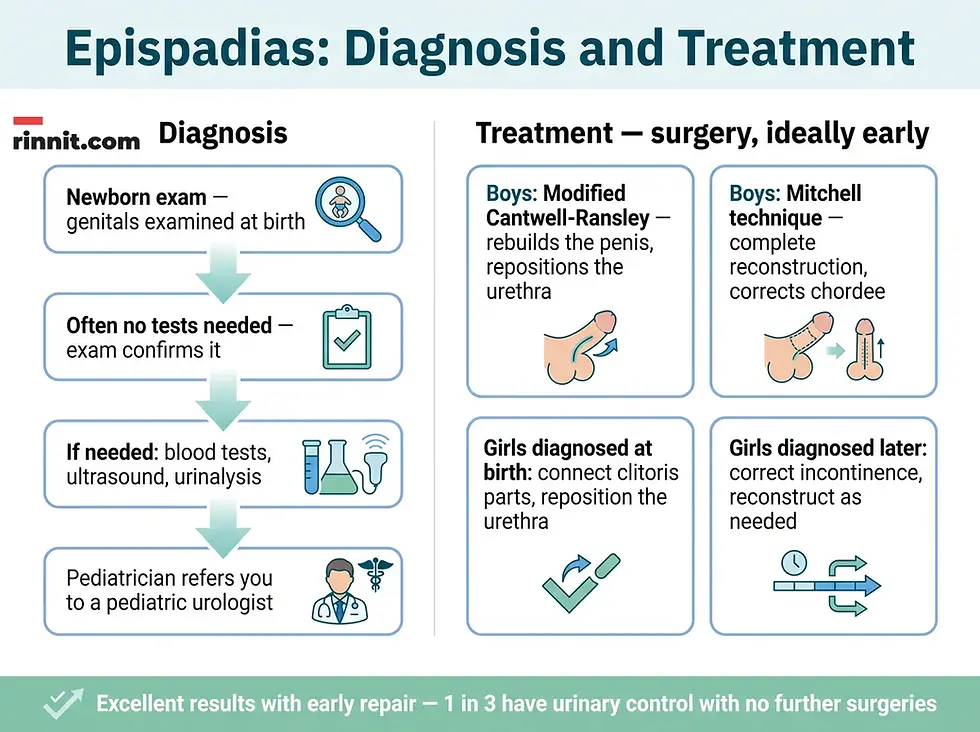
Healthcare providers usually diagnose this condition when a baby is born. Providers notice the unusually shaped penis in a boy, or the unusual clitoris and labia in a girl [1]. If the pediatrician detects epispadias, they will refer you to a pediatric urologist for treatment [1].
What tests will my baby need?
Often, your provider won't need to do any diagnostic tests. They can confirm the diagnosis just by examining your baby [1]. Your provider may recommend tests to confirm the extent of the problem [1].
Is epispadias diagnosed during pregnancy?
Epispadias is usually not diagnosed during pregnancy [1]. It is very difficult to detect on an ultrasound [1].
Treatment: How Is Epispadias Treated?
Surgery can correct epispadias to improve the look and function of the genitals [1]. Your pediatric urologist will discuss the surgical options with you. Healthcare providers recommend doing epispadias repair as early as possible [1]. Early surgery helps achieve better results, especially with bladder control [1] [3]. Your child may need more than one surgery [1].
What are the goals of surgery for boys?
Types of surgery for boys
Your provider's recommendation will depend on the type of epispadias [1]. A child with exstrophy-epispadias complex may need a more intricate surgery [1].
Technique | What the surgeon does |
Modified Cantwell-Ransley technique | Rebuilds the penis — the surgeon may partially reconstruct the penis and move the urethra to a better location [1] |
Mitchell technique | Completely reconstructs the penis, ensuring the urethra is in the best position and correcting chordee [1] |
Surgery options for girls
Girls typically need less complex epispadias surgery than boys do [1]. Fertility usually isn't an issue, as epispadias doesn't commonly affect the female reproductive system [1]. The type of surgery may depend on how early a provider diagnosed epispadias [1].
If diagnosed at birth | If diagnosed or treated later |
Connect the two parts of the clitoris [1] | Correct incontinence (lack of urine control) [1] |
Place the urethra in the correct location [1] | Reconstruct a narrow vaginal opening [1] |
Urinary control most likely won't be a problem | Additional reconstruction may be needed |
How long will recovery take?
The recovery period depends on the complexity of the repair [1]. Children who had a minor procedure will recover quickly [1]. For children with bladder exstrophy, epispadias repair may be one procedure of many that they need. Recovery will take longer [1].
Outlook: What Can I Expect?
When surgeons perform repairs at birth, children achieve excellent results [1]. Among these children, 1 in 3 will have urinary control without needing any other surgeries [1]. A child born with other conditions, such as bladder exstrophy, will probably need additional procedures to repair the bladder [1]. With surgical repair, most children can achieve urinary control [1].
Are there complications from surgery?
Sometimes, after major surgery, a hole called a fistula can open from the urethra to the skin [1]. However, this isn't very common today with advanced surgical techniques [1]. If it does happen, the fistula may close on its own, or your child may need another procedure to close the fistula [1].
Prevention: Can Epispadias Be Prevented?
There is no known way to prevent epispadias [1]. Because the cause involves early embryonic development, there is nothing parents do — or fail to do — that makes it happen.
Living With Epispadias: When to See a Provider
Your provider will explain how to care for the surgical site after the procedure. Follow your provider's instructions to relieve pain and keep the area clean.
After-surgery warning signs
Seek immediate medical help if your child has any of the following:
Warning sign | What it looks like |
High fever | Elevated body temperature |
Signs of infection at the surgical site | Red, swollen, or leaking fluid [1] |
Other worrying symptoms | Anything unusual after surgery |
Go to the emergency room or call emergency services if your child has a high fever, signs of infection at the surgical site (red, swollen, or leaking fluid), or other worrying symptoms [1].
Common questions from parents
Common question | What the evidence says |
Will surgery affect erectile function? | No — epispadias repair should not affect erectile function [1] |
Will it affect fertility? | Not usually for women; men with penopubic epispadias or exstrophy-epispadias complex may experience infertility, and surgery may reduce these problems [1] |
Is the child at higher risk for UTIs? | No — studies haven't shown any connection between epispadias and more urinary tract infections [1] |
Can a baby boy be circumcised? | Providers recommend delaying circumcision until after surgery, because the surgeon may need to use foreskin tissue to rebuild the penis [1] |
If you had epispadias as a child, talk to your healthcare provider about how it might affect you.
Key Takeaways
Epispadias is a rare birth defect, but it is one that modern pediatric urology handles with excellent results. The urethra simply needs to be repositioned and, in boys, the penis rebuilt. Because it is usually spotted at the first newborn exam, most children are treated early and go on to have normal-appearing genitalia and bladder control. If you notice urine leaking during toilet training, an unusually curved penis, or anything concerning about your child's genitals, see your provider — a pediatric urologist can take it from there.
Take the Next Step
If your newborn's genitals look unusual, or your child is leaking urine during toilet training, schedule an evaluation with a pediatric urologist. Early repair delivers the best results. (If you or your child ever need emotional support around a rare diagnosis, the 988 Suicide and Crisis Lifeline — call or text 988 — is available 24/7.)
Further reading: Urology Care Foundation — What Is Epispadias? · Orphanet — Isolated Epispadias · NICHD — Birth Defects
Frequently Asked Questions
1. What is epispadias?
Epispadias is a rare birth defect in which the urethra — the tube that carries urine out of the body — doesn't fully develop, leaving the urethral opening on top of the penis or near the clitoris rather than at its normal position.
2. Is epispadias serious?
Epispadias is usually detected at birth and treated with surgery that produces excellent results, including normal-appearing genitalia and bladder control. Because it can cause urinary incontinence, treatment is essential.
3. How common is epispadias?
Epispadias is very rare, affecting about 1 in 117,000 male babies and 1 in 484,000 female babies.
4. What is the difference between epispadias and hypospadias?
Both are urethral birth defects describing where the urethral opening sits. In epispadias (epi- means "above") the opening is on top of the penis; in hypospadias (hypo- means "below") it is along the bottom.
5. What causes epispadias?
The exact cause is unknown, but it occurs when a developing baby has a problem with the cloacal membrane, which normally helps form the gastrointestinal, urinary, and reproductive organs.
6. How is epispadias diagnosed?
Usually at the first newborn exam, by examining the genitals. Blood tests, ultrasound, and urinalysis may confirm the extent of the problem. It is usually not detected on prenatal ultrasound.
7. How is epispadias treated?
With repair surgery, ideally done as early as possible. Boys may receive the modified Cantwell-Ransley or Mitchell technique; girls usually need less complex repair. Some children need more than one surgery.
8. Can epispadias go away on its own?
No. Because the urethra doesn't fully develop, surgery is needed to reposition the opening, rebuild the genitals, and protect bladder control.
9. What is the outlook for children with epispadias?
Excellent when repaired at birth — 1 in 3 children will have urinary control without needing any other surgeries, and most children achieve urinary control with surgical repair.
10. Does epispadias affect future fertility or sexual function?
Surgery should not affect erectile function. Female fertility is usually unaffected, but men with penopubic epispadias or the exstrophy-epispadias complex may experience fertility problems that surgery can reduce.
Related Reading
References
Cleveland Clinic. Epispadias. Cleveland Clinic. Last updated May 26, 2021. https://my.clevelandclinic.org/health/diseases/21551-epispadias
Yu B, Li J, Song H, et al. Single-center experience with isolated male epispadias: outcomes of Thiersch-Duplay and modified Cantwell-Ransley repairs by anatomical subtype. J Pediatr Urol. 2026;22(5):106138. doi:10.1016/j.jpurol.2026.106138. PMID: 42475811.
Rathod KJ, Agrawal V, Babu R, et al. Long-term outcomes of bladder exstrophy-epispadias complex: a multicenter study by Indian Association of Pediatric Surgeons. J Indian Assoc Pediatr Surg. 2026;31(2):230-238. doi:10.4103/jiaps.jiaps_339_25. PMID: 41958798.
Medical Disclaimer
This article is for informational purposes only and does not constitute medical advice. Always seek the advice of your physician or other qualified health provider with any questions you may have regarding a medical condition. Never disregard professional medical advice or delay in seeking it because of something you have read here.



Comments