Hypospadias: Symptoms, Causes & Treatment Explained

Updated: 2 days ago
Medically reviewed by Dr. Baraa Alnahhal, MD · Last reviewed: September 2026
At a Glance
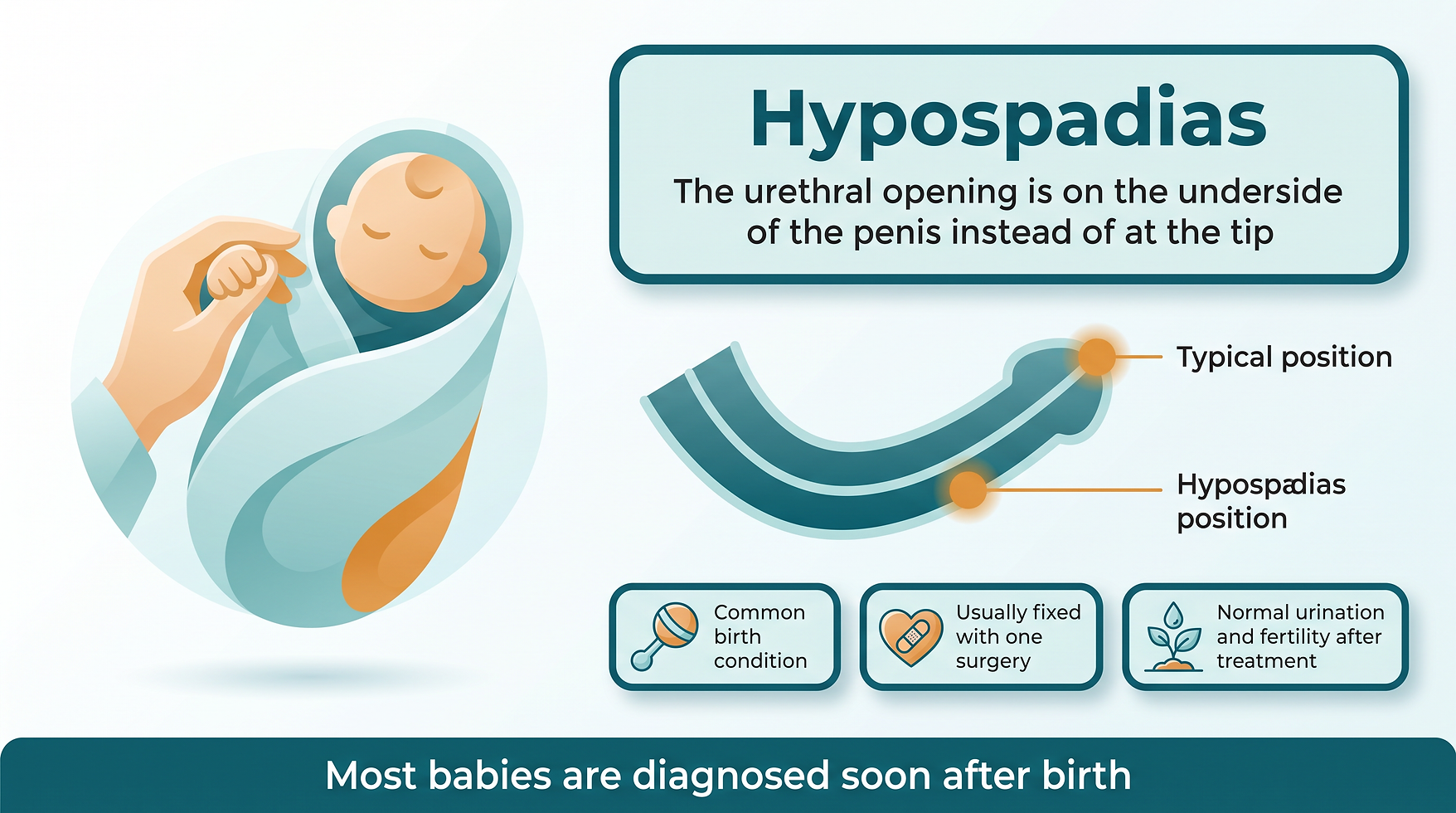
TL;DR: Hypospadias (hi-poe-SPAY-dee-us) is a common birth condition in which the opening of the urethra — the tube that drains urine from the bladder — is on the underside of the penis instead of at the tip. Most babies are diagnosed soon after birth through a routine physical exam. Some mild forms need no treatment, but most cases are corrected with surgery, usually between 6 and 12 months of age. For most men, the outcome is highly successful: the penis looks typical, urination is normal, and fertility is not affected. One important note for parents of newborn boys: delay circumcision until the baby has been evaluated, since the foreskin tissue may be needed during surgery.
Quick Answer:
What is hypospadias? A common birth condition where the urethral opening is on the underside of the penis instead of at the tip; it forms as the baby develops in the womb.
What are the main signs? An opening somewhere other than the tip of the penis, a downward curve of the penis (chordee), a hooded appearance of the foreskin, and unusual urine spraying.
When is it diagnosed? Most babies are diagnosed soon after birth while still in the hospital, through a physical exam.
What causes it? A change in how certain hormones act as the urethra and foreskin form before birth; in most cases the exact cause isn't known.
Does it need surgery? Some minor forms don't, but treatment usually involves surgery to move the urethral opening to the tip of the penis, typically between 6 and 12 months of age.
What are the long-term results? Surgery is highly successful for most men — normal urination, a typical-looking penis, and fertility that isn't blocked.
What should parents do first? Talk to the pediatrician, get a referral to a pediatric urologist, and hold off on circumcision until after evaluation.
What Is Hypospadias, Exactly?
Hypospadias (hi-poe-SPAY-dee-us) is a condition that happens as the unborn baby, called a fetus, develops in the womb. The opening of the urethra — the tube that drains urine from the bladder and out of the body — forms on the underside of the penis instead of at the tip.
The location of the opening can vary. It can be anywhere from underneath the tip of the penis, which is more common, to the base of the penis, which is less common.
Here's the good news for parents: hypospadias is common and doesn't cause difficulty in caring for your baby. Surgery usually can create a typical-looking penis that works properly. With successful treatment, most men can pass urine properly, and the condition won't block sperm from fertilizing an egg.
What Are the Signs of Hypospadias?
In most cases, the opening of the urethra is within the head of the penis. Less often, it's at the middle or the base of the penis. Rarely, the opening is in or beneath the scrotum.
Signs of hypospadias may include:
An opening of the urethra at a place other than the tip of the penis.
A downward curve of the penis. This condition is called chordee.
A hooded appearance of the penis because only the top half is covered by foreskin.
Differences in spraying when passing urine.
Sign | What Parents Notice | How Common |
Urethral opening not at the tip | Opening within the head of the penis, or lower on the shaft or base | Most common sign — in most cases the opening is within the head |
Chordee (downward curve) | The penis curves downward | Frequently occurs alongside the opening |
Hooded foreskin | Only the top half of the penis is covered by foreskin | Common associated feature |
Unusual urine spraying | Urine stream sprays differently than expected | May be noticed during diaper changes |
Opening in or beneath the scrotum | Opening located at the far end of the underside | Rare |
When Should You See a Doctor?
Most babies with hypospadias are diagnosed soon after birth while still in the hospital. But it may be harder to identify if there's only a slight change in where the urethral opening is.
Talk with your doctor or other healthcare professional if you have concerns about the look of your child's penis or if your child has problems passing urine.
What Causes Hypospadias?
Hypospadias is a condition that is present at birth. As the penis develops in a male unborn baby, certain hormones stimulate how the urethra and foreskin form. Hypospadias results from a change in the action of these hormones, which keeps the two sides of the urethral folds from joining completely. The location of the urethral opening depends on when that joining stopped.
In most cases, the exact cause of hypospadias is not known. Sometimes, hypospadias is caused by gene changes, but environment also may play a role.
What Raises the Risk?
Although the cause of hypospadias is usually not known, several factors may be linked with the condition:
Risk Factor | What Research Suggests |
Family history | More common in babies with a family history of hypospadias |
Genetics | Some gene changes may alter the hormones that stimulate male genital development |
Maternal age over 35 | Some research suggests a higher risk in male babies born to women older than 35 |
Certain pregnancy exposures | A link to maternal exposure to certain hormones or compounds such as pesticides or industrial chemicals is being studied; more research is needed to confirm |
How hypospadias develops — hormones guide development, the urethral folds begin to join, and joining stops early so the opening forms on the underside — plus risk factors: family history, genetics, maternal age over 35, and certain pregnancy exposures.
What Happens If Hypospadias Is Not Treated?
If hypospadias is not treated, it can result in differences in how the penis looks, problems learning to use a toilet, an unusual curve of the penis with an erection, and problems releasing sperm from the penis — a process called an ejaculation. This is why follow-through on treatment matters, even when the condition seems minor at first.
How Is Hypospadias Diagnosed?
Your child's pediatrician can diagnose hypospadias based on a physical exam. You'll likely be referred to a surgeon who specializes in genital and urinary conditions, called a pediatric urologist, for more evaluation. Medical centers with specialty teams can help you look at treatment options and can provide expert treatment.
There's one situation that calls for extra attention. When the opening of the urethra is not at the tip of the penis and the testicles can't be felt on exam, the genitals may be hard to identify as clearly male or female. This is called atypical genitalia. When this happens, more evaluation by a multispecialty team is recommended.
How Is Hypospadias Treated?
Some forms of hypospadias are very minor and do not need surgery. But treatment usually involves surgery to put the urethral opening at the tip of the penis. If needed, surgery to straighten the shaft of the penis also is done. Surgery usually takes place between the ages of 6 and 12 months.
A Word on Circumcision
This matters for parents of newborn boys. Circumcision likely won't be done if the penis looks different from usual. Instead, the foreskin tissue may be left in place for use during surgery to create a penis that looks and works properly.
If hypospadias is found during circumcision, the procedure is usually finished. In either situation, referral to a pediatric urologist is recommended.
Scenario | What Typically Happens |
Hypospadias seen at birth | Circumcision is usually not done; foreskin may be saved for surgical repair |
Hypospadias found during circumcision | The procedure is usually finished |
Either scenario | Referral to a pediatric urologist is recommended |
What Does the Surgery Involve?
For most forms of hypospadias, treatment involves a single surgery that's done on an outpatient basis. Some forms of hypospadias require more than one surgery.
When the urethral opening is near the base of the penis, the surgeon may need to use tissue grafts from the foreskin or from the inside of the mouth to reconstruct the urinary channel in the proper position.
How Successful Is the Surgery?
For most men, surgery is highly successful. Most of the time, the penis looks typical after surgery. Most men can pass urine properly. And with successful hypospadias treatment, the condition won't block sperm from fertilizing an egg.
Occasionally, a hole called a fistula develops along the underside of the penis where the new urinary channel was created. This results in urine leaking. Rarely, there is a problem with wound healing or scarring. These complications may need another surgery for repair.
Outcome | How Often |
Penis looks typical after surgery | Most of the time |
Normal urination | Most men |
Fertility unaffected | With successful treatment |
Fistula (urine leak) along the new channel | Occasionally |
Wound healing or scarring problems | Rarely |
Need for a repair surgery | Only when a complication occurs |
What About Follow-Up Care?
Your child will need a couple of visits to the surgeon after surgery. After that, regular follow-up with your child's pediatric urologist is recommended after toilet training and at puberty to check for healing and possible complications.
The four-stage pathway — Exam at Birth, Pediatric Urologist, Surgery at 6–12 Months, Follow-Up Care — with a note that outcomes are highly successful: most men urinate normally and fertility is preserved.
How Should Parents Prepare for the Appointment?
Most often, babies with hypospadias are diagnosed while still in the hospital after birth. If your baby has hypospadias, you'll likely be referred to a pediatric urologist.
What you can do. Before the appointment, ask a family member or friend to go with you — that person can help you remember information and provide support. Also make a list of questions to ask your doctor or other healthcare professional.
Questions to ask might include: Does my child need to have surgery? When is the best time for surgery? What are the risks with this surgery? What happens if my child doesn't have the surgery? Will this condition affect my child's fertility or sexual function later in life? What is the likelihood of future children having the same condition? Are there any brochures or other printed material that I can have? What websites do you suggest? Feel free to ask other questions during the appointment.
What to expect from your doctor. Be ready to answer questions from your baby's healthcare professional, such as: Has anyone else in your family been diagnosed with hypospadias? Does your child's penis curve downward during an erection? Have you noticed any unusual spraying when your child passes urine?
Conclusion: A Common Condition With a Highly Successful Fix
Hypospadias may feel like a lot to take in as a parent, but the facts are reassuring. It's a common birth condition, usually caught at the hospital right after birth, and it doesn't make caring for your baby any harder. Surgery — typically a single outpatient procedure between 6 and 12 months — corrects the opening's position and straightens the shaft when needed. For most men, the long-term result is a typical-looking penis, normal urination, and full fertility.
Three practical takeaways. First, talk to your pediatrician if you notice any signs, even a slight change in where the urethral opening sits or unusual urine spraying. Second, if you have a newborn boy, wait on circumcision until a professional evaluation is done — the foreskin tissue may be part of the repair. Third, keep the follow-up appointments after toilet training and at puberty; they're quick checks that protect the long-term result.
Call to action: Book a conversation with your pediatrician, ask for a referral to a pediatric urologist, and bring this guide's question list to the appointment.
Frequently Asked Questions
What is hypospadias?
Hypospadias (hi-poe-SPAY-dee-us) is a common birth condition in which the opening of the urethra is on the underside of the penis instead of at the tip. The urethra is the tube that drains urine from the bladder and out of the body. The condition forms as the baby develops in the womb.
What are the signs of hypospadias?
Signs include an opening of the urethra at a place other than the tip of the penis, a downward curve of the penis called chordee, a hooded appearance because only the top half is covered by foreskin, and differences in spraying when passing urine.
When is hypospadias diagnosed?
Most babies are diagnosed soon after birth while still in the hospital, based on a physical exam by the pediatrician. It can be harder to identify when there's only a slight change in where the urethral opening is.
What causes hypospadias?
It results from a change in the action of the hormones that stimulate how the urethra and foreskin form before birth. This keeps the two sides of the urethral folds from joining completely — the location of the opening depends on when joining stopped. In most cases the exact cause is not known; gene changes and environment may play a role.
Does hypospadias always need surgery?
No. Some forms are very minor and do not need surgery. But treatment usually involves surgery to move the urethral opening to the tip of the penis, typically performed between 6 and 12 months of age. Some cases need more than one surgery.
Should circumcision be done if my baby has hypospadias?
Circumcision likely won't be done if the penis looks different from usual, because the foreskin tissue may be needed during repair surgery. If hypospadias is found during circumcision, the procedure is usually finished — but either way, referral to a pediatric urologist is recommended.
How successful is hypospadias surgery?
For most men, surgery is highly successful. Most of the time the penis looks typical afterward, most men can pass urine properly, and successful treatment won't block sperm from fertilizing an egg. Occasionally a fistula (a small hole that leaks urine) develops, or rarely there are wound healing problems — both may need a repair surgery.
Can hypospadias affect fertility later in life?
With successful treatment, hypospadias won't block sperm from fertilizing an egg. That's one reason follow-up at toilet training and puberty is recommended, and a reason to ask your pediatric urologist about fertility and sexual function if you have concerns.
References
Hypospadias — Symptoms & causes. mayoclinic.org
Hypospadias — Diagnosis & treatment. mayoclinic.org
Disclaimer: This article is for general educational purposes only and is not a substitute for professional medical advice, diagnosis or treatment. Always seek the guidance of your healthcare professional with any questions about your child's situation. In a medical emergency, call 911 or your local emergency number.
Comments