Congenital Penile Curvature (Chordee): Signs, Causes, Diagnosis, and Treatment Options

Updated: 1 day ago
Medically reviewed by Dr. Baraa Alnahhal, MD · Last reviewed: October 2026
Quick Answer
Congenital penile curvature (chordee) is a birth condition in which the penis bends or curves, most noticeably during an erection [1]. It occurs in about 4% to 10% of male births [1]. Most cases are mild and need no treatment, but severe cases can cause pain during sex or distress and are fixed with surgery, typically around age 2 [1].
What the research says
Surgery works well in adults, but it is not clear which technique is best. A systematic review of 55 articles covering 2,956 men with congenital penile curvature (1,375 had plication and 1,580 had corporoplasty) reported successful straightening in 75% to 100% of plication cases and 73% to 100% of corporoplasty cases. The authors could not say which technique is better because the studies were of low quality and reported outcomes in very different ways (PubMed: Britton et al., J Sex Med, 2022) [2].
Most men needed only one operation, but some reported side effects years later. In a retrospective review of 116 men operated on for congenital penile curvature without hypospadias, 87 (75%) were reached by telephone survey after a mean follow-up of 89 months. Of these, 81 (93.1%) were successfully treated with one operation. No one reported new erectile dysfunction, but 15 men reported shortening of the penis and 4 reported decreased sensation of the glans (PubMed: Nyirády et al., J Urol, 2008) [3].
An injection option has been tested, but only in a non-randomized series. In a prospective registry of 453 men who received collagenase Clostridium histolyticum injections (408 with Peyronie's disease and 45 with congenital penile curvature), curvature improved by 25 to 30 degrees (40% to 50%) in the congenital group versus 20 to 25 degrees (33% to 35%) in the Peyronie's group, and the difference was not statistically significant. The authors describe this as the first evidence for a non-surgical option in congenital curvature, but the study was non-randomized with short-term follow-up and needs external validation (PubMed: Kulkarni et al., J Sex Med, 2023) [4].
Mild curvature is common, even without hypospadias. A review reports varying degrees of penile curvature in 4% to 10% of males who do not have hypospadias, and names penile degloving and dorsal plication as the most widely used repair techniques (PubMed: Montag & Palmer, TheScientificWorldJournal, 2011) [5].
Many people notice it at puberty, and surgery works well. A clinical review notes patients usually present after puberty, when erections make the curve obvious; when severe curves make intercourse difficult or impossible, repair is recommended and excellent outcomes can be expected. Nesbit-type repairs generally had fewer recurrences than the simpler plication technique (PubMed: Makovey et al., Current Urology Reports, 2012) [6].
Curves and twisting can be corrected with excellent cosmetic results. In a small retrospective series of 9 children aged 5 to 16 with both penile torsion and chordee without hypospadias, every patient had excellent functional and cosmetic results, with no residual chordee or torsion at 12 to 24 months of follow-up (PubMed: Bhat et al., Journal of Pediatric Urology, 2014) [7].
What Is Congenital Penile Curvature?
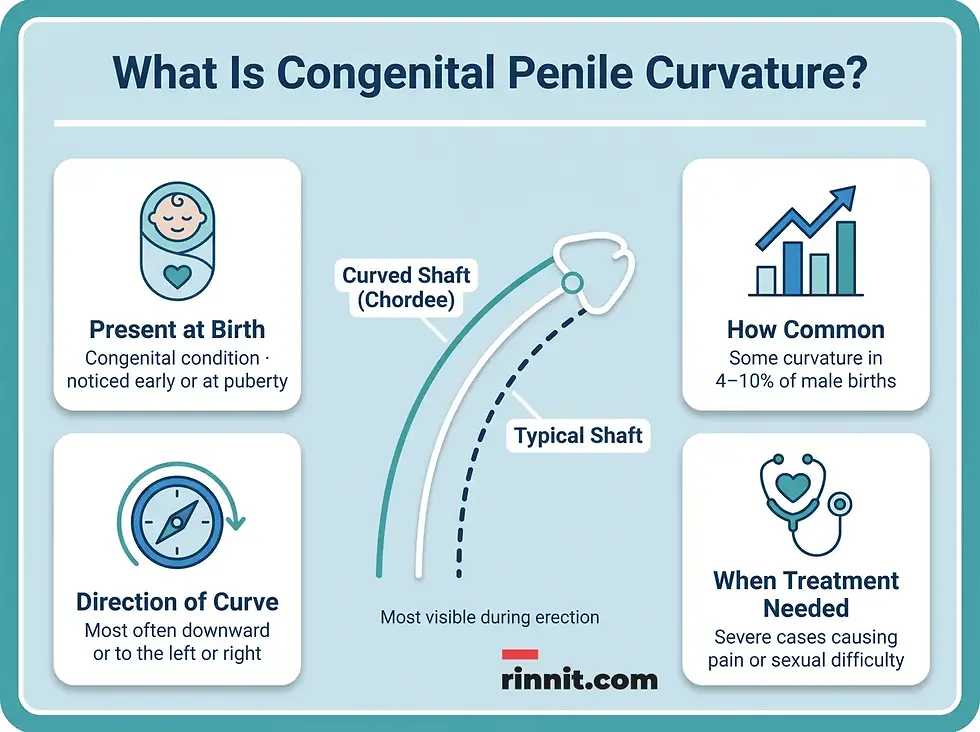
Congenital penile curvature, also known as chordee, is a condition that can affect newborn boys. It causes the penis to bend or curve, and the curve becomes more apparent during an erection [1].
You may notice penile curvature early in a baby's life, such as when changing a diaper [1]. In other cases, chordee may go undiscovered until puberty, when erections begin [1].
Most congenital penile curvatures are mild and do not require treatment [1]. But in more severe cases, the penis is significantly bent or twisted along the shaft [1]. This can cause self-consciousness, pain, or problems with sexual function. It could also make it difficult to aim urine into the toilet [1]. In these cases, surgery may be necessary [1].
Key Fact | Detail |
Definition | Condition present at birth that causes the penis to bend or curve |
Also known as | Chordee |
Most noticeable | During an erection |
Prevalence | Some degree of curvature in 4% to 10% of male births |
Most common direction | Downward, or slightly to the left or right |
Treatment need | Most cases mild; severe cases may need surgery |
Is a Curved Penis Normal?
Some degree of penile curving can be normal [1]. In many cases, the penis curves slightly to the left or right when erect. Penile curvature can also cause the penis to bend upward or downward [1]. A mild, painless curve that does not cause problems often needs nothing more than reassurance.
How Rare Is Congenital Penile Curvature?
Studies show that some degree of penile curvature is present in 4% to 10% of male births [1]. It can occur as its own condition or alongside other conditions [1].
Related Condition | What It Is |
Hypospadias | The urethra does not stop at the tip of the penis but continues down the shaft or toward the scrotum |
Abnormal foreskin | Foreskin does not form as it should, leaving skin on other parts of the penis that can cause curvature |
Penile torsion | The penis appears twisted or turned |
What are the signs and symptoms of chordee (congenital penile curvature)?
The main sign of chordee is a curved penis [1]. The bend can range from mild to severe, and the severity of the bend is best seen when the penis is erect [1].
Sign or Symptom | What Happens |
Visible curve | A bend, slight twist, or curve of the penis, most noticeable during an erection |
Pain | Typically does not cause pain until the penis is erect |
Intercourse difficulty | May make sexual intercourse uncomfortable, and can cause pain for a partner |
Urination difficulty | A caregiver may notice a child has trouble aiming pee into the toilet or urinal |
Emotional impact | Can cause self-consciousness about sexual activity |
Chordee looks like a bend, slight twist, or curve of the penis. It most often bends down or to the left or right, but it can also bend upward [1].
What Causes Congenital Penile Curvature?
Researchers do not know the exact cause of congenital penile curvature. However, they believe it has to do with how elastic tissue in the penis forms during fetal development [1].
Because the condition forms before birth, it is present from day one, even when the curve is not noticed until much later.
What are the complications of chordee (congenital penile curvature)?
Chordee itself has no medical complications [1], and its impact is on sexual health and emotional well-being rather than physical health. The impact is on sexual health and emotional well-being rather than physical health.
Impact Area | Effect |
Sexual health | Intercourse can become uncomfortable or downright painful |
Emotional health | Can cause distress or self-esteem issues |
Daily function | Difficulty aiming urine in some cases |
How is congenital penile curvature diagnosed?
A healthcare provider performs a physical exam to diagnose chordee [1]. It is best for the provider to make the diagnosis while the penis is erect, so they can see the exact curvature [1].
It is normal to feel uncomfortable discussing a penile curvature with your provider. Let your provider know how you are feeling about your diagnosis, so they can best help you. Providers are accustomed to these conversations and will never judge you [1].
How is congenital penile curvature treated?
Treatment usually is not necessary unless the condition interferes with sexual function or sexual intercourse [1]. In these cases, surgery can fix the curvature [1].
Scenario | Typical Approach |
Mild curvature, no pain or sexual issues | No treatment needed |
Severe curvature causing pain or sexual difficulty | Surgery to correct the curve |
Mild curvature causing self-esteem distress | Surgery is a personal choice |
Child diagnosed, future impact considered | Parent or guardian may choose early surgery after discussion with the healthcare team |
At What Age Is Chordee Treated?
Healthcare providers usually recommend surgical treatment during early childhood, around age 2 [1]. This is because it is easier for a penis to repair and continue to develop before adulthood [1].
If a person does not realize they have chordee until they are older and it affects their sexual health, surgery is still an option. Being an adult does not rule out having surgery to fix chordee [1].

How is chordee different from Peyronie's disease?
The key difference between chordee and Peyronie's disease is timing, as chordee is a congenital penile curvature you are born with, while Peyronie's disease is acquired later in life. The key difference is timing. A congenital curvature is something you are born with. Peyronie's disease is acquired, meaning you develop it at some point in life.
Feature | Chordee | Peyronie's Disease |
Origin | Present at birth | Develops at some point in life |
Underlying cause | How the penis forms (elastic tissue in fetal development) | Scar tissue in the penis |
Length or girth change | Not a defining feature | Can cause loss of length or girth |
Typical curve direction | Downward or slightly sideways, or a combination | Curve formed by the scar tissue band |
Possible causes | Unknown, related to fetal tissue formation | Injury to the penis or a connective tissue disorder |
Congenital penile curvature does not involve scar tissue [1]. Rather, it results from how the penis forms, and usually involves a downward or slightly sideways curve or a combination of both. Peyronie's disease is a condition where scar tissue causes the penis to curve, lose length, or lose girth, and it can cause pain and make sex difficult [1].
Chordee vs. Hypospadias
Chordee and hypospadias are not the same condition. You can have chordee with or without hypospadias, which is when the urethra is not at the tip of the penis [1].

Prognosis: Does Chordee Get Worse or Go Away?
Does congenital penile curvature get worse? No, it typically does not worsen over time [1]. Your healthcare provider can let you know what to expect if you do not treat a curved penis.
Will chordee go away on its own? No. Because it is something you were born with and affects the tissues within the penis, it will not correct itself as you get older [1].
Can Congenital Penile Curvature Be Prevented?
No, you cannot prevent congenital penile curvature [1]. It forms during fetal development, before birth [1].
How can people live well with congenital penile curvature?
Living with congenital penile curvature includes talking to a healthcare provider about concerns, especially if the curve causes pain or affects your sexual relationships.
When to See a Healthcare Provider
Talk to a healthcare provider if you have concerns about a curved penis, especially if it is causing pain and affecting your sexual relationships [1]. While talking about your penis can be difficult, your provider is the best person to answer your questions and recommend treatment.
Questions to Ask Your Provider
Question | Why It Matters |
Do you recommend surgery? | Clarifies whether treatment is needed |
What does surgery involve? | Sets expectations for the procedure |
Should my child have surgery for chordee? | Helps parents weigh long-term impact |
When is the best time to have surgery? | Typically early childhood, around age 2 |
What is the recovery like? | Planning around healing time |
What are options other than surgery? | Understands when treatment can be skipped |
Conclusion
Congenital penile curvature affects an estimated 4% to 10% of male births, and in most cases the bend is mild and harmless. But when the curve is severe enough to cause pain during sex, emotional distress, or urination difficulties, effective treatment exists: a surgical correction that is usually performed in early childhood and remains an option at any age.
The curve will not go away on its own, but it also typically will not get worse. The right next step is a straightforward conversation with a healthcare provider — no judgment, clear answers, and a plan that fits your situation.
When a Curved Penis Needs Attention
If you or your child has a curved penis causing pain, sexual difficulty, or distress, talk to a healthcare provider about whether surgery is the right option.
Related reading: Peyronie's disease explained, hypospadias in newborns
Frequently Asked Questions
1. What is congenital penile curvature?
Congenital penile curvature, also known as chordee, is a condition present at birth where the penis bends or curves. The curve becomes more apparent during an erection and most often bends downward or to the left or right.
2. How common is congenital penile curvature?
Studies show that some degree of penile curvature is present in 4% to 10% of male births. It can occur on its own or alongside conditions like hypospadias, abnormal foreskin, or penile torsion.
3. Is a curved penis normal?
Some degree of curving can be normal. The penis can curve slightly to the left or right when erect, and curvature can also bend the penis upward or downward. A mild, painless curve that causes no problems often needs no treatment.
4. What causes congenital penile curvature?
Researchers do not know the exact cause, but they believe it has to do with how elastic tissue in the penis forms during fetal development.
5. Does chordee cause pain?
Chordee typically does not cause pain until the penis is erect. The pain can affect comfortable sexual intercourse and may also cause pain for a sexual partner.
6. Does congenital penile curvature get worse over time?
No, it typically does not worsen over time. A healthcare provider can explain what to expect if a curved penis is left untreated.
7. Will chordee go away on its own?
No. Because it is present at birth and affects the tissues within the penis, chordee will not correct itself as a person gets older.
8. How is congenital penile curvature diagnosed?
A healthcare provider performs a physical exam. Diagnosis is best made while the penis is erect, so the provider can see the exact curvature.
9. When is surgery needed for chordee?
Surgery is usually considered when the curvature interferes with sexual function or intercourse, or when it causes significant distress. It is typically performed in early childhood, around age 2, but remains an option for adults.
10. What is the difference between chordee and Peyronie's disease?
Chordee is present at birth and results from how the penis forms, without scar tissue. Peyronie's disease is acquired later in life and is caused by scar tissue that makes the penis curve, and can also cause loss of length or girth.
11. Can congenital penile curvature be prevented?
No, congenital penile curvature cannot be prevented, as it forms during fetal development before birth.
References
Cleveland Clinic. Congenital Penile Curvature. Cleveland Clinic. April 23, 2024. https://my.clevelandclinic.org/health/diseases/15952-congenital-penile-curvature
Britton CJ, Jefferson FA, Findlay BL, Sharma V, Hernandez JC, Levine LA, Ziegelmann MJ. Surgical correction of adult congenital penile curvature: a systematic review. J Sex Med. 2022;19(2):364-376. doi:10.1016/j.jsxm.2021.11.017. PMID: 34996726.
Nyirády P, Kelemen Z, Bánfi G, Rusz A, Majoros A, Romics I. Management of congenital penile curvature. J Urol. 2008;179(4):1495-1498. doi:10.1016/j.juro.2007.11.059. PMID: 18295273.
Kulkarni Y, Green B, Pattillo C, Stirland I, Flores A, Ziegelmann M, Kohler T, Helo S, Trost L. Efficacy of collagenase Clostridium histolyticum in men with congenital penile curvature. J Sex Med. 2023;20(2):194-199. doi:10.1093/jsxmed/qdac006. PMID: 36763911.
Montag S, Palmer LS. Abnormalities of penile curvature: chordee and penile torsion. TheScientificWorldJournal. 2011;11:1470-1478. PMID 21805016. https://doi.org/10.1100/tsw.2011.136
Makovey I, Higuchi TT, Montague DK, et al. Congenital penile curvature: update and management. Current Urology Reports. 2012;13(4):290-297. PMID 22688922. https://doi.org/10.1007/s11934-012-0257-x
Bhat A, Sabharwal K, Bhat M, et al. Correction of penile torsion and chordee by mobilization of urethra with spongiosum in chordee without hypospadias. Journal of Pediatric Urology. 2014;10(6):1238-1243. PMID 25130900. https://doi.org/10.1016/j.jpurol.2014.06.016
Medical Disclaimer
This article is for informational purposes only and does not constitute medical advice. Always seek the advice of your physician or other qualified health provider with any questions you may have regarding a medical condition. Never disregard professional medical advice or delay in seeking it because of something you have read here.



Comments