Stress Incontinence: Symptoms, Causes, and Treatment Options Explained

Updated: 2 days ago
Medically reviewed by Dr. Baraa Alnahhal, MD · Last reviewed: September 2026
Medical disclaimer: This article is for general education only and is not a substitute for professional medical advice, diagnosis, or treatment. Always consult a qualified healthcare professional about your specific condition. Information drawn from Mayo Clinic patient education pages and peer-reviewed sources, noted throughout.
TL;DR
Stress incontinence is urine leakage triggered by physical activity — coughing, sneezing, laughing, lifting, or exercising — because the muscles and tissues that control the urethra have weakened. It is not caused by emotional stress, and it is not the same as overactive bladder. It is far more common in women (especially after childbirth), while in men it most often follows prostate surgery. Treatments range from pelvic floor (Kegel) exercises and weight loss to devices and surgery, and notably no medicine is approved to treat stress incontinence in the United States. Most people can significantly reduce or stop leakage with the right plan, and incontinence is not a normal part of aging.
Quick Answer
Stress incontinence is urine leakage that happens when movement or activity puts pressure on the bladder — such as coughing, laughing, sneezing, running, or lifting something heavy. It occurs when the pelvic floor muscles and urinary sphincter that control the urethra become weakened, most often after childbirth in women or prostate surgery in men. It is unrelated to mental stress. Treatment starts with pelvic floor exercises, fluid management, and lifestyle changes, and may progress to devices (pessaries, disposable inserts) or surgery (such as a midurethral sling), which is the most common surgical fix. No medication is approved for this condition in the U.S. [1] [2]
What is stress incontinence, and how is it different from overactive bladder?
Urinary incontinence is the loss of bladder control. Stress incontinence happens when movement or activity puts pressure on the bladder, causing urine to leak — coughing, laughing, sneezing, running, or heavy lifting. The Mayo Clinic is explicit about one point of confusion: stress incontinence is not related to mental stress [1].
Equally important, it is not the same as urgency incontinence or overactive bladder (OAB). Those conditions cause the bladder muscle to spasm, producing a sudden, hard-to-delay need to urinate. In stress incontinence, the problem is structural — weakened support and control of the urethra — rather than a muscle spasm [1]. The two can also occur together, which is called mixed urinary incontinence [1].
Feature | Stress incontinence | Urgency incontinence / OAB | Mixed incontinence |
Primary trigger | Physical pressure on the bladder (coughing, laughing, sneezing, lifting, exercise, sex) | Bladder muscle spasms causing a sudden urge | Both triggers together |
What happens in the body | Pelvic floor muscles and urinary sphincter weaken, so the urethra cannot stay closed under pressure | Bladder muscle contracts before you are ready | Combination of both mechanisms |
Typical warning | Leakage coincides with the activity itself | Sudden need to rush to the bathroom, with or without leakage | Elements of both patterns |
Common in | Women (after childbirth); men after prostate surgery | Increases with age in both sexes | Very common — most people with incontinence have more than one type |
Stress incontinence is much more common in women than in men [1]. It also carries a heavy emotional burden: people who leak often feel ashamed, avoid work and social activities, skip exercise, and isolate themselves — even though treatment can manage it and improve quality of life [1].
What does stress incontinence feel like, and when should I see a doctor?
If you have stress incontinence, you may leak urine when you cough or sneeze, laugh, bend over, lift something heavy, exercise, or have sex. You might not leak every time you do one of these things, but any activity that puts pressure on your bladder makes leaking more likely — and having a full bladder increases the chances further [1].
The Mayo Clinic's guidance on when to seek care is practical rather than alarmist: talk to a healthcare professional if your symptoms bother you or get in the way of daily activities such as work, hobbies, and social life [1]. There is no "severity threshold" that must be crossed — the threshold is whether the condition affects your life.

What causes stress incontinence in women and men?
Stress incontinence happens when the muscles and tissues linked to urinating weaken. Two structures matter most: the pelvic floor muscles that support the urethra, and the urinary sphincter that controls the release of urine [1].
Normally, as the bladder fills and expands, valve-like muscles in the urethra stay closed so you do not leak until you reach a bathroom. When those muscles weaken, anything that puts force on the stomach and pelvic muscles — sneezing, bending over, lifting, or laughing hard — pushes pressure onto the bladder and can cause leakage [1].
Who is affected | Main cause of weakening | How it develops |
People assigned female at birth | Tissue or nerve damage during childbirth | Leakage may begin soon after delivery or years later |
People assigned male at birth | Prostatectomy (surgical removal of the prostate, usually for prostate cancer) | The sphincter sits right below the prostate around the urethra and can be weakened by surgery |
Both sexes | Illnesses that cause chronic coughing | Repeated pressure from coughing strains the support system |
Both sexes | Obesity | Excess weight increases pressure on the abdominal and pelvic organs |
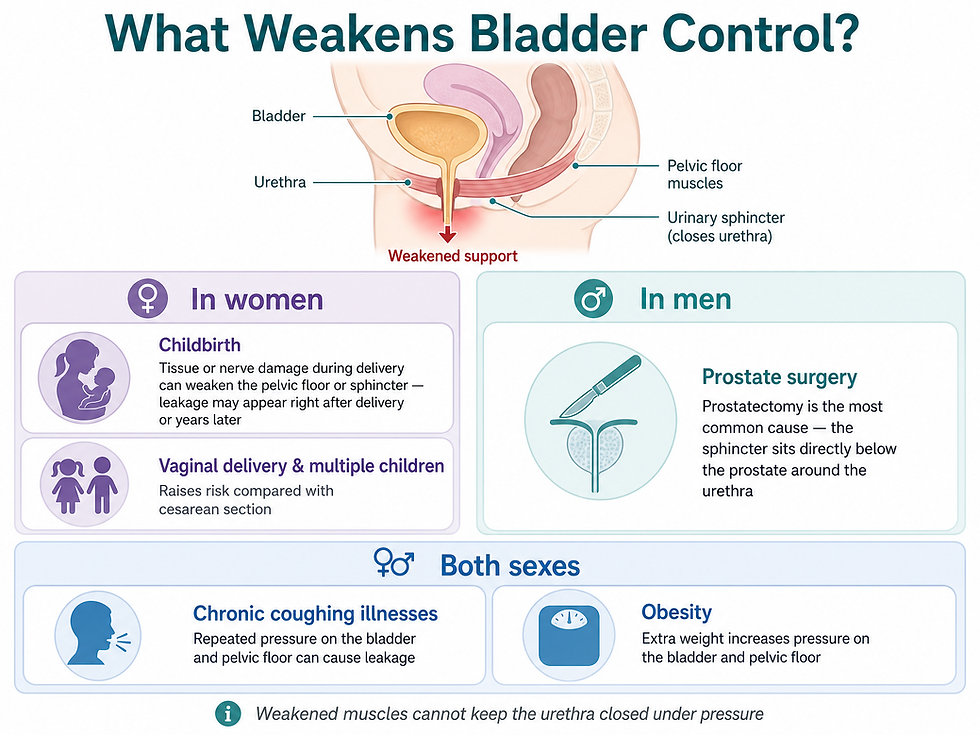
Two additional details worth knowing. First, in men, the most common factor leading to stress incontinence is prostatectomy — the sphincter lies directly below the prostate gland and wraps around the urethra, so its removal can weaken control [1]. Second, for women, vaginal delivery raises the risk of urinary incontinence compared with cesarean section, and having more than one child raises it further [1].
What makes stress incontinence more likely, and what complications can it cause?
Beyond the specific causes above, several risk factors increase the odds of developing stress incontinence. Age is one — muscles weaken over time — but the Mayo Clinic stresses that some stress incontinence can happen at any age [1]. Body weight is another: people who are overweight or obese face higher risk because excess weight presses on the abdominal and pelvic organs [1].
Risk factor | Who it applies to | Why it matters |
Age | Everyone | Muscles weaken with physical changes of aging |
Body weight (overweight/obesity) | Everyone | Excess weight increases pressure on abdominal and pelvic organs |
Vaginal delivery | Females | More likely to cause urinary incontinence than cesarean section |
Multiple children | Females | Each additional child raises the risk |
Chronic coughing illnesses | Everyone | Repeated coughing strains the urethral support system |
Prostate surgery | Males | The most common factor in male stress incontinence |
Left unmanaged, stress incontinence can cause real complications. Emotional upset is common: embarrassment can disrupt work, social life, relationships, and even sex life, and some people feel ashamed of needing pads or incontinence garments [1]. Mixed urinary incontinence frequently develops alongside it. And prolonged contact with urine can cause skin rash or soreness — the Mayo Clinic advises changing pads often and using continence pads rather than menstrual pads to prevent skin breakdown [1].
How is stress incontinence diagnosed?
Diagnosis is usually straightforward. A first appointment typically involves a voiding diary (what and how much you drink, and when and how often you urinate), a medical history, a physical exam (including a pelvic exam in women and a rectal exam), a urine sample test for infection or blood traces, a brief neurological exam to check the pelvic nerves, and a urinary stress test, where the clinician watches for urine loss while you cough or bear down with a full bladder [2].
Common cases often need no further testing. When the picture is less clear, bladder function tests may be ordered [2]:
Test | What it measures | Who typically needs it |
Post-void residual | How much urine stays in the bladder after urinating, via ultrasound or a catheter | Older adults, people with prior bladder surgery, or people with diabetes |
Urodynamics | Bladder pressure during filling and emptying; checks for stress incontinence and pelvic floor strength | People whose treatment (especially surgery) depends on precise muscle and pressure data |
Cystoscopy | Direct view inside the bladder and urethra with a scope | People with unclear or persistent symptoms; usually done in a medical office |
Most people with clear symptoms will not need any of these specialized tests [2].
What treatment options work for stress incontinence?
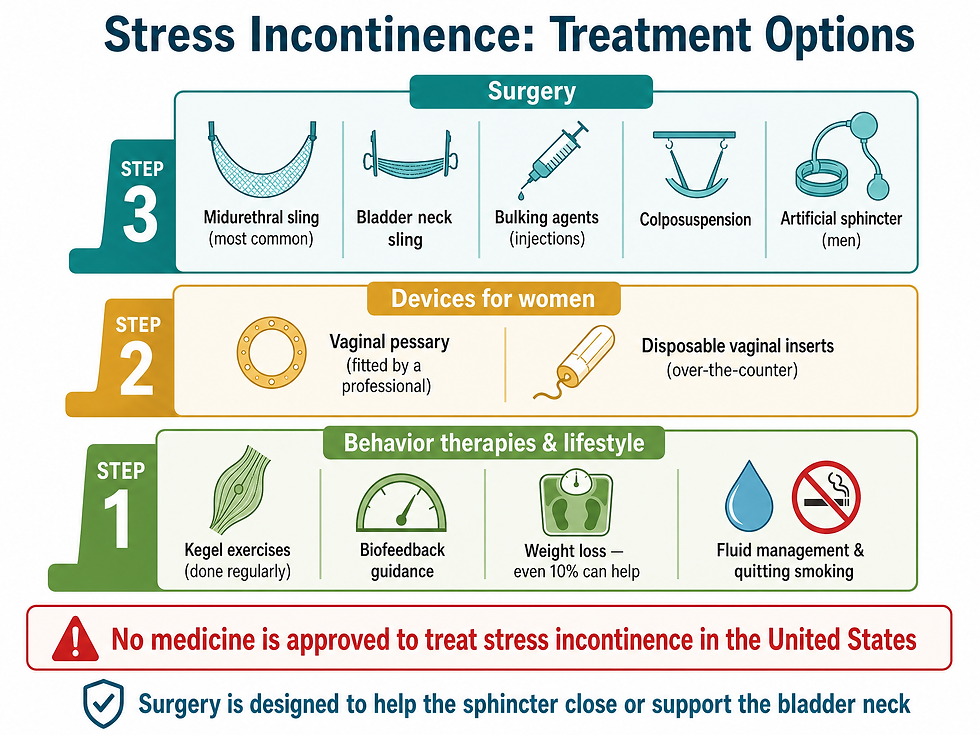
Your healthcare professional may suggest a mix of approaches. If a urinary tract infection is present, it is treated first [2]. A crucial fact that changes how treatment plans are built: there is no medicine approved to treat stress incontinence in the United States [2]. Treatment therefore leans on behavior therapy, devices, and — when needed — surgery.
Behavior therapies and lifestyle changes
The foundation of treatment is behavioral. Pelvic floor muscle exercises (Kegels) strengthen the pelvic floor and urinary sphincter, but they only work if done regularly. Biofeedback — pressure sensors or electrical stimulation that guide correct contractions — can make the exercises more effective. Once the muscles are strong, squeezing them before any leakage-causing activity can prevent leaks [2].
Other behavior therapies include fluid management (guidance on how much, what type, and when to drink — without restricting so much that you become dehydrated), lifestyle changes (quitting smoking, losing excess weight, treating an ongoing cough all lessen risk and improve symptoms), and bladder training — a toilet schedule used especially for mixed incontinence, where urinating more often helps urge-type leakage [2].
Lifestyle approach | What the evidence says |
Weight loss | Even a 10% weight loss may greatly improve stress incontinence for people with a BMI of 30 or higher, by reducing pressure on the bladder and pelvic floor |
Fiber intake | Constipation worsens incontinence; soft, regular bowel movements ease strain on pelvic floor muscles — whole grains, legumes, fruits, and vegetables help |
Pelvic floor exercises | Regularity is the deciding factor; biofeedback improves technique; learned with a physical therapist or care team |
Smoking cessation | Chronic cough from smoking repeatedly strains the support system for the urethra |
Devices for women
Women have two non-surgical device options. A vaginal pessary — a ring with two bumps that sit on each side of the urethra — is placed by a healthcare professional and supports the urethra to prevent leakage during activity; it must be removed and cleaned regularly [2]. Vaginal inserts look like tampons, support the urethra, can be bought without a prescription, and are disposable — a practical choice for people who want to avoid surgery [2].
Surgery
Surgery for stress incontinence is designed to help the sphincter close or to support the bladder neck [2].
Procedure | How it works | Notes |
Midurethral sling (women) | A small piece of mesh is placed under the urethra in a minimally invasive procedure | The most common procedure; these slings are considered safe and effective, but your surgeon will discuss risks and benefits |
Bladder neck sling (women) | A tissue strip from the lower abdomen or thigh is placed at the bladder neck through a cut into the abdomen | Commonly used when incontinence persists after another procedure |
Bulking agents (women and men) | Gels are injected into tissues around the upper urethra to bulk up the area | Less invasive option available for both sexes |
Retropubic colposuspension (women) | Sutures joined to ligaments along the pubic bone lift and support tissues near the bladder neck and upper urethra | Can be done laparoscopically or through a larger abdominal incision |
Inflatable artificial sphincter (men) | A cuff around the upper urethra, connected to a pressure-controlling balloon and a hand pump in the scrotum, takes over the sphincter's job | May require additional surgery over time to keep working |
In men, treatment options are bulking agents and the inflatable artificial sphincter [2].
How do I cope day to day while getting treatment?
Treatments often greatly reduce — and possibly stop — leakage, but some people still leak occasionally. Being prepared makes daily life far easier [2]. When going out, keep incontinence pads or protective undergarments and a change of clothes in a purse or backpack (or in the car), know where restrooms are, and choose seating that makes them easy to reach. Protect your skin by changing out of wet clothing quickly and using a barrier cream if your skin is often wet [2].
For intimacy, the Mayo Clinic offers concrete advice: talk openly with your partner, avoid fluids for about an hour before sex, empty your bladder beforehand, try positions that give better pelvic control (for women, being on top may help), keep doing Kegels, and keep towels or disposable pads handy to ease worry [2].
"Incontinence is not a usual part of aging. Treatments can cure stress incontinence or greatly reduce its effects on your life." — Mayo Clinic
Finding a professional who will work with you — and discussing the pros and cons of each option — is worth your time. Support groups such as the National Association for Continence offer resources and community [2].
What should I prepare before my appointment?
Your professional may have you complete a symptom form and keep a bladder diary for a few days: record when, how much, and what kind of fluids you consume, how much you urinate, and when leakage occurs. The diary often reveals patterns that reduce the need for some testing [2]. If special tests are needed, you may be referred to a urologist or, for women, a urogynecologist [2].
To make the most of the visit, bring a family member or friend to help remember what is discussed, and prepare a list of your symptoms (including when leakage occurs), all medicines, vitamins, and supplements with doses and frequency, and the questions you want to ask [2].
Conclusion: Don't normalize leakage — act on it
Stress incontinence is common, treatable, and never something you simply have to live with. It is not caused by mental stress, it is different from overactive bladder, and — most importantly — it is not a normal part of aging. The path forward is well established: keep a bladder diary, start or ask about regular pelvic floor exercises, address weight and chronic cough, and see a healthcare professional if leakage bothers you or limits the activities you enjoy. If you leak with activity and have not had it evaluated, the single best next step is to book an appointment and bring a three-day bladder diary. For sudden urine loss with fever, back pain, or visible blood, seek medical care promptly.
If you have any concern about stress incontinence, talk to a healthcare professional who can assess your situation and recommend the right treatment plan for you.
FAQ
Is stress incontinence related to stress or anxiety?
No. Despite the name, stress incontinence is not related to mental or emotional stress. It is named for the physical "stress" (pressure) placed on the bladder by activities such as coughing, sneezing, laughing, or lifting [1].
Why do I leak urine when I laugh, sneeze, or exercise?
When the pelvic floor muscles and urinary sphincter weaken, anything that forces the stomach and pelvic muscles — a sneeze, a laugh, a heavy lift — pushes pressure onto the bladder and can push urine past the weakened urethral valve [1].
How is stress incontinence different from overactive bladder?
Stress incontinence leaks with physical pressure on the bladder because support muscles have weakened. Overactive bladder involves bladder muscle spasms that cause a sudden, urgent need to urinate. You can have both at once (mixed incontinence) [1].
Is there medication for stress incontinence?
No medication is approved to treat stress incontinence in the United States. Treatment is based on pelvic floor exercises, fluid and lifestyle management, devices, and, when needed, surgery [2].
Can Kegel exercises really fix stress incontinence?
Pelvic floor muscle exercises can significantly help, but only if done regularly, and ideally with guidance from a physical therapist. Biofeedback can improve technique. Strong muscles can also be deliberately squeezed before leakage-causing activities to prevent leaks [2].
Can weight loss really reduce leakage?
Yes. Excess weight increases pressure on the abdominal and pelvic organs. Even a 10% weight loss may greatly improve stress incontinence in people with a BMI of 30 or higher [2].
Does stress incontinence only affect women?
No, although it is much more common in women. In men, it most often follows prostatectomy (prostate removal surgery), because the urinary sphincter sits directly below the prostate around the urethra. Options for men include bulking agents and an inflatable artificial sphincter [1] [2].
Will I always need pads, or can it be cured?
Not necessarily. Treatments can cure stress incontinence or greatly reduce its effects, though some people still leak occasionally and benefit from being prepared with pads and spare clothing [2]. Incontinence is not a normal part of aging.
References
Urology Care Foundation — What is stress urinary incontinence (SUI)?
JAMA Network Open (2022) — Updated Prevalence of Urinary Incontinence in Women
European Association of Urology (2025) — Mapping the burden of female urinary incontinence
PMC (2023) — Latest evidence on post-prostatectomy urinary incontinence
Journal of Urology (2024) — Updates to incontinence after prostate treatment (CEASAR 10-year data)
Comments