
Prostatic Urethral Lift (PUL)

Updated: 3 days ago
Medically reviewed by Dr. Baraa Alnahhal, MD · Last reviewed: October 2026
Prostatic Urethral Lift (PUL) is a minimally invasive outpatient procedure designed to treat symptoms of benign prostatic hyperplasia (BPH). By using small permanent implants to pull enlarged prostate tissue away from the urethra, the procedure restores normal urine flow without cutting or heating tissue. PUL offers rapid symptom relief, a quick recovery time, and a significantly lower risk of sexual side effects compared to traditional surgical options.
Quick Answer
A prostatic urethral lift is a procedure that treats urinary problems from an enlarged prostate. A urologist inserts small implants through the urethra to pull back the prostate lobes and widen the urinary channel. It typically takes less than an hour under local anesthesia, and patients often go home the same day, with improved flow while preserving sexual function. [1]
What the research says
A sham-controlled trial showed rapid, sustained symptom relief. In the randomized, blinded L.I.F.T. study of 206 men (140 PUL, 66 sham), the American Urological Association Symptom Index fell by 11.1 points with PUL versus 5.9 with sham at 3 months (p=0.003). Peak urinary flow rose by 4.4 mL/s at 3 months and remained 4.0 mL/s higher at 12 months, and no new erectile or ejaculatory dysfunction occurred (Roehrborn et al., J Urol, 2013).
Benefits lasted five years, with 13.6% needing surgical retreatment. Among the L.I.F.T. participants followed for 5 years, symptom score, quality of life, BPH Impact Index and peak flow improved by 36%, 50%, 52% and 44% respectively. Surgical retreatment was 13.6% over 5 years, adverse events were mild to moderate and transient, and sexual function was stable (Roehrborn et al., Can J Urol, 2017).
Compared with TURP, PUL preserved ejaculation and recovery quality better. In the BPH6 randomized trial of 80 men at 10 European centers, both PUL and transurethral resection of the prostate (TURP) gave significant symptom relief at 12 months, while preservation of ejaculation and quality of recovery were superior with PUL (p<0.01). The authors noted the small sample size and that participants could not be blinded (Sonksen et al., Eur Urol, 2015).
What is a prostatic urethral lift (PUL)?
Prostatic Urethral Lift (PUL), often referred to by the brand name UroLift, is a modern approach to managing benign prostatic hyperplasia (BPH). As the prostate gland enlarges with age, it can compress the urethra, leading to significant urinary difficulties. Unlike traditional surgeries that involve removing or destroying prostate tissue, PUL utilizes small, permanent implants to mechanically hold the prostate lobes open, much like tie-backs on a window curtain. [1]
This procedure is particularly beneficial for individuals whose BPH symptoms do not respond well to medication but who wish to avoid the more intensive recovery and potential side effects associated with major surgery. Since its FDA approval in 2013, the procedure has been performed hundreds of thousands of times, establishing itself as a reliable mid-term solution for urinary health. [1]
The Mechanism of Action
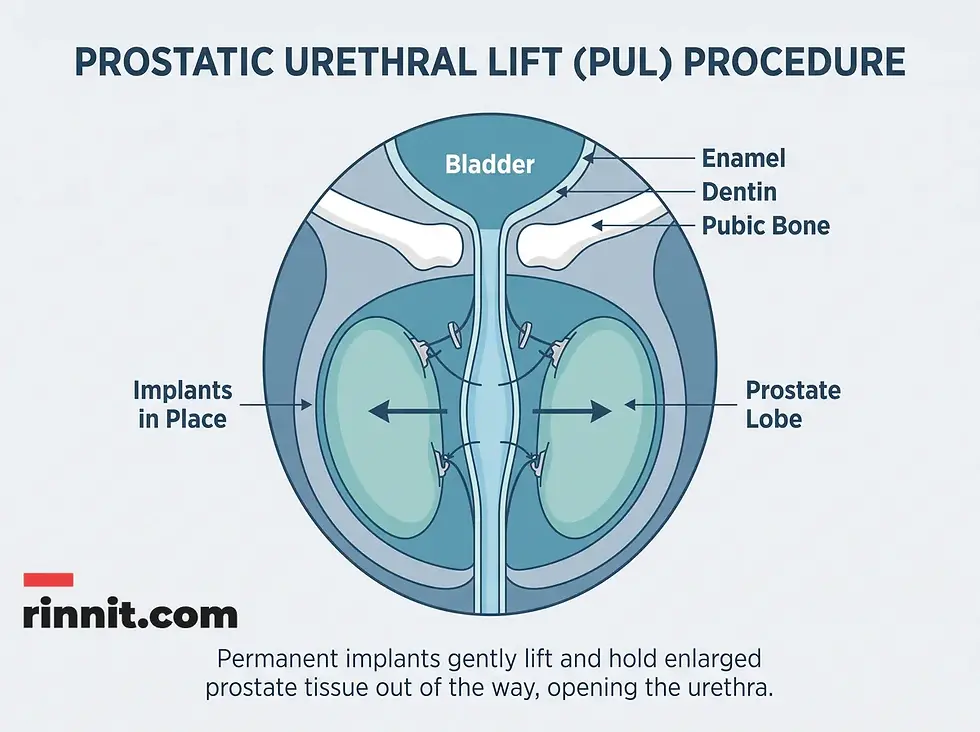
The prostate gland consists of five segments or lobes. When these lobes increase in size, they put pressure on the urethra, the tube through which urine and ejaculate leave the body. During a PUL, a urologist places between two and six thin, stainless-steel implants into the lateral lobes of the prostate. These implants pull the tissue toward the prostate’s outer walls, immediately widening the urethral opening and facilitating easier urination. [1]
How is a prostatic urethral lift (PUL) done, and how do you prepare?
The journey toward a PUL begins with a comprehensive evaluation of the patient’s general health and the specific characteristics of their BPH. Urologists utilize several diagnostic tools to determine if a patient is a suitable candidate for the procedure.
Diagnostic Test | Purpose |
Urine Flow Test | Measures the speed, strength, and volume of the urinary stream. |
Post-Void Residual Volume | Determines how much urine remains in the bladder after voiding. |
Transrectal Ultrasound | Provides detailed images of the prostate size and shape. |
Cystoscopy | Uses a camera to visualize the internal structure of the urethra and bladder. |
Urinalysis | Checks for infections or chemical imbalances in the urine. |
Preparing for the Procedure
Patients are generally advised to stop eating or drinking at least six hours before the procedure. It is crucial to inform the healthcare provider about all current medications, especially blood thinners like aspirin or anti-inflammatory drugs, as these can increase the risk of bleeding during the procedure. Most patients receive a mild sedative to help them relax, along with local anesthesia to numb the treatment area. [1]
During the Procedure
The procedure is performed in an office or ambulatory surgery center and typically takes less than an hour. The surgical team uses a cystoscope to guide the UroLift device into the urethra. Once positioned, the device deploys the implants into the prostate walls. Because the procedure is minimally invasive, most patients can be discharged shortly after the medical team confirms they can urinate independently. [1]

What are the benefits and success rates of a prostatic urethral lift?
One of the most significant advantages of PUL is its ability to preserve sexual function. Traditional BPH treatments, such as TURP (Transurethral Resection of the Prostate), carry a higher risk of erectile dysfunction or retrograde ejaculation. PUL significantly reduces these risks while providing rapid relief from urinary symptoms. [1]
“A prostatic urethral lift has fewer sexual side effects than TURP, but its symptom relief is generally smaller and repeat treatment is more common. Studies show that less than 14% of people who have a PUL need additional treatment after five years.” [1]
Comparison of BPH Treatments
Feature | Prostatic Urethral Lift (PUL) | Traditional Surgery (e.g., TURP) |
Invasiveness | Minimally Invasive | Invasive |
Setting | Outpatient | Inpatient (Hospital Stay) |
Recovery Time | 1–4 Weeks | 4–8 Weeks |
Sexual Function | High Preservation | Moderate Risk of Dysfunction |
Catheter Use | Often Not Required | Usually Required |
What is recovery and the long-term outlook after a prostatic urethral lift?
Recovery from a prostatic urethral lift is generally swift. Most patients report feeling significantly better within a week, although full recovery can take up to four weeks. During the initial recovery phase, it is common to experience some discomfort, such as a burning sensation during urination or minor pelvic pain. These symptoms are typically managed effectively with over-the-counter pain relievers like NSAIDs or acetaminophen. [1]

Essential Aftercare Tips
Hydration: Drinking extra water helps clear any blood from the urine and flushes the urinary system.
Medication Adherence: Patients must finish the full course of any prescribed antibiotics to prevent infection.
Activity Level: While normal activities can often be resumed quickly, heavy lifting or strenuous exercise should be avoided for a short period as directed by the urologist. [1]
Conclusion
Prostatic Urethral Lift offers a compelling middle ground for men seeking relief from BPH symptoms without the intensity of major surgery. By focusing on mechanical widening rather than tissue destruction, the procedure provides a faster return to daily life and protects long-term sexual health. If you are experiencing persistent urinary issues, consult with a urologist to determine if PUL is the right choice for your needs.
Frequently Asked Questions
What is the primary purpose of a prostatic urethral lift?
The primary purpose is to relieve the symptoms of benign prostatic hyperplasia (BPH), such as difficulty urinating, by pulling enlarged prostate tissue away from the urethra using small implants.
Is the PUL procedure permanent?
The implants used in the procedure are permanent. However, while the success rate is high, there is a small risk that symptoms could return over time, requiring further treatment.
How long does the procedure take?
A prostatic urethral lift is an outpatient procedure that typically takes less than one hour to complete.
Will I need a catheter after the procedure?
Most patients do not require a catheter and can go home the same day once they are able to urinate on their own.
What are the most common side effects?
Common temporary side effects include blood in the urine, a burning sensation when peeing, and an increased urge to urinate. These usually resolve within a few weeks.
Does PUL affect sexual function?
One of the key benefits of PUL is that it has a much lower risk of causing erectile dysfunction or retrograde ejaculation compared to traditional BPH surgeries.
Who is not a candidate for PUL?
Patients with an exceptionally large prostate, a very long urethra, or severe urinary retention may not be suitable candidates for this specific procedure.
What kind of anesthesia is used?
Most procedures are performed using local anesthesia to numb the area, often accompanied by a mild sedative to help the patient relax.
How soon will I see results?
Many patients notice an improvement in their urinary symptoms within two weeks, with full benefits typically realized within a month.
When should I contact my healthcare provider after the procedure?
You should call your provider if you experience a fever, an absolute inability to urinate, severe pain that isn’t helped by medication, or heavy, persistent bleeding.
How do I prepare for a prostatic urethral lift?
Stop eating and drinking at least six hours before the procedure, and tell your healthcare provider about all current medications, especially blood thinners such as aspirin and anti-inflammatory drugs, which can raise bleeding risk. Most patients receive a mild sedative plus local anesthesia, and you are discharged once the team confirms you can urinate on your own [1].
Related Reading
References
Cleveland Clinic. Prostatic Urethral Lift (PUL). Cleveland Clinic Health Library. Accessed October 11, 2026. https://my.clevelandclinic.org/health/procedures/prostatic-urethral-lift
Roehrborn CG, Gange SN, Shore ND, et al. The prostatic urethral lift for the treatment of lower urinary tract symptoms associated with prostate enlargement due to benign prostatic hyperplasia: the L.I.F.T. Study. J Urol. 2013;190(6):2161-2167. PMID: 23764081. DOI: https://doi.org/10.1016/j.juro.2013.05.116
Roehrborn CG, Barkin J, Gange SN, et al. Five year results of the prospective randomized controlled prostatic urethral L.I.F.T. study. Can J Urol. 2017;24(3):8802-8813. PMID: 28646935. https://pubmed.ncbi.nlm.nih.gov/28646935/
Sonksen J, Barber NJ, Speakman MJ, et al. Prospective, randomized, multinational study of prostatic urethral lift versus transurethral resection of the prostate: 12-month results from the BPH6 study. Eur Urol. 2015;68(4):643-652. PMID: 25937539. DOI: https://doi.org/10.1016/j.eururo.2015.04.024
Medical disclaimer
This article is for informational purposes only and is not a substitute for professional medical advice, diagnosis, or treatment. Always seek the advice of your physician or other qualified health provider with any questions you may have about a medical condition.



Comments