Prostate Ultrasound and Biopsy: Why It's Done, How to Prepare, What to Expect and Recovery

Updated: 2 days ago
Written and medically reviewed by Dr. Baraa Alnahhal, MD · Last reviewed: November 2026 · How we review
Quick Answer: What is a prostate ultrasound and biopsy?
A prostate ultrasound and biopsy is a short test in which a urologist places an ultrasound probe in the rectum to see the prostate and guide a thin needle that takes several tiny tissue samples to check for prostate cancer. Mild soreness and blood in urine, stool or semen are common afterward. [1]
What the research says
An MRI first can make biopsies more targeted. In a trial of 500 men with suspected prostate cancer, doing an MRI first and biopsying only suspicious areas found clinically significant cancer in 38%, compared with 26% using standard ultrasound-guided biopsy. About 28% of men in the MRI group avoided a biopsy, and fewer were diagnosed with cancers unlikely to cause harm. (Kasivisvanathan et al., New England Journal of Medicine, 2018) [2]
Serious infection is rare with the through-the-skin approach. A review of 112 groups covering more than 42,000 men who had a biopsy through the skin between the scrotum and anus (transperineal biopsy) found sepsis in about 0.05% of men given preventive antibiotics and 0.08% of those who weren't. (Basourakos et al., European Urology Open Science, 2022) [3]
Key takeaways
The ultrasound probe guides the needle so your urologist can take samples from the right places. [1]
You may need to stop blood thinners like warfarin, clopidogrel, aspirin or ibuprofen before the test. [1]
Blood in urine or stool for three to five days and in semen for up to two to three months is common. [1]
Avoid heavy lifting for two to three days afterward to help prevent bleeding. [1]
Get urgent care for a fever of 100 °F or higher, chills, heavy bleeding, severe pain or being unable to pee. [1]
What is a prostate ultrasound and biopsy?
Your prostate is a gland that makes fluid for semen, the fluid that carries sperm. It surrounds part of your urethra, the tube that carries urine and sperm out of your body, and its muscles help push semen out. [1]
In this test, an ultrasound probe is placed in your rectum. It uses sound waves to make images of your prostate and guides your doctor in taking a biopsy, a small tissue sample of the gland. The test is used to diagnose prostate cancer or find the reason for other prostate problems. [1]
Why would you need a prostate biopsy?

Your provider may recommend this test if you have: [1]
A high level of prostate-specific antigen (PSA) on a PSA blood test
An abnormal prostate exam
Problems with your prostate, such as trouble pushing urine or semen out
A high PSA level or an abnormal exam can suggest a higher risk of prostate cancer, and the biopsy shows whether cancer is actually there. [1]
How do you prepare for a prostate biopsy?
Preparation is simple: [1]
Blood thinners: Ask your doctor whether and when to stop blood-thinning medicines such as warfarin (Coumadin®), clopidogrel (Plavix®), aspirin or ibuprofen before the biopsy, because they raise the risk of bleeding. Don't stop a prescribed blood thinner on your own. If you already take blood thinners, your doctor will tell you how many days before the biopsy to stop them.
Food and drink: Most providers don't require a special diet, but they suggest eating lightly and drinking only clear liquids before the procedure.
Extra instructions: Check with your provider's office for anything else you need to do.
What happens during a prostate ultrasound and biopsy?
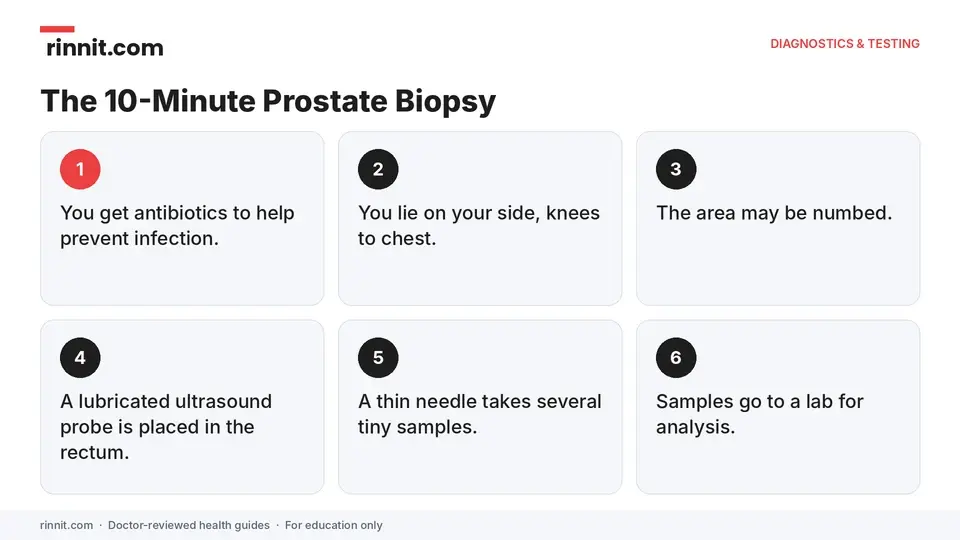
The procedure is short and usually takes about 10 minutes. A urologist, a doctor who specializes in urinary and male genital problems, performs it. [1]
You're given antibiotics when you arrive to help prevent infection.
You lie on your side and bring your knees up to your chest.
The area may be numbed to reduce discomfort.
A lubricated ultrasound probe is placed in your rectum to create images of your prostate.
A small needle passes through the probe to take several tiny tissue samples. You may feel mild pressure or discomfort.
The samples are sent to a lab for analysis.
What happens after the biopsy?

When it's over, you can usually go back to your normal meals and activities unless your provider tells you otherwise. Some urologists prescribe antibiotics after the biopsy too. Soreness for a few days is normal. Your provider will contact you when your results are ready. [1]
What you may notice | How long it usually lasts | Is it normal? |
Soreness | A few days | Yes |
Blood in urine or stool | Three to five days | Yes, common |
Blood in semen | Up to two to three months | Yes; it isn't harmful to you or your partner and goes away on its own |
Trouble urinating | A few days | Often minor; get help right away if you can't urinate at all |
Sources: [1]
Avoid heavy lifting for two to three days to help prevent bleeding. [1]
What are the risks?
Some men develop a urinary tract infection or a prostate infection after the biopsy. These infections are rare and usually easy to treat with antibiotics. Some men also have trouble urinating for a few days, which usually goes away on its own. [1]
When should you call your doctor or go to the ER?
Call your provider or go to an emergency room if you develop: [1]
A fever of 100 °F (37.8 °C) or higher
Shaking or chills
Excessive bleeding
Excessive pain
Inability to urinate
If you go to the emergency room, tell the staff that you just had a prostate ultrasound and biopsy. [1]
Conclusion
A prostate ultrasound and biopsy is a quick test that gives a clear answer when a PSA test or prostate exam raises concern. Preparation is simple, the procedure takes about 10 minutes and most side effects, like soreness and blood in urine, stool or semen, fade on their own.
Know the warning signs of infection or bleeding, and contact your provider right away if they appear. Your care team will explain your results and the next steps.
Keep learning: Read our guide to the PSA test or our explainer on the prostate exam. For more trusted, doctor-reviewed health guides, visit Rinnit.com.
FAQ
What is a prostate ultrasound and biopsy?
A test that uses an ultrasound probe in the rectum to guide a needle that takes small prostate tissue samples.
Why would I need a prostate biopsy?
Usually because of a high PSA level or an abnormal prostate exam.
How long does a prostate biopsy take?
The procedure usually takes about 10 minutes.
How do I prepare for a prostate biopsy?
Stop blood thinners as your doctor directs, eat lightly and drink clear liquids beforehand.
Does a prostate biopsy hurt?
The area may be numbed; you may feel mild pressure or discomfort.
Is blood in my urine normal after a prostate biopsy?
Yes. Blood in urine or stool is common for three to five days.
How long will I have blood in my semen?
Up to two to three months, and it isn't harmful to you or your partner.
Can I go back to normal activities after a prostate biopsy?
Usually yes, but avoid heavy lifting for two to three days.
What are the risks of a prostate biopsy?
Rare urinary or prostate infections and short-term trouble urinating.
When should I go to the ER after a prostate biopsy?
If you have a fever of 100 °F or higher, chills, heavy bleeding, severe pain or can't urinate.
Related Reading
Active Surveillance for Prostate Cancer: Tests, Benefits and Risks explains active surveillance for prostate cancer.
MRI-Guided Prostate Biopsy: Fusion Biopsy, Prep, Risks and Results explains the targeted prostate biopsy guided by MRI.
What Is Metastatic Prostate Cancer? A Plain-Language Guide to Stage 4 Prostate Cancer explains prostate cancer that has spread beyond the prostate.
Prostate Cancer Recurrence: Complete Guide to Signs, Diagnosis, and Treatment Options covers prostate cancer that comes back after treatment and how it's found.
Benign Prostatic Hyperplasia (BPH): Symptoms, Causes, and Treatment describes a noncancerous enlarged prostate, a common cause of urinary symptoms.
Prostatitis Guide: Symptoms, Causes, Diagnosis, and Treatment explains prostate inflammation and infection, including after a biopsy.
Prostate: Location, Function, Conditions and Health Checks describes where your prostate is, what it does and the checks used to keep it healthy.
References
Cleveland Clinic. Prostate Biopsy & Ultrasound: Procedure Details, Risks & Benefits. Cleveland Clinic. Last updated July 27, 2020. https://my.clevelandclinic.org/health/diagnostics/15817-prostate-ultrasound-and-biopsy
Kasivisvanathan V, Rannikko AS, Borghi M, et al. MRI-Targeted or Standard Biopsy for Prostate-Cancer Diagnosis. N Engl J Med. 2018;378(19):1767-1777. PMID 29552975. https://doi.org/10.1056/NEJMoa1801993
Basourakos SP, Alshak MN, Lewicki PJ, et al. Role of Prophylactic Antibiotics in Transperineal Prostate Biopsy: A Systematic Review and Meta-analysis. Eur Urol Open Sci. 2022;37:53-63. PMID 35243391. https://doi.org/10.1016/j.euros.2022.01.001
Medical disclaimer
This article is for general education only and does not replace advice from a qualified healthcare professional. Talk to your doctor about your own diagnosis and treatment, and seek emergency care right away for severe or sudden symptoms.



Comments