PSA Test: Normal Levels by Age, How to Prepare and What High Results Mean

Updated: 2 days ago
Written and medically reviewed by Dr. Baraa Alnahhal, MD · Last reviewed: November 2026 · How we review
Quick Answer: What is a PSA test?
A PSA test is a blood test that measures prostate-specific antigen (PSA), a protein made by normal and cancerous prostate tissue. It's used to screen for prostate cancer. Normal PSA rises with age, from up to 2.5 ng/mL in your 40s to up to 5.5 ng/mL in your 70s. A high PSA does not mean you have cancer. [1]
What the research says
PSA screening lowered prostate cancer deaths over 23 years. In a European trial of 162,236 men aged 55 to 69, those invited to screening had 13% fewer prostate cancer deaths; one death was prevented for every 456 men invited, while prostate cancer diagnoses rose by 30%. (Roobol et al., The New England Journal of Medicine, 2025) [2]
Screening has trade-offs to discuss with your provider. A meta-analysis of five trials with 721,718 men found screening probably has no effect on overall deaths, and modelling estimated that for every 1,000 men screened, about 25 more would report erectile dysfunction and 3 more would need pads for incontinence. (Ilic et al., BMJ, 2018) [3]
Key takeaways
A PSA test measures a protein made by the prostate gland. [1]
Normal PSA levels rise slowly with age, even without cancer. [1]
Avoid sexual activity and vigorous exercise for 48 hours before the test. [1]
A high PSA does not confirm cancer; only a biopsy can diagnose prostate cancer. [1]
A normal PSA does not completely rule out prostate cancer. [1]
What is a PSA test?
A prostate-specific antigen (PSA) test is a blood test that measures the level of PSA, a protein your prostate gland makes. Both normal and cancerous prostate tissue make PSA, but prostate cancer tends to make more of it. [1]
Providers use the test to screen for prostate cancer and other conditions that raise PSA, usually alongside a digital rectal exam (DRE). Finding prostate cancer early improves the chance of successful treatment. [1]
Who should get a PSA test, and how often?
Guidelines advise deciding about PSA screening together with your provider, usually starting around age 50, after talking through its benefits and harms. If you choose to screen, the test is often repeated every 1 to 2 years. If you are at higher risk, you may start around age 40. [1]
You are at higher risk if you: [1]
Have a first-degree relative, or two or more extended relatives, with prostate cancer
Are Black
After an abnormal result, your provider may recommend closer monitoring with PSA and other screening every 6 to 12 months. If you already have prostate cancer, PSA tests show whether treatment is working or whether the cancer has come back. [1]
How do you prepare for a PSA test?
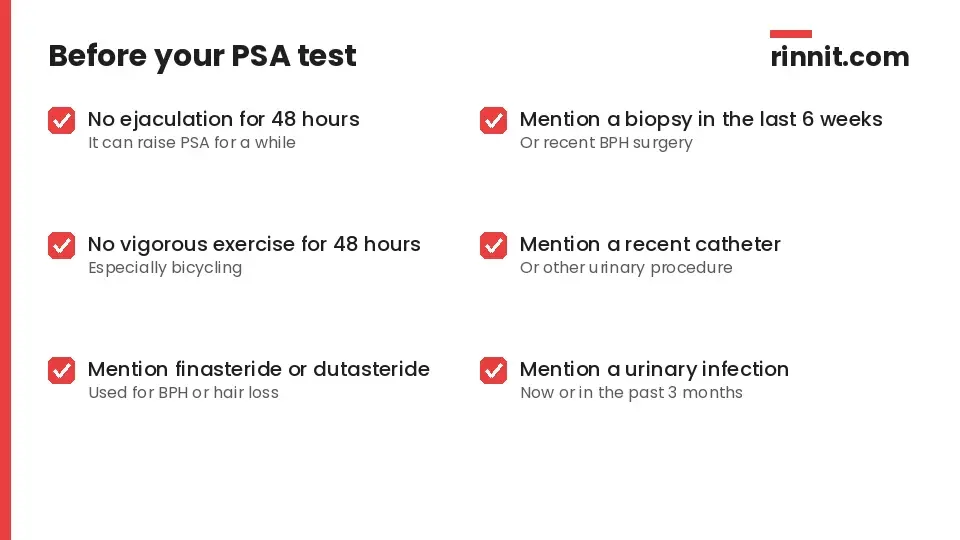
Some activities and medicines can change your PSA result.
Some activities and medicines can change your PSA level, so follow your provider's instructions closely. [1]
What to avoid for 48 hours before the test
Sexual activity, including masturbation: ejaculation can raise PSA for a while
Exercise: vigorous exercise, especially bicycling, can raise PSA for a while
Sources: [1]
What to tell your provider
Let your provider know if you: [1]
Take finasteride or dutasteride for an enlarged prostate (BPH), or finasteride for hair loss
Have had BPH surgery, such as transurethral resection
Had a prostate biopsy in the last six weeks
Recently used a urinary catheter or had another urinary procedure
Have a liver condition, such as cirrhosis or hepatitis C
Have a urinary tract infection now or had one in the past three months
What happens during a PSA test?
A provider cleans the skin, usually on your arm, and uses a thin needle to draw a small blood sample from a vein. The draw takes only a few minutes, and the sample goes to a lab. [1]
Afterward, keep the bandage on and dry for a few hours, drink plenty of fluids and avoid exercise for a few hours, because exercising soon after a blood draw can cause dizziness, fainting, nausea, bleeding or bruising. [1]
Are there risks?
You may feel tired, lightheaded or nauseated during or right after the draw, and the needle site may be sore or bruised for a few days. [1]
What are normal PSA levels by age?
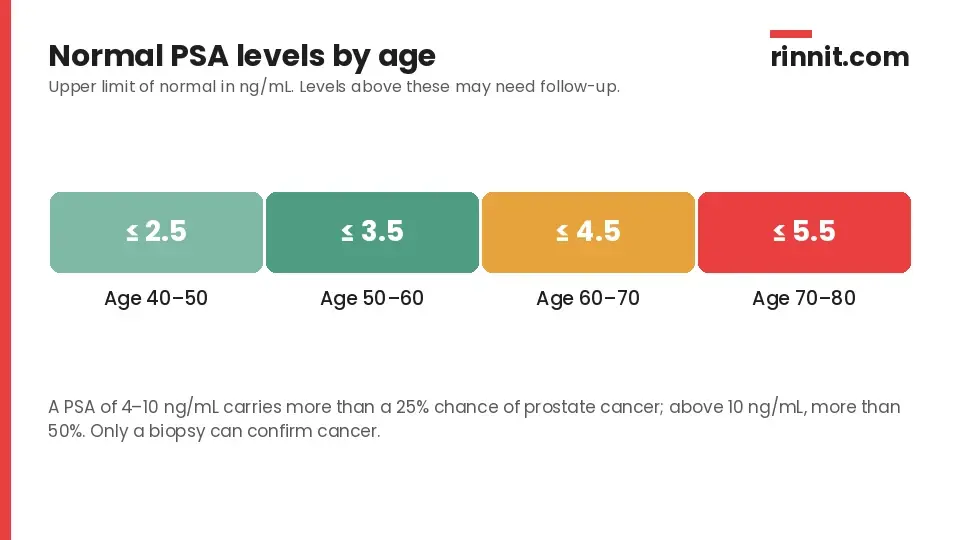
Normal PSA rises slowly with age.
PSA rises slowly as you get older, even if you do not have cancer or another prostate condition. [1]
Age | Normal PSA (ng/mL) | Considered abnormal |
40 to 50 | 0 to 2.5 | Above 2.5 |
50 to 60 | 0 to 3.5 | Above 3.5 |
60 to 70 | 3.5 to 4.5 | Above 4.5 |
70 to 80 | 4.5 to 5.5 | Above 5.5 |
Sources: [1]
What does a high PSA mean?

A high PSA is a reason for follow-up, not a diagnosis.
A PSA above the expected range for your age does not confirm cancer, but it means your risk is higher. No single PSA level confirms or rules out prostate cancer. [1]
PSA level | Chance of prostate cancer |
4 to 10 ng/mL | More than 25% |
Above 10 ng/mL | More than 50% |
Sources: [1]
If your PSA is in these ranges, talk with your provider about further testing. Results usually come back within a week, and your provider may schedule a visit to go over them. [1]
What else can raise PSA?
Conditions other than cancer can raise PSA, including benign prostatic hyperplasia (BPH), prostatitis and urinary tract infections. Some prostate cancers also do not raise PSA, so a normal result does not rule out cancer completely. [1]
What happens after a high PSA?
Imaging: an MRI or transrectal ultrasound gives a detailed view of the prostate and can show suspicious areas
Prostate biopsy: a small tissue sample is checked for cancer; this is the only way to diagnose prostate cancer, and your care team will explain any findings
Sources: [1]
When should you see a provider?
Talk to your provider about PSA testing if you have a prostate and are 50 or older, if you have a higher risk because of family history or being Black, or if you have possible symptoms of prostate cancer. [1]
Early prostate cancer usually causes no symptoms. Later signs can include urinary changes such as a weak stream or burning, blood in your urine or semen, pain in your lower back, hips or chest, bone pain, unexplained weight loss, erectile dysfunction and painful ejaculation. [1]
Can you lower your PSA?
There is no guaranteed way to lower your PSA. Some research suggests a plant-based diet rich in vegetables, legumes and lycopene-rich foods such as tomatoes and watermelon, enough vitamin D and regular physical activity may help. [1]
Conclusion
A PSA test is a simple blood test that can find signs of prostate cancer early, when treatment works best. Because many things besides cancer can raise PSA, one high result is a reason for follow-up, not a diagnosis.
Talk with your provider about when to start screening and how often to test, based on your age and risk.
Keep learning: Read our guide to the prostate and its common conditions or our guide to benign prostatic hyperplasia (BPH). For more background, see the National Cancer Institute's PSA test fact sheet.
FAQ
What is a PSA test?
A blood test that measures prostate-specific antigen, a protein made by the prostate, to screen for prostate cancer and other prostate conditions. [1]
What is a normal PSA level by age?
Up to 2.5 ng/mL at 40 to 50, 3.5 at 50 to 60, 4.5 at 60 to 70 and 5.5 at 70 to 80. [1]
What PSA level is concerning?
A PSA of 4 to 10 ng/mL carries more than a 25% chance of prostate cancer, and above 10 ng/mL more than a 50% chance. [1]
When should I start PSA screening?
Usually around age 50, or around 40 if you have a family history of prostate cancer or are Black. [1]
How often should I get a PSA test?
Most providers recommend every 2 to 3 years, or every 6 to 12 months after an abnormal result. [1]
What should I avoid before a PSA test?
Avoid ejaculation and vigorous exercise, especially cycling, for 48 hours before the test. [1]
Does a high PSA mean I have cancer?
No; BPH, prostatitis and urinary infections can also raise PSA, and only a biopsy can confirm cancer. [1]
Can I have prostate cancer with a normal PSA?
Yes; some prostate cancers do not raise PSA. [1]
How long do PSA results take?
Usually within a week. [1]
Can I lower my PSA naturally?
There is no guaranteed way, though a plant-based diet, vitamin D and regular activity may help. [1]
Related Reading
Active Surveillance for Prostate Cancer: Tests, Benefits and Risks explains active surveillance for prostate cancer.
Prostatectomy: Types, Surgery, Risks and Recovery explains prostate removal surgery and recovery.
MRI-Guided Prostate Biopsy: Fusion Biopsy, Prep, Risks and Results explains the targeted prostate biopsy guided by MRI.
Prostate: Location, Function, Conditions and Health Checks explains the gland that makes PSA.
Benign Prostatic Hyperplasia (BPH): Symptoms, Causes, and Treatment covers a common non-cancer cause of high PSA.
Prostatitis Guide: Symptoms, Causes, Diagnosis, and Treatment describes prostate inflammation that can raise PSA.
Prostate Cancer Recurrence: Complete Guide to Signs, Diagnosis, and Treatment Options explains how PSA tests help track cancer after treatment.
Cancer Screening: Which Tests Are Recommended, When to Start and the Risks gives an overview of recommended cancer screening tests, starting ages and the benefits and risks.
PSMA PET Scan for Prostate Cancer: How It Works, How to Prepare and How Accurate It Is explains the prostate cancer imaging scan used for staging and recurrence.
Digital Rectal Exam (DRE): Why It's Done, Positions and What to Expect explains the gloved finger exam of the rectum, anus and prostate.
Tumor Markers: Common Types, How They're Used, Results and Limits explains the main tumor marker tests and what their results can and can't show.
References
Cleveland Clinic. Prostate-Specific Antigen (PSA) Test: Purpose & Results. Cleveland Clinic. Last updated March 21, 2024. https://my.clevelandclinic.org/health/diagnostics/24615-psa-test
Roobol MJ, de Vos II, Månsson M, et al. European Study of Prostate Cancer Screening - 23-Year Follow-up. N Engl J Med. 2025;393(17):1669-1680. PMID 41160819. https://doi.org/10.1056/NEJMoa2503223
Ilic D, Djulbegovic M, Jung JH, et al. Prostate cancer screening with prostate-specific antigen (PSA) test: a systematic review and meta-analysis. BMJ. 2018;362:k3519. PMID 30185521. https://doi.org/10.1136/bmj.k3519
Medical disclaimer
This article is for general education only and does not replace advice from a qualified healthcare professional. Talk to your doctor about your own diagnosis and treatment, and seek emergency care right away for severe or sudden symptoms.



Comments