PSMA PET Scan for Prostate Cancer: How It Works, How to Prepare and How Accurate It Is

Updated: 2 days ago
Written and medically reviewed by Dr. Baraa Alnahhal, MD · Last reviewed: November 2026 · How we review
Quick Answer
A PSMA PET scan is an imaging test that finds prostate cancer cells anywhere in the body. A radioactive tracer that sticks to PSMA, a protein on most prostate cancer cells, is injected into a vein, and a scanner shows where it collects. It's used to stage higher-risk prostate cancer and find cancer that has come back after treatment.
What the research says
PSMA PET beats conventional imaging for staging: in the proPSMA randomized trial of 302 men with high-risk prostate cancer, PSMA PET/CT was 92% accurate for detecting spread to lymph nodes or distant sites, compared with 65% for CT plus bone scan, with sensitivity of 85% vs 38% (Hofman MS et al., Lancet, 2020) [2]
The advantage holds across studies: a meta-analysis of 31 studies and 2,431 patients found PSMA PET detected lymph node spread with 73.7% sensitivity and 97.5% specificity, compared with 38.9% and 82.6% for MRI, and bone spread with 98% sensitivity compared with 73% for bone scans (Chow KM et al., European Urology, 2023) [3]
Key takeaways
Uses a PSMA-targeting tracer such as Ga-68 PSMA-11 or piflufolastat F-18 with PET/CT or PET/MRI.
Used for staging intermediate- to high-risk prostate cancer and for recurrence when PSA rises after treatment.
No fasting; keep taking medicines; under 2 hours in total.
Can detect cancer at PSA levels as low as 0.2–0.3 ng/mL.
Not entirely prostate-specific; some normal tissues and other conditions take up the tracer.
What is a PSMA PET scan?
PET (positron emission tomography) uses a small amount of radioactive tracer to show activity in the body's cells. Most prostate cancer cells carry far more PSMA on their surface than normal cells, so a PSMA-targeting tracer lights up cancer deposits in the prostate, lymph nodes, bones and other organs. The PET images are combined with CT or MRI to show exactly where the deposits are. It is a newer, more sensitive version of a standard PET scan. Sources: [1]

A PSMA PET scan usually takes under 2 hours.
Why is it done?
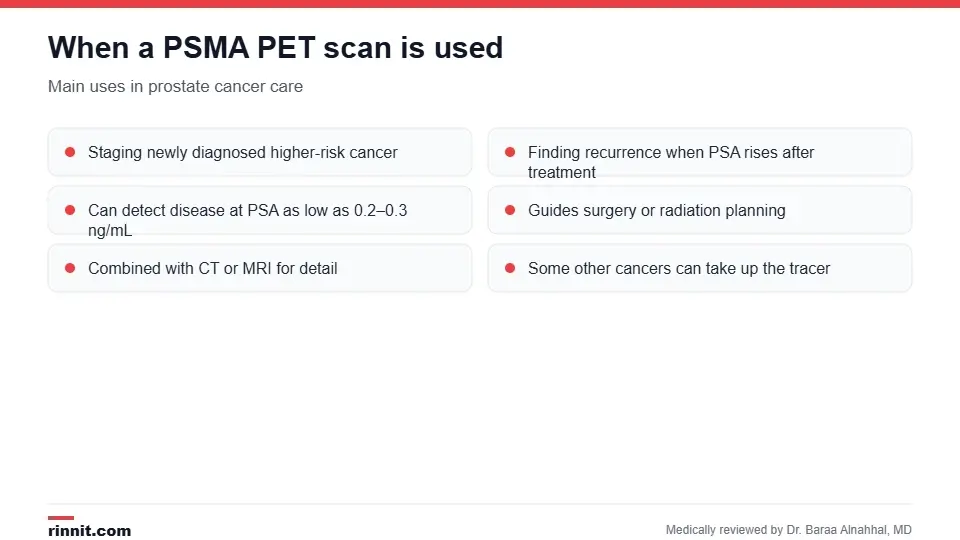
PSMA PET is used at diagnosis and when cancer may have come back.
Initial staging: to check whether newly diagnosed intermediate- or high-risk prostate cancer has spread, often based on Gleason score and PSA.
Recurrence: to find where cancer has returned when the PSA level rises after surgery or radiation, a situation called prostate cancer recurrence.
Treatment planning: to guide surgery, radiation and treatment for metastatic prostate cancer, including PSMA-targeted radioligand therapy. Sources: [1]
How do I prepare?
No fasting is needed; eat and drink normally and keep taking your medicines unless told otherwise.
Drink plenty of water before and after the scan.
Wear comfortable clothes without metal.
Tell your care team if you have trouble lying still or feel claustrophobic. Sources: [1]
What happens during the scan?
A technologist places an IV line and injects the PSMA tracer.
You rest quietly for about an hour while the tracer travels through your body.
You urinate just before the scan to empty your bladder.
You lie on a table that moves through the scanner for about 30 minutes; you'll need to stay still.
The IV is removed and you can usually go home and resume normal activities. Sources: [1]
The whole visit usually takes less than 2 hours. The radiation dose is small, and the tracer leaves your body mostly in urine within a day. Sources: [1]
How accurate is it?
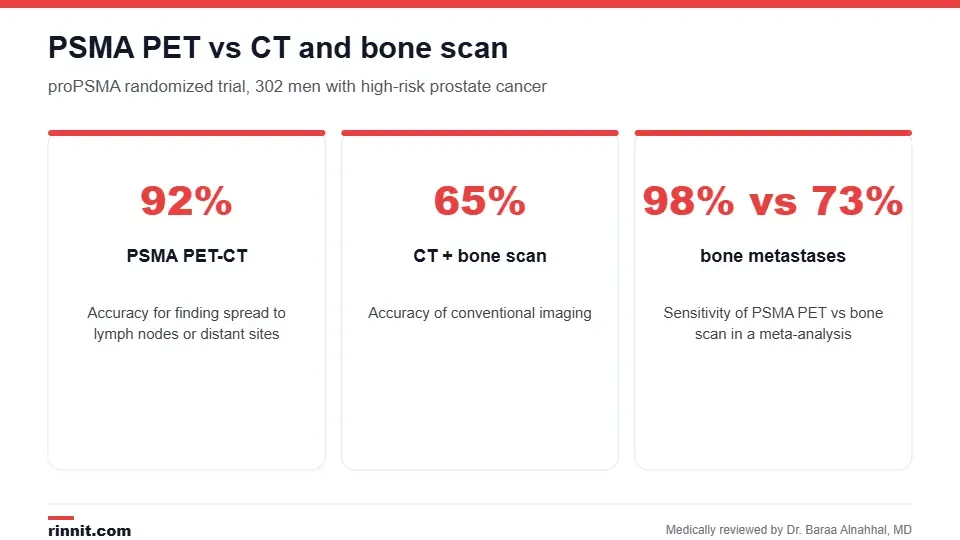
PSMA PET detects spread more accurately than conventional imaging.
Comparison | PSMA PET | Conventional imaging |
Overall accuracy for spread (proPSMA trial) | 92% | 65% (CT and bone scan) |
Lymph node sensitivity | 73.7% | 38.9% (MRI) |
Lymph node specificity | 97.5% | 82.6% (MRI) |
Bone sensitivity | 98.0% | 73.0% (bone scan) |
PSMA PET can find recurrent cancer at PSA levels of about 0.2–0.3 ng/mL. At a PSA of about 0.5 ng/mL, there is roughly a 50% chance of finding a lesion about 5 mm in size. Very small deposits can still be missed, and MRI remains valuable for looking at the prostate itself. Sources: [1, 2, 3]
Understanding your results
A radiologist or nuclear medicine doctor reviews the images, and results usually reach your provider within a few days. The report notes where the tracer collected and how intensely. The tracer normally collects in the salivary glands, kidneys, liver, bowel and bladder, and it can also show up in some other tumors, healing fractures or benign conditions, so findings are interpreted with your history and sometimes confirmed with a biopsy or other imaging. Sources: [1]
Side effects and risks
Side effects are uncommon and mild: tiredness, headache, a change in taste or, rarely, an allergic reaction to the tracer. The radiation exposure is low. Tell your care team if you have kidney problems or have had reactions to tracers before. Sources: [1]
Conclusion
A PSMA PET scan gives a far clearer picture of where prostate cancer is than CT and bone scans, which helps match treatment to the true extent of disease. Ask your provider whether it fits your stage and PSA level, and how the results might change your treatment plan.
Keep learning: read about the PSA test and the Gleason score.
Frequently asked questions
What does a PSMA PET scan show?
Where prostate cancer cells are in the body, including lymph nodes, bones and other organs.
Do I need to fast?
No. Eat and drink normally and keep taking your medicines unless told otherwise.
How long does it take?
Under 2 hours: injection, about an hour of waiting and a scan of about 30 minutes.
How accurate is PSMA PET?
About 92% accurate for detecting spread in high-risk cancer, compared with 65% for CT and bone scans.
Can it find recurrence at low PSA levels?
Yes, often at PSA levels around 0.2–0.3 ng/mL.
Is it better than MRI?
They answer different questions. MRI shows the prostate in detail; PSMA PET shows spread throughout the body.
Is the radiation dose safe?
Yes. The dose is low, and most of the tracer leaves your body in urine within a day.
Can the scan show things that aren't cancer?
Yes. Some normal tissues and benign conditions take up the tracer, so findings are interpreted carefully.
What are the side effects?
Usually none; sometimes tiredness, headache or a change in taste.
When will I get results?
Usually within a few days.
Related Reading
PSMA-Targeted Therapy (Pluvicto): How It Works and What to Expect explains PSMA-targeted therapy for advanced prostate cancer.
MRI-Guided Prostate Biopsy: Fusion Biopsy, Prep, Risks and Results explains the targeted prostate biopsy guided by MRI.
PSA Test: Normal Levels by Age, How to Prepare and What High Results Mean the blood test that often leads to a PSMA PET scan.
Gleason Score: How Prostate Cancer Is Graded and What Your Score Means the grade that helps decide who needs staging scans.
PET Scan: Uses, Preparation, What to Expect and Results how PET imaging works.
Prostate Cancer Recurrence: Complete Guide to Signs, Diagnosis, and Treatment Options when PSMA PET is used after treatment.
What Is Metastatic Prostate Cancer? A Plain-Language Guide to Stage 4 Prostate Cancer the spread PSMA PET helps detect.
References
Cleveland Clinic. PSMA PET Scan for Prostate Cancer. Cleveland Clinic. Last updated January 29, 2025. https://my.clevelandclinic.org/health/diagnostics/psma-pet-scan
Hofman MS, Lawrentschuk N, Francis RJ, et al. Prostate-specific membrane antigen PET-CT in patients with high-risk prostate cancer before curative-intent surgery or radiotherapy (proPSMA): a prospective, randomised, multicentre study. Lancet. 2020;395(10231):1208-1216. PMID 32209449. https://doi.org/10.1016/S0140-6736(20)30314-7
Chow KM, So WZ, Lee HJ, et al. Head-to-head comparison of the diagnostic accuracy of prostate-specific membrane antigen positron emission tomography and conventional imaging modalities for initial staging of intermediate- to high-risk prostate cancer: a systematic review and meta-analysis. European Urology. 2023;84(1):36-48. PMID 37032189. https://doi.org/10.1016/j.eururo.2023.03.001
Medical disclaimer
This article is for general education only and does not replace advice from a qualified healthcare professional. Talk to your doctor about your own diagnosis and treatment, and seek emergency care right away for severe or sudden symptoms.



Comments