Gleason Score: How Prostate Cancer Is Graded and What Your Score Means

Updated: 4 days ago
Written and medically reviewed by Dr. Baraa Alnahhal, MD · Last reviewed: November 2026 · How we review
Quick Answer: What is a Gleason score?
A Gleason score is a grading system for prostate cancer. A pathologist looks at prostate tissue from a biopsy under a microscope, grades the two largest cancer areas from 1 to 5, and adds them together. Scores range from 6 (low grade) to 10 (high grade). Lower-grade cancer tends to grow more slowly and is less likely to spread. [1]
What the research says
A simpler five-group system sorts risk more clearly. In more than 20,000 men treated with surgery and 5,501 treated with radiation, a five-group grading system based on Gleason scores separated recurrence risk better than older groupings, including the important difference between 3+4 and 4+3. (Epstein et al., European Urology, 2016) [2]
Low-risk cancer can often be watched safely. Among 993 men with favorable- or intermediate-risk prostate cancer managed with active surveillance, survival from prostate cancer was 98.1% at 10 years and 94.3% at 15 years. (Klotz et al., Journal of Clinical Oncology, 2015) [3]
Key takeaways
The Gleason score grades how abnormal prostate cancer cells look. [1]
Each area gets a grade from 1 (near normal) to 5 (very abnormal). [1]
The two largest areas are added, so scores range from 6 to 10. [1]
A score of 6 is low grade; 8 to 10 is high grade. [1]
The score is one of several factors used to plan treatment. [1]
What is a Gleason score?
The Gleason score is a grading system for prostate cancer. Pathologists assign it by examining tissue samples from your prostate under a microscope. [1]
Providers use the score to classify your cancer, which helps them plan treatment and estimate your prognosis (the likely outcome after treatment). [1]
How is the Gleason score calculated?
Prostate cancer begins when cells change from normal to abnormal. Early on, cancer cells can look a lot like healthy cells, and they look less normal as the disease progresses. [1]
A pathologist grades each tissue sample on a scale of 1 to 5: [1]
Grade | How the cells look |
1 | Very much like normal cells |
2 to 4 | Progressively less like normal cells |
5 | Very abnormal |
Sources: [1]
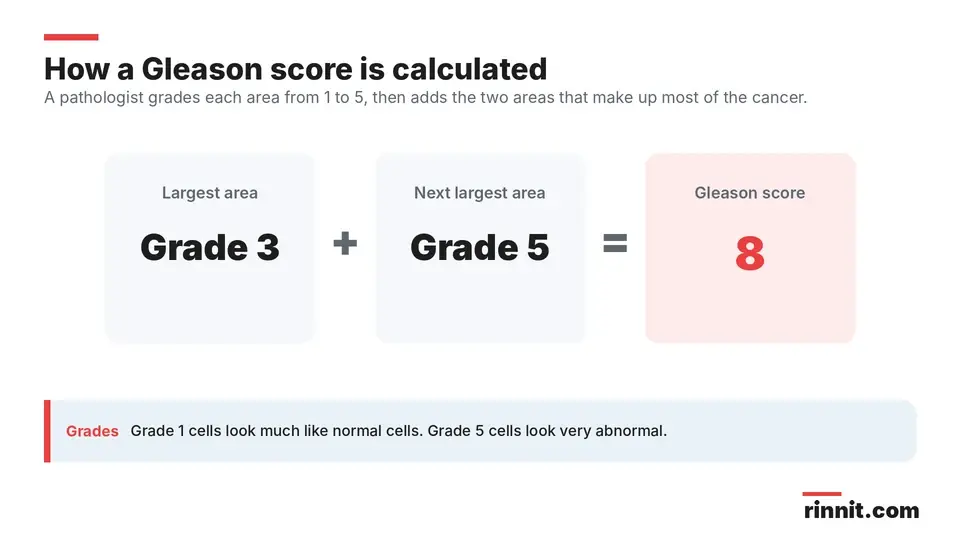
A cancer can have several areas with different grades. The pathologist picks the two areas that make up most of the cancer, called the primary and secondary patterns, and adds their grades. [1]
For example, if the largest area is grade 3 and the next largest is grade 5, your Gleason score is 8. [1]
What do Gleason scores mean?
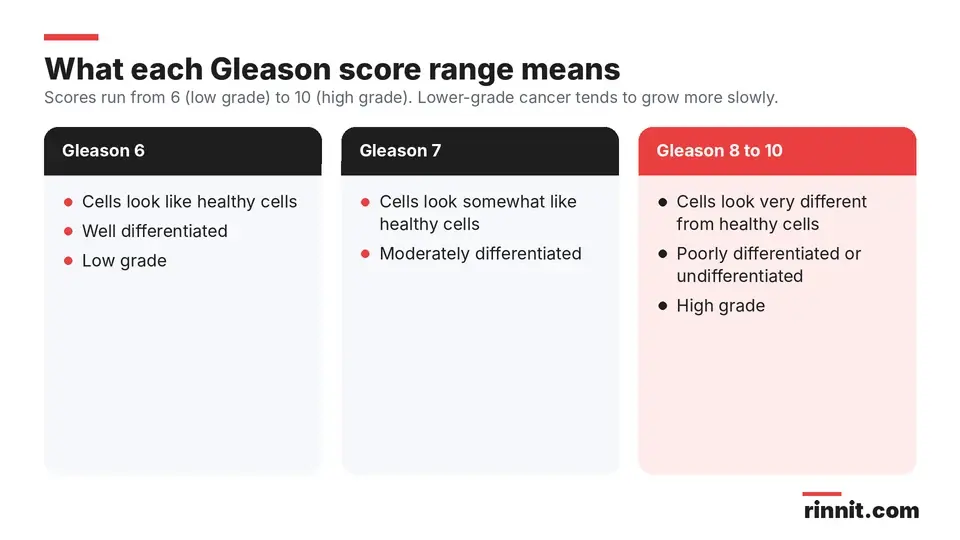
Scores range from 6 to 10. Any area with a combined score of 6 or higher is considered cancer. [1]
Gleason score | How the cells look | Description |
6 | Like healthy cells | Well differentiated (low grade) |
7 | Somewhat like healthy cells | Moderately differentiated |
8, 9 or 10 | Very different from healthy cells | Poorly differentiated or undifferentiated (high grade) |
Sources: [1]
Low-grade cancer usually grows more slowly and is less likely to metastasize (spread). [1]
Is a Gleason score good or bad?
A Gleason score is not good or bad on its own. It helps predict how quickly prostate cancer might grow. [1]
What else affects your treatment plan?
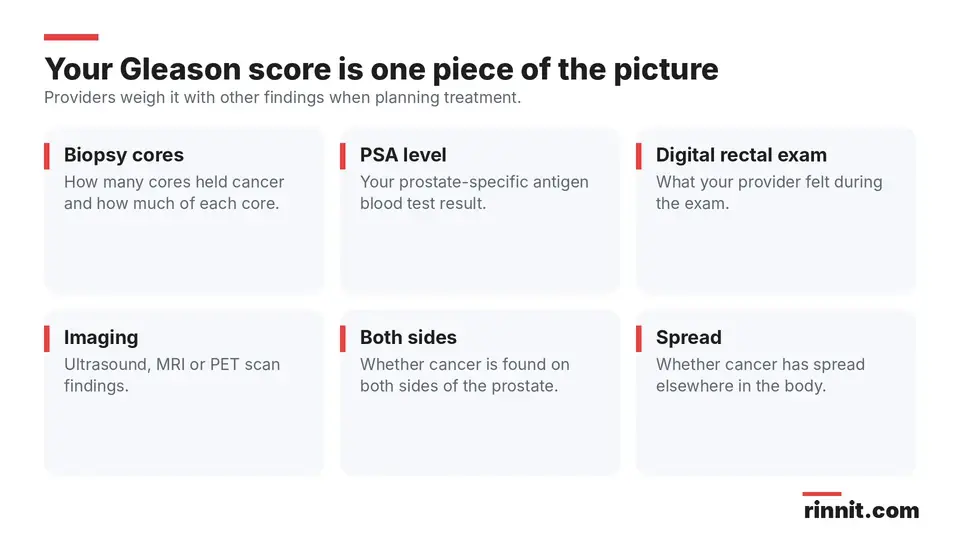
Your Gleason score is one of several factors your provider considers, including: [1]
How many biopsy cores contained cancer, and whether most cells in those cores were cancerous
Your PSA (prostate-specific antigen) blood level
Results of a digital rectal exam
Imaging from an ultrasound, MRI or PET scan
Whether cancer is on both sides of the prostate
Whether the cancer has spread to other parts of your body
Your care team will explain your cancer's stage along with your score.
How is tissue collected for a Gleason score?
During a prostate biopsy, your provider collects several samples, called cores, from your prostate. A pathologist then grades them. [1]
Conclusion
Your Gleason score describes how your prostate cancer cells look compared with healthy cells, which helps predict how quickly the cancer may grow. A 6 is low grade, and 8 to 10 is high grade.
Numbers don't tell the whole story. Ask your provider how your score fits with your PSA, imaging and biopsy details, and what your treatment options are.
Keep learning: Read our guide to focal therapy for prostate cancer or our guide to prostate cancer recurrence. For more background, see the NCI prostate cancer page.
FAQ
What is a Gleason score?
It is a grading system that shows how abnormal prostate cancer cells look under a microscope. [1]
How is a Gleason score calculated?
A pathologist grades the two largest cancer areas from 1 to 5 and adds them together. [1]
What is the range of Gleason scores?
Scores range from 6 (low grade) to 10 (high grade). [1]
Is a Gleason score of 6 cancer?
Yes. A combined score of 6 or higher is considered cancer, and 6 is low grade. [1]
What does a Gleason score of 7 mean?
The cells look somewhat like healthy cells and are moderately differentiated. [1]
What does a Gleason score of 8 to 10 mean?
The cells look very different from healthy cells and are high grade. [1]
Is a high Gleason score bad?
It is not good or bad by itself; it helps predict how fast the cancer may grow. [1]
What else is used with the Gleason score?
Biopsy core results, PSA level, digital rectal exam, imaging and whether cancer has spread. [1]
How is tissue for a Gleason score collected?
Through a prostate biopsy that takes several samples called cores. [1]
Who assigns the Gleason score?
A pathologist who examines the prostate tissue under a microscope. [1]
Related Reading
Active Surveillance for Prostate Cancer: Tests, Benefits and Risks explains active surveillance for prostate cancer.
MRI-Guided Prostate Biopsy: Fusion Biopsy, Prep, Risks and Results explains the targeted prostate biopsy guided by MRI.
What Is Metastatic Prostate Cancer? A Plain-Language Guide to Stage 4 Prostate Cancer explains what happens when prostate cancer spreads.
Prostate Cancer Recurrence: Complete Guide to Signs, Diagnosis, and Treatment Options covers how grade relates to cancer coming back.
Focal Therapy for Prostate Cancer describes a treatment option that depends partly on your Gleason score.
Prostate: Location, Function, Conditions and Health Checks explains the gland where the biopsy samples come from.
PSMA PET Scan for Prostate Cancer: How It Works, How to Prepare and How Accurate It Is explains the prostate cancer imaging scan used for staging and recurrence.
Pathology Report: How to Read Margins, Grade, Stage and More explains how to read the sections and key terms of a pathology report.
References
Cleveland Clinic. Gleason Score: Grading System for Prostate Cancer. Cleveland Clinic. Last updated October 13, 2023. https://my.clevelandclinic.org/health/diagnostics/22087-gleason-score
Epstein JI, Zelefsky MJ, Sjoberg DD, et al. A Contemporary Prostate Cancer Grading System: A Validated Alternative to the Gleason Score. Eur Urol. 2016;69(3):428-435. PMID 26166626. https://doi.org/10.1016/j.eururo.2015.06.046
Klotz L, Vesprini D, Sethukavalan P, et al. Long-term follow-up of a large active surveillance cohort of patients with prostate cancer. J Clin Oncol. 2015;33(3):272-277. PMID 25512465. https://doi.org/10.1200/JCO.2014.55.1192
Medical disclaimer
This article is for general education only and does not replace advice from a qualified healthcare professional. Talk to your doctor about your own diagnosis and treatment, and seek emergency care right away for severe or sudden symptoms.



Comments