PSMA-Targeted Therapy (Pluvicto): How It Works and What to Expect

Updated: 2 days ago
Written and medically reviewed by Dr. Baraa Alnahhal, MD · Last reviewed: November 2026 · How we review
Quick Answer
PSMA-targeted therapy is radiation treatment for advanced prostate cancer that uses a radioactive tracer to seek out PSMA, a protein on prostate cancer cells, and deliver radiation directly to tumors. It's used for metastatic prostate cancer that hasn't responded to other treatments. It doesn't cure cancer, but it can shrink tumors, slow growth and ease symptoms.
What the research says
It helped men live longer: in the VISION trial of 831 men with metastatic castration-resistant prostate cancer, adding Lu-177-PSMA-617 to standard care extended median survival from 11.3 to 15.3 months and time without progression from 3.4 to 8.7 months, with more serious side effects (52.7% vs. 38.0%) but no loss of quality of life (Sartor O et al., New England Journal of Medicine, 2021) [2]
More PSA responses than chemotherapy: in the TheraP trial of 200 men, PSA fell by at least 50% in 66% given Lu-PSMA-617 versus 37% given cabazitaxel chemotherapy, with fewer serious side effects (33% vs. 53%) (Hofman MS et al., Lancet, 2021) [3]
Key takeaways
PSMA-targeted therapy delivers radiation directly to prostate cancer cells.
It's used for advanced prostate cancer that has spread.
Treatment is an injection every six weeks, up to six times.
It doesn't cure cancer but can shrink tumors and extend life.
Dry mouth, fatigue and nausea are common side effects.
What is PSMA-targeted therapy?
PSMA (prostate-specific membrane antigen) is a protein on the outside of prostate cancer cells. PSMA-targeted therapy attaches a radioactive element, lutetium-177, to a molecule that finds PSMA. This lets radiation reach the tumors while having little effect elsewhere. Sources: [1]
Who it's for
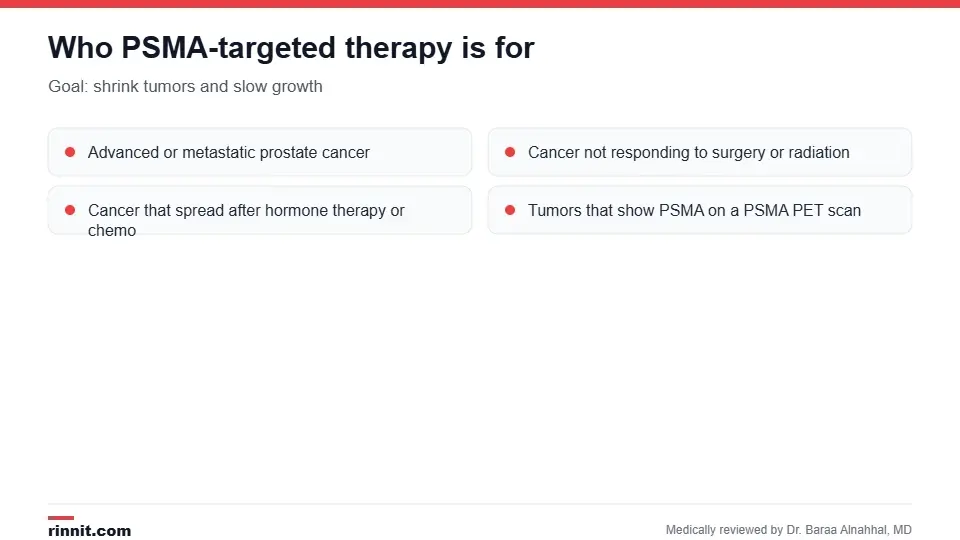
The goal is to shrink tumors, slow growth and ease symptoms.
It's used for metastatic prostate cancer or cancer that hasn't responded to other treatments. Hormone therapy is usually tried first, and some people also have chemotherapy first. Sources: [1, 2]
How to prepare
You'll have a medical history and physical exam.
Bring a list of past treatments, current medicines and questions.
You'll have blood tests and imaging, such as CT, MRI and a PSMA PET scan, which shows whether your tumors carry PSMA. Sources: [1]
What happens during treatment
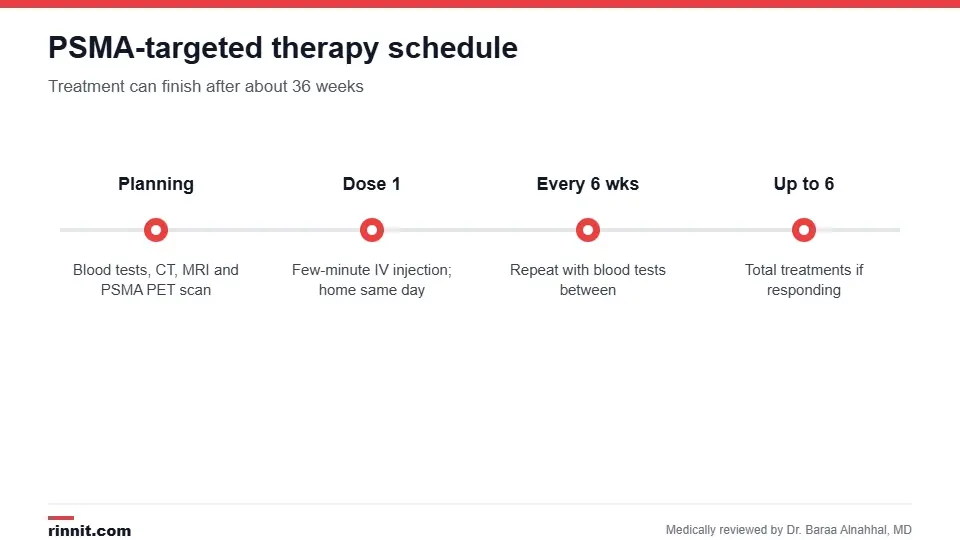
Treatment can finish after about 36 weeks.
A standard dose is injected through a small needle into a vein, usually in your arm.
The injection takes just a few minutes.
You may get anti-nausea medicine.
You're observed and can usually go home the same day.
Treatment repeats every six weeks, up to six times, with blood tests between sessions. Sources: [1]
If you're responding well, treatment finishes after about 36 weeks, a little over eight months. Sources: [1]
Side effects

Regular blood tests check your blood counts.
Side effect | Notes |
Dry mouth and dry eyes | Common |
Fatigue | Common |
Nausea, vomiting, loss of appetite | Anti-nausea medicine may help |
Pain | Common |
Low hemoglobin or platelets | Checked with blood tests |
Because it targets cells with high PSMA, it limits damage to healthy cells. Sources: [1, 2, 3]
Recovery
Some people keep their normal routine; others need to rest for at least a few days.
Rest, and avoid large meals, caffeine and alcohol before bed.
Try light exercise if your provider approves.
Eat lean proteins, vegetables, fruit and whole grains; an oncology dietitian can help.
Lean on family, friends and support groups. Sources: [1]
Outlook
PSMA-targeted therapy isn't a cure, but some people have a longer remission. You'll need regular follow-up and testing. Sources: [1, 2]
When to call your provider
Contact your provider about any side effects. Call right away for a fever, unusual bleeding or bruising, or peeing much less than usual, since Pluvicto can lower blood counts and affect the kidneys. Follow your team's instructions to drink plenty of fluids and limit close contact with others, especially children and pregnant people, for a few days after each dose.
Keep up with regular follow-ups for blood tests and symptom checks. Sources: [1]
Conclusion
PSMA-targeted therapy gives men with advanced prostate cancer a precise new option that can shrink tumors and extend life. Regular blood tests and follow-up help your team manage side effects.
Keep learning: read about metastatic prostate cancer and the PSMA PET scan.
Frequently asked questions
What is PSMA-targeted therapy?
Radiation therapy that targets a protein on prostate cancer cells.
What is Pluvicto?
The brand name for lutetium-177 PSMA therapy.
Who can get PSMA-targeted therapy?
People with advanced prostate cancer that hasn't responded to other treatments.
How is it given?
As an injection into a vein.
How often is it given?
Every six weeks, up to six treatments.
Do I stay in the hospital?
No. It's usually given as an outpatient.
Does PSMA therapy cure prostate cancer?
No, but it can shrink tumors and extend life.
What are the side effects?
Dry mouth, dry eyes, fatigue, nausea and low blood counts.
Why do I need a PSMA PET scan first?
To confirm your tumors carry PSMA.
When was it FDA-approved?
In 2022.
Related Reading
What Is Metastatic Castration-Resistant Prostate Cancer (mCRPC)? A Plain-Language Guide the cancer PSMA therapy treats.
PSMA PET Scan for Prostate Cancer: How It Works, How to Prepare and How Accurate It Is the scan used to plan treatment.
Androgen Deprivation Therapy: Managing Advanced Prostate Cancer hormone therapy for prostate cancer.
What Is Metastatic Prostate Cancer? A Plain-Language Guide to Stage 4 Prostate Cancer stage 4 prostate cancer.
Nuclear Medicine Imaging: How Tracer Scans Work, Safety and Results how radioactive tracers are used.
References
Cleveland Clinic. PSMA-Targeted Therapy: Purpose & Results. Cleveland Clinic. Last updated February 27, 2023. https://my.clevelandclinic.org/health/treatments/24775-psma-targeted-therapy
Sartor O, de Bono J, Chi KN, et al. Lutetium-177-PSMA-617 for metastatic castration-resistant prostate cancer. N Engl J Med. 2021;385(12):1091-1103. PMID 34161051. https://doi.org/10.1056/NEJMoa2107322
Hofman MS, Emmett L, Sandhu S, et al. [177Lu]Lu-PSMA-617 versus cabazitaxel in patients with metastatic castration-resistant prostate cancer (TheraP): a randomised, open-label, phase 2 trial. Lancet. 2021;397(10276):797-804. PMID 33581798. https://doi.org/10.1016/S0140-6736(21)00237-3
Medical disclaimer
This article is for general education only and does not replace advice from a qualified healthcare professional. Talk to your doctor about your own diagnosis and treatment, and seek emergency care right away for severe or sudden symptoms.



Comments