Post-Void Residual (PVR) Test: How It's Done, Normal Levels and High PVR

Updated: 2 days ago
Written and medically reviewed by Dr. Baraa Alnahhal, MD · Last reviewed: November 2026 · How we review
Quick Answer
A post-void residual (PVR) test measures how much urine is left in the bladder after you pee. It's used to check for urinary retention, when the bladder doesn't empty fully. It's usually done with a quick, painless bladder ultrasound. Roughly 50 to 100 mL or less is generally considered normal. Results are often available right away.
What the research says
Bladder scanners are accurate enough for routine use: a review of 22 studies comparing bladder scanners, standard ultrasound and catheter drainage found no clinically significant difference in measured bladder volume, and different scanner brands performed similarly (Manfredini G et al., The French Journal of Urology, 2025) [2]
Scanner results track catheter results closely: in 67 people with voiding problems, PVR measured by two bladder scanners correlated strongly with the true volume drained by catheter (correlation 0.93–0.95), with no significant differences between examiners (Park YH et al., Neurourology and Urodynamics, 2011) [3]
Key takeaways
Measures urine left in the bladder after you urinate.
Usually done with a quick, painless bladder ultrasound; sometimes with a catheter.
Roughly 50–100 mL or less is generally normal; your provider interprets your result.
A high PVR means urinary retention, often from an enlarged prostate, blockage or nerve problems.
Go to the ER if you can't pee at all.
Why is it done?
Frequent urination, a weak stream or trouble starting to pee.
Feeling that your bladder hasn't emptied completely.
Urine leakage, including overflow incontinence.
Repeated urinary tract infections or bladder stones.
To evaluate an enlarged prostate (BPH) or neurogenic bladder and monitor treatment.
After surgery or childbirth, or when starting medicines that can cause retention. Sources: [1]
How is it done?
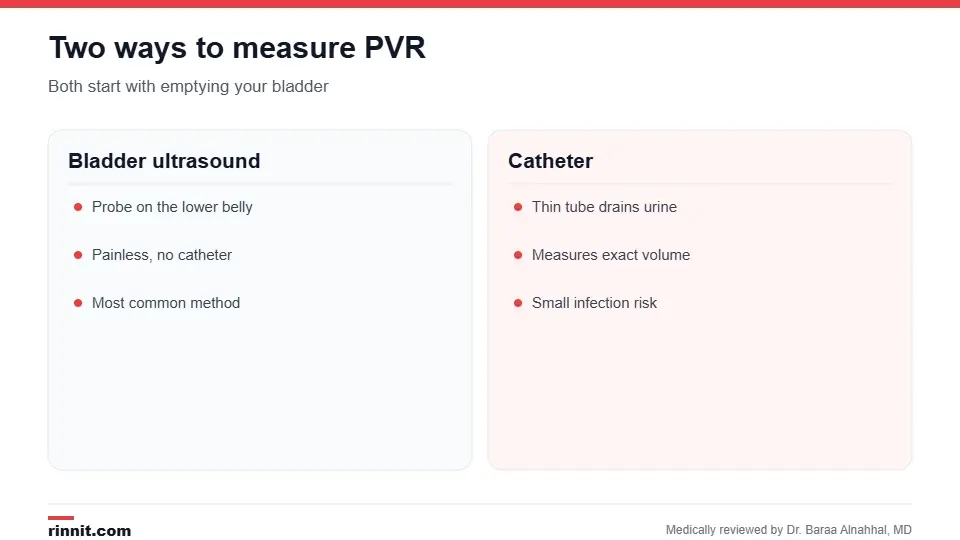
Both methods start with emptying your bladder.
First, you empty your bladder as completely as you can. The PVR is then measured right away. Sources: [1]
Bladder ultrasound (bladder scan): you lie on your back, gel is applied to your lower belly and a probe calculates the leftover volume in seconds. It's painless and the most common method; see bladder ultrasound. A transvaginal probe is sometimes used.
Catheterization: the area is cleaned and numbed, a thin tube is passed through the urethra into the bladder, and the leftover urine is drained and measured. It gives an exact volume. Sources: [1, 2, 3]
No special preparation is usually needed. Sources: [1]
What do the results mean?
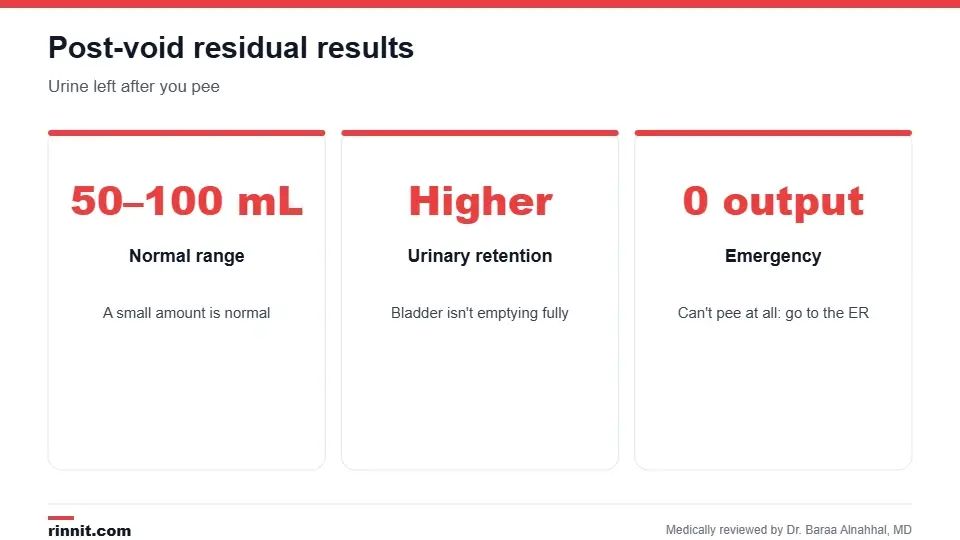
Your provider decides what's normal for you.
PVR | What it generally means |
Less than about 50–100 mL | Generally normal |
Higher than that | Urinary retention; the bladder isn't emptying fully |
Unable to urinate at all | Acute urinary retention: an emergency |
Sources: [1]
What's normal varies with age and health, and a single high reading may be repeated, since nervousness or an unusual setting can affect how well you empty. Results are often available right away. Sources: [1]
Causes of a high PVR

Many causes are treatable.
Enlarged prostate.
Bladder outlet obstruction, such as a narrowed urethra or a tumor.
Nerve problems that affect the bladder, such as from diabetes, spinal cord injury or multiple sclerosis.
Medicine side effects, such as some antihistamines, antidepressants and opioids.
Pelvic organ prolapse, such as a cystocele. Sources: [1]
Treatment depends on the cause and may include medicines, catheter use, surgery or other procedures. Sources: [1]
Risks
A bladder scan has no risks. Catheterization carries small risks of a UTI, blood in the urine and, rarely, injury to the urethra or bladder; drinking extra water afterward helps ease discomfort. Sources: [1]
Go to the ER right away if you can't pee at all. Contact your provider for belly pain or swelling, pain when peeing, fever, or cloudy or foul-smelling urine. Sources: [1]
Conclusion
A PVR test is a quick way to see whether your bladder empties fully. Most tests use a painless ultrasound, and the result helps your provider find and treat the cause of urinary symptoms before they lead to infections or kidney problems.
Keep learning: read about urinary retention and BPH.
Frequently asked questions
What does a post-void residual test measure?
The amount of urine left in your bladder after you pee.
What is a normal PVR?
Generally about 50–100 mL or less.
How is PVR measured?
Usually with a quick bladder ultrasound; sometimes with a catheter.
Does a PVR test hurt?
A bladder scan doesn't; a catheter may cause brief discomfort.
What does a high PVR mean?
Your bladder isn't emptying fully (urinary retention).
What causes a high PVR?
An enlarged prostate, blockage, nerve problems or medicines.
Do I need to prepare?
Usually not.
How soon are results available?
Often right away.
Can PVR be measured at home?
Not usually; it's done in a clinic or hospital.
When is urinary retention an emergency?
If you can't pee at all.
Related Reading
What is Urinary Retention? the condition a high PVR indicates.
Benign Prostatic Hyperplasia (BPH): Symptoms, Causes, and Treatment a common cause of incomplete bladder emptying.
Neurogenic Bladder: Causes, Symptoms, and Management bladder problems from nerve damage.
Bladder Ultrasound: Why It's Done, How to Prepare and What Results Mean the scan most often used to measure PVR.
Overflow Incontinence: Managing Chronic Urinary Retention and Leaks leaking from a bladder that doesn't empty.
References
Cleveland Clinic. Post-Void Residual Urine Test: Levels & Results. Cleveland Clinic. Last updated February 9, 2024. https://my.clevelandclinic.org/health/diagnostics/16423-postvoid-residual
Manfredini G, Anract J, Barry Delongchamps N. Post-void residual measurement: a comprehensive review of the clinical relevance and precision of bladder scanner devices. Fr J Urol. 2025;35(5):102870. PMID 39983905. https://doi.org/10.1016/j.fjurol.2025.102870
Park YH, Ku JH, Oh SJ. Accuracy of post-void residual urine volume measurement using a portable ultrasound bladder scanner with real-time pre-scan imaging. Neurourol Urodyn. 2011;30(3):335-338. PMID 20658544. https://doi.org/10.1002/nau.20977
Medical disclaimer
This article is for general education only and does not replace advice from a qualified healthcare professional. Talk to your doctor about your own diagnosis and treatment, and seek emergency care right away for severe or sudden symptoms.



Comments