Cystocele (Prolapsed Bladder): Symptoms, Causes, and Treatment

Updated: 3 days ago
Medically reviewed by Dr. Baraa Alnahhal, MD · Last reviewed: October 2026

Quick answer
A cystocele is a prolapsed bladder that drops and pushes on the front wall of the vagina because the supporting pelvic floor has weakened, often from childbirth, aging or obesity. Symptoms include pelvic pressure, a vaginal bulge and trouble urinating. Treatment ranges from watchful waiting and Kegel exercises to a pessary or surgery if other measures fail. [1] [2]
What the research says
According to PubMed:
Pelvic floor muscle training eases prolapse symptoms. In the POPPY trial, 447 women with newly diagnosed, symptomatic pelvic organ prolapse (the wider group that includes a cystocele) were randomly assigned to one-to-one individualised pelvic floor muscle training or a lifestyle advice leaflet. At 12 months the training group reported a bigger drop in prolapse symptom scores (mean reduction 3.77 vs 2.09 points; adjusted difference 1.52, 95% CI 0.46 to 2.59) (Hagen et al., Lancet, 2014; DOI).
The benefit may last for years. In an 11-year record-linkage follow-up of 293 POPPY participants, 43.6% of the training group had needed further prolapse treatment compared with 52.8% of the control group (adjusted odds ratio 0.61, 95% CI 0.37 to 0.99) (Fenocchi et al., Int Urogynecol J, 2023; DOI).
A pessary is a reasonable first option for many. In a Dutch trial of 440 women with symptomatic prolapse randomised to a pessary or surgery, 54.1% of the pessary group later crossed over to surgery, and non-inferiority of the pessary on patient-reported improvement could not be shown. Healthcare costs were about €1,807 lower with the pessary (Ben et al., BMJ Open, 2024; DOI).
Study details are from PubMed abstracts.
What is a cystocele?
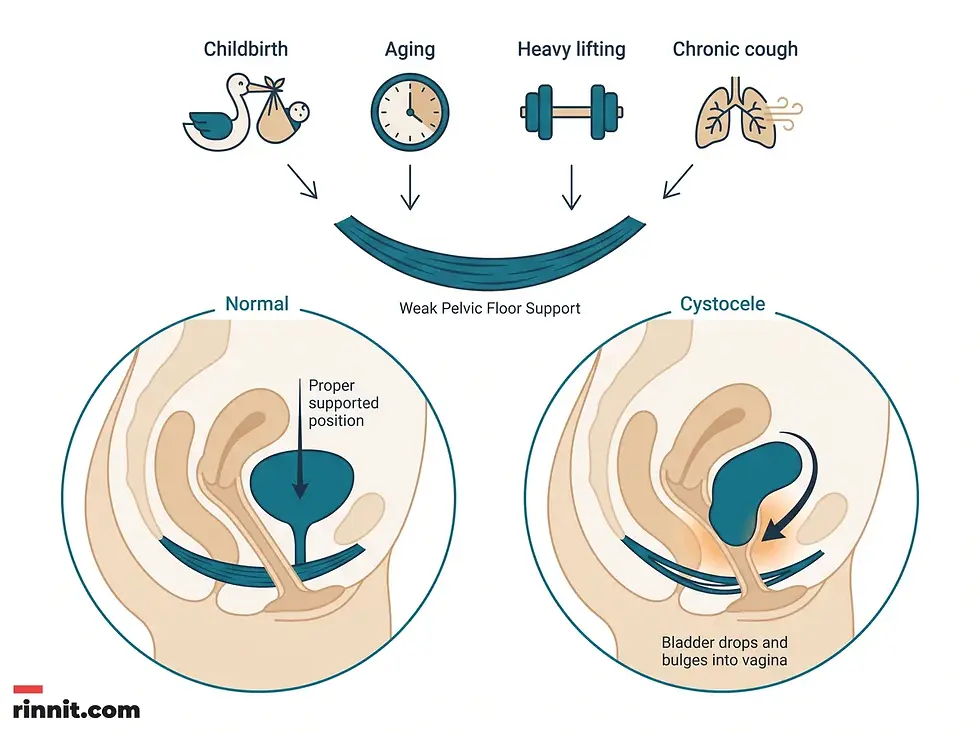
The organs of the pelvis, the bladder, uterus, and rectum, are held in place by the pelvic floor, a supporting layer of muscles, ligaments, and connective tissues. When this layer weakens or comes under repeated pressure, the bladder can slip down out of its normal position. [1]
A cystocele (also called anterior vaginal prolapse or a prolapsed bladder) happens when the bladder drops from its place in the pelvis and pushes on the front wall of the vagina.
The result can be a sensation of pressure in the pelvis and sometimes a visible bulge of tissue inside the vagina. "Anterior" refers to the front wall of the vagina, where the bladder sits, which is why the condition is also called anterior prolapse. [1] [3]
How does the pelvic floor normally support the bladder?
Think of the pelvic floor as a supportive hammock slung between the hip bones. In a healthy pelvis, it cradles the bladder, uterus, and rectum and keeps them in their normal positions through daily activities like standing, walking, lifting, and coughing.
The bladder normally sits behind and above the front wall of the vagina. When the hammock stretches or tears, from childbirth, aging, or chronic strain, the bladder can sink downward and press into the vagina, creating a bulge. This is the cystocele. [1]
What are the symptoms of a cystocele (prolapsed bladder)?
People with a mild cystocele may not see or feel any symptoms at all. When symptoms do appear, they tend to cluster around pressure in the pelvis and changes in how the bladder works. [1]
Symptom clue | What it looks or feels like |
Fullness or pressure | A feeling of fullness or pressure in the pelvis and vagina [1] |
A bulge | A bulge of tissue in the vagina that you can see or feel [1] |
Worse with strain | More pelvic pressure when straining, coughing, bearing down, or lifting objects [1] |
Urination trouble | Difficulty starting a urine stream, feeling the bladder is not empty after urinating, needing to urinate often, or leaking urine (urinary incontinence) [1] |
Standing vs lying down | Symptoms are often more noticeable after standing for long periods and may go away when you lie down [1] |
The standing-versus-lying-down pattern is one of the most distinctive clues. Gravity pulls the unsupported bladder downward when you are upright, and the pressure eases when you are horizontal.
When should you see a doctor about a cystocele?
A prolapsed bladder may cause discomfort, but it is rarely painful. The bigger concern is that it can make emptying the bladder difficult, which may lead to bladder infections. Make an appointment with your healthcare professional if you have symptoms that bother you or affect your daily life. [1]
What causes a cystocele and who is at risk?
The single underlying cause of a cystocele is a weakened pelvic floor. The pelvic floor contains the muscles, ligaments, and connective tissues that support the bladder and other pelvic organs. Aging, giving birth, or frequent straining can cause that weakness. [1]
Several conditions put repeated stress on the pelvic floor and raise the risk over time.
Risk factor | Why it matters |
Pregnancy and vaginal childbirth | Vaginal delivery stretches the pelvic floor; forceps-assisted delivery, more than one pregnancy, and high-birth-weight infants raise the risk further [1] |
Aging | Risk rises with age, especially after menopause, when the body produces less of the hormone estrogen [1] |
Hysterectomy | Removing the uterus may add to pelvic floor weakness, though this does not always happen [1] |
Inherited connective tissues | Some people are born with weaker connective tissues, making cystocele more likely [1] |
Obesity | Being overweight or obese increases pressure on the pelvic floor [1] |
On top of these, five everyday pressures repeatedly stress the pelvic floor and contribute to the weakening: pregnancy and vaginal childbirth, being overweight or obese, repeated heavy lifting, straining when passing stool, and a long-term cough or bronchitis. [1]
How is a cystocele diagnosed?
Diagnosis is usually straightforward and relies mainly on a physical exam rather than complex testing. [2]
Test | What it checks |
Pelvic exam | The provider looks for a tissue bulge in the vagina and may ask you to bear down as if passing stool, which shows how straining affects the prolapse [2] |
Pelvic floor strength check | You contract the pelvic floor muscles as if stopping the urine stream, so the provider can assess their strength [2] |
Medical history | Includes your medical and surgical history and your pregnancy history [2] |
Bladder and urine tests | Some people have tests to see how well the bladder empties, and a urine sample may be checked for signs of a bladder infection [2] |
What are the treatment options for a cystocele?
Treatment depends on your symptoms, how much they bother you, the degree of the prolapse, and whether you have related conditions such as urinary incontinence or more than one type of pelvic organ prolapse. [2]
People who have few or no symptoms most often do not need treatment. A wait-and-see approach with follow-up visits to check the prolapse is a common and entirely appropriate plan. [2]
Approach | How it works | Best for |
Watchful waiting | Follow-up visits to monitor the prolapse without active treatment | Few or no bothersome symptoms |
Kegel exercises | Pelvic floor muscle exercises that strengthen the muscles supporting the bladder and other pelvic organs; a physical therapist teaching them with biofeedback (sensors that confirm you are doing the exercises correctly) may be the best way to learn | Mild prolapse and symptom relief at home |
Pessary | A silicone ring fitted into the vagina to support the bladder; the provider fits the device and shows you how to remove, clean, and replace it | Symptom relief without surgery, including while awaiting surgery or when surgery is not wanted or too risky |
Surgery | The bladder is lifted back into place and held there with stitches, performed through the vagina, laparoscopically (small incisions with tiny cameras and tools, sometimes robotic-assisted), or through open surgery | Prolapse that persists when other treatments do not help |
Two important things to know about surgery. First, if the cystocele is linked with a prolapsed uterus, the provider may suggest repairing the prolapse and also removing the uterus (a hysterectomy); other versions of the procedure leave the uterus in place and support the top of the vagina instead. Second, surgical results can last many years, but there is some risk that the prolapse will happen again, which may mean another surgery later. [2]
If you are pregnant or planning to become pregnant, your provider may suggest postponing surgery until you are done having children. Pelvic floor exercises or a pessary can ease symptoms in the meantime. [2]
A pessary does not fix the prolapse, but it can help ease symptoms. It is a support device, not a cure.
What self-care can you do at home for a cystocele?
Kegel exercises are the cornerstone of home care. You tighten the pelvic floor muscles, the same muscles you use to stop urinating, hold the contraction for five seconds, then relax for five seconds. If that is too hard at first, start with a two-second hold and three-second rest. Work up to ten-second holds, repeat the exercises ten times, and do each set three times a day. Once you know the technique, you can do Kegels anywhere, at your desk or on the couch, with no one knowing. [2]

The other home habits all follow the same logic: reduce the pressure that pushes down on the pelvic floor. [2]
Home habit | The reasoning |
Treat and prevent constipation | High-fiber foods keep stool soft so you do not strain [2] |
Avoid heavy lifting | Use good form: stand close to the object and bend your knees to lift with your legs, not your back [2] |
Manage coughing | Get treatment for a long-term cough or bronchitis, and do not smoke [2] |
Manage your weight | A healthy weight reduces constant downward pressure on the pelvic floor [2] |
How should you prepare for a cystocele appointment?
If symptoms of a prolapsed bladder bother you, make an appointment with your main healthcare professional or gynecologist. Bring a list of your symptoms and when they began, your other medical conditions and pregnancy history, all medicines, vitamins, and supplements with doses and frequency, and your questions. [2]
Useful questions to ask include: What is the most likely cause of my symptoms? What other causes are possible? What tests do I need? What treatment do you suggest? Should I restrict my activities? What can I do at home to ease my symptoms? And should I see a specialist? [2]
Your provider is likely to ask you several questions in return: Do you leak urine? Do you have bladder infections often? Do you have pain or leak urine during sex? Do you have a bad cough? Do you strain when passing stool? What seems to make your symptoms better or worse? And do you want to have children in the future? Answering the last one honestly matters, because plans for future pregnancies affect which treatments are recommended. [2]
Conclusion
A cystocele is a common, treatable consequence of a weakened pelvic floor, and for many people it is also a manageable one. Mild cases may never need more than watchful waiting, and the daily habits of Kegel exercises, constipation prevention, careful lifting, cough management, and weight control can meaningfully reduce symptoms and help keep the prolapse from getting worse. When symptoms interfere with daily life, a fitted pessary offers a non-surgical option, and surgery provides relief that can last many years for prolapse that does not respond to other measures. [1] [2]
The condition is rarely painful, but it should not be ignored: difficulty emptying the bladder can lead to infections, and effective help is available. [1]
Next steps: If you notice pelvic pressure, a bulge, or new urinary symptoms, talk with a healthcare professional rather than waiting it out alone.
Frequently asked questions
Is a cystocele the same as a prolapsed bladder?
Yes. Cystocele, anterior vaginal prolapse, and prolapsed bladder are three names for the same condition: the bladder dropping and pushing on the front wall of the vagina. "Anterior" refers to the front wall of the vagina, where the bladder sits. [1] [3]
Does a cystocele hurt?
A prolapsed bladder may cause discomfort, but it is rarely painful. The more concerning effects are practical ones: difficulty emptying the bladder, urinary leakage, and a higher chance of bladder infections. [1]
Can a cystocele go away on its own?
A mild cystocele with few or no symptoms often needs no treatment, and watchful waiting with follow-up visits is a standard approach. Kegel exercises can strengthen the support under the bladder and ease symptoms. [2]
What is a pessary and does it cure a cystocele?
A pessary is a silicone ring fitted into the vagina to support the bladder. It does not fix the prolapse, but it can ease symptoms. It is often used for a time before surgery, or by people who do not want surgery or for whom surgery is too risky. [2]
Will surgery fix a cystocele permanently?
Surgery lifts the bladder back into place with stitches, and results can last many years, but there is some risk that the prolapse will happen again, which may mean another surgery. If you plan to have children, providers may suggest waiting until you are done having children before surgical repair. [2]
This article is for general education and is not a substitute for professional medical advice, diagnosis, or treatment. Always consult a qualified healthcare professional about your individual situation.
References
Mayo Clinic Staff. Anterior vaginal prolapse (cystocele) - Symptoms and causes. Mayo Clinic. June 7, 2025. https://www.mayoclinic.org/diseases-conditions/cystocele/symptoms-causes/syc-20369452
Mayo Clinic Staff. Anterior vaginal prolapse (cystocele) - Diagnosis and treatment. Mayo Clinic. June 7, 2025. https://www.mayoclinic.org/diseases-conditions/cystocele/diagnosis-treatment/drc-20369457
National Institute of Diabetes and Digestive and Kidney Diseases. Cystocele. NIDDK. August 2020. https://www.niddk.nih.gov/health-information/urologic-diseases/cystocele
Hagen S, Stark D, Glazener C, et al. Individualised pelvic floor muscle training in women with pelvic organ prolapse (POPPY): a multicentre randomised controlled trial. Lancet. 2014;383(9919):796-806. PMID 24290404. https://doi.org/10.1016/S0140-6736(13)61977-7
Fenocchi L, Best C, Mason H, et al. Long-term effects and costs of pelvic floor muscle training for prolapse: trial follow-up record-linkage study. Int Urogynecol J. 2023;34(1):239-246. PMID 35763050. https://doi.org/10.1007/s00192-022-05272-9
Ben ÂJ, van der Vaart LR, E Bosmans J, et al. Cost-effectiveness of pessary therapy versus surgery for symptomatic pelvic organ prolapse: an economic evaluation alongside a randomised non-inferiority controlled trial. BMJ Open. 2024;14(5):e075016. PMID 38692718. https://doi.org/10.1136/bmjopen-2023-075016



Comments