What Is Rectal Prolapse? A Plain-Language Guide to the Condition, Its Signs, and Its Treatment

Updated: 3 days ago
Medically reviewed by Dr. Baraa Alnahhal, MD · Last reviewed: October 2026
Quick Answer: Rectal Prolapse at a Glance
Rectal prolapse is a condition in which the rectum stretches and slips out of the anus, appearing as a reddish lump, often while straining [1]. Other signs include fecal incontinence, constipation and leaking blood or mucus [1]. It most often affects women over age 50 [1]. It is rarely an emergency [1], and although medicines help constipation, surgery is usually needed [1] [2].
Feature | Details |
What it is | The rectum becomes stretched and slips out of the anus, so part of it can be seen outside the body [1]. |
What it looks and feels like | A reddish lump that comes out, often while straining during a bowel movement. It may slip back in or stay out [1]. |
Other signs | Fecal incontinence, constipation or loose stools, leaking blood or mucus, and a feeling that the rectum is not empty after a bowel movement [1]. |
Who gets it | |
Urgency | It may cause pain but is rarely a medical emergency [1]. |
Treatment |
What the research says
Surgery works best, but the prolapse can come back. A meta-analysis looked at surgery for recurrent external rectal prolapse in 9 studies with 531 patients. The authors note that the recurrence risk reported in the literature after prolapse surgery is 6% to 27%. In the studies reviewed, the prolapse came back in 27.9% of patients after perineal (through the area around the anus) surgery and 15.6% after abdominal surgery, but the authors say more randomized trials are needed to show which approach is best. (Fuschillo et al., Int J Colorectal Dis, 2025) [3]
Two common abdominal operations had similar results. A systematic review and meta-analysis compared mesh rectopexy with resection rectopexy, the two most common operations performed through the abdomen. It found no statistically significant difference in operating time, hospital stay, complication rate, improvement in constipation and incontinence, or recurrence. The authors concluded that the choice should be individualized and based on the surgeon's preference and expertise. (Koimtzis et al., J Clin Med, 2024) [4]
What Is Rectal Prolapse?
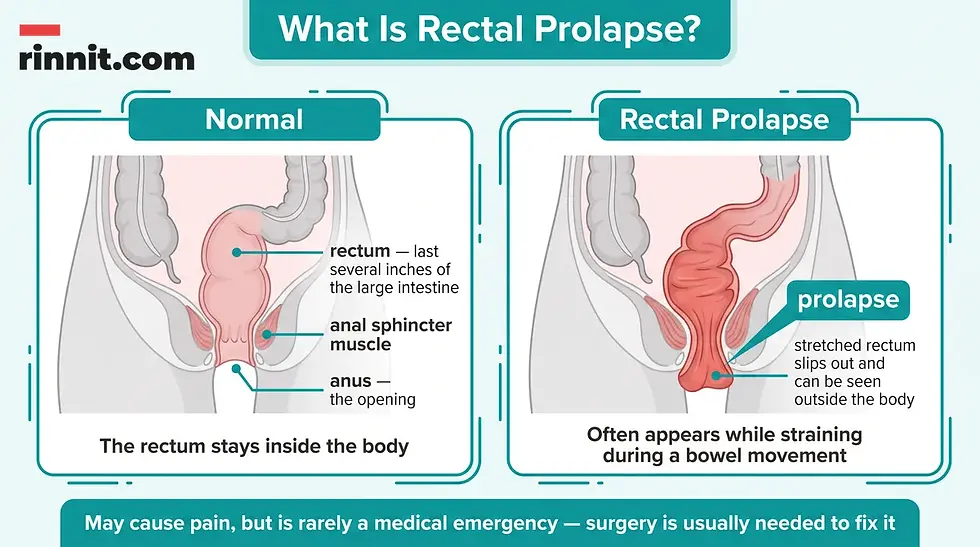
Rectal prolapse happens when the rectum becomes stretched and sticks out from the anus. In other words, part of the rectum slips out of its normal position and can be seen outside the body [1]. While it may cause pain, it is rarely a medical emergency [1]. That does not mean it should be ignored: it typically needs treatment to be fixed.
What Does Rectal Prolapse Look and Feel Like?
Rectal prolapse often looks like a reddish lump that comes out of the anus, typically while straining during a bowel movement [1]. The lump may slip back inside the anus, or it may continue to be seen [1]. Other symptoms may include:
Symptom | What you might notice |
Reddish lump | Comes out of the anus, often while straining. May slip back inside or stay out [1]. |
Fecal incontinence | You cannot control your bowel movements [1]. |
Constipation or loose stools | Bowel movements that are hard and infrequent, or unusually loose [1]. |
Leaking blood or mucus | Blood or mucus leaks from the rectum [1]. |
Incomplete emptying | A feeling that your rectum is not empty after a bowel movement [1]. |
How Is Rectal Prolapse Different From Hemorrhoids?
Sometimes it is hard to tell the difference [2]. Hemorrhoids are swollen veins in or around the rectum and anus, while rectal prolapse involves the rectum itself slipping out. Because the two can look and feel similar, a healthcare professional uses exams and tests to tell them apart and to rule out other related health problems [2].
When Should I See a Doctor?
Make an appointment with a healthcare professional if you notice a lump coming out of your anus, leaking of blood or mucus, trouble controlling your bowel movements, or any other symptom that worries you. Get emergency care if the prolapse cannot be pushed back in, turns dark red, purple or black, or comes with severe pain, fever or heavy bleeding, because the tissue may be trapped and losing its blood supply. Rectal prolapse is rarely a medical emergency [1], so urgent care usually is not required, but it usually needs treatment, and surgery is usually needed to fix it [1] [2].
What Causes Rectal Prolapse?
The cause of rectal prolapse is unclear [1]. It is a common belief that rectal prolapse is related to childbirth, but about one-third of women with this health problem never had children [1]. So while childbirth may play a role for some, it is not the explanation for everyone.
Who Is at Higher Risk?

How Is Rectal Prolapse Diagnosed?
Rectal prolapse is diagnosed with tests that a healthcare professional may suggest to find the prolapse and rule out other related health problems [2].

Test | How it works | What it shows |
Digital rectal exam | A gloved, lubricated finger is placed into your rectum. You may be asked to bear down [2]. | |
Anal manometry | A narrow, flexible tube is inserted into the anus and rectum, and a small balloon at the tip may be blown up [2]. | Measures the tightness of your anal sphincter and how your rectum is working [2]. |
Colonoscopy | A flexible tube is placed in your rectum to look at all of the colon [2]. | Rules out other conditions, such as hemorrhoids, polyps, or colon cancer [2]. |
Defecography | Dye is added to an imaging study, such as an X-ray or MRI [2]. | Shows structural changes in and around the lower digestive tract and how well your rectal muscles are working [2]. |
How Is Rectal Prolapse Treated?
Treatment for rectal prolapse often involves surgery [2]. Treatment for constipation with stool softeners, suppositories, and other medicines is often needed too [2]. Medicines manage the constipation and straining, while the prolapse itself is usually repaired with an operation.
There are different surgical methods for treating rectal prolapse [2]. Your healthcare professional will pick the best treatment for you after going over your age, health problems, and how your bowels work [2].
What is the bottom line on rectal prolapse?
Rectal prolapse happens when the rectum becomes stretched and slips out of the anus, often appearing as a reddish lump during bowel movements that may slip back inside or stay visible. It can bring pain, leaking of blood or mucus, constipation or loose stools, a feeling of incomplete emptying, and trouble controlling bowel movements [1]. It is rarely a medical emergency [1], but it usually needs treatment: medicines can manage constipation and straining, yet surgery is usually needed to repair the prolapse [1] [2]. It most often affects women over 50, and straining from constipation may raise the risk, though the cause is unclear [1]. If you notice a lump, leaking, or any loss of bowel control, see a healthcare professional. A few exams can tell prolapse apart from hemorrhoids and other conditions [2], and your care team can choose the surgical approach that fits your age, health, and bowel function [2].
Want more digestive health guides? Explore more plain-language health information at Rinnit.com.
Frequently Asked Questions
What is rectal prolapse?
Rectal prolapse happens when the rectum becomes stretched and sticks out from the anus, so that part of it can be seen outside the body [1].
What are the symptoms of rectal prolapse?
A reddish lump that comes out of the anus, often while straining during a bowel movement. It may slip back inside or stay out [1]. You may also have fecal incontinence, constipation or loose stools, leaking blood or mucus from the rectum, and a feeling that your rectum is not empty after a bowel movement [1].
Is rectal prolapse a medical emergency?
No. While it may cause pain, it is rarely a medical emergency [1]. However, it usually needs treatment, often surgery, to be fixed [1] [2].
What causes rectal prolapse?
The cause is unclear [1]. It is a common belief that it is related to childbirth, but about one-third of women with the condition never had children [1].
Who is at higher risk of rectal prolapse?
Most people with rectal prolapse are women, it most often happens in people over age 50, and constipation, with the straining it involves, may increase the risk [1].
How is rectal prolapse different from hemorrhoids?
Sometimes it is hard to tell them apart [2]. Hemorrhoids are swollen veins, while rectal prolapse involves the rectum itself slipping out. Healthcare professionals use exams and tests, such as a digital rectal exam, anal manometry, colonoscopy, and defecography, to tell the difference and rule out other conditions like polyps or colon cancer [2].
How is rectal prolapse diagnosed?
Through a digital rectal exam (a gloved, lubricated finger checks the sphincter muscles, sometimes while you bear down), anal manometry (a narrow tube with a small balloon measures sphincter tightness), colonoscopy (a flexible tube views the colon to rule out other conditions), and defecography (dye plus X-ray or MRI shows structural changes and how the rectal muscles work) [2].
How is rectal prolapse treated?
Constipation is treated with stool softeners, suppositories, and other medicines, which are often needed [2]. Surgery is usually needed to treat the rectal prolapse itself [1] [2]. There are different surgical methods, and your healthcare professional picks the best one after reviewing your age, health problems, and how your bowels work [2].
Can rectal prolapse be pushed back in?
Sometimes. Your provider may show you how to gently push the tissue back with a clean, lubricated hand. Get emergency care if it will not go back in, turns dark red, purple, or black, or causes severe pain.
What is recovery like after rectal prolapse surgery?
Recovery depends on the type of surgery, and many people go home within a few days. Your surgeon will explain how long to avoid heavy lifting and straining and how to keep your stools soft while you heal.
Related Reading
Learn more in our guide to Rectocele Repair: Surgery Types, Procedure, Risks and Recovery.
References
Mayo Clinic Staff. Rectal prolapse - Symptoms and causes. Mayo Clinic. Published June 21, 2025. https://www.mayoclinic.org/diseases-conditions/rectal-prolapse/symptoms-causes/syc-20352837
Mayo Clinic Staff. Rectal prolapse - Diagnosis and treatment. Mayo Clinic. Published June 21, 2025. https://www.mayoclinic.org/diseases-conditions/rectal-prolapse/diagnosis-treatment/drc-20450472
Fuschillo G, et al. Comparison between perineal and abdominal approaches for the surgical treatment of recurrent external rectal prolapse: a systematic review and meta-analysis. Int J Colorectal Dis. 2025;40(1):26. PMID 39875708. https://doi.org/10.1007/s00384-024-04771-z
Koimtzis G, et al. Mesh Rectopexy or Resection Rectopexy for Rectal Prolapse; Is There a Gold Standard Method: A Systematic Review, Meta-Analysis and Trial Sequential Analysis. J Clin Med. 2024;13(5):1363. PMID 38592257. https://doi.org/10.3390/jcm13051363
Medical disclaimer
This article is for general informational purposes only and does not constitute medical advice. Always consult a qualified healthcare professional for diagnosis and treatment decisions. See a healthcare professional if you notice a lump coming out of your anus, leaking of blood or mucus, or trouble controlling your bowel movements.



Comments