Flexible Sigmoidoscopy: Prep, Procedure, Results and Risks

Updated: 2 days ago
Written and medically reviewed by Dr. Baraa Alnahhal, MD · Last reviewed: November 2026 · How we review
Quick Answer: What is a flexible sigmoidoscopy?
A flexible sigmoidoscopy is a test that lets a provider look inside the rectum and the lower third of the colon with a flexible tube that has a light and camera. It's used to find the cause of bleeding, belly pain or changes in bowel habits and to screen for colorectal cancer. It takes 5 to 15 minutes. [1]
What the research says
One screening test can protect for about two decades. In a UK trial of about 170,000 adults aged 55 to 64, people invited to a single flexible sigmoidoscopy had 24% fewer colorectal cancers and 25% fewer deaths from colorectal cancer over a median of 21 years than people who were not invited. The benefit was strongest in the lower colon and rectum. (Wooldrage et al., The Lancet Gastroenterology & Hepatology, 2024) [2]
The benefit held up in a large US trial. Among adults aged 55 to 74 followed for about 16 years, those offered flexible sigmoidoscopy screening had 18% fewer colorectal cancers and 25% fewer colorectal cancer deaths than those receiving usual care. The drop in deaths was limited to the lower (distal) colon. (Miller et al., The Lancet Gastroenterology & Hepatology, 2019) [3]
Results were similar in Italy. In a trial of 34,272 adults, a single flexible sigmoidoscopy cut colorectal cancer cases by 19% and deaths by 22% across the whole group. Among people who actually had the test, cases fell by 33% and deaths by 39%. (Senore et al., Annals of Internal Medicine, 2022) [4]
Key takeaways
A flexible sigmoidoscopy examines the rectum and the lower third of the colon, including the sigmoid and descending colon. [1]
It helps explain rectal bleeding, belly pain, constipation or diarrhea and can screen for colorectal cancer. [1]
Prep usually means clear liquids, a laxative and one or two enemas, and most people stay awake without sedation. [1]
The test takes about 5 to 15 minutes, and you can usually eat, drive and return to activities the same day. [1]
Serious complications are rare. If polyps or signs of cancer are found, a colonoscopy may be recommended. [1]
In large screening trials, one flexible sigmoidoscopy lowered colorectal cancer cases and deaths for many years. [2] [3]
What is a flexible sigmoidoscopy?
A flexible sigmoidoscopy is a test that lets your provider examine your rectum and the lower third of your colon, including the sigmoid colon and descending colon. A thin, flexible tube with a light and a camera, called a sigmoidoscope, sends images to a monitor so your provider can look for growths, inflammation or signs of cancer. [1]

It is a fast test. Most people stay awake and go back to their normal activities the same day. [1]
Flexible sigmoidoscopy vs. colonoscopy and rigid sigmoidoscopy
A flexible sigmoidoscopy is shorter than a colonoscopy and checks less of the colon. A rigid sigmoidoscope is a shorter, straight tube that examines only the rectum and is used less often today. [1]
Feature | Flexible sigmoidoscopy | Rigid sigmoidoscopy |
Area examined | Rectum and lower third of the colon | Rectum only |
Scope | Thin, flexible tube with a light and camera | Shorter, straight tube |
Sigmoid colon | Gives a better view | Not examined |
How often used | Preferred in most cases | Used less often today |
Sources: [1]
Why is a flexible sigmoidoscopy done?
Your provider may recommend a flexible sigmoidoscopy to check digestive symptoms or to screen for colon cancer. Common reasons include: [1]
Reason | What the test looks for |
Rectal bleeding or blood in stool | The source of the bleeding |
Ongoing belly pain, constipation or diarrhea | A cause in the rectum or lower colon |
Suspected colitis | Inflammation of the colon lining |
Colon polyps | Growths that can be checked and removed |
Abnormal imaging results | A closer look at an area seen on a scan |
Past radiation to the pelvis | Changes in the colon after treatment |
Colorectal cancer screening | Polyps or signs of cancer |
Sources: [1]
How do you prepare for a flexible sigmoidoscopy?
Your rectum and lower colon need to be empty so your provider can see clearly. Follow the bowel prep instructions you are given closely. [1]
Step | What it involves |
Diet | A clear liquid diet for part of the day before the test |
Laxative | A laxative to help empty your bowels |
Enemas | One or two enemas shortly before the procedure |
Iron supplements | May need to be stopped one to two weeks before |
Blood thinners and diabetes medicines | May need to be adjusted |
Other medicines | Most blood pressure, heart, lung and seizure medicines can usually be continued |
Sources: [1]
Tell your provider about every medicine you take. Before the test, a nurse reviews your medical history, and your provider explains the procedure and asks you to sign a consent form. [1]
What happens during a flexible sigmoidoscopy?
The test is usually done in a clinic or endoscopy center. Sedation is usually not needed, and most people stay awake. You lie on your left side with your knees bent. [1]

Your provider gently inserts a lubricated scope through your anus into your rectum.
The scope is advanced through the rectum and the sigmoid colon.
Air is passed into the colon to inflate it slightly for a clearer view.
The camera sends images to a monitor.
If needed, your provider takes biopsies (small tissue samples), removes polyps or treats bleeding or open sores.
The scope is slowly withdrawn while the colon lining is checked again.
Sources: [1]
You may feel mild cramping, pressure or an urge to pass gas. The test should not hurt, even during a biopsy, because the colon lining does not sense pain. It usually takes 5 to 15 minutes. [1]
Flexible sigmoidoscopy at a glance
Item | Typical detail |
Usual setting | Clinic or endoscopy center |
Sedation | Usually not needed |
Position | Lying on your left side with knees bent |
How long it takes | About 5 to 15 minutes |
What you may feel | Mild cramping, pressure or an urge to pass gas |
Biopsy results | Usually within several days |
Sources: [1]
What happens after a flexible sigmoidoscopy?
Most people feel fine after the test. If you did not have sedation, you can drive home right away. You can eat normally and return to your usual activities. You may keep passing gas for a short time as the air leaves your colon. [1]
What do flexible sigmoidoscopy results mean?
Your provider may talk with you about early findings right after the test. If a biopsy was taken, those results usually take several days. Possible findings include: [1]
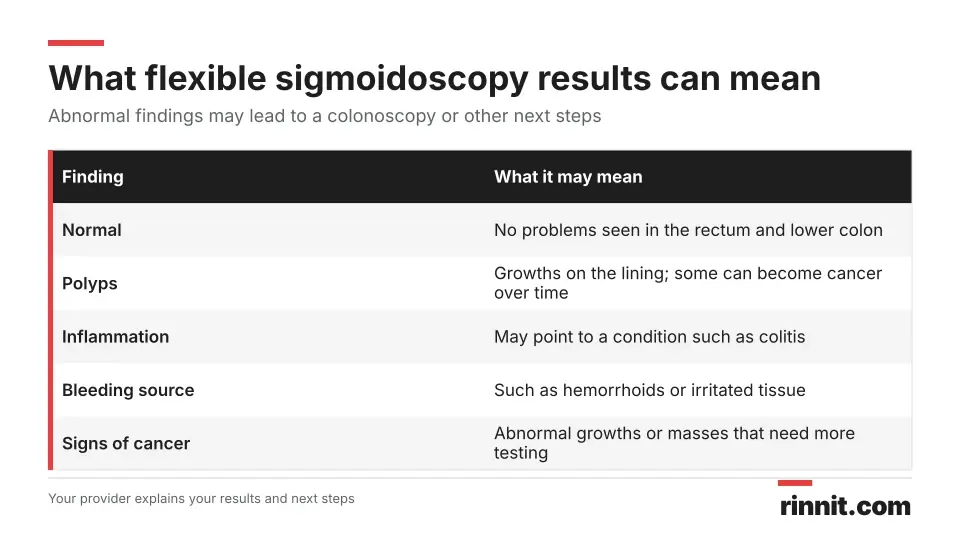
Finding | What it may mean |
Normal | No problems were seen in the rectum and lower colon |
Polyps | Growths on the colon lining; some can become cancer over time |
Inflammation | May point to a condition such as colitis |
Bleeding source | Such as hemorrhoids or irritated tissue |
Signs of cancer | Abnormal growths or masses that need more testing |
Sources: [1]
If your results are abnormal, next steps may include a colonoscopy to check the rest of your colon, polyp removal, more imaging, treatment for inflammation or a referral to a specialist. If cancer is found, your care team will explain what it means and the next steps. [1]
What are the risks of a flexible sigmoidoscopy?
A flexible sigmoidoscopy is generally safe, and serious complications are rare. [1]
Possible mild side effects: cramping, bloating and light bleeding.
Rare risks: perforation (a tear in the colon wall), severe belly pain and bleeding, especially after a biopsy or polyp removal.
Bleeding: most bleeding is minor, stops on its own and can usually be controlled during the procedure.
Sources: [1]
When should you call your provider after a flexible sigmoidoscopy?
Problems after the test are uncommon, but these signs need attention right away: [1]
Severe belly pain that is worse than ordinary gas cramps
A firm or swollen belly
Fever
Vomiting
Heavy rectal bleeding (more than a few tablespoons)
Questions to ask your provider
Why do I need a flexible sigmoidoscopy instead of a colonoscopy?
How should I do my bowel prep, and when should I use the enemas?
Which medicines should I stop or change, and when?
Will you take biopsies or remove polyps during the test?
When and how will I get my results?
Conclusion
A flexible sigmoidoscopy is a short test that looks at your rectum and lower colon to explain symptoms such as bleeding, belly pain or bowel changes, check for inflammation and polyps, and screen for colorectal cancer. Prep is usually simple, sedation is rarely needed and most people are back to normal the same day. [1]
Serious complications are rare. Large screening trials show that even a single flexible sigmoidoscopy can lower the chance of developing or dying from colorectal cancer for many years. If polyps or other problems are found, your provider may recommend a colonoscopy to check the rest of your colon. [1] [2]
Keep learning: Read our guides to colon polyps, colon cancer and colonoscopy vs. sigmoidoscopy. For more on this test, see the National Institute of Diabetes and Digestive and Kidney Diseases guide to flexible sigmoidoscopy.
FAQ
What is a flexible sigmoidoscopy?
It is a test that uses a thin, flexible tube with a light and camera to look inside your rectum and the lower third of your colon.
Why would I need a flexible sigmoidoscopy?
It can help find the cause of rectal bleeding, ongoing belly pain, constipation or diarrhea, look for colitis or polyps, and screen for colorectal cancer.
How is it different from a colonoscopy?
A flexible sigmoidoscopy is shorter and checks only the rectum and lower colon, while a colonoscopy examines the whole colon.
How do I prepare for a flexible sigmoidoscopy?
Prep may include clear liquids for part of the day before, a laxative and one or two enemas shortly before the test. Follow your provider's instructions closely.
Do I need to stop any medicines?
Tell your provider about all your medicines. Iron may need to be stopped one to two weeks before, and blood thinners or diabetes medicines may need adjusting.
Does a flexible sigmoidoscopy hurt?
You may feel mild cramping, pressure or an urge to pass gas, but it should not be painful, even if a biopsy is taken.
Will I be sedated?
Sedation is usually not needed, so most people stay awake and can drive home right away.
How long does a flexible sigmoidoscopy take?
The test usually takes about 5 to 15 minutes.
When will I get my results?
Your provider may share early findings right after the test. Biopsy results usually take several days.
What are the risks?
Mild cramping, bloating and light bleeding can happen. Rare risks include a tear in the colon wall, severe belly pain and bleeding, especially after a biopsy or polyp removal.
When should I call my provider after the test?
Get help right away for severe belly pain, a firm or swollen belly, fever, vomiting or heavy rectal bleeding of more than a few tablespoons.
Related Reading
Learn more in our guide to Lower Endoscopy: Colonoscopy vs. Sigmoidoscopy, Prep, Procedure and Recovery.
Learn more in our guide to Colon Cancer: Symptoms, Screening, Diagnosis, Treatment and Support.
Learn more in our guide to Colon Polyps: Complete Guide to Symptoms, Causes, and Treatment.
Learn more in our guide to Ulcerative Colitis: Symptoms, Causes, Diagnosis, and Treatment Explained.
Learn more in our guide to Proctitis: Complete Guide to Symptoms, Causes, Diagnosis, and Treatment.
Learn more in our guide to Diverticulitis: Symptoms, Causes, Treatment & Diet — Complete Guide.
References
Cleveland Clinic. Flexible Sigmoidoscopy: What Is It, Prep & Procedure. Cleveland Clinic. Last updated April 23, 2026. https://my.clevelandclinic.org/health/diagnostics/4953-flexible-sigmoidoscopy
Wooldrage K, Robbins EC, Duffy SW, et al. Long-term effects of once-only flexible sigmoidoscopy screening on colorectal cancer incidence and mortality: 21-year follow-up of the UK Flexible Sigmoidoscopy Screening randomised controlled trial. Lancet Gastroenterol Hepatol. 2024;9(9):811-824. PMID 39038482. https://doi.org/10.1016/S2468-1253(24)00190-0
Miller EA, Pinsky PF, Schoen RE, et al. Effect of flexible sigmoidoscopy screening on colorectal cancer incidence and mortality: long-term follow-up of the randomised US PLCO cancer screening trial. Lancet Gastroenterol Hepatol. 2019;4(2):101-110. PMID 30502933. https://doi.org/10.1016/S2468-1253(18)30358-3
Senore C, Riggi E, Armaroli P, et al. Long-Term Follow-up of the Italian Flexible Sigmoidoscopy Screening Trial. Ann Intern Med. 2022;175(1):36-45. PMID 34748376. https://doi.org/10.7326/M21-0977
Medical disclaimer
This article is for general education only and does not replace advice from a qualified healthcare professional. Talk to your doctor about your own diagnosis and treatment, and seek emergency care right away for severe or sudden symptoms.



Comments