CA 19-9 Blood Test: Uses, High Levels, Limits and Pancreatic Cancer

Updated: 3 days ago
Written and medically reviewed by Dr. Baraa Alnahhal, MD · Last reviewed: November 2026 · How we review
Quick Answer
The CA 19-9 blood test measures carbohydrate antigen 19-9, a tumor marker made in larger amounts by some cancers, most notably pancreatic cancer and bile duct cancer. It's used to support a diagnosis, check whether treatment is working and watch for recurrence. It is not a screening test, and a normal result doesn't rule out cancer.
What the research says
CA 19-9 is useful but has well-known pitfalls: an evidence review found CA 19-9 is the most studied blood marker for pancreatic cancer in people with symptoms and helps predict outlook and response to treatment, but false negatives in Lewis-negative people and false positives in up to 10–60% of people with blocked bile ducts limit its use (Ballehaninna UK, Chamberlain RS, Journal of Gastrointestinal Oncology, 2012) [2]
It's weak at screening pancreas cysts: a meta-analysis of people with intraductal papillary mucinous neoplasms (IPMN) found the standard CA 19-9 cutoff of 37 U/mL detected high-grade changes or cancer with only 35% sensitivity, though specificity was 90%, so it shouldn't be used alone (Leseman CA et al., JAMA Network Open, 2026) [3]
Key takeaways
A tumor marker blood test linked mainly to pancreatic and bile duct cancers.
Used for diagnosis support, treatment planning, monitoring and recurrence, not screening.
Bile duct blockage, gallstones, pancreatitis, liver disease and other conditions can raise it.
About 5–10% of people don't make CA 19-9, so low levels don't rule out cancer.
A rising level during follow-up can signal cancer returning.
What is CA 19-9?
CA 19-9, also called sialylated Lewis a antigen, is a sugar-protein made by cells lining the pancreas, bile ducts and digestive tract. Some cancers release much more of it into the blood. People whose genes don't produce the Lewis antigen can't make CA 19-9 at all, even if they have cancer. Sources: [1, 2]
Why is it done?
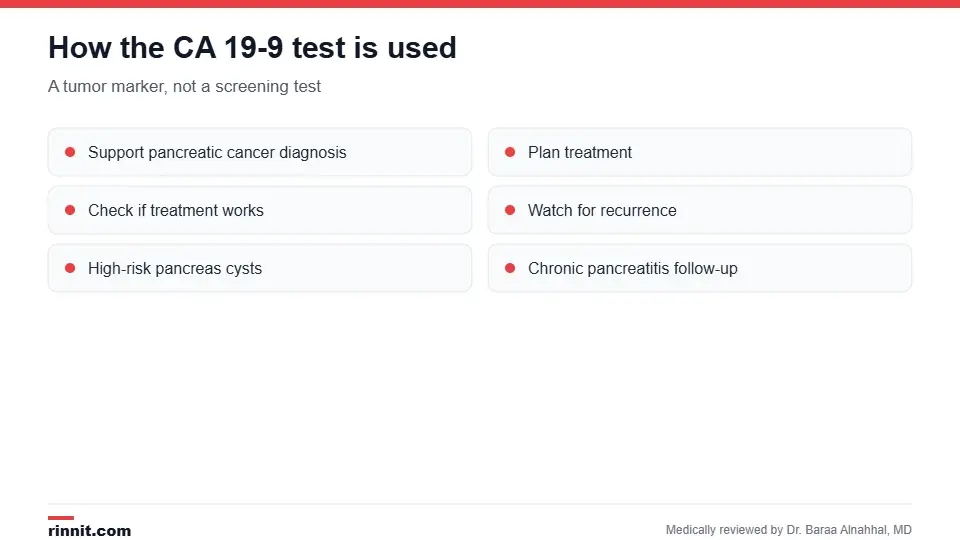
CA 19-9 is a tumor marker, not a screening test.
To support the diagnosis of pancreatic cancer or bile duct cancer (cholangiocarcinoma) when imaging finds a mass.
To get a baseline before treatment and see whether treatment is working.
To watch for cancer returning after treatment.
For people at higher risk, such as those with pancreatic cysts like IPMN, chronic pancreatitis or new diabetes after age 50. Sources: [1]
CA 19-9 can also be raised in stomach, colorectal, liver, gallbladder, ovarian, bladder, esophageal, lung and thyroid cancers. It's one of several tumor markers, often checked with CEA. Sources: [1]
How the test is done
It's a routine blood draw from a vein in your arm. No preparation is needed. Ask your provider when to expect results. Sources: [1]
What do the results mean?
Labs report a normal range, often below about 37 U/mL, though cutoffs vary. Higher levels can point to cancer, but they don't confirm it. Very high levels, or levels that keep rising over time, are more concerning. Your provider interprets the result with your symptoms, imaging such as a CT scan or endoscopic ultrasound, and a biopsy. Sources: [1, 2, 3]
Research suggests the test detects pancreatic cancer in about 8 out of 10 people who have symptoms of it. Sources: [1]
Noncancer causes of high CA 19-9

Many benign conditions can raise CA 19-9.
Bile duct infection, inflammation or blockage, including from gallstones.
Pancreatitis, including autoimmune pancreatitis.
Chronic hepatitis and cirrhosis.
Chronic kidney failure.
Lung disease.
Ovarian cysts.
Rheumatic and thyroid diseases. Sources: [1]
Limits of the test

CA 19-9 is one piece of the puzzle.
It isn't recommended for screening people without symptoms.
About 5–10 out of 100 people make little or no CA 19-9.
A blocked bile duct can raise levels a lot, so testing is often repeated after the blockage is relieved.
A normal result doesn't rule out cancer. Sources: [1, 2, 3]
Conclusion
The CA 19-9 test is a valuable tool for managing pancreatic and bile duct cancers, especially for tracking treatment and recurrence. On its own, though, it can't diagnose or rule out cancer, so it's always interpreted alongside imaging and other tests.
Keep learning: read about pancreatic cancer and blood tests for cancer.
Frequently asked questions
What is the CA 19-9 test?
A blood test for a tumor marker linked mainly to pancreatic and bile duct cancers.
Can CA 19-9 diagnose pancreatic cancer?
No. It supports a diagnosis made with imaging and biopsy.
Is CA 19-9 used for screening?
No. It's not recommended for people without symptoms.
What is a normal CA 19-9 level?
Often below about 37 U/mL, but labs vary.
What can raise CA 19-9 besides cancer?
Bile duct blockage, gallstones, pancreatitis, liver disease and other conditions.
Can CA 19-9 be normal with cancer?
Yes. Some people can't make CA 19-9.
Do I need to fast?
No preparation is needed.
Why is CA 19-9 checked after treatment?
A rising level can signal cancer returning.
Is CA 19-9 the same as CEA?
No. They're different tumor markers often checked together.
What happens if my CA 19-9 is high?
Your provider will order imaging and other tests to find the cause.
Related Reading
Pancreatic Cancer: Symptoms, Causes, and Treatment — A Clear Guide for Patients and Families the cancer most linked to CA 19-9.
Cholangiocarcinoma (Bile Duct Cancer): Symptoms, Causes, and Treatment bile duct cancer that can raise CA 19-9.
Tumor Markers: Common Types, How They're Used, Results and Limits an overview of cancer blood markers.
CEA Test (Carcinoembryonic Antigen): Normal Levels, High Results and Limits another tumor marker often tested alongside.
Pancreatitis: Symptoms, Causes, and Treatment — A Clear Guide to Understanding and Managing the Condition inflammation that can raise CA 19-9.
References
Cleveland Clinic. CA 19-9 Blood Test. Cleveland Clinic. Last updated January 28, 2026. https://my.clevelandclinic.org/health/diagnostics/ca-19-9-blood-test
Ballehaninna UK, Chamberlain RS. The clinical utility of serum CA 19-9 in the diagnosis, prognosis and management of pancreatic adenocarcinoma: an evidence based appraisal. J Gastrointest Oncol. 2012;3(2):105-119. PMID 22811878. https://doi.org/10.3978/j.issn.2078-6891.2011.021
Leseman CA, Bonomi AM, Schuitema J, et al. Serum CA19.9 for detecting high-grade dysplasia and invasive carcinoma in patients with intraductal papillary mucinous neoplasm: a systematic review and meta-analysis. JAMA Netw Open. 2026;9(6):e2617587. PMID 42360746. https://doi.org/10.1001/jamanetworkopen.2026.17587
Medical disclaimer
This article is for general education only and does not replace advice from a qualified healthcare professional. Talk to your doctor about your own diagnosis and treatment, and seek emergency care right away for severe or sudden symptoms.

Comments