Blood Tests for Cancer: Types, What They Can Show and What Results Mean

Updated: 2 days ago
Written and medically reviewed by Dr. Baraa Alnahhal, MD · Last reviewed: November 2026 · How we review
Quick Answer: Can a blood test detect cancer?
Blood tests for cancer are one of many tools providers use to diagnose, assess and manage cancer, but blood work alone can't detect most types of cancer. It can help detect some blood cancers, such as leukemia, lymphoma and multiple myeloma. To confirm cancer, you'll almost always need more tests, such as a biopsy or imaging. [1]
What the research says
Multi-cancer blood tests can find hidden cancers, but many positives are false alarms. In 6,621 adults aged 50 and older without cancer symptoms, a multi-cancer early detection blood test found a cancer signal in 92 people (1.4%). Of these, 35 (38%) were diagnosed with cancer and 57 (62%) were not, and it took a median of 79 days to reach an answer. (Schrag et al., The Lancet, 2023) [2]
These tests rarely flag people without cancer but miss many cancers. In a validation study of 4,077 people, a methylation-based multi-cancer blood test had a specificity of 99.5% and an overall sensitivity of 51.5%. When it found a cancer signal, it predicted where the cancer started correctly 88.7% of the time. (Klein et al., Annals of Oncology, 2021) [3]
Protein-based blood tests show early promise. In a study of 440 people, panels of 10 blood proteins identified early-stage cancers across 18 tumor types with high accuracy, detecting 93% of the earliest cancers in men and 84% in women. Larger studies are still needed. (Budnik et al., BMJ Oncology, 2024) [4]
Key takeaways
Blood work alone can't detect most cancers, but it can help detect some blood cancers like leukemia, lymphoma and multiple myeloma. [1]
The four main types are the CBC, tumor marker tests, blood protein tests and circulating tumor cell tests. [1]
Tumor marker tests such as PSA and CA-125 look for substances that may be higher with certain cancers. [1]
You'll almost always need more tests, such as a biopsy or imaging, to confirm a diagnosis. [1]
Normal blood test results don't rule out cancer. [1]
Some tests require fasting for 8 to 12 hours, and results usually take a day or two. [1]
Does cancer show up in blood work?

Blood tests are one of the many ways providers diagnose, assess and manage cancer. But in most cases, you'll need more than blood tests for an official diagnosis. Blood work alone can't detect most types of cancer, but it can help detect some blood cancers, like: [1]
Hodgkin lymphoma
Non-Hodgkin lymphoma
Leukemia
Multiple myeloma
Types of blood tests for cancer
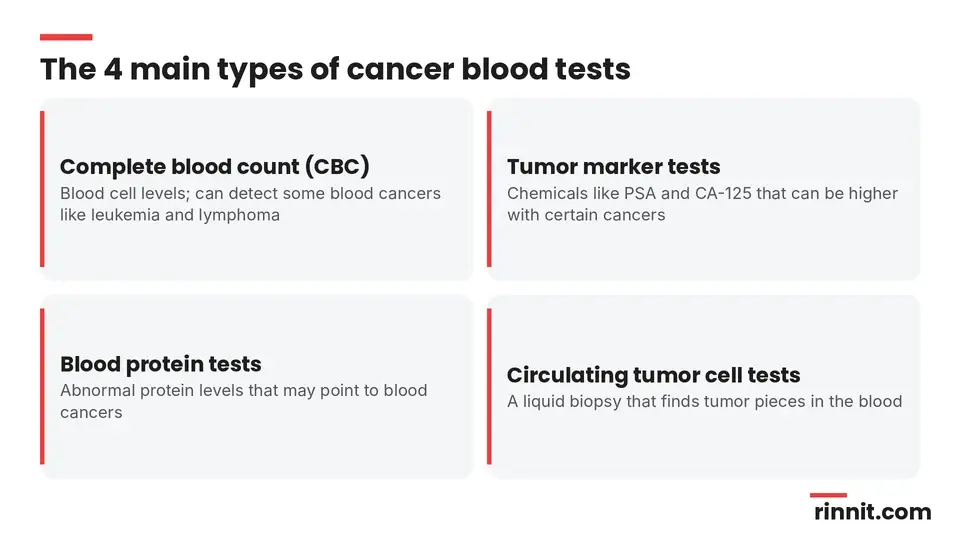
Healthcare providers group cancer blood tests into four main types: [1]
Test type | What it checks | How it's used |
Levels of your blood cells | Can detect some blood or immune system cancers like leukemia and lymphoma, show how your body responds to treatment and whether cancer has spread to your bone marrow; it can't detect solid cancers like lung, breast or colon cancer | |
Tumor marker tests | Chemicals released into the bloodstream; high levels can be a sign of cancer | CA-125 helps plan treatment and check for return of cancers such as ovarian cancer; PSA checks a protein made by the prostate, and high levels might point to prostate cancer |
Blood protein tests | Abnormal protein levels | High levels could point to blood cancers like leukemia, lymphoma and multiple myeloma; a comprehensive metabolic panel (CMP) includes a total protein test |
Circulating tumor cell (CTC) tests | Tiny pieces of tumors circulating in the blood (a type of liquid biopsy) | Help predict outcomes in metastatic breast, prostate or colon cancer; few or no CTCs suggest a favorable outcome |
Sources: [1]
What other tests will you need?
Blood tests usually aren't enough for a cancer diagnosis. You'll almost certainly need more tests, which may include: [1]
A biopsy: a small sample of tissue from an organ or bone marrow is sent to a lab for analysis
Imaging tests: X-rays, CT scans, MRI scans or PET scans help your provider locate tumors and see how far they've spread
Specialized tests: for example, a mammogram to help diagnose breast cancer or a Pap smear to detect cervical cancer
Does early cancer show in blood work?
Most cancers don't show up in routine blood work. But some specialized blood tests may detect early cancers in some people: [1]
The Galleri test: a blood test that uses DNA sequencing to find unique patterns and can detect more than 50 types of cancer, which may show whether you have cancer and where it started
Proteomics-based plasma test: a 2024 study of 440 people found that a new protein-based blood test may help detect 18 types of cancer early, though more research is needed
Results of these tests must be interpreted with caution, and any further testing or treatment should be discussed with a qualified healthcare provider. Routine cancer screenings can also help find certain cancers before you have symptoms, so ask your provider which age-appropriate screenings you need. [1]
How do cancer blood tests work?
Together with other tests, blood work can give your provider important information about: [1]
Chemicals and proteins in your blood that might indicate cancer
Blood cell levels that are too high or too low, possibly because of cancer
How advanced a cancer is
How well treatment is working
Whether cancer has come back (recurrence)
How do you prepare for a cancer blood test?
Your provider will give you specific instructions, which can differ depending on the test. In some cases, you may need to fast for 8 to 12 hours before the test, meaning you shouldn't eat or drink anything except water. You may also need to avoid certain medicines beforehand. [1]
What happens during the blood test?
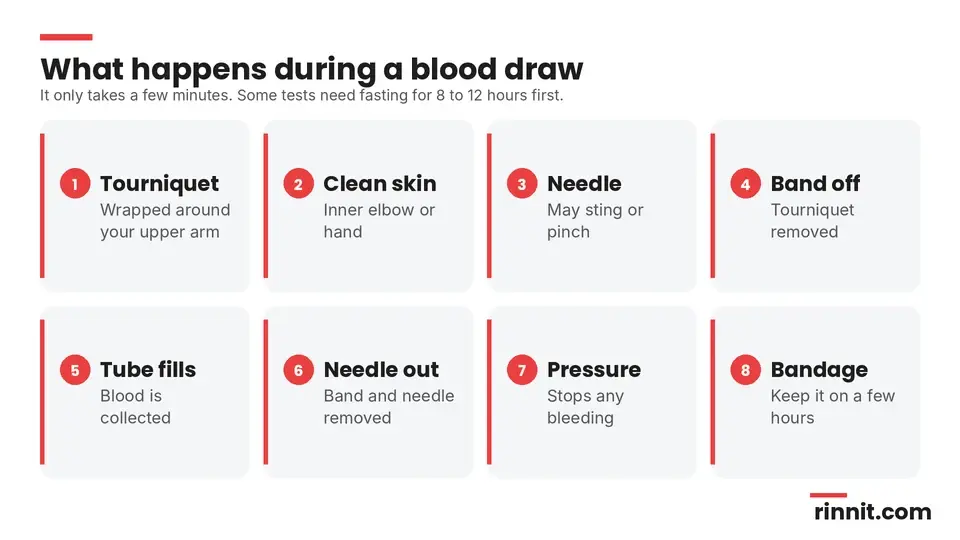
Collecting a blood sample only takes a few minutes. Your provider will: [1]
Wrap a tight band (tourniquet) around your upper arm.
Clean an area of skin, usually on the inside of your elbow or on your hand.
Insert a needle, which may sting or pinch.
Remove the tourniquet.
Attach a tube to the needle and fill it with blood.
Remove the band and the needle.
Press on the puncture site to help stop any bleeding.
Put a bandage on your skin.
What happens after the test?
Keep the bandage on for a few hours. If your provider advises it, avoid exercise for a few hours afterward, because a higher heart rate can increase bleeding. [1]
What are the risks?
Blood tests are safe and involve very little risk. You might get a small bruise where the needle went in. Rarely, the vein swells; a warm compress, like a warm washcloth or heating pad, can help. [1]
When will you get results?
You'll probably get results in a day or two, but some tests can take several days. Your provider will tell you when to expect them and go over them with you. [1]
What if your results are abnormal?
If your blood test suggests you might have cancer, your provider will refer you to an oncologist, a cancer specialist. The oncologist may order more tests to confirm the diagnosis and recommend a treatment plan. Cancer treatment almost always involves a team of different specialists working together. [1]
Can you have cancer with normal blood tests?
Yes. Because blood work alone can't detect most cancers, you can have normal results and still have cancer. Blood cancers such as leukemia, lymphoma and multiple myeloma are the exceptions. [1]
Can a lipid panel detect cancer?
No. A lipid panel measures cholesterol and triglycerides to check your risk of heart disease and stroke. Providers don't use it to check for cancer. [1]
Questions to ask your provider
Which blood tests are you ordering, and what are you looking for?
Do I need to fast or stop any medicines before the test?
What would an abnormal result mean for me?
Will I need a biopsy or imaging tests?
Which cancer screenings are recommended for my age?
Conclusion
Blood tests for cancer give your provider useful clues about your overall health, organ function and possible disease. They can help detect blood cancers like leukemia, lymphoma and multiple myeloma, track treatment and watch for cancer coming back, but they can't diagnose most cancers on their own.
If a blood test raises concern, you'll need more tests, such as a biopsy or imaging, before anyone can make a diagnosis. Keep up with your age-appropriate cancer screenings, and talk with your provider about what each test result means for you.
Keep learning: Read our guides to the complete blood count (CBC), the bone marrow biopsy, the PET scan and biopsy.
FAQ
Can a blood test detect cancer?
Blood work alone can't detect most cancers, but it can help detect some blood cancers like leukemia, lymphoma and multiple myeloma. [1]
What are the main types of blood tests for cancer?
The complete blood count (CBC), tumor marker tests, blood protein tests and circulating tumor cell tests. [1]
Can a CBC detect cancer?
A CBC can detect some blood or immune system cancers like leukemia and lymphoma, but not solid cancers like lung, breast or colon cancer. [1]
What is a tumor marker test?
It measures chemicals released into the blood. High levels, such as of PSA or CA-125, can be a sign of certain cancers. [1]
What is the Galleri test?
It's a blood test that uses DNA sequencing to look for more than 50 types of cancer and where they started. [1]
Can you have cancer with normal blood work?
Yes. Normal blood tests don't rule out most cancers, except some blood cancers. [1]
Do I need to fast before a cancer blood test?
Sometimes. Some tests require fasting for 8 to 12 hours, and your provider will tell you. [1]
How long do cancer blood test results take?
Usually a day or two, though some tests take several days. [1]
What happens if my cancer blood test is abnormal?
Your provider will refer you to an oncologist, who may order more tests to confirm the diagnosis. [1]
Can a lipid panel detect cancer?
No. A lipid panel measures cholesterol and triglycerides and isn't used to check for cancer. [1]
Related Reading
Learn more in our guide to Understanding Leukemia: Types, Symptoms, and Modern Management.
Learn more in our guide to Lymphoma: Symptoms, Types, Causes, Diagnosis and Treatment.
Learn more in our guide to Hodgkin's Lymphoma: Symptoms, Causes & Treatment.
Learn more in our guide to Non-Hodgkin's Lymphoma: Symptoms, Causes, and Treatment Options Explained.
Learn more in our guide to What Is Multiple Myeloma? A Plain-Language Guide to Symptoms, Causes, and Treatment.
Learn more in our guide to Ovarian Cancer: Symptoms, Causes, and Treatment — A Clear Guide to Understanding and Managing the Disease.
CEA Test (Carcinoembryonic Antigen): Normal Levels, High Results and Limits explains the tumor marker blood test used to monitor this cancer.
Tumor Markers: Common Types, How They're Used, Results and Limits explains the main tumor marker tests and what their results can and can't show.
Liquid Biopsy: Blood Testing for Tumor Cells and Tumor DNA explains the blood test that looks for tumor cells and tumor DNA.
References
Cleveland Clinic. Blood Tests for Cancer: Diagnosis & Screening. Cleveland Clinic. Last updated May 6, 2024. https://my.clevelandclinic.org/health/diagnostics/22338-blood-tests-for-cancer
Schrag D, Beer TM, McDonnell CH, et al. Blood-based tests for multicancer early detection (PATHFINDER): a prospective cohort study. Lancet. 2023;402(10409):1251-1260. PMID 37805216. https://doi.org/10.1016/S0140-6736(23)01700-2
Klein EA, Richards D, Cohn A, et al. Clinical validation of a targeted methylation-based multi-cancer early detection test using an independent validation set. Ann Oncol. 2021;32(9):1167-1177. PMID 34176681. https://doi.org/10.1016/j.annonc.2021.05.806
Budnik B, Amirkhani H, Forouzanfar MH, et al. Novel proteomics-based plasma test for early detection of multiple cancers in the general population. BMJ Oncol. 2024;3(1):e000073. PMID 39886137. https://doi.org/10.1136/bmjonc-2023-000073
Medical disclaimer
This article is for general education only and does not replace advice from a qualified healthcare professional. Talk to your doctor about your own diagnosis and treatment, and seek emergency care right away for severe or sudden symptoms.



Comments