Lipid Panel: What It Measures, Normal Cholesterol Levels and How to Prepare

Updated: 2 days ago
Written and medically reviewed by Dr. Baraa Alnahhal, MD · Last reviewed: November 2026 · How we review
Quick Answer: What is a lipid panel?
A lipid panel is a blood test that measures the fats (lipids) in the blood: LDL, VLDL and HDL cholesterol, total cholesterol and triglycerides. Providers use it to screen for and monitor the risk of cardiovascular disease. Ideal adult levels are total cholesterol below 200 mg/dL, LDL below 100 mg/dL, HDL above 60 mg/dL and triglycerides below 150 mg/dL. [1]
What the research says
Lowering LDL cholesterol lowers heart attacks and strokes. In data from about 170,000 people in 26 randomized trials, each 1.0 mmol/L (about 39 mg/dL) reduction in LDL cholesterol cut major vascular events by about 22% and all-cause deaths by 10%. (Cholesterol Treatment Trialists' Collaboration, The Lancet, 2010) [2]
Non-fasting LDL predicted risk about as well as fasting LDL. In 4,299 matched pairs of US adults followed for about 14 years, fasting and nonfasting LDL cholesterol had similar value for predicting death from any cause and from heart disease. (Doran et al., Circulation, 2014) [3]
Key takeaways
A lipid panel measures cholesterol and triglycerides from one blood sample. [1]
It helps assess your risk of heart disease, heart attack and stroke. [1]
Most tests need a 10 to 12 hour fast, but some do not; follow your provider's instructions. [1]
Results are interpreted together with your age, history and other risk factors. [1]
An abnormal result does not always mean you need treatment. [1]
What is a lipid panel?
A lipid panel measures fat molecules called lipids in your blood. Too many lipids can lead to fatty buildup in your arteries, narrowing them and raising your risk of cardiovascular disease. It is used in both children and adults. [1]
Other names include lipid profile, lipid test, cholesterol panel, coronary risk panel and fasting or non-fasting lipid panel. [1]
What does a lipid panel measure?

One blood sample gives five results.
Measurement | What it is |
LDL cholesterol | "Bad" cholesterol that can collect in blood vessels and raise cardiovascular risk |
VLDL cholesterol | Made by your liver and carries mostly triglycerides; it is usually estimated from your triglyceride level |
HDL cholesterol | "Good" cholesterol that helps reduce LDL buildup in blood vessels |
Total cholesterol | Your overall level: LDL, VLDL and HDL combined |
Triglycerides | A type of fat from food; excess is linked to cardiovascular disease and pancreatitis |
Sources: [1]
Some versions of the test include extra measurements. [1]
Why would you need a lipid panel?
Providers order lipid panels to: [1]
Check whether your cholesterol is in a healthy or high-risk range
Monitor levels after an abnormal result or if you have heart disease risk factors
See how you are responding to cholesterol medicine
Help diagnose other conditions, such as liver disease
Who may need more frequent testing?
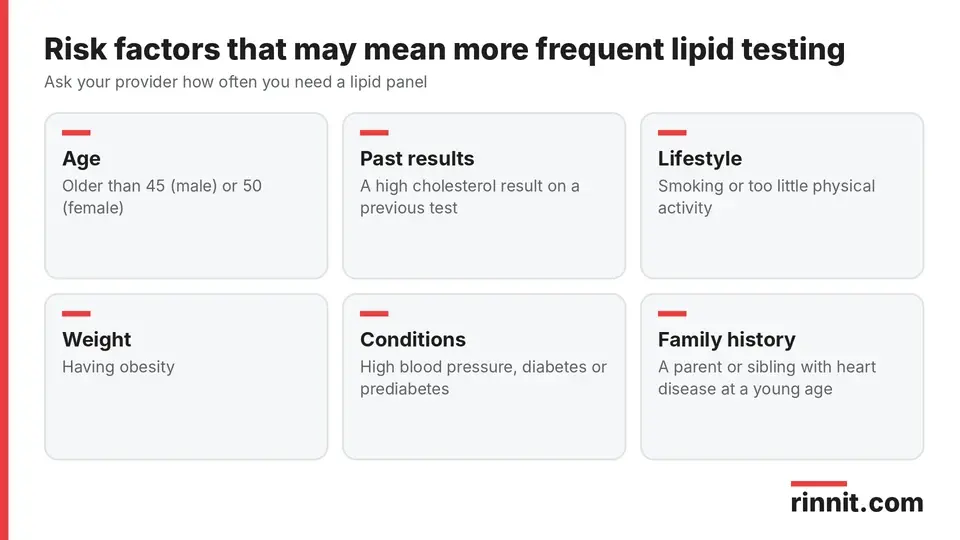
Risk factors guide how often you need a lipid panel.
Your provider may suggest frequent screening if you have cardiovascular risk factors, such as: [1]
Age over 45 for males or over 50 for females
A high cholesterol result on a previous test
Smoking cigarettes
Obesity
Not getting enough physical activity
High blood pressure
Diabetes or prediabetes
A parent or sibling who developed heart disease at a young age
Children may need a lipid panel too. Cholesterol in children is linked to heredity, obesity and diet, and most kids with high cholesterol have a parent with high cholesterol. Lipid panels can also help diagnose pancreatitis, chronic kidney disease and hypothyroidism. [1]
How do you prepare for a lipid panel?
You may be asked to fast for 10 to 12 hours before the test, meaning nothing to eat or drink except water, but many lipid panels can now be done without fasting. Some lipid panels can be done without fasting, so ask your provider in advance and follow their instructions. If you were told to fast and accidentally ate, let them know, because the test is less useful without fasting. [1]
What happens during a lipid panel?
A phlebotomist finds a vein, usually inside your elbow, cleans the area and draws a small blood sample with a needle, which may feel like a small pinch. They then hold gauze on the site and place a bandage. The whole process usually takes less than five minutes, and results usually come back in a few days. [1]
What are normal lipid panel results?
Results list the test name, your number, the normal range and whether your result is normal, high or low. Ideal levels, in milligrams per deciliter (mg/dL), are: [1]
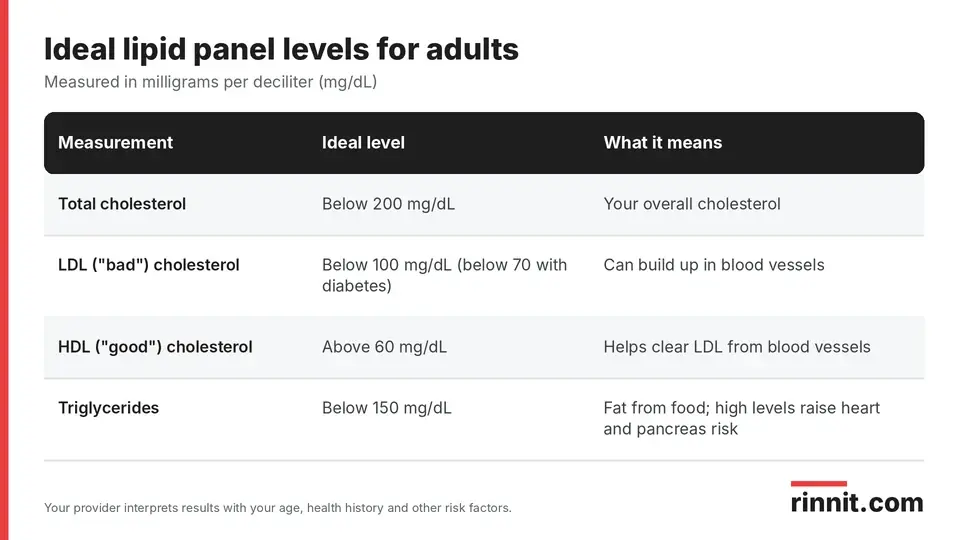
Your provider reads these numbers alongside your other risk factors.
Measurement | Ideal level |
Total cholesterol | Below 200 mg/dL |
HDL cholesterol | Above 60 mg/dL |
LDL cholesterol | Below 100 mg/dL (below 70 mg/dL with diabetes) |
Triglycerides | Below 150 mg/dL |
Sources: [1]
Results outside these targets may be classed as borderline, intermediate or high risk. In general, high total cholesterol, LDL and triglycerides and low HDL raise cardiovascular risk. Abnormally low cholesterol is rare and is usually caused by a condition leading to malnutrition. [1]
What if your lipid panel is abnormal?
An abnormal result does not necessarily mean you have a medical condition or need treatment. A healthy range for you depends on your age, overall health, medical history, medicines and other risk factors, and many providers use a risk calculator to decide on next steps. [1]
If your results are abnormal, your provider may recommend: [1]
Continued monitoring
Changes to what you eat or more physical activity
A cholesterol-lowering medicine
Contact your provider if you develop new cardiovascular risk factors, since you may need more frequent testing. [1]
Conclusion
A lipid panel is a quick blood test that gives a clear picture of your cholesterol and triglycerides and helps estimate your heart disease risk. Most require a fast, so check the instructions before your appointment.
Your numbers are only one part of the picture. Talk with your provider about your overall risk and the plan that fits you.
Keep learning: Read our high blood cholesterol guide or our guide to hypertriglyceridemia. For more background, see the NHLBI page on blood cholesterol.
FAQ
What is a lipid panel?
It is a blood test that measures cholesterol and triglycerides to assess your risk of heart disease, heart attack and stroke.
What does a lipid panel measure?
LDL, VLDL and HDL cholesterol, total cholesterol and triglycerides.
What are normal lipid panel levels?
Total cholesterol below 200 mg/dL, HDL above 60 mg/dL, LDL below 100 mg/dL and triglycerides below 150 mg/dL.
What LDL level is ideal if I have diabetes?
Below 70 mg/dL.
Do I need to fast before a lipid panel?
Usually 10 to 12 hours with only water, though some tests can be done without fasting; follow your provider's instructions.
What if I ate before a fasting lipid panel?
Tell your provider, because the result may be less useful.
How long does a lipid panel take?
The blood draw takes less than five minutes, and results usually come back in a few days.
How often should I get a lipid panel?
It depends on your risk factors, age and history; your provider will tell you.
Does an abnormal lipid panel mean I need medicine?
Not necessarily; options include monitoring, diet and activity changes or a cholesterol-lowering medicine.
Can cholesterol be too low?
Rarely; very low levels usually come from a condition causing malnutrition.
Related Reading
Cardiac Blood Tests: Heart Disease Risk Tests and Ideal Levels explains the blood tests used to estimate heart disease risk.
Carotid Intima-Media Thickness (CIMT) Test: Checking Artery Walls explains the ultrasound that measures carotid artery wall thickness.
High Blood Cholesterol: What Your Numbers Mean, Why It Matters, and How to Lower It explains the condition a lipid panel is used to find.
Understanding Hyperlipidemia: Managing High Cholesterol for Heart Health covers abnormal lipid levels and how they are managed.
Familial Hypercholesterolemia: The Inherited Cholesterol Condition Most People Never Know They Have describes an inherited cause of very high LDL found on lipid testing.
Hypertriglyceridemia: Understanding High Triglycerides and Heart Health explains what a high triglyceride result means.
Blood Tests for Heart Disease Risk: Lipids, Lp(a), apoB and hs-CRP explains the blood tests used to estimate coronary artery disease risk.
References
Cleveland Clinic. Lipid Panel: What It Is, Purpose & Results. Cleveland Clinic. Last updated December 9, 2024. https://my.clevelandclinic.org/health/diagnostics/17176-lipid-panel
Cholesterol Treatment Trialists' (CTT) Collaboration; Baigent C, Blackwell L, Emberson J, et al. Efficacy and safety of more intensive lowering of LDL cholesterol: a meta-analysis of data from 170,000 participants in 26 randomised trials. Lancet. 2010;376(9753):1670-1681. PMID 21067804. https://doi.org/10.1016/S0140-6736(10)61350-5
Doran B, Guo Y, Xu J, et al. Prognostic value of fasting versus nonfasting low-density lipoprotein cholesterol levels on long-term mortality: insight from the National Health and Nutrition Examination Survey III (NHANES-III). Circulation. 2014;130(7):546-553. PMID 25015340. https://doi.org/10.1161/CIRCULATIONAHA.114.010001
Medical disclaimer
This article is for general education only and does not replace advice from a qualified healthcare professional. Talk to your doctor about your own diagnosis and treatment, and seek emergency care right away for severe or sudden symptoms.



Comments