Carotid Intima-Media Thickness (CIMT) Test: Checking Artery Walls

Updated: 2 days ago
Written and medically reviewed by Dr. Baraa Alnahhal, MD · Last reviewed: November 2026 · How we review
Quick Answer
A carotid intima-media thickness (CIMT) test is a painless ultrasound that measures the thickness of the inner two layers of the carotid artery walls in the neck. Thicker walls can be an early sign of atherosclerosis and a higher risk of heart attack and stroke. It needs no preparation, uses no radiation and takes 30 to 45 minutes.
What the research says
Thicker walls mean higher risk: a review of 8 large studies found that each 0.1-mm increase in carotid wall thickness raised the risk of heart attack by about 15% and stroke by about 18% (Lorenz MW et al., Circulation, 2007) [2]
It adds little to standard risk scores: in 45,828 people, adding CIMT to a standard heart risk score barely improved prediction of heart attacks and strokes (Den Ruijter HM et al., JAMA, 2012) [3]
Key takeaways
A CIMT test measures the thickness of your carotid artery walls.
Thicker walls can signal atherosclerosis and higher heart attack and stroke risk.
It's a painless ultrasound with no radiation.
It takes about 30 to 45 minutes and needs no preparation.
Results are usually combined with other risk factors.
What is a CIMT test?
The carotid artery wall has three layers. The intima (inner layer) and media (middle layer) can thicken years before plaque causes symptoms. A CIMT test uses ultrasound to measure these layers in millimeters. It's related to a standard carotid ultrasound, which looks for narrowing and blood flow problems, but CIMT focuses on wall thickness as a risk marker. Sources: [1]
Why it's done

CIMT can show early artery changes before symptoms appear.
High cholesterol.
High blood pressure.
High blood sugar or diabetes.
Smoking or tobacco use.
Estimating your risk of heart attack, stroke and other heart and blood vessel problems. Sources: [1]
CIMT may be used alongside blood tests for heart disease risk and a lipid panel. Sources: [1]
How to prepare
No special preparation is needed.
Wear loose clothing, such as an open-collar or button-up shirt, so your neck is easy to reach. Sources: [1]
What happens during the test
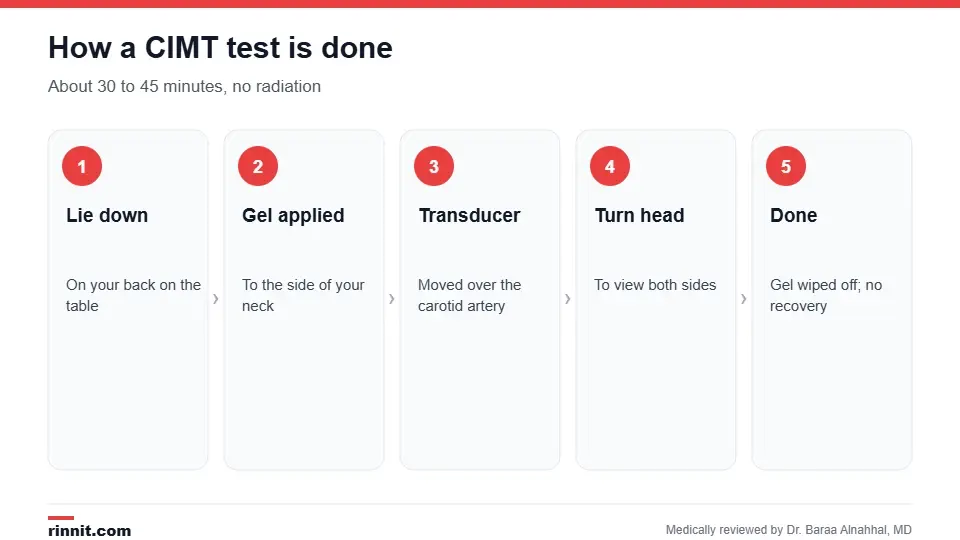
The test takes about 30 to 45 minutes.
You lie on your back on an exam table.
A technologist applies gel to your neck.
A handheld transducer is moved over your neck to capture images of the carotid arteries.
You may be asked to turn your head.
The gel is wiped off, and you can go back to your day. Sources: [1]
Risks
There are no known risks. The test uses sound waves, not radiation, and no recovery time is needed. Sources: [1]
What the results mean
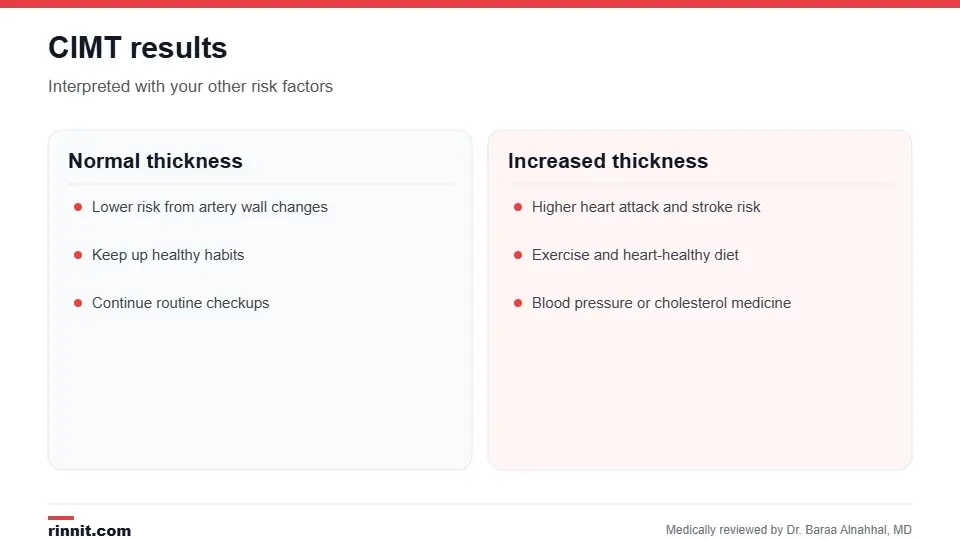
Your provider interprets CIMT with your other risk factors.
Result | What it may mean | Possible next steps |
Normal thickness | Lower risk from artery wall changes | Keep up healthy habits |
Increased thickness | Higher risk of heart attack or stroke | Lifestyle changes, cholesterol or blood pressure medicines |
A radiologist reviews the images and measurements and sends results to your primary care provider or cardiologist. If thickening is found, your provider may recommend exercise, a heart-healthy diet such as the Mediterranean diet, and medicines for blood pressure or cholesterol. Research shows CIMT is linked to future events but adds only modest value beyond standard risk scores, so it's used as one piece of the picture. Sources: [1, 2, 3]
Conclusion
A CIMT test is a simple, risk-free ultrasound that can reveal early artery wall changes. It helps you and your provider understand your heart attack and stroke risk and decide whether to step up prevention.
Keep learning: read about the carotid ultrasound and carotid artery disease.
Frequently asked questions
What is a CIMT test?
An ultrasound that measures the thickness of your carotid artery walls.
What does a thick carotid wall mean?
It may signal atherosclerosis and higher cardiovascular risk.
Does it hurt?
No. It's a painless ultrasound.
How long does it take?
About 30 to 45 minutes.
Does it use radiation?
No.
Do I need to prepare?
No. Just wear clothing that leaves your neck open.
Who should get a CIMT test?
People with risk factors such as high cholesterol, high blood pressure or smoking.
Is CIMT the same as a carotid ultrasound?
It's related but focuses on wall thickness rather than narrowing.
What happens if results are abnormal?
Lifestyle changes and possibly medicines.
Who reads the results?
A radiologist, who sends them to your provider.
Related Reading
Carotid Ultrasound: Why It's Done, What to Expect and What Results Mean ultrasound of the neck arteries.
Carotid Artery Disease: The Silent Stroke Risk in Your Neck, Explained the condition CIMT helps assess.
Lipid Panel: What It Measures, Normal Cholesterol Levels and How to Prepare a cholesterol blood test.
Blood Tests for Heart Disease Risk: Lipids, Lp(a), apoB and hs-CRP blood tests for heart disease risk.
Carotid Angiography: Imaging Neck Arteries for Stroke Risk X-ray imaging of the neck arteries.
References
Cleveland Clinic. Carotid Intima-Media Thickness (CIMT) Test. Cleveland Clinic. Last updated May 3, 2023. https://my.clevelandclinic.org/health/diagnostics/24944-carotid-intima-media-thickness-cimt-test
Lorenz MW, Markus HS, Bots ML, et al. Prediction of clinical cardiovascular events with carotid intima-media thickness: a systematic review and meta-analysis. Circulation. 2007;115(4):459-467. PMID 17242284. https://doi.org/10.1161/CIRCULATIONAHA.106.628875
Den Ruijter HM, Peters SA, Anderson TJ, et al. Common carotid intima-media thickness measurements in cardiovascular risk prediction: a meta-analysis. JAMA. 2012;308(8):796-803. PMID 22910757. https://doi.org/10.1001/jama.2012.9630
Medical disclaimer
This article is for general education only and does not replace advice from a qualified healthcare professional. Talk to your doctor about your own diagnosis and treatment, and seek emergency care right away for severe or sudden symptoms.



Comments