CA-125 Blood Test: What It Measures, Normal Levels and What High Results Mean

Updated: 2 days ago
Written and medically reviewed by Dr. Baraa Alnahhal, MD · Last reviewed: November 2026 · How we review
Quick Answer: What is a CA-125 blood test?
A CA-125 test is a blood test that measures cancer antigen 125, a protein that can be high in ovarian cancer. Providers use it to check whether ovarian cancer treatment is working and watch for cancer coming back. It doesn't diagnose cancer on its own, because many noncancerous conditions raise CA-125. Levels above 35 units per milliliter are high. [1]
What the research says
Screening the general population with CA-125 doesn't save lives. In a trial of 202,562 women aged 50 to 74, yearly screening that included CA-125 found more cancers earlier, but after a median of 16.3 years ovarian and tubal cancer deaths were the same (0.6%) as in women who weren't screened. The authors concluded general population screening can't be recommended. (Menon et al., The Lancet, 2021) [2]
CA-125 remains the main ovarian cancer marker, with limits. A review notes that CA-125 has been the primary ovarian cancer marker for four decades, usually with a cutoff of 35 U/mL, but no professional society recommends using it to screen average-risk women without symptoms. It remains valuable for monitoring people during and after treatment. (Charkhchi et al., Cancers, 2020) [3]
Key takeaways
CA-125 is a protein that can rise in cancers of the ovaries, fallopian tubes and peritoneum. [1]
The test is mainly used to monitor treatment and check for ovarian cancer coming back. [1]
It may also screen people at high risk, such as those with a BRCA gene change or a family history. [1]
Many noncancerous conditions, including periods, pregnancy and endometriosis, can raise CA-125. [1]
Providers look at a series of results over time rather than one number. [1]
What is a CA-125 test?
A CA-125 test measures the amount of a protein called CA-125 (cancer antigen 125) in your blood. A high level can be a sign of ovarian cancer. Providers use the test as part of an overall approach to monitoring ovarian cancer, especially during and after treatment. [1]
The test alone doesn't diagnose or detect cancer, because many noncancerous conditions can also raise CA-125 levels. [1]
Why would you need a CA-125 blood test?
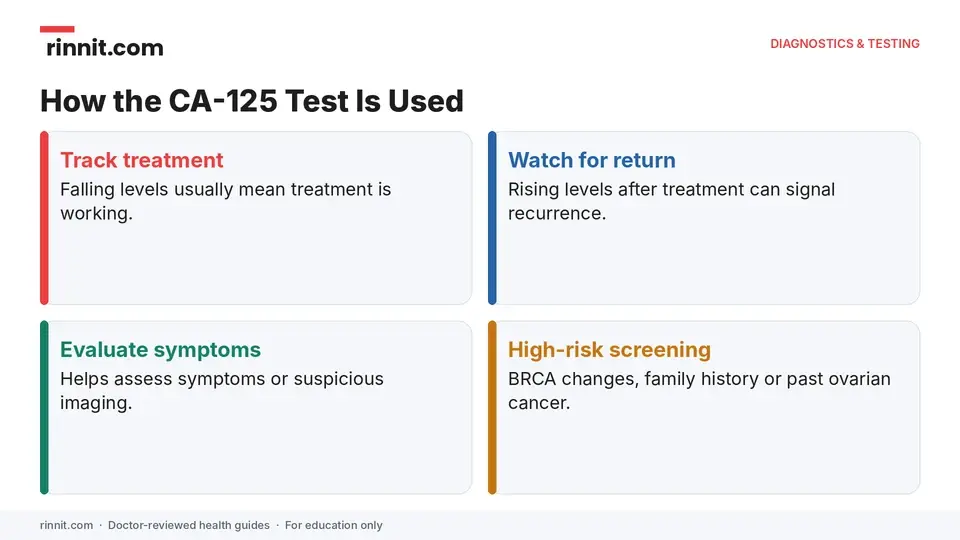
A CA-125 blood test may be used to: [1]
See if ovarian cancer treatment is working. Falling CA-125 levels usually mean treatment is working.
Watch for signs of ovarian cancer coming back after successful treatment.
Help evaluate women with symptoms of ovarian cancer or suspicious imaging findings.
It's also a way to screen for ovarian cancer in people at high risk, such as people who: [1]
Have inherited a change in a BRCA gene
Have a biological family member with ovarian cancer
Have had ovarian cancer before
The test shouldn't be used if you have no symptoms or risk factors for ovarian cancer. [1]
What type of cancer does CA-125 relate to?
CA-125 doesn't test for or diagnose cancer. It measures a protein that can be high in certain cancers, mainly those of the: [1]
Ovaries
Fallopian tubes
Peritoneum (the lining of your abdomen)
It isn't reliable for detecting cancers of the bowel (intestines). [1]
How does a CA-125 test work?
A provider takes a small blood sample from a vein in your arm. You may feel a slight prick or sting, and the draw takes a few minutes. You don't need to do anything to prepare. [1]
The only risks are those of any blood draw. You may feel lightheaded or notice a bruise afterward. Infection or heavy bleeding is rare. [1]
What is a normal CA-125 level?
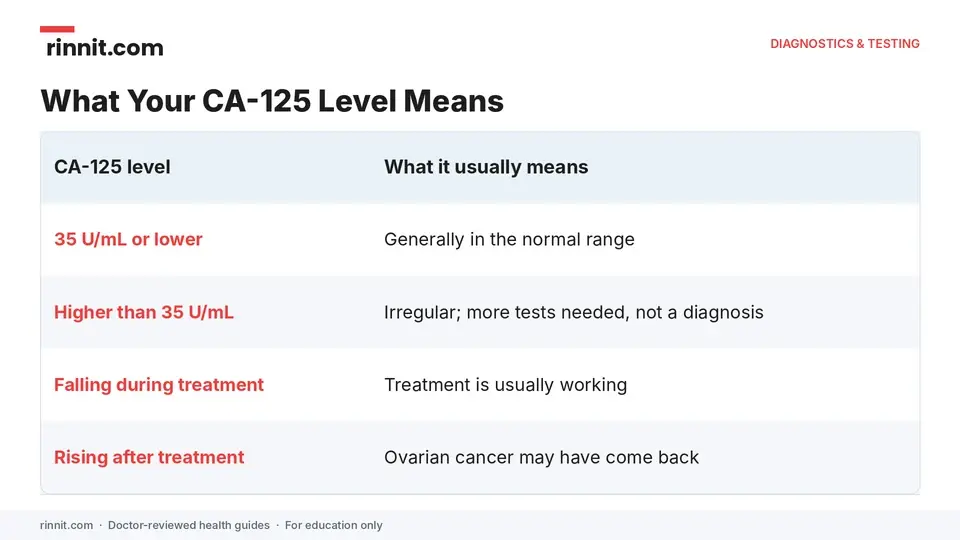
Normal ranges can vary, and labs may use different tests. In general: [1]
CA-125 level | What it usually means |
35 U/mL or lower | Generally considered in the normal range |
Higher than 35 U/mL | Considered irregular; more tests are needed, and a high level doesn't by itself mean cancer |
Falling over a series of tests (during treatment) | Usually a sign that treatment is working |
Rising after treatment | May mean ovarian cancer has come back |
Sources: [1]
Your CA-125 level doesn't tell your provider whether cancer has spread. [1]
What causes a high CA-125 level besides cancer?
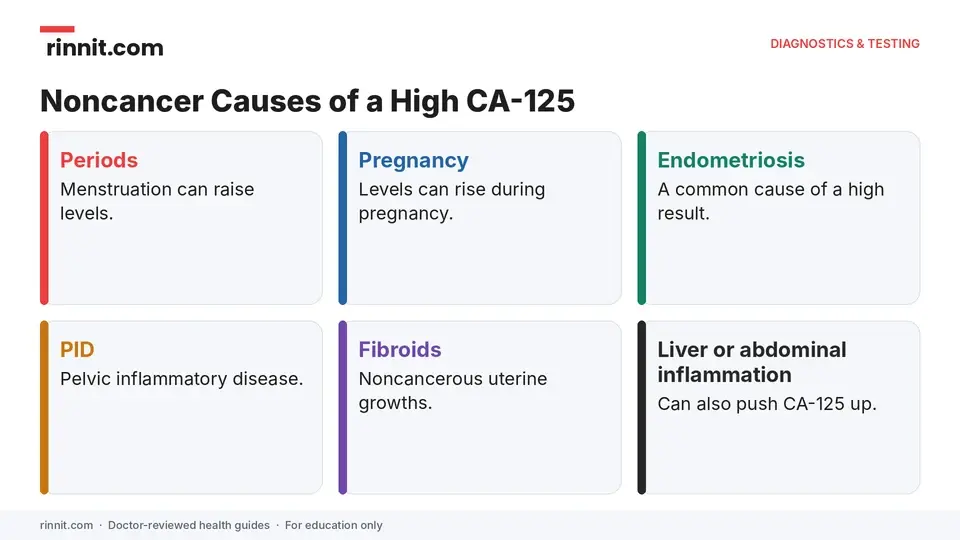
The test is known for both false positives and false negatives, because other conditions can raise CA-125. These include: [1]
Having your period
Pregnancy
Uterine fibroids
Inflammation in your abdomen
Liver disease
What happens after an abnormal result?
One test result usually isn't helpful on its own. Providers order CA-125 tests in a series so they can see changes over time. If your result is irregular, your provider will likely order more tests, such as a transvaginal ultrasound, CT scan or MRI, or repeat the CA-125 test later. [1]
Conclusion
The CA-125 blood test is one tool your care team uses to track ovarian cancer and see whether treatment is working. It's useful for monitoring and for screening people at high risk, but it can't diagnose cancer by itself because many other conditions also raise CA-125.
Talk with your provider about your results and what they mean for your care. Only your provider should interpret your CA-125 numbers in context.
Keep learning: Read our guide to ovarian cancer or our explainer on BRCA testing. For more trusted, doctor-reviewed health guides, visit Rinnit.com.
FAQ
What is a CA-125 blood test?
A blood test that measures cancer antigen 125, a protein that can be high in ovarian cancer.
What is a normal CA-125 level?
Generally 35 units per milliliter or lower, though ranges vary by lab.
Does a high CA-125 mean I have cancer?
No. Many noncancerous conditions raise CA-125, so more tests are needed.
What conditions can raise CA-125?
Periods, pregnancy, endometriosis, pelvic inflammatory disease, fibroids, abdominal inflammation and liver disease.
Why is CA-125 used in ovarian cancer?
To check whether treatment is working and to watch for cancer coming back.
Who should get a CA-125 test?
People with symptoms or risk factors for ovarian cancer, not people with neither.
Can CA-125 detect ovarian cancer early?
It's not accurate enough on its own and is used with other tests.
Do I need to prepare for a CA-125 test?
No. It's a simple blood draw with no preparation.
Can CA-125 detect bowel cancer?
No. It isn't reliable for detecting cancers of the bowel.
What tests follow a high CA-125?
Often a transvaginal ultrasound, CT scan or MRI, or a repeat CA-125 test.
Related Reading
Ovarian Cancer: Symptoms, Causes, and Treatment — A Clear Guide to Understanding and Managing the Disease explains the cancer that CA-125 is mainly used to monitor.
Fallopian Tube Cancer: Understanding Risks, Symptoms, and Treatment Options covers a related cancer that can also raise CA-125.
Understanding Primary Peritoneal Cancer: Symptoms, Risks, and Care explains cancer of the abdominal lining, another cause of high CA-125.
Endometriosis: Symptoms, Causes, and Treatment describes a common noncancerous condition that can raise CA-125.
Pelvic Inflammatory Disease: Symptoms, Causes & Treatment — A Clear Guide covers a pelvic infection that can cause a falsely high CA-125.
Ovarian Cysts: Symptoms, Causes, and Treatment Options Explained explains ovarian cysts, which providers may evaluate with imaging and CA-125.
Tumor Markers: Common Types, How They're Used, Results and Limits explains the main tumor marker tests and what their results can and can't show.
References
Cleveland Clinic. CA-125 Blood Test: Procedure, Results & Interpretation. Cleveland Clinic. Last updated August 5, 2026. https://my.clevelandclinic.org/health/diagnostics/17830-ca-125-blood-test
Menon U, Gentry-Maharaj A, Burnell M, et al. Ovarian cancer population screening and mortality after long-term follow-up in the UK Collaborative Trial of Ovarian Cancer Screening (UKCTOCS): a randomised controlled trial. Lancet. 2021;397(10290):2182-2193. PMID 33991479. https://doi.org/10.1016/S0140-6736(21)00731-5
Charkhchi P, Cybulski C, Gronwald J, et al. CA125 and Ovarian Cancer: A Comprehensive Review. Cancers (Basel). 2020;12(12):3730. PMID 33322519. https://doi.org/10.3390/cancers12123730
Medical disclaimer
This article is for general education only and does not replace advice from a qualified healthcare professional. Talk to your doctor about your own diagnosis and treatment, and seek emergency care right away for severe or sudden symptoms.



Comments